
← Back to your LP12 build

Pearl Reference

McIntosh · Streaming Integrated Amplifier

McIntosh MSA5500 Streaming Integrated Amplifier

$8,000

Signature technologiesThe McIntosh story

On demonstrationIn stock

On the floor at our Portland showroom. Ask and we will set it up for you to hear. New and sealed units are in stock.

McIntosh · Streaming Integrated Amplifier

The MSA5500 puts a McIntosh network streamer, DAC, preamplifier and 100-watt power amplifier in one six-inch-high chassis, with HDMI ARC for the television, a phono input for the turntable and Roon, AirPlay, Google Cast, Spotify, TIDAL and Qobuz on board.

Streaming built in: AirPlay, Google Cast, Spotify Connect, TIDAL Connect, Qobuz Connect, Roon Ready, Bluetooth 5.0. Remote included.

100 W
per channel into 8 Ω; 160 W into 4 Ω
12 inputs
6 analog, 7 digital including HDMI ARC, plus network
Wi-Fi 6
two antennas, Ethernet and Bluetooth 5.0
38 lb
17.2 kg; 17½ in wide, 6 in high

Authorized McIntosh Labs dealer · Advice and support from Pearl Audio · Trade-ins welcome

The story

The MSA5500, introduced in late 2024, is the McIntosh for a listener who wants one component and a pair of loudspeakers. The amplifier section is the direct-coupled 100-watt design of the MA5300: 100 watts per channel into 8 ohms, 160 into 4, distortion rated at 0.005 percent, a damping factor above 200, Power Guard, Sentry Monitor and a pair of dual-scale blue watt meters behind the black glass. Ahead of it sit McIntosh's eight-channel, 32-bit/384 kHz Quad Balanced DAC and a network streamer with two Wi-Fi 6 antennas, an Ethernet port and Bluetooth 5.0 with AAC, aptX HD and aptX Adaptive.

The streaming platforms are the ones people already use. Apple AirPlay, Google Cast, Spotify Connect, TIDAL Connect and Qobuz Connect each hand the stream to the MSA5500 from the service's own app, and it is Roon Ready and Roon Tested, so a Roon library or a Roon Nucleus streams to it directly; network playback runs to 24-bit/192 kHz. The McIntosh Cast Connect app handles network setup and Google Cast enrollment rather than acting as another music app, and either Wi-Fi or wired Ethernet can connect it, with Ethernet the more dependable choice where it is available.

Wired digital sources connect by two coaxial and two optical inputs, USB for 32-bit/384 kHz PCM, DXD and DSD up to DSD256, an MCT input that carries CD audio and the DSD64 layer of an SACD from a McIntosh transport, and HDMI ARC, which brings the television's sound through the main loudspeakers, folds Dolby and DTS to stereo and lets the TV remote run volume and power over CEC. One balanced and four unbalanced analog inputs and a fixed-load moving-magnet phono input keep a turntable and a legacy source in the system; a moving-coil cartridge needs an external phono stage on a line input.

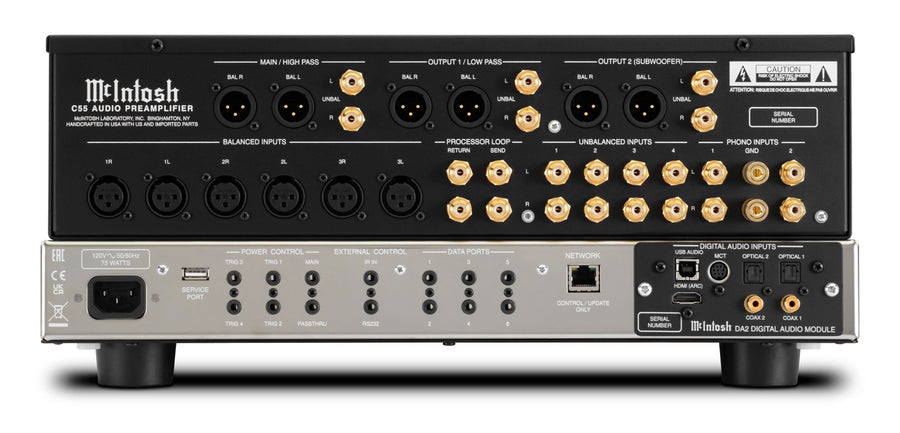
Bass and treble controls, a subwoofer output, an unbalanced variable preamplifier output for a larger amplifier later, Home Theater PassThru, RS232, two data ports, an IR input and a Power Control output finish the rear panel, and the High Drive headphone output includes HXD crossfeed. The Absolute Sound's Jason Methfessel reviewed the MSA5500 in May 2025, and AVForums' Ed Selley gave it 9/10 and a Highly Recommended award the same month, later naming it Best High-End All-In-One system for 2025/2026. With the antennas vertical it stands 8⅛ inches high; folded flat it is six inches high and 22¼ inches deep.

Pearl Audio recommends the MSA5500 for a living room or a second system where one box should do everything, and pairs it with the Sonus faber Lumina V, Concertino G4 or Bowers & Wilkins 805 D5; the McIntosh ML1 Mk II is the all-McIntosh pairing. The MA8950 is the step up to Autoformers and two phono inputs, with the DS200 adding the same streaming platforms to any larger McIntosh.

McIntosh MSA5500 Lifestyle1

Key technologies

  • Integrated network streamer. Wi-Fi 6 on two antennas, Ethernet and Bluetooth 5.0 (AAC, aptX HD, aptX Adaptive), with AirPlay, Google Cast, Spotify Connect, TIDAL Connect, Qobuz Connect and Roon Ready; network playback to 24-bit/192 kHz.
  • Quad Balanced DAC. McIntosh's eight-channel, 32-bit/384 kHz converter runs four DAC channels per audio channel in a balanced configuration to cancel noise and distortion common to the pairs.
  • HDMI ARC with CEC. Television audio returns over HDMI, Dolby and DTS fold down to stereo, and the TV remote controls volume and power.
  • Direct-coupled 100 W amplifier. A solid-state output stage with no Autoformer, so 100 W into 8 Ω rises to 160 W into 4 Ω, with a damping factor above 200.
  • MCT input. Carries CD audio and the DSD64 stereo layer of an SACD from a McIntosh transport without conversion to PCM.
  • Power Guard and Sentry Monitor. Real-time anti-clipping and fuseless short-circuit protection.
  • Preamplifier output. An unbalanced variable output can feed an external power amplifier when the system outgrows the internal one, with the MSA5500 staying on as streamer, DAC and control center.
Specifications
Type Streaming integrated amplifier, solid state, direct-coupled output
Power output 100 W per channel into 8 Ω; 160 W per channel into 4 Ω (FTC rating 100 W), 20 Hz – 20 kHz
Total harmonic distortion 0.005%
Dynamic headroom 1.8 dB
Frequency response 20 Hz – 20 kHz, +0/−0.5 dB; 10 Hz – 100 kHz, +0/−3 dB
Signal-to-noise ratio 95 dB high level; 82 dB moving-magnet phono; 110 dB power amplifier input
Sensitivity 0.5 V balanced / 0.25 V unbalanced (high level); 2.5 mV phono; 1 V power amplifier input
Input impedance 20 kΩ balanced / 20 kΩ unbalanced; phono fixed
Damping factor >200 into 8 Ω; >100 into 4 Ω
Streaming Apple AirPlay, Google Cast, Spotify Connect, TIDAL Connect, Qobuz Connect, Roon Ready, Roon Tested; Bluetooth 5.0 with AAC, aptX HD and aptX Adaptive
Network Wi-Fi 6 (two antennas) and Ethernet; network playback 24-bit, 44.1 – 192 kHz; McIntosh Cast Connect app for setup
Analog inputs 1 balanced, 4 unbalanced, 1 moving-magnet phono (fixed loading)
Digital inputs 2 coaxial and 2 optical (24-bit, 44.1 – 192 kHz); 1 USB (32-bit, 44.1 – 384 kHz PCM; DSD64, DSD128, DSD256; DXD 352.8 and 384 kHz); 1 MCT (CD and SACD DSD64); 1 HDMI ARC (audio only)
DAC 8-channel 32-bit/384 kHz Quad Balanced
Outputs Gold-plated speaker binding posts; 1 unbalanced variable preamplifier output; 1 subwoofer output; ¼ in High Drive headphone output with HXD
Tone controls Bass and treble, bypass and input assign
Meters Two dual-scale blue watt meters
Control Home Theater PassThru; input level match; RS232; 1 Power Control output; 2 data ports; IR sensor input; HDMI CEC; remote included
Power requirement 120 V, 50/60 Hz, 3.2 A; standby under 0.25 W
Dimensions (W × H × D) 17½ × 6 × 18¾ in (44.5 × 15.2 × 47.6 cm); 8⅛ in (20.6 cm) high with antennas vertical, 22¼ in (56.5 cm) deep with antennas horizontal
Weight 38 lb (17.2 kg); shipping 55.5 lb (25.2 kg)
Warranty 3-year limited (McIntosh USA)

McIntosh MSA5500 product page and specifications · Owner's manual (PDF) · Brochure (PDF)

Where it sits in the range

McIntosh's integrated amplifiers, from the 12-inch MA252 to the 350-watt MA12000. The MSA5500 is the only one with streaming built in.

  • McIntosh MA252: hybrid, four preamplifier tubes and 100 W direct-coupled solid-state output, 12 in wide, $5,000
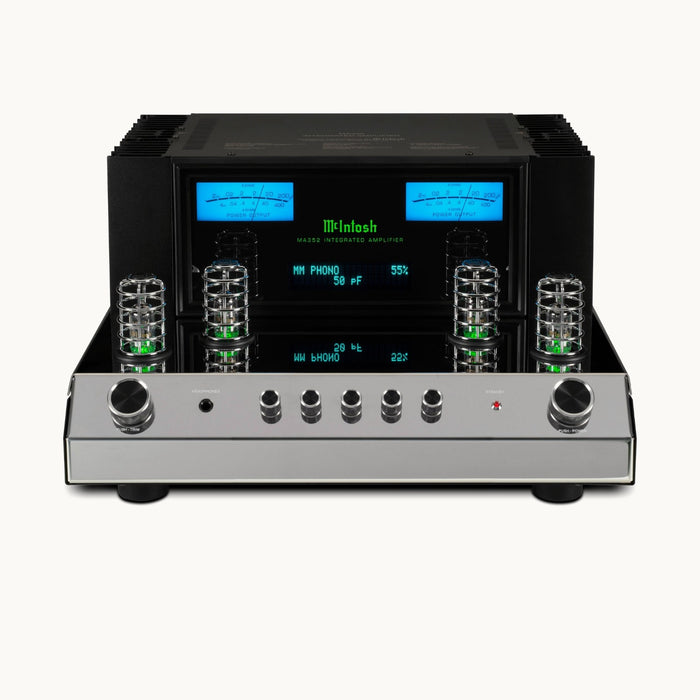
  • McIntosh MA352: hybrid, four preamplifier tubes and 200 W direct-coupled output, all analog, five-band equalizer, $8,000
  • McIntosh MSA5500 (this model): 100 W direct coupled with network streaming, DAC and HDMI ARC built in, $8,000
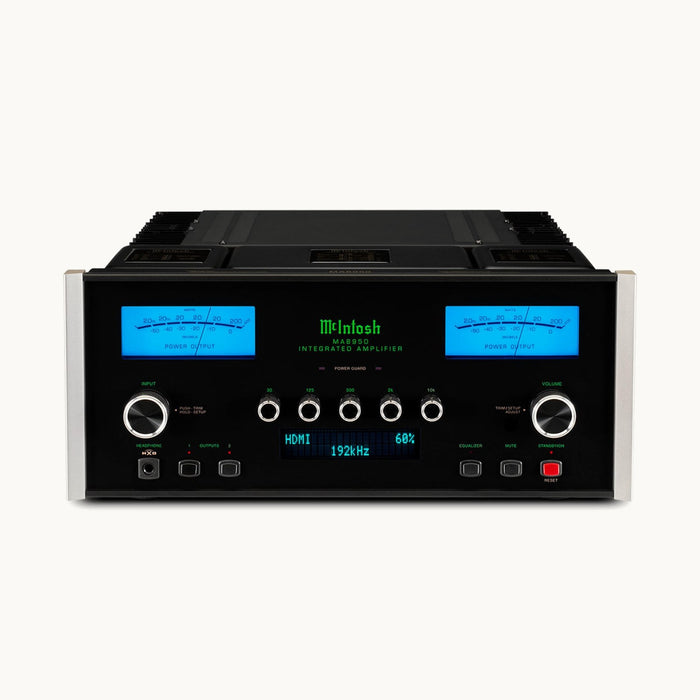
  • McIntosh MA8950: 200 W through Autoformers, two phono inputs, DA2 digital module, five-band equalizer, $10,500
  • McIntosh MA9500: 300 W through Autoformers, two adjustable phono inputs, DA2 module, eight-band equalizer, $14,000
  • McIntosh MA2375: all tube, 75 W from four KT88s through Unity Coupled transformers, configurable phono, $15,000
  • McIntosh MA12000: hybrid, four-tube preamplifier and 350 W Autoformer output, 17 inputs, eight-band equalizer, $17,500

For streaming with a larger McIntosh amplifier, the DS200 streaming DAC adds the same platforms to any integrated or preamplifier.

Reviews

McIntosh purchases are completed in store or by phone or email after a consultation; ask us about delivery and installation. McIntosh products are not available for carrier shipment.

Plan your McIntosh system with Pearl Audio

Pearl Audio is an authorized McIntosh dealer. We will set up the network and your streaming services, connect the television over HDMI ARC, match loudspeakers, and arrange a listening appointment in our Portland showroom. Call (503) 222-2599 or email sales@pearlaudio.com.

Signature technologies

The engineering behind the McIntosh MSA5500 Streaming Integrated Amplifier

McIntosh gives its technologies names because each one solves a specific problem. Here is what each does, where it came from, why it matters in a system, and what you may hear.

Signature technologySince 1977

Power Guard

A comparator that watches the amplifier's input and output waveforms and eases the input drive, in real time, the moment the output begins to clip. Read the deep diveClose

What it does

Every amplifier has a point at which it runs out of clean output and the peaks of the waveform flatten. Power Guard compares the shape of the input signal with the shape of the output signal. The two match until the amplifier reaches its limit; when they diverge, the circuit drives a photo-optical attenuator at the input and reduces the drive just enough to keep the output within its clean range. It acts only when needed and only for as long as the overload lasts, and it does not add power: a 450-watt amplifier remains a 450-watt amplifier.

Why it matters in a system

Hard clipping produces harmonics that sound harsh and, sustained, can burn out tweeters; it is the most common way a good system is damaged at a party. Power Guard lets a McIntosh amplifier be driven to its limit without that risk, which matters most with low-sensitivity loudspeakers, large rooms and recordings with wide dynamic range. In a home theater it means a seven-channel MC257 or a Class D MI-series amplifier can be run hard on a film soundtrack without harm. Two amber indicators show when the circuit is working; if you see them often, the system needs more amplifier, not more volume.

What you may hear

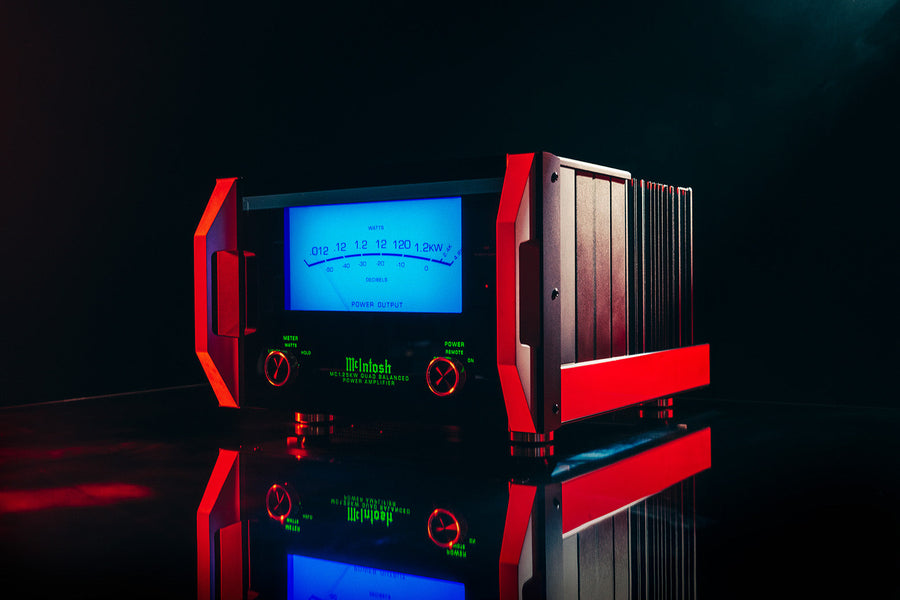
Demanding peaks that stay musical instead of turning hard, and the confidence to listen at realistic levels. Most owners never see Power Guard act, which is the point. On the MA252 and MA352 the small-signal tubes flash amber when it does.

Signature technologySince 1967

Sentry Monitor

Fuseless protection that watches the output current and disengages the output stage before the current can reach a damaging level, then resets itself when the fault clears. Read the deep diveClose

What it does

A shorted loudspeaker cable, a failed driver or a brutal passage into a very low impedance can ask an output stage for more current than its devices can survive. Sentry Monitor measures the output current continuously and, at the threshold McIntosh sets for each model, disconnects the output stage in a fraction of a second. There is no fuse in the signal path to replace and nothing to degrade the sound; when the condition returns to normal the circuit re-engages on its own. On the tube amplifiers the small-signal tubes flash red when it has acted.

Why it matters in a system

Output protection is usually a fuse (slow, and audible as a resistance in the signal path) or a relay that trips late. Sentry Monitor is neither, and it has been on every McIntosh solid-state amplifier since the company's first transistor designs, which is one reason McIntosh amplifiers from the 1970s are still in daily use. In a system it is the insurance that lets you run long speaker cables, bi-wire, or drive a demanding loudspeaker without worrying about the one bad connection that ends an evening.

What you may hear

Nothing, unless something is wrong. If playback stops and the indicators show a fault, correct the cause, follow the reset instructions in the owner's manual for your model, and the amplifier is back. There is no fuse to find.

Signature technologySince 2000

Quad Balanced

Two complete balanced push-pull amplifiers per channel, combined at the Autoformer so that noise and distortion common to both cancel; the same principle runs McIntosh's eight-channel DAC in Quad Balanced mode. Read the deep diveClose
A rack of finished Autoformers, wound and wired in the McIntosh factory in Binghamton, New York

What it does

In a Quad Balanced McIntosh power amplifier each channel contains two matched, fully balanced amplifiers. Each handles half of the push-pull waveform and their outputs are summed in the Autoformer. Noise and distortion products that appear identically in both halves are common-mode and cancel in the summation, while the music, which is differential, adds. The idea scales down to digital: the DA2 Digital Audio Module's eight-channel, 32-bit converter runs four converter channels per stereo channel in Quad Balanced mode, averaging their output so random converter noise falls and the signal stays.

Why it matters in a system

A big amplifier is only as good as its noise floor, and 1,200 watts of headroom is worth little if the background hisses. The MC1.25KW's 124 dB signal-to-noise ratio and the MC611's 124 dB are the measurable results of the architecture, and they are why these amplifiers can drive very sensitive loudspeakers, or horns, without audible hum or hiss. On the digital side the Quad Balanced DAC is what lets McIntosh preamplifiers, integrated amplifiers and the DS200 streamer take a 32-bit/384 kHz or DSD512 file and deliver it with a 100 dB or better dynamic range.

What you may hear

A black background behind quiet passages, instruments that emerge from silence rather than from a faint haze, and the same calm at high volume as at low. In digital sources, a smoothness that does not blur detail.

Signature technology

Monogrammed Heatsinks

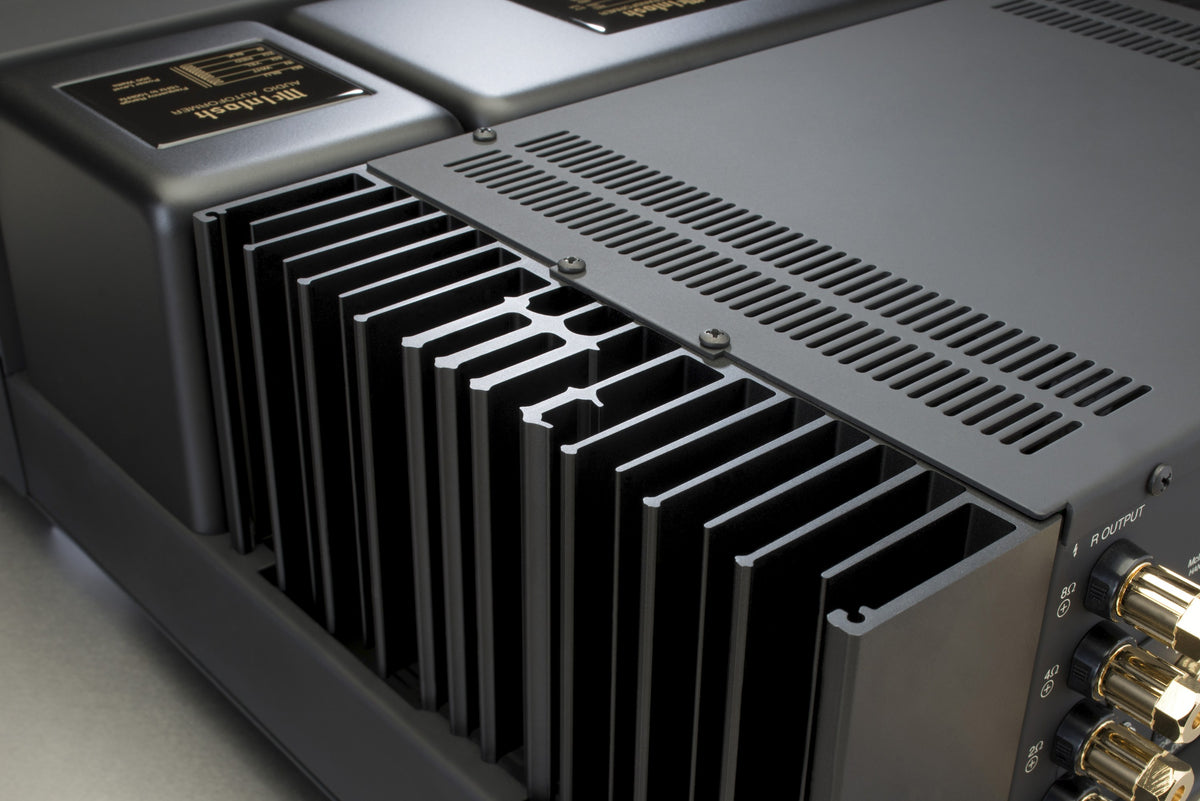
Heatsinks cast in a highly conductive alloy, with the McIntosh initials formed by their fins, bolted directly to the high-current output transistors so the amplifier reaches and holds its operating temperature without thermal lag. Read the deep diveClose
A McIntosh Monogrammed Heatsink: the company initials are formed by the fins

What it does

An output transistor's behavior changes with temperature, and in a conventional amplifier the devices warm, the heatsink lags, and the bias wanders for the first half hour of listening. McIntosh's Monogrammed Heatsinks connect each bank of output transistors to a large casting of high-thermal-conductivity material, so heat moves out of the device immediately and the whole assembly settles quickly to a stable temperature. The fins are arranged to spell the company's monogram when seen from above, which is why the glass tops of the MC462 and MC611 let you look down on them.

Why it matters in a system

Thermal stability is sound-quality engineering, not decoration. An output stage at a steady temperature keeps its bias, its distortion and its channel match constant from the first track to the last, and runs the transistors well inside their ratings, which is why McIntosh amplifiers are known for decades of service. The heatsinks are also silent: there are no fans in an MC-series amplifier or an MC257 home theater amplifier, so nothing in the rack adds noise to a quiet room.

What you may hear

The first note sounding like the hundredth. A system that does not need to warm up for an hour before it is itself, and no fan noise in the pauses.

Signature technologySince 1967

Blue Watt meters

Fast-responding, peak-reading meters that turn the amplifier's output into a visible reference, one per channel, scaled in watts and in decibels relative to rated power, lit McIntosh blue. Read the deep diveClose
Final test in Binghamton: every McIntosh amplifier is checked on the bench, meters included, before it ships

What it does

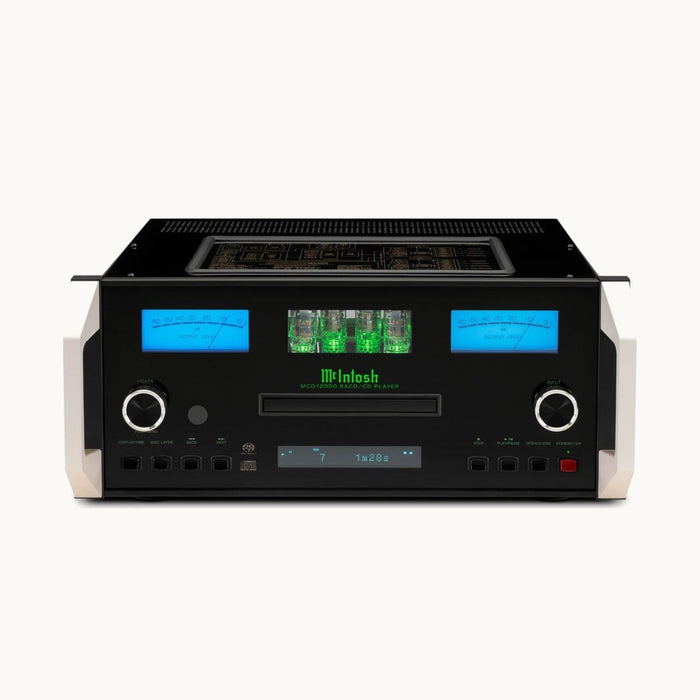
A McIntosh output meter reads the power the channel is delivering to the loudspeaker. Its face carries a watts scale and a decibel scale referenced to rated output: 0 dB is rated power, -10 dB is one tenth of it, -20 dB one hundredth. The movement is quick; McIntosh specifies that the MC462's meters indicate at least 95 percent of the power of a single cycle of a 2,000 Hz tone burst, fast enough to show a drum strike. A Hold mode on the power amplifiers locks the pointer at the highest peak and lets it fall at roughly 6 dB per minute so the peak can be read. On preamplifiers and the MCD12000 the meters show output level; on the MC257 a TripleView housing carries three mechanical meters for the front channels.

Why it matters in a system

The meters are an instrument before they are an ornament. They show how much of the amplifier a loudspeaker is using, which tells you whether the system has headroom or is living near its limit; they show the recording's balance when the left and right pointers diverge; and they make the dynamic range of a good recording visible, which is a quiet lesson in why power matters. Since the first solid-state McIntosh amplifiers of 1967 they have also been the company's signature, recognized across a room before a note is played, and the reason a McIntosh system has a presence other electronics do not.

What you may hear

Watch the needles rise with an orchestral swell and settle as the music relaxes, then listen for the same thing. Owners find the meters change how they hear dynamics. The blue glow is part of the McIntosh experience; the information is why it has lasted.

Design heritage, since the 1960s

Black glass, gold lettering and the illuminated logo

The front panel is a sheet of glass, lettered from the back in McIntosh's own ink so the markings read gold in daylight and glow teal in a dim room, with the logo lit from behind. It has defined the look of a McIntosh since the 1960s and it is why a sixty-year-old C22 still reads as new. Read the deep diveClose
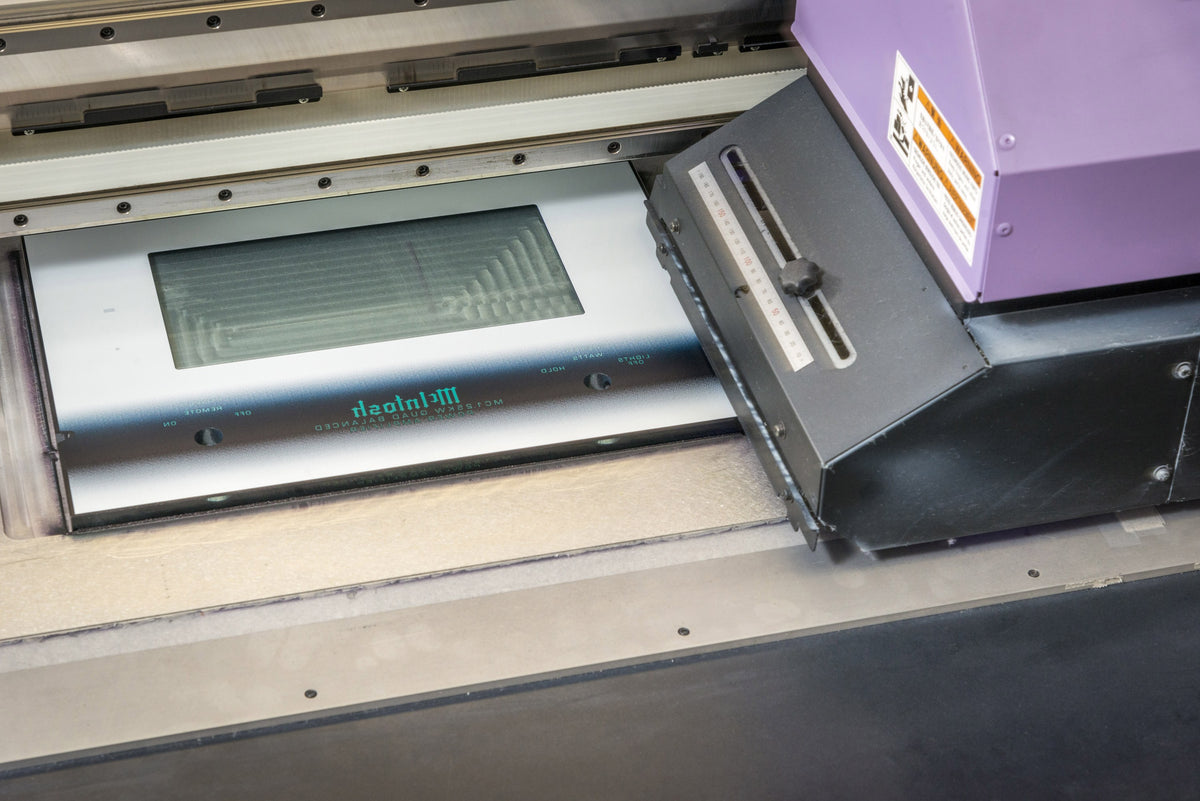
A McIntosh glass front panel leaving the printer, lettered from the back in the factory in Binghamton

What it does

Most front panels are painted or anodized metal with printed legends that wear. In the 1960s Gordon Gow suggested a different construction: a glass panel, screen-printed on its back face with an ink McIntosh developed itself. Because the lettering is behind the glass it cannot rub off, and because of the ink's pigment the markings read as gold under room light and as teal when lit from behind in a dim room. The lamps, now direct LEDs on current models, also illuminate the McIntosh name and the blue meter faces. Each panel is cut, printed and finished in Binghamton, and McIntosh describes every faceplate as a unique, handmade piece.

Why it matters in a system

Longevity, first: the panel of a 1963 C22 or a 1967 MC2505 looks today as it did when it was made, which is a large part of why McIntosh components hold their value and why a system can be built over decades from components of different ages that match. Coherence, second: a C2800 preamplifier, an MC462 amplifier and a DS200 streamer share the same glass, the same lettering and the same light, so a complete system reads as one instrument. It also places the engineering where you can see it, from the meters to the glass-topped transformer enclosures on the current amplifiers.

What you may hear

Nothing directly; this is the part of the design you see. What it changes is how a system lives in a room: lights low, the panels glowing gold and teal, the meters moving, the equipment itself part of the evening.

Signature technologySince 2014

Headphone Crossfeed Director (HXD)

A switchable circuit that feeds a controlled, time-shaped portion of each channel to the opposite ear, restoring to headphones some of the spatial character of listening to loudspeakers. Read the deep diveClose

What it does

With loudspeakers each ear hears both channels, the far one slightly later and softer, and the brain builds a stage in front of you from those differences. Headphones remove that: the left ear hears only the left channel. HXD adds a measured amount of the opposite channel to each earpiece, filtered and delayed to mimic what the far loudspeaker would have contributed, so instruments mixed hard to one side stop sitting inside the earcup and take a place in a shared space. It is switchable, so you can compare with it in and out.

Why it matters in a system

Headphone listening is where a preamplifier or integrated amplifier gets used late at night, and HXD is why a McIntosh C2800 or MA9500 is a complete headphone system rather than a jack on the back. It works with the High Drive headphone amplifier, which has the gain and current for demanding headphones, so a serious pair of planars or high-impedance dynamics needs no separate amplifier. The effect depends on the recording and the headphones; McIntosh leaves the choice to you.

What you may hear

Compare a familiar stereo recording with HXD on and off. Listen for a more cohesive sense of placement, less of the hole in the middle of the head, and instruments panned far left or right that feel connected to the rest of the band.

Signature technology

High Drive headphone amplifier

A dedicated headphone amplifier stage with the gain and current to drive demanding headphones from the quarter-inch jack of a McIntosh preamplifier, integrated amplifier or player. Read the deep diveClose

What it does

A headphone jack on most electronics is an afterthought: a resistor off the main output or a small op-amp with little current behind it, fine for efficient earbuds and short of breath with anything else. McIntosh's High Drive section is an amplifier designed for the job, with increased gain and output power compared with a conventional headphone output, and a low output impedance (47 ohms on the MCD600) so that the headphone, not the amplifier, sets the frequency balance. On most components it is paired with the Headphone Crossfeed Director.

Why it matters in a system

Planar-magnetic and high-impedance dynamic headphones need voltage swing and current that a passive jack cannot supply; underdriven, they sound thin and compressed. High Drive lets a C55, an MA8950 or a C8 double as a headphone system of real quality without a separate box, cable and power supply, which keeps the rack simple and the late-night listening serious. The MHA200, McIntosh's tube headphone amplifier, is the dedicated alternative when headphones are the main event.

What you may hear

Fuller bass and more dynamic range from difficult headphones, a sense of ease at volume, and the same tonal character as the loudspeaker system the component drives.

System integration

Home Theater PassThru

A fixed-gain input that lets a McIntosh two-channel preamplifier or integrated amplifier sit inside a surround system: the processor drives the front channels through the McIntosh at unity gain, and the two-channel system stays untouched for music. Read the deep diveClose

What it does

Mixing a serious stereo system with a home theater usually means compromising one of them. Home Theater PassThru assigns one input of the McIntosh preamplifier or integrated amplifier to the surround processor's front left and right outputs and passes it at a fixed level, so the processor's own volume control and calibration govern the front loudspeakers during a film. Select any other input and the McIntosh is a pure two-channel preamplifier again, with the processor out of the signal path. On the C55 and C2800 a Processor Loop adds a send and return for an external processor or equalizer.

Why it matters in a system

It lets one pair of main loudspeakers and one McIntosh amplifier serve both music and film without re-cabling or re-calibrating, which is how a C2800 and MC462 can anchor a theater built on an MX124 processor while remaining a reference stereo system at night. For a client building in stages it also means the stereo system can be bought first and the theater added later around it.

What you may hear

Film soundtracks through the main loudspeakers at the processor's calibrated level, and your records through the same loudspeakers with nothing from the theater in the way.

System integration

Power Control

A low-voltage control link between McIntosh components: switch the preamplifier on and the amplifier, player, turntable and streamer wake with it, with their meter lighting following along. Read the deep diveClose

What it does

Every McIntosh component carries Power Control jacks. A three-conductor cable runs from the preamplifier's POWER CONTROL MAIN (or a Trigger output) to the POWER CONTROL IN of the next component, and on down the chain; the power command and the meter-illumination command travel on that one cable. On a power amplifier a rear switch sets the behavior: REMOTE follows the preamplifier, ON keeps the amplifier on regardless, OFF keeps it off. The C55 and C2800 provide a Main output and four Trigger outputs so a complex system, or a second zone, can be sequenced; Data ports and IR inputs carry the remote-control commands alongside.

Why it matters in a system

A separates system is only as pleasant to live with as its first thirty seconds. Power Control turns a rack of McIntosh components into one instrument that comes to life from a single button and shuts down the same way, with the amplifiers' lighting switching with the rest. It also lets the Eco power-management feature on current amplifiers be used safely: an amplifier that has switched itself off after a period of silence returns the moment the preamplifier wakes it. The matching McIntosh Power Control Cables are available in several factory lengths; Pearl Audio can specify the right ones for your rack.

What you may hear

Nothing, by design; Power Control carries commands, not audio. What you notice is a system that behaves as one component, and meters that light together.

Signature technology

Solid Cinch speaker binding posts

Patented, gold-plated loudspeaker terminals whose clamping barrel presses straight down on the spade lug without turning it, so a heavy cable stays exactly where you set it and cannot work loose. Read the deep diveClose
Gold-plated Solid Cinch speaker binding posts on the rear panel of a McIntosh integrated amplifier

What it does

On an ordinary binding post the nut that tightens the connection also rotates against the spade lug, dragging it round, twisting a stiff cable and, over time, loosening under its own torque. Solid Cinch separates the two motions. Only the top turns; a separate clamping barrel moves straight down and presses the spade flat against the gold-plated contact surface. The lug stays at the angle you chose, neighboring connections stay clear of one another, and the contact is metal to metal under real pressure. On the MC611 each impedance tap has its own set of posts, spaced for cable management.

Why it matters in a system

The loudspeaker connection carries the most current in the system and is the one most often made badly. A spade that has crept round a post can touch its neighbor, and a short at the output of a 600-watt amplifier is exactly what Sentry Monitor exists to catch; Solid Cinch is the reason it rarely has to. With the large-gauge, stiff cables used in a serious system, the ability to clamp hard while keeping the cable straight is the difference between a connection you make once and one you check every month.

What you may hear

Nothing you would attribute to a terminal, which is the aim. You notice it with the cables in your hands: a large spade stays perfectly aligned as you tighten, and the connection does not change.

Made in the USASince 1951

Handcrafted in Binghamton, New York

McIntosh electronics are designed, built and tested at 2 Chambers Street in Binghamton, New York, where the company has been since 1951 and where its transformers are still wound by hand. Read the deep diveClose
The McIntosh factory at 2 Chambers Street, Binghamton, New York, from the air

What it does

McIntosh moved from Silver Spring, Maryland, to Binghamton in 1951 and built its present factory at 2 Chambers Street in 1956. The company still makes the parts that matter most to its sound on the premises. Output transformers and Autoformers are hand-wound and potted in the building; the glass front panels are cut, screen-printed and finished there; circuit boards are populated on the company's own surface-mount line, up to 7,000 boards a month, with temperature-sensitive and large components placed by hand, and every board is tested individually before it goes into a chassis. Every finished component goes through a bench test before it leaves.

Why it matters in a system

Keeping engineering, winding, assembly and test under one roof is how a company controls the consistency that lets a 1961 circuit and a 2026 amplifier sound like relatives. It is also what makes long-term service real: McIntosh maintains documentation and parts for decades of production, and a component bought today can go back to the people who built it. For an owner this is the practical meaning of heritage, a system that can be repaired, updated and handed on.

What you may hear

Consistency between units and across years, and the quiet confidence of equipment that was measured before it shipped. The glass-topped transformer enclosures on the current amplifiers let you see the work.

All McIntosh technologies

The McIntosh story

Seventy-seven years of American engineering you can see working: the Unity Coupled transformer, the Autoformer, the blue meter and the glass panel, still made in Binghamton.

Founded 1949 in Silver Spring, Maryland (in Binghamton, New York since 1951) by Frank H. McIntosh and Gordon J. Gow · mcintoshlabs.com

Milestones

  1. 1949 Founded on the Unity Coupled Circuit Frank H. McIntosh and Gordon Gow found McIntosh in Silver Spring, Maryland. U.S. Patent 2,477,074 covers the Unity Coupled Circuit; the 50W-1 is the first product, the AE2 preamplifier follows in 1950.
  2. 1951 Binghamton, New York The company moves to the second floor of 320 Water Street in Binghamton; Sidney Corderman joins as head of research, engineering and development and stays forty years. The factory at 2 Chambers Street, built in eight months in 1956, is still home.
  3. 1954 MC30, MC60 and the chrome chassis The MC30 and MC60 establish the chrome chassis as a McIntosh design element; the C8 preamplifier shows that industrial design matters; the MR55 of 1957 is the first McIntosh tuner.
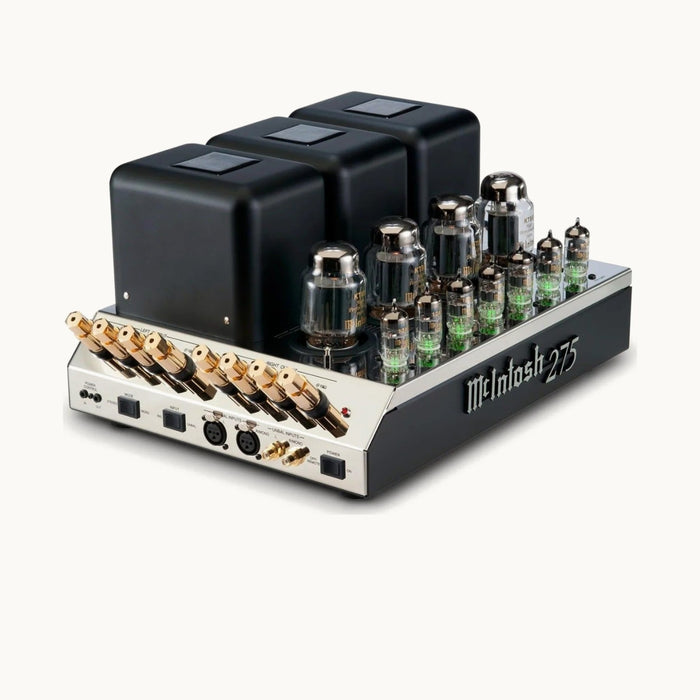
  4. 1961 MC275 The MC275 stereo tube amplifier arrives with the MC225 and MC240. Discontinued in 1971, it returns in 1993 and has been in production since; today in its sixth generation.McIntosh MC275 Power Amplifier
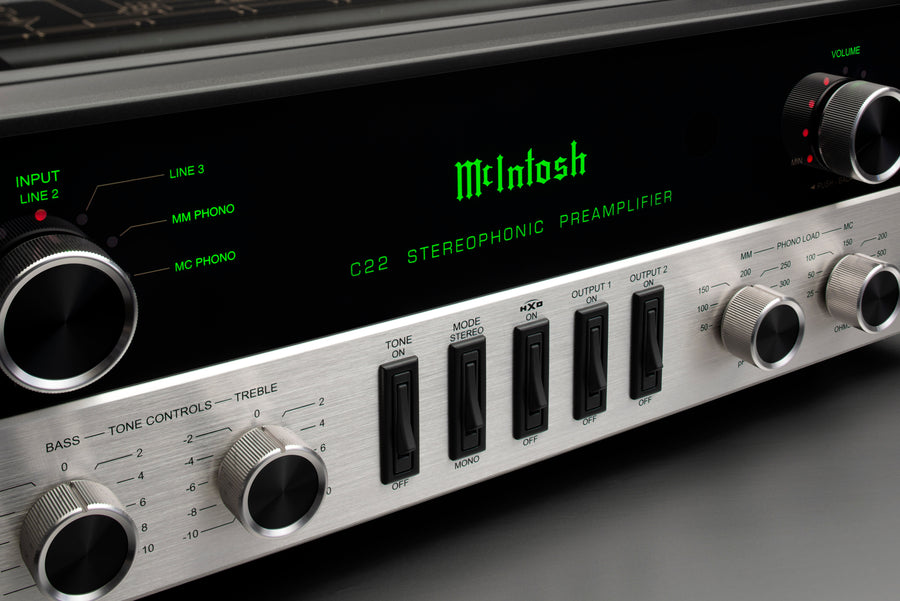
  5. 1963 C22 and the illuminated glass panel The C22 tube preamplifier (1963-1972) pairs with the MC275. Through the 1960s McIntosh develops the back-printed glass front panel: gold lettering by day, teal by night.McIntosh C22 Preamplifier Mk V
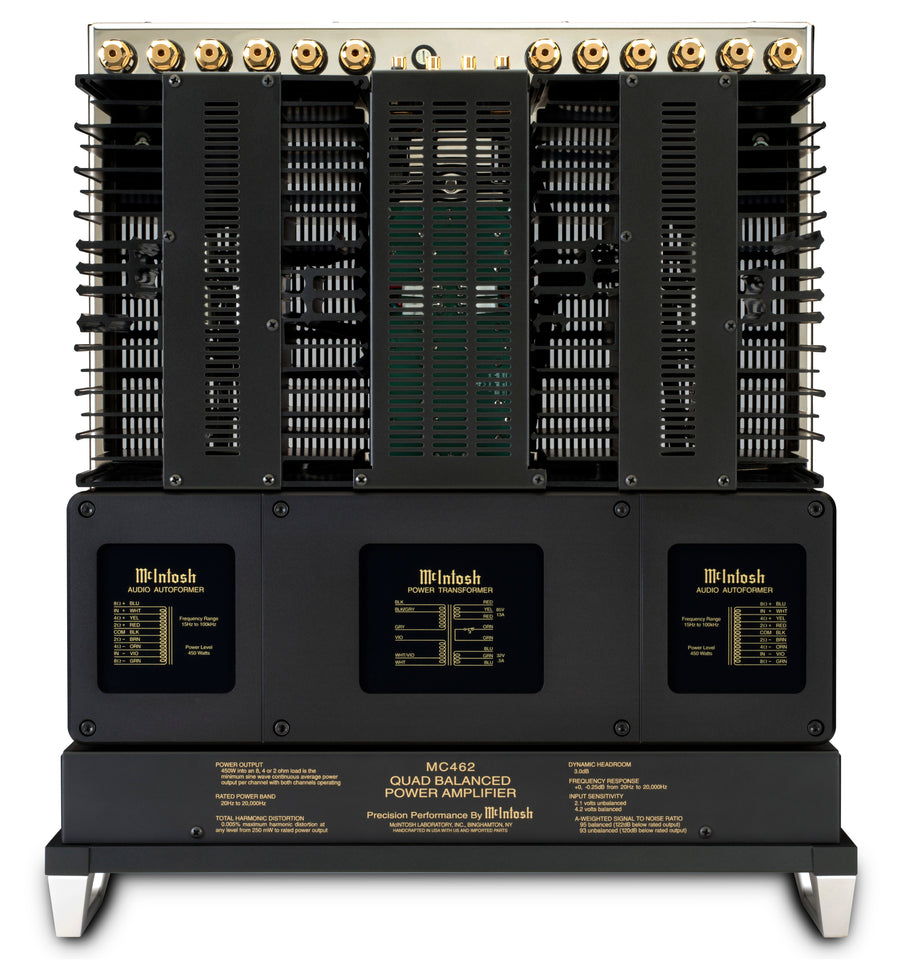
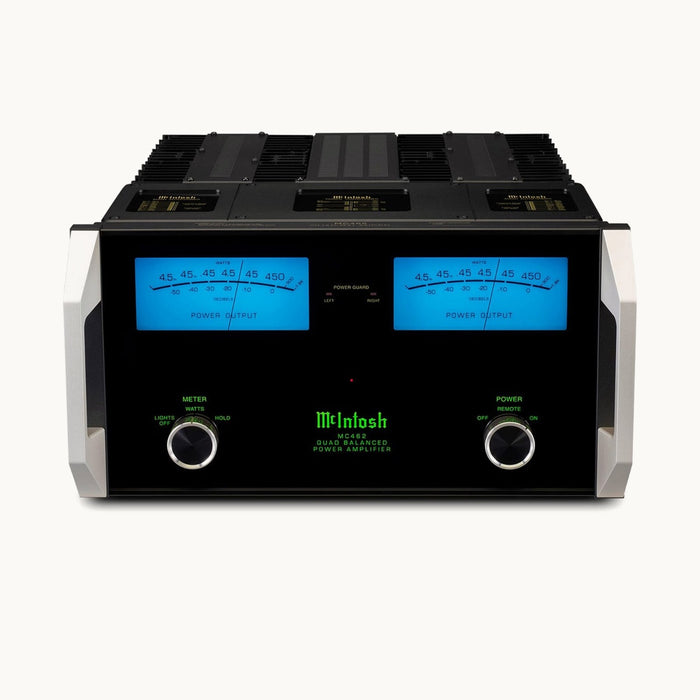
  6. 1967 Solid state, with Autoformers The MC2505 and MC2105 are McIntosh's first transistor amplifiers: output Autoformers, Sentry Monitor protection, illuminated output meters and an all-glass front panel, the template for every McIntosh amplifier since.McIntosh MC462 Power Amplifier
  7. 1969 Woodstock McIntosh amplifiers, by most accounts about twenty MC3500 tube monoblocks, power the Woodstock festival.
  8. 1974 The Wall of Sound On March 23 the Grateful Dead unveil the Wall of Sound at the Cow Palace: 48 McIntosh MC2300 amplifiers, 28,800 watts. The MR78 FM tuner of 1972 belongs to the same years.
  9. 1977 Power Guard The MC2205 is the first amplifier with Power Guard, the anti-clipping comparator carried by every McIntosh amplifier since. Frank McIntosh retires; Gordon Gow becomes president.
  10. 1980 XRT20 line array and MC2500 The XRT20 brings line-array loudspeakers into the home and the MC2500 (1980-1990) becomes the big stereo amplifier of the decade; the MCD7000 is the first McIntosh CD player.McIntosh XRT2.1K Floorstanding Loudspeaker
  11. 1993 Gordon Gow Commemorative MC275 After Gow's death in 1989 and the 1990 sale to Clarion, the MC275 returns as a commemorative edition and never leaves the line again.
  12. 1999 50 years: the MC2000 Sidney Corderman comes out of retirement to design the MC2000, a limited-edition vacuum-tube amplifier for the company's fiftieth anniversary.
  13. 2000 Quad Balanced and a new president The MC1201 monoblock introduces the Quad Balanced architecture behind today's MC1.25KW, MC611 and MC462. In 2001 Charlie Randall, an engineer with the company since 1988, becomes president and CEO.McIntosh MC1.25KW Power Amplifiers (pair)
  14. 2007 MT10 turntable Two years after the Reference System of 2005, McIntosh introduces its first turntable, the MT10, with an illuminated speed meter and McIntosh green platter.McIntosh MT10 Precision Turntable
  15. 2017 Hybrid Drive and the digital module The MA252 is the first McIntosh hybrid integrated amplifier; the DA1 Digital Audio Module makes the digital section replaceable. Frank McIntosh and Gordon Gow enter the Consumer Technology Hall of Fame.McIntosh MA252 Integrated Amplifier
  16. 2019 70th anniversary The MC2152 amplifier and C70 preamplifier mark 70 years; the MC901 puts a tube and a solid-state amplifier on one chassis; the DA2 module arrives. The MC1502 and C22 Mk V carry the anniversary designs forward.
  17. 2024 75 years, and Bose McIntosh marks its 75th anniversary. In November, Highlander Partners (owner since 2022) sells McIntosh Group, parent of McIntosh and Sonus faber, to Bose Corporation. Manufacturing stays in Binghamton.
  18. 2026 MA2375 In June the MA2375 becomes the first McIntosh vacuum-tube integrated amplifier in more than a decade: Unity Coupled transformers, Sentry Monitor and Power Guard SGS in one 75-watt chassis.McIntosh MA2375 Vacuum Tube Integrated Amplifier
  19. Now McIntosh MSA5500 Streaming Integrated Amplifier The MSA5500 is the MA5300's platform with streaming built in: Roon Ready, AirPlay, Google Cast and TIDAL, Qobuz and Spotify Connect over Wi-Fi 6, in McIntosh's 100-watt direct-coupled integrated amplifier.
Read the McIntosh story
McIntosh MC275 vacuum tube amplifier, low angle

McIntosh Laboratory was founded in 1949 in Silver Spring, Maryland, by Frank H. McIntosh, a radio engineer who had run a Washington consulting practice, and Gordon J. Gow, the young engineer he had hired in 1946 to help build an amplifier that did not yet exist: one that could deliver real power across the whole audible band with distortion below one percent. Their answer was the Unity Coupled Circuit, patented in 1949 as U.S. Patent 2,477,074, which wound the output transformer into the operating circuit of the tubes with paired plate and cathode windings. The 50W-1 amplifier that carried it was the company's first product, and the AE2 of 1950 its first preamplifier. In 1951 the company moved to the second floor of a building in Binghamton, New York, where Sidney Corderman joined as head of research, engineering and development; the factory McIntosh still occupies at 2 Chambers Street opened in 1956.

The 1950s and 1960s made the McIntosh look. The MC30 and MC60 of 1954 and 1955 established the chrome chassis, the C8 preamplifier showed that industrial design mattered, and the MR55 of 1957 was the first McIntosh tuner. Through the 1960s the company developed the front panel it is known for: a sheet of glass, screen-printed from the back in an ink McIntosh made itself, so the lettering reads gold under room light and glows teal in the dark and never wears off. The stereo tube amplifiers of the decade, the MC225, MC240 and MC275 of 1961, with the C22 preamplifier of 1963, are the designs collectors chase today; the MC275 has been back in production since 1993 and the C22 is in its fifth version. Dave O'Brien spent those years on the road running the McIntosh Performance Clinics, bench-testing customers' amplifiers of every make in dealers' stores, a tradition of measured proof that the company has never given up.

McIntosh's history runs through the music of the period. In 1969 McIntosh amplifiers, by most accounts about twenty MC3500 tube monoblocks, powered Woodstock. On March 23, 1974, the Grateful Dead unveiled the Wall of Sound at the Cow Palace with 48 McIntosh MC2300 solid-state amplifiers delivering 28,800 watts. The MC2300 belonged to the transistor generation McIntosh had begun in 1967 with the MC2505 and MC2105, the first solid-state amplifiers to keep output transformers, which McIntosh called Autoformers, so that the amplifier delivered full power into any loudspeaker impedance; the same amplifiers introduced Sentry Monitor protection, the illuminated output meters and the all-glass front panel. The MC2205 of the late 1970s added Power Guard, the anti-clipping circuit that has been on every McIntosh amplifier since. Frank McIntosh retired in 1977 and Gordon Gow became president; the XRT20 of 1980 brought line-array loudspeakers into the home, and the MCD7000 was the company's first CD player.

Gow died in 1989 and the company was sold to Clarion of Japan in 1990, the year Frank McIntosh also died; the MC275 returned in 1993 as the Gordon Gow Commemorative edition. D&M Holdings bought McIntosh in 2003; Fine Sounds of Milan, parent of Sonus faber and Audio Research, bought it in 2012; a management buyout in 2014 led to the group's renaming as McIntosh Group and its move to New York; Highlander Partners acquired the group in June 2022 and sold it to Bose Corporation in November 2024. Through all of it the company stayed in Binghamton, and since 2001 it has been led by Charlie Randall, an electrical engineer who joined in 1988 and rose through engineering to president. The MC1201 of 2000 brought the Quad Balanced architecture that defines today's big amplifiers; the Reference System of 2005, the MT10 turntable of 2007, the first hybrid integrated amplifier (the MA252 of 2017), the replaceable DA1 and DA2 digital modules, and the 70th-anniversary MC2152 and C70 of 2019 mark the modern era. Frank McIntosh and Gordon Gow were inducted into the Consumer Technology Hall of Fame in 2017.

The McIntosh of 2026 still winds its transformers by hand at 2 Chambers Street, still prints its glass panels in the building, and still tests every component on the bench before it ships. The MA2375 of June 2026, the first McIntosh vacuum-tube integrated amplifier in more than a decade, carries the Unity Coupled transformers of 1949, the Sentry Monitor of 1967 and a tube form of the Power Guard of 1977 in one chassis, which is as good a summary of the company as any. Pearl Audio holds the largest McIntosh inventory in Oregon.
The complete McIntosh story and technology library

McIntosh at Pearl Audio

Pearl Audio has represented McIntosh since 2005, the year the store was founded, and is the longest-running McIntosh dealer in the Northwest. We are a McIntosh Platinum dealer, and two decades on McIntosh remains the brand we know most thoroughly: we keep the core of the range on the floor in Portland, hold a deep inventory, and our staff are McIntosh factory trained. McIntosh components are sold for pickup at Pearl Audio, with local delivery and installation available within the Portland, Oregon service area; we do not ship them by carrier.

John's take

Why we carry the MSA5500 Streaming Integrated Amplifier

The MSA5500 is for the person who wants a real McIntosh system, not a pile of boxes assembled around a streaming app. You can start music from the services you already use, connect a television through HDMI ARC, add a turntable, and still have conventional digital and analog inputs waiting for the next source. That is a lot of system in one component, but it does not feel like a compromise disguised as convenience.

I would look at it first when the room, the furniture, or simply common sense says the system should be simpler. Its direct-coupled amplifier has enough output for many serious loudspeakers, and the preamplifier and subwoofer outputs mean the first system does not have to be the last one.

John, owner, Pearl Audio

The Pearl Audio experience

How we work with you

A system at this level should be heard, thoughtfully matched, and properly set up. From the first audition to long-term ownership, you work with the same people, in person.

  1. 01

    Listen first

    Hear the MSA5500 Streaming Integrated Amplifier by appointment in one of our two purpose-designed demonstration rooms, with your own music and time to compare without pressure.

  2. 02

    Placement and setup advice

    Ask us about placement, connections, ventilation and system configuration, and about delivery.

  3. 03

    Support for as long as you own it

    We support everything we sell for as long as you own it, whether the answer comes by phone, in the shop, or through factory service.

  4. 04

    A path for what comes next

    Trade-in assistance and qualifying 100% Trade-Up options give you flexibility when your listening priorities or your system change.

Search