Winding an Autoformer coil by hand at the McIntosh factory in Binghamton, New York

McIntosh technology

The engineering behind McIntosh

McIntosh gives its technologies names because each one solves a specific problem. Here is what each does, where it came from, why it matters in a system, and what you may hear.

Founding technologySince 1949

Unity Coupled Circuit

The output transformer is wound into the tube circuit itself, with paired plate and cathode windings, so a McIntosh tube amplifier delivers its rated power at every loudspeaker tap with low distortion. It is the circuit the company was founded on in 1949. Read the deep diveClose
Spools of magnet wire feeding the transformer winding machines at McIntosh in Binghamton

What it does

In a conventional push-pull tube amplifier the output transformer sits at the end of the circuit, in the plate path alone, and the designer trades bass extension against high-frequency behavior and stability. Frank McIntosh and Gordon Gow put the transformer inside the operating circuit. Separate but tightly related primary windings sit in both the plate and the cathode path of each output tube, wound together (bifilar) so their magnetic behavior is almost identical. Because the cathodes work through their own winding, part of the output is returned locally against the tube's own change, which linearizes the stage almost instantaneously; the close coupling also removes most of the leakage inductance that limits bandwidth in an ordinary transformer. The secondary then presents the reconstructed waveform at dedicated 4, 8 and 16 ohm connections.

Why it matters in a system

Local correction inside the output stage lowers distortion across the band and lowers the amplifier's output impedance, so the tubes keep control of the loudspeaker's motion and bass notes stop cleanly rather than blooming. The tight coupling also lets the output tubes hand current to each other without a distortion step, which is why a Unity Coupled amplifier can run in efficient Class AB at substantial power without the hardness that usually comes with it. In practice the circuit lets a 75-watt MC275 or MA2375 behave like a far more powerful amplifier on loudspeakers that would embarrass most tube designs, and it is why the same output stage has stayed in production, in one form or another, since 1961.

What you may hear

Clarity from deep bass to the top octave, bass that is controlled rather than merely warm, and a sense of ease at volume that owners often describe as a tube amplifier that someone has supercharged. On the MC275 and MA2375 the tubes are visible doing the work; the measurements say the work is done with unusual precision.

Signature technologySince 1967

Autoformer output

A single-winding output transformer between the transistors and the loudspeaker, so a McIntosh solid-state amplifier delivers its full rated power into 2, 4 or 8 ohm loads and the output devices always see the load they were designed for. Read the deep diveClose
Winding an Autoformer coil by hand at McIntosh in Binghamton, New York

What it does

Most solid-state amplifiers connect the output transistors directly to the loudspeaker, which means the amplifier's power, distortion and heat all change with the loudspeaker's impedance: typically more power into 4 ohms than 8, and strain into 2. McIntosh instead passes the output through an Autoformer, its name for an autotransformer wound in Binghamton, with taps for 2, 4 and 8 ohms. The transistors work into one optimized load regardless of the loudspeaker connected, and the Autoformer transforms current and voltage to suit the tap in use. It also isolates the loudspeaker from DC, so a fault in the amplifier cannot push direct current into a woofer.

Why it matters in a system

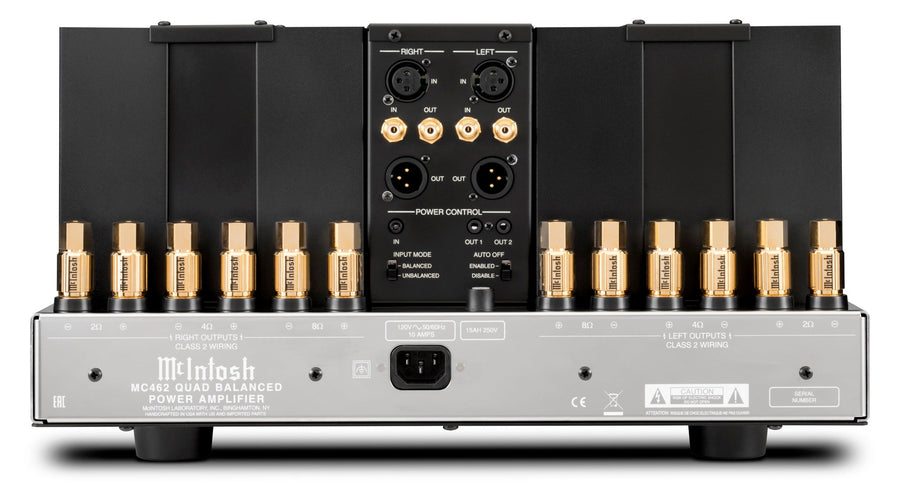
An amplifier whose output stage sees the same load every time is an amplifier whose character does not depend on the loudspeaker. The MC462 is rated at the same 450 watts per channel into 2, 4 and 8 ohms, and the MC1.25KW at 1,200 watts into all three, so a difficult load such as a large electrostatic or a four-ohm floorstander with a punishing impedance dip gets the full amplifier rather than a stressed one. In a system built around a McIntosh amplifier the loudspeaker choice opens up, and the amplifier runs cooler and longer because its transistors are never asked to work outside their design window.

What you may hear

Bass that stays the same weight and definition when you change loudspeakers, dynamics that do not compress into difficult loads, and a quiet composure at high volume. The Autoformer is also the reason a McIntosh amplifier can safely drive an unusual impedance that would trip a conventional design into protection.

Signature technologySince 1977

Power Guard

A comparator that watches the amplifier's input and output waveforms and eases the input drive, in real time, the moment the output begins to clip. Read the deep diveClose

What it does

Every amplifier has a point at which it runs out of clean output and the peaks of the waveform flatten. Power Guard compares the shape of the input signal with the shape of the output signal. The two match until the amplifier reaches its limit; when they diverge, the circuit drives a photo-optical attenuator at the input and reduces the drive just enough to keep the output within its clean range. It acts only when needed and only for as long as the overload lasts, and it does not add power: a 450-watt amplifier remains a 450-watt amplifier.

Why it matters in a system

Hard clipping produces harmonics that sound harsh and, sustained, can burn out tweeters; it is the most common way a good system is damaged at a party. Power Guard lets a McIntosh amplifier be driven to its limit without that risk, which matters most with low-sensitivity loudspeakers, large rooms and recordings with wide dynamic range. In a home theater it means a seven-channel MC257 or a Class D MI-series amplifier can be run hard on a film soundtrack without harm. Two amber indicators show when the circuit is working; if you see them often, the system needs more amplifier, not more volume.

What you may hear

Demanding peaks that stay musical instead of turning hard, and the confidence to listen at realistic levels. Most owners never see Power Guard act, which is the point. On the MA252 and MA352 the small-signal tubes flash amber when it does.

Signature technology

Power Guard Screen Grid Sensor (SGS)

The vacuum-tube form of Power Guard: it monitors the current in the screen grids of the output tubes and reduces input drive in real time if that current becomes excessive. Read the deep diveClose

What it does

A waveform comparator suits a transistor amplifier, but an output tube under stress gives an earlier and more specific warning: its screen-grid current rises. Power Guard SGS senses that current in each KT88 output tube. When it climbs toward the level at which the tube would be damaged, the circuit reduces the input signal, in real time and only by as much as is needed, so the tubes keep working inside their safe range. Like Power Guard, SGS does not add power; it protects the tubes and the loudspeakers from the consequences of overdrive.

Why it matters in a system

Output tubes are the consumable part of a tube amplifier, and overdrive is what wears them out early. By catching the overload at the tube itself rather than at the loudspeaker terminals, SGS protects the most expensive parts in the amplifier and the loudspeaker at the same time. With a 75-watt integrated amplifier such as the MA2375 driving a large room, that is the difference between a tube set that lasts years and one that does not. Frequent SGS activity is a signal to reduce the listening level or to consider a more powerful amplifier.

What you may hear

Nothing during normal listening. When the tube stage is pushed, peaks are eased instead of splintering, and the amplifier's indicator lets you know. Think of it as a safeguard built into the tubes' own behavior rather than an effect on the sound.

Signature technologySince 1967

Sentry Monitor

Fuseless protection that watches the output current and disengages the output stage before the current can reach a damaging level, then resets itself when the fault clears. Read the deep diveClose

What it does

A shorted loudspeaker cable, a failed driver or a brutal passage into a very low impedance can ask an output stage for more current than its devices can survive. Sentry Monitor measures the output current continuously and, at the threshold McIntosh sets for each model, disconnects the output stage in a fraction of a second. There is no fuse in the signal path to replace and nothing to degrade the sound; when the condition returns to normal the circuit re-engages on its own. On the tube amplifiers the small-signal tubes flash red when it has acted.

Why it matters in a system

Output protection is usually a fuse (slow, and audible as a resistance in the signal path) or a relay that trips late. Sentry Monitor is neither, and it has been on every McIntosh solid-state amplifier since the company's first transistor designs, which is one reason McIntosh amplifiers from the 1970s are still in daily use. In a system it is the insurance that lets you run long speaker cables, bi-wire, or drive a demanding loudspeaker without worrying about the one bad connection that ends an evening.

What you may hear

Nothing, unless something is wrong. If playback stops and the indicators show a fault, correct the cause, follow the reset instructions in the owner's manual for your model, and the amplifier is back. There is no fuse to find.

Signature technologySince 2000

Quad Balanced

Two complete balanced push-pull amplifiers per channel, combined at the Autoformer so that noise and distortion common to both cancel; the same principle runs McIntosh's eight-channel DAC in Quad Balanced mode. Read the deep diveClose
A rack of finished Autoformers, wound and wired in the McIntosh factory in Binghamton, New York

What it does

In a Quad Balanced McIntosh power amplifier each channel contains two matched, fully balanced amplifiers. Each handles half of the push-pull waveform and their outputs are summed in the Autoformer. Noise and distortion products that appear identically in both halves are common-mode and cancel in the summation, while the music, which is differential, adds. The idea scales down to digital: the DA2 Digital Audio Module's eight-channel, 32-bit converter runs four converter channels per stereo channel in Quad Balanced mode, averaging their output so random converter noise falls and the signal stays.

Why it matters in a system

A big amplifier is only as good as its noise floor, and 1,200 watts of headroom is worth little if the background hisses. The MC1.25KW's 124 dB signal-to-noise ratio and the MC611's 124 dB are the measurable results of the architecture, and they are why these amplifiers can drive very sensitive loudspeakers, or horns, without audible hum or hiss. On the digital side the Quad Balanced DAC is what lets McIntosh preamplifiers, integrated amplifiers and the DS200 streamer take a 32-bit/384 kHz or DSD512 file and deliver it with a 100 dB or better dynamic range.

What you may hear

A black background behind quiet passages, instruments that emerge from silence rather than from a faint haze, and the same calm at high volume as at low. In digital sources, a smoothness that does not blur detail.

Signature technology

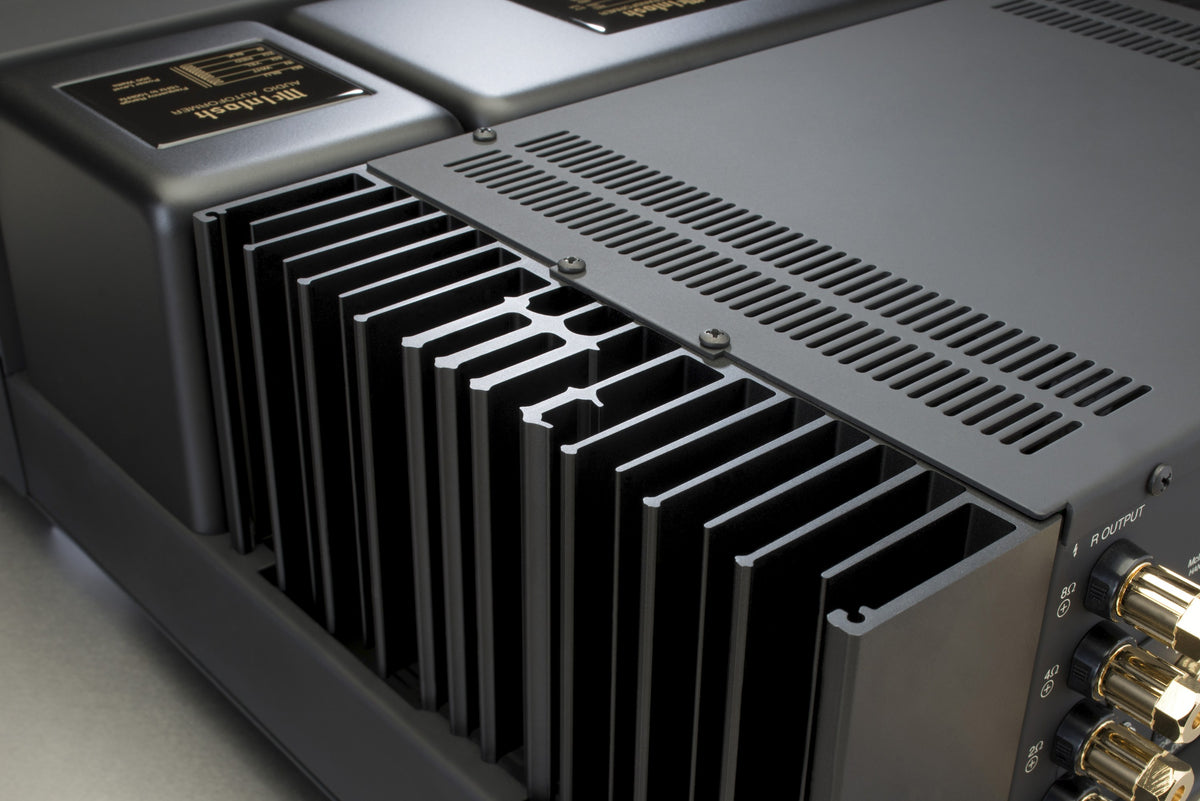
Monogrammed Heatsinks

Heatsinks cast in a highly conductive alloy, with the McIntosh initials formed by their fins, bolted directly to the high-current output transistors so the amplifier reaches and holds its operating temperature without thermal lag. Read the deep diveClose
A McIntosh Monogrammed Heatsink: the company initials are formed by the fins

What it does

An output transistor's behavior changes with temperature, and in a conventional amplifier the devices warm, the heatsink lags, and the bias wanders for the first half hour of listening. McIntosh's Monogrammed Heatsinks connect each bank of output transistors to a large casting of high-thermal-conductivity material, so heat moves out of the device immediately and the whole assembly settles quickly to a stable temperature. The fins are arranged to spell the company's monogram when seen from above, which is why the glass tops of the MC462 and MC611 let you look down on them.

Why it matters in a system

Thermal stability is sound-quality engineering, not decoration. An output stage at a steady temperature keeps its bias, its distortion and its channel match constant from the first track to the last, and runs the transistors well inside their ratings, which is why McIntosh amplifiers are known for decades of service. The heatsinks are also silent: there are no fans in an MC-series amplifier or an MC257 home theater amplifier, so nothing in the rack adds noise to a quiet room.

What you may hear

The first note sounding like the hundredth. A system that does not need to warm up for an hour before it is itself, and no fan noise in the pauses.

Signature technology

Dynamic Power Manager

For McIntosh's direct-coupled multichannel amplifiers: a power-management circuit that delivers each channel's full rated output into 4 or 8 ohm loudspeakers, however many channels are working at once. Read the deep diveClose

What it does

A home theater amplifier is rarely asked for equal power from every channel; a film soundtrack loads the three front channels hard and the surrounds lightly, then reverses. In an amplifier without an Autoformer, McIntosh uses Dynamic Power Manager to allocate the power supply's reserves so that each channel can deliver its rated power into either a 4 or an 8 ohm load, regardless of how many channels are driven. The MC257 is rated at 250 watts for each of its three front channels and 200 watts for each of its seven channels, into 4 or 8 ohms, under those conditions.

Why it matters in a system

Many multichannel amplifiers quote a per-channel figure that holds only with one or two channels driven; the real-world number with all channels working is lower. DPM is McIntosh's way of making the published figure the figure you get, so a seven-channel system built around one MC257 behaves like seven dedicated amplifiers. For a dedicated theater it also means the front three channels can be matched to larger loudspeakers without a second amplifier.

What you may hear

Soundtracks that keep their scale in the loudest scenes, dialogue that stays clear while the surrounds are busy, and no sense of the amplifier running out of breath when every channel is working.

Signature technologySince 1967

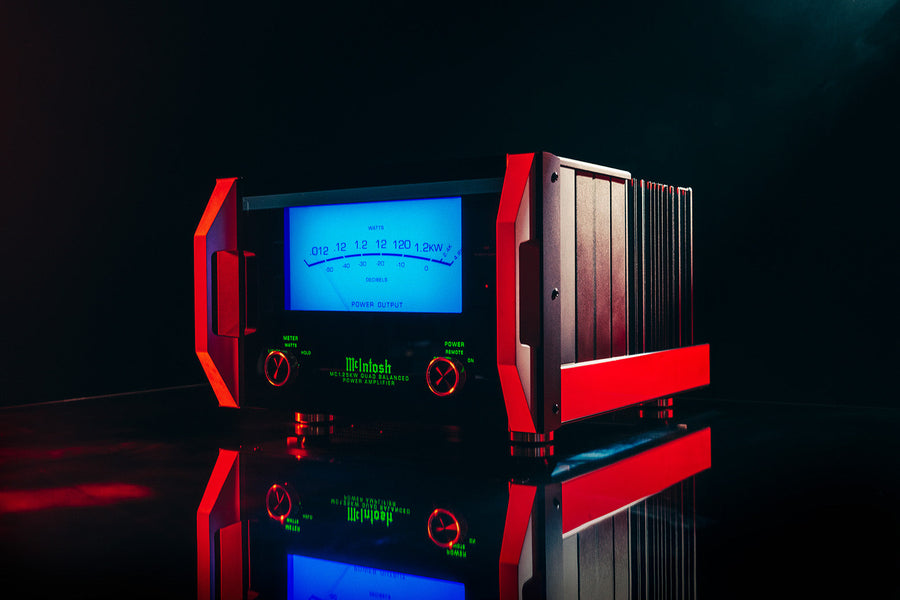
Blue Watt meters

Fast-responding, peak-reading meters that turn the amplifier's output into a visible reference, one per channel, scaled in watts and in decibels relative to rated power, lit McIntosh blue. Read the deep diveClose
Final test in Binghamton: every McIntosh amplifier is checked on the bench, meters included, before it ships

What it does

A McIntosh output meter reads the power the channel is delivering to the loudspeaker. Its face carries a watts scale and a decibel scale referenced to rated output: 0 dB is rated power, -10 dB is one tenth of it, -20 dB one hundredth. The movement is quick; McIntosh specifies that the MC462's meters indicate at least 95 percent of the power of a single cycle of a 2,000 Hz tone burst, fast enough to show a drum strike. A Hold mode on the power amplifiers locks the pointer at the highest peak and lets it fall at roughly 6 dB per minute so the peak can be read. On preamplifiers and the MCD12000 the meters show output level; on the MC257 a TripleView housing carries three mechanical meters for the front channels.

Why it matters in a system

The meters are an instrument before they are an ornament. They show how much of the amplifier a loudspeaker is using, which tells you whether the system has headroom or is living near its limit; they show the recording's balance when the left and right pointers diverge; and they make the dynamic range of a good recording visible, which is a quiet lesson in why power matters. Since the first solid-state McIntosh amplifiers of 1967 they have also been the company's signature, recognized across a room before a note is played, and the reason a McIntosh system has a presence other electronics do not.

What you may hear

Watch the needles rise with an orchestral swell and settle as the music relaxes, then listen for the same thing. Owners find the meters change how they hear dynamics. The blue glow is part of the McIntosh experience; the information is why it has lasted.

Design heritage, since the 1960s

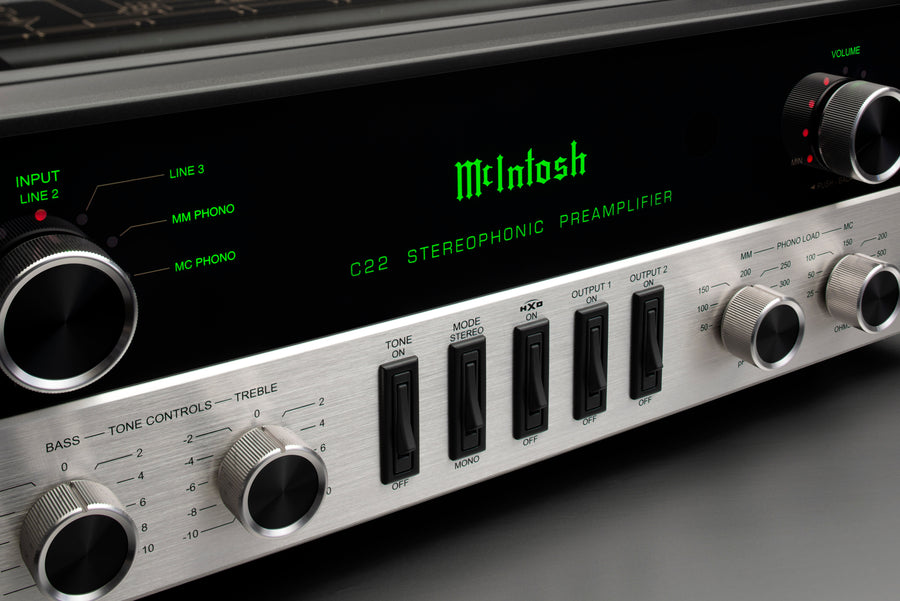
Black glass, gold lettering and the illuminated logo

The front panel is a sheet of glass, lettered from the back in McIntosh's own ink so the markings read gold in daylight and glow teal in a dim room, with the logo lit from behind. It has defined the look of a McIntosh since the 1960s and it is why a sixty-year-old C22 still reads as new. Read the deep diveClose
A McIntosh glass front panel leaving the printer, lettered from the back in the factory in Binghamton

What it does

Most front panels are painted or anodized metal with printed legends that wear. In the 1960s Gordon Gow suggested a different construction: a glass panel, screen-printed on its back face with an ink McIntosh developed itself. Because the lettering is behind the glass it cannot rub off, and because of the ink's pigment the markings read as gold under room light and as teal when lit from behind in a dim room. The lamps, now direct LEDs on current models, also illuminate the McIntosh name and the blue meter faces. Each panel is cut, printed and finished in Binghamton, and McIntosh describes every faceplate as a unique, handmade piece.

Why it matters in a system

Longevity, first: the panel of a 1963 C22 or a 1967 MC2505 looks today as it did when it was made, which is a large part of why McIntosh components hold their value and why a system can be built over decades from components of different ages that match. Coherence, second: a C2800 preamplifier, an MC462 amplifier and a DS200 streamer share the same glass, the same lettering and the same light, so a complete system reads as one instrument. It also places the engineering where you can see it, from the meters to the glass-topped transformer enclosures on the current amplifiers.

What you may hear

Nothing directly; this is the part of the design you see. What it changes is how a system lives in a room: lights low, the panels glowing gold and teal, the meters moving, the equipment itself part of the evening.


Signature technologySince 2017

Hybrid Drive

A vacuum-tube stage for the small signal followed by a solid-state stage for the power: one component, two circuit types, each placed where McIntosh believes its strengths matter. Read the deep diveClose
Output tubes and small-signal tubes glowing in a McIntosh vacuum-tube amplifier

What it does

A music signal and a loudspeaker ask very different things of an amplifier. At the input the signal is small and the job is to select, control level and add voltage gain without burying detail; at the output the job is to deliver the voltage and current a moving loudspeaker demands. Hybrid Drive divides the work. In the MA252, MA352 and MA12000 integrated amplifiers a vacuum-tube preamplifier (12AX7A and 12AT7 tubes) handles the first task and a solid-state power amplifier the second, in sequence and always both. The MA252 and MA352 use direct-coupled output stages; the MA12000 adds Autoformers. In the C12000 preamplifier and MCD12000 player the idea runs in parallel instead: each has both a tube and a solid-state output stage, and you choose which feeds the system.

Why it matters in a system

It is not a switch between a tube sound and a transistor sound, and it is not a tube buffer added for decoration. The tubes work where their harmonic behavior and low-level resolution are most audible, and the transistors work where current, control and durability count, so a hybrid McIntosh can drive a real loudspeaker in a real room while keeping the dimensionality and tonal color people buy tube equipment for. The three integrated amplifiers scale the same idea: the MA252 keeps a system simple, the MA352 adds power, meters and a five-band equalizer, and the MA12000 surrounds it with 350 watts through Autoformers and a full set of analog and digital inputs.

What you may hear

Image depth and an unforced musical flow from the tube stage, with the composure and loudspeaker control of a McIntosh solid-state amplifier. Loudspeakers, source, room and recording still decide most of what you hear; Hybrid Drive describes how the amplifier is built, not a sound preset.

Signature technologySince 2017

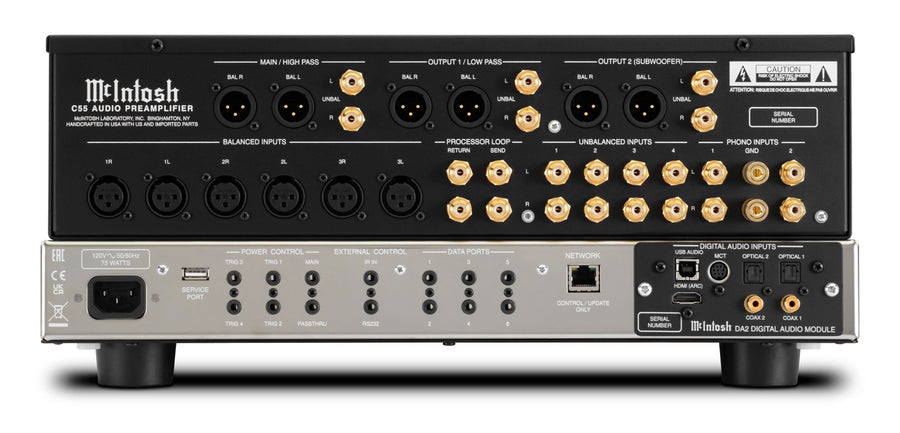
DA2 Digital Audio Module

The digital section of a McIntosh preamplifier or integrated amplifier lives on a replaceable module, so the analog component you buy can keep pace with digital formats; the current DA2 carries an eight-channel, 32-bit Quad Balanced DAC with DSD512 and HDMI ARC. Read the deep diveClose
A McIntosh preamplifier display reporting a 192 kHz HDMI ARC signal through its DA2 digital module

What it does

Digital audio changes faster than a well-built analog amplifier wears out. McIntosh's answer, introduced as the DA1 in 2017, was to put all of a component's digital inputs and its converter on one module that a dealer can replace. The DA2 of 2019 is the second generation: two coaxial and two optical inputs at 24-bit/192 kHz, a USB input for 32-bit/384 kHz PCM, DSD up to DSD512 and DXD, an MCT input for McIntosh SACD/CD transports, and an audio-only HDMI ARC input that lets a television's remote control the volume. At its heart is an eight-channel, 32-bit converter run in Quad Balanced mode, with better dynamic range and lower distortion than the DA1.

Why it matters in a system

A McIntosh C55 or MA9500 is a thirty-year component. The module means its digital section does not have to be. Owners of DA1-equipped components (C49, MA5300 and others) can have the DA2 fitted by an authorized dealer rather than replacing the whole unit, and the next module will slot in the same way. The HDMI ARC input also folds the television into a two-channel system without a separate processor, which is how most people actually use a serious stereo today.

What you may hear

Files and streams at their full resolution through the same analog stage as your records, television sound through the main loudspeakers with the familiar remote, and a component that still sounds current years after purchase.

Signature technology

Twin-laser disc transport and the MCT connection

McIntosh disc players read SACD and CD with a twin-laser pickup, one wavelength for each format, and the MCT output carries the SACD's DSD layer to a McIntosh preamplifier or integrated amplifier over a secure proprietary link. Read the deep diveClose

What it does

A CD is read with a 790 nm laser and an SACD with a 650 nm laser; McIntosh players carry both in one twin-beam pickup rather than compromising on a single wavelength, read the disc at double speed and buffer the data for error correction and tracking. The disc sits in a die-cast aluminum tray. SACD's copy protection forbids its DSD layer from leaving a player over an ordinary digital output, which is why most SACD players convert to analog internally. McIntosh's MCT connection solves that: the MCT500 transport passes DSD128 for SACD (and 24-bit/96 kHz for CD) over a dedicated cable to the MCT input on a McIntosh preamplifier, integrated amplifier or the DS200, where the Quad Balanced DAC does the conversion.

Why it matters in a system

For an owner with a shelf of SACDs the MCT link means one converter for every source, in the component that already has it, and a transport that will outlast several generations of DAC. The MCD600 and MCD12000 players take the other route, with their own Quad Balanced converters, digital inputs for a streamer or server, and in the MCD12000 selectable tube and solid-state output stages. Either way the disc remains a first-class source in a McIntosh system rather than a legacy one.

What you may hear

SACD at its native resolution through the same converter as your files, quiet, stable playback from a heavy transport, and a player that does not need replacing when the rest of the system moves on.

Signature technologySince 2014

Headphone Crossfeed Director (HXD)

A switchable circuit that feeds a controlled, time-shaped portion of each channel to the opposite ear, restoring to headphones some of the spatial character of listening to loudspeakers. Read the deep diveClose

What it does

With loudspeakers each ear hears both channels, the far one slightly later and softer, and the brain builds a stage in front of you from those differences. Headphones remove that: the left ear hears only the left channel. HXD adds a measured amount of the opposite channel to each earpiece, filtered and delayed to mimic what the far loudspeaker would have contributed, so instruments mixed hard to one side stop sitting inside the earcup and take a place in a shared space. It is switchable, so you can compare with it in and out.

Why it matters in a system

Headphone listening is where a preamplifier or integrated amplifier gets used late at night, and HXD is why a McIntosh C2800 or MA9500 is a complete headphone system rather than a jack on the back. It works with the High Drive headphone amplifier, which has the gain and current for demanding headphones, so a serious pair of planars or high-impedance dynamics needs no separate amplifier. The effect depends on the recording and the headphones; McIntosh leaves the choice to you.

What you may hear

Compare a familiar stereo recording with HXD on and off. Listen for a more cohesive sense of placement, less of the hole in the middle of the head, and instruments panned far left or right that feel connected to the rest of the band.

Signature technology

High Drive headphone amplifier

A dedicated headphone amplifier stage with the gain and current to drive demanding headphones from the quarter-inch jack of a McIntosh preamplifier, integrated amplifier or player. Read the deep diveClose

What it does

A headphone jack on most electronics is an afterthought: a resistor off the main output or a small op-amp with little current behind it, fine for efficient earbuds and short of breath with anything else. McIntosh's High Drive section is an amplifier designed for the job, with increased gain and output power compared with a conventional headphone output, and a low output impedance (47 ohms on the MCD600) so that the headphone, not the amplifier, sets the frequency balance. On most components it is paired with the Headphone Crossfeed Director.

Why it matters in a system

Planar-magnetic and high-impedance dynamic headphones need voltage swing and current that a passive jack cannot supply; underdriven, they sound thin and compressed. High Drive lets a C55, an MA8950 or a C8 double as a headphone system of real quality without a separate box, cable and power supply, which keeps the rack simple and the late-night listening serious. The MHA200, McIntosh's tube headphone amplifier, is the dedicated alternative when headphones are the main event.

What you may hear

Fuller bass and more dynamic range from difficult headphones, a sense of ease at volume, and the same tonal character as the loudspeaker system the component drives.

System integration

Home Theater PassThru

A fixed-gain input that lets a McIntosh two-channel preamplifier or integrated amplifier sit inside a surround system: the processor drives the front channels through the McIntosh at unity gain, and the two-channel system stays untouched for music. Read the deep diveClose

What it does

Mixing a serious stereo system with a home theater usually means compromising one of them. Home Theater PassThru assigns one input of the McIntosh preamplifier or integrated amplifier to the surround processor's front left and right outputs and passes it at a fixed level, so the processor's own volume control and calibration govern the front loudspeakers during a film. Select any other input and the McIntosh is a pure two-channel preamplifier again, with the processor out of the signal path. On the C55 and C2800 a Processor Loop adds a send and return for an external processor or equalizer.

Why it matters in a system

It lets one pair of main loudspeakers and one McIntosh amplifier serve both music and film without re-cabling or re-calibrating, which is how a C2800 and MC462 can anchor a theater built on an MX124 processor while remaining a reference stereo system at night. For a client building in stages it also means the stereo system can be bought first and the theater added later around it.

What you may hear

Film soundtracks through the main loudspeakers at the processor's calibrated level, and your records through the same loudspeakers with nothing from the theater in the way.

System integration

Power Control

A low-voltage control link between McIntosh components: switch the preamplifier on and the amplifier, player, turntable and streamer wake with it, with their meter lighting following along. Read the deep diveClose

What it does

Every McIntosh component carries Power Control jacks. A three-conductor cable runs from the preamplifier's POWER CONTROL MAIN (or a Trigger output) to the POWER CONTROL IN of the next component, and on down the chain; the power command and the meter-illumination command travel on that one cable. On a power amplifier a rear switch sets the behavior: REMOTE follows the preamplifier, ON keeps the amplifier on regardless, OFF keeps it off. The C55 and C2800 provide a Main output and four Trigger outputs so a complex system, or a second zone, can be sequenced; Data ports and IR inputs carry the remote-control commands alongside.

Why it matters in a system

A separates system is only as pleasant to live with as its first thirty seconds. Power Control turns a rack of McIntosh components into one instrument that comes to life from a single button and shuts down the same way, with the amplifiers' lighting switching with the rest. It also lets the Eco power-management feature on current amplifiers be used safely: an amplifier that has switched itself off after a period of silence returns the moment the preamplifier wakes it. The matching McIntosh Power Control Cables are available in several factory lengths; Pearl Audio can specify the right ones for your rack.

What you may hear

Nothing, by design; Power Control carries commands, not audio. What you notice is a system that behaves as one component, and meters that light together.

Signature technology

Solid Cinch speaker binding posts

Patented, gold-plated loudspeaker terminals whose clamping barrel presses straight down on the spade lug without turning it, so a heavy cable stays exactly where you set it and cannot work loose. Read the deep diveClose
Gold-plated Solid Cinch speaker binding posts on the rear panel of a McIntosh integrated amplifier

What it does

On an ordinary binding post the nut that tightens the connection also rotates against the spade lug, dragging it round, twisting a stiff cable and, over time, loosening under its own torque. Solid Cinch separates the two motions. Only the top turns; a separate clamping barrel moves straight down and presses the spade flat against the gold-plated contact surface. The lug stays at the angle you chose, neighboring connections stay clear of one another, and the contact is metal to metal under real pressure. On the MC611 each impedance tap has its own set of posts, spaced for cable management.

Why it matters in a system

The loudspeaker connection carries the most current in the system and is the one most often made badly. A spade that has crept round a post can touch its neighbor, and a short at the output of a 600-watt amplifier is exactly what Sentry Monitor exists to catch; Solid Cinch is the reason it rarely has to. With the large-gauge, stiff cables used in a serious system, the ability to clamp hard while keeping the cable straight is the difference between a connection you make once and one you check every month.

What you may hear

Nothing you would attribute to a terminal, which is the aim. You notice it with the cables in your hands: a large spade stays perfectly aligned as you tighten, and the connection does not change.

Loudspeaker technologySince 1980

XRT line array loudspeakers

A tall column of small drivers that radiates as a line rather than a point, so the sound field is even across the room and the stereo image holds from almost every seat; a McIntosh idea since the XRT20 of 1980. Read the deep diveClose
The driver column of a McIntosh XRT line-array loudspeaker, seen without its grille

What it does

A single tweeter radiates in a widening sphere, so its level falls quickly with distance and its tonal balance changes as you move. A line array of many identical small drivers, stacked floor to ceiling height, radiates a cylindrical wavefront: level falls more slowly with distance, less energy goes to the floor and ceiling, and the balance stays constant across the width of the room. McIntosh's XRT2.1K carries 81 drivers per loudspeaker: six 8-inch woofers and two 6.5-inch low-midrange drivers in an aluminum bass cabinet, and an array of 28 two-inch aluminum-magnesium upper-midrange domes and 45 three-quarter-inch tweeters with neodymium magnets, suspended from the bass cabinet on steel spiders. The XRT1.1K uses 70 drivers and the XCS1.5K center channel 43.

Why it matters in a system

Most reference loudspeakers have one good seat. A line array has a row of them, which suits a large room, a long sofa or a family that listens together, and its 90 dB sensitivity with an 8-ohm load and a 2,000-watt rating means it can use everything an MC1.25KW or a pair of MC611s can give. Tri-wire and tri-amp terminals let the bass cabinet and array be driven separately. It is also the loudspeaker McIntosh voices its own electronics with: the XRT and XCS models are built to be heard together as a theater or a two-channel reference.

What you may hear

A stereo image that does not collapse when you stand up or move to the other end of the sofa, treble that stays smooth at high level, and bass from 12 Hz that fills a large room without strain.

Made in the USASince 1951

Handcrafted in Binghamton, New York

McIntosh electronics are designed, built and tested at 2 Chambers Street in Binghamton, New York, where the company has been since 1951 and where its transformers are still wound by hand. Read the deep diveClose
The McIntosh factory at 2 Chambers Street, Binghamton, New York, from the air

What it does

McIntosh moved from Silver Spring, Maryland, to Binghamton in 1951 and built its present factory at 2 Chambers Street in 1956. The company still makes the parts that matter most to its sound on the premises. Output transformers and Autoformers are hand-wound and potted in the building; the glass front panels are cut, screen-printed and finished there; circuit boards are populated on the company's own surface-mount line, up to 7,000 boards a month, with temperature-sensitive and large components placed by hand, and every board is tested individually before it goes into a chassis. Every finished component goes through a bench test before it leaves.

Why it matters in a system

Keeping engineering, winding, assembly and test under one roof is how a company controls the consistency that lets a 1961 circuit and a 2026 amplifier sound like relatives. It is also what makes long-term service real: McIntosh maintains documentation and parts for decades of production, and a component bought today can go back to the people who built it. For an owner this is the practical meaning of heritage, a system that can be repaired, updated and handed on.

What you may hear

Consistency between units and across years, and the quiet confidence of equipment that was measured before it shipped. The glass-topped transformer enclosures on the current amplifiers let you see the work.

Search