
← Back to your LP12 build

Pearl Reference

McIntosh · Hybrid Integrated Amplifier

McIntosh MA12000 Integrated Amplifier

$17,500

Signature technologiesThe McIntosh story

On demonstrationIn stock

On the floor at our Portland showroom. Ask and we will set it up for you to hear. New and sealed units are in stock.

McIntosh · Hybrid Integrated Amplifier

The MA12000 is McIntosh's most powerful integrated amplifier: a four-tube preamplifier ahead of a 350-watt solid-state Autoformer output stage, with 17 inputs, two adjustable phono stages and an eight-band equalizer in one 108-pound chassis.

Hybrid Drive: vacuum-tube preamplifier, solid-state Autoformer power amplifier. DA2 module and remote included.

350 W
per channel into 2, 4 or 8 Ω
4 tubes
12AX7A, two per channel, in the preamplifier
17 inputs
10 analog, 7 digital
108 lb
48.9 kg; 17½ in wide, 9 7/16 in high

Authorized McIntosh Labs dealer · Advice and support from Pearl Audio · Trade-ins welcome

The story

The MA12000 combines the two things McIntosh is known for in one chassis. Introduced in 2021 as the company's most powerful integrated amplifier, it runs four 12AX7A tubes, two per channel, in the preamplifier stage under a glass top, and a solid-state power amplifier rated at 350 watts per channel into 2, 4 or 8 ohms through McIntosh Autoformers. The power supply carries twice the filter capacity of the company's other integrateds, a reserve aimed at low-frequency control and the dynamic swings that large loudspeakers demand; distortion is rated at 0.03 percent for the tube stage and 0.005 percent for the power amplifier, and the power amplifier input reaches 114 dB signal-to-noise.

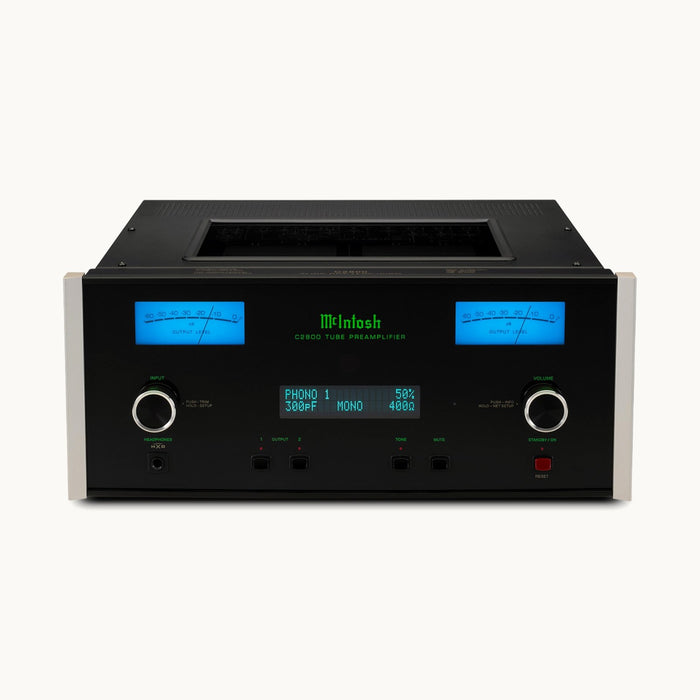
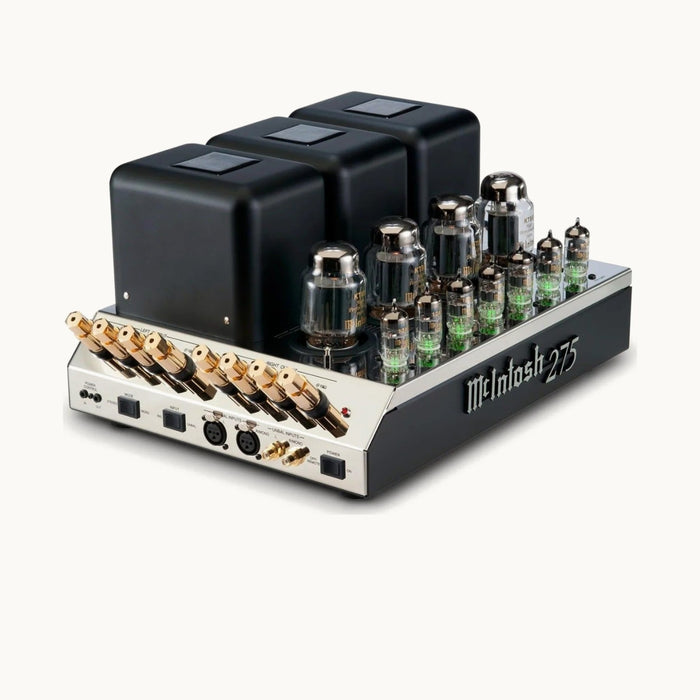
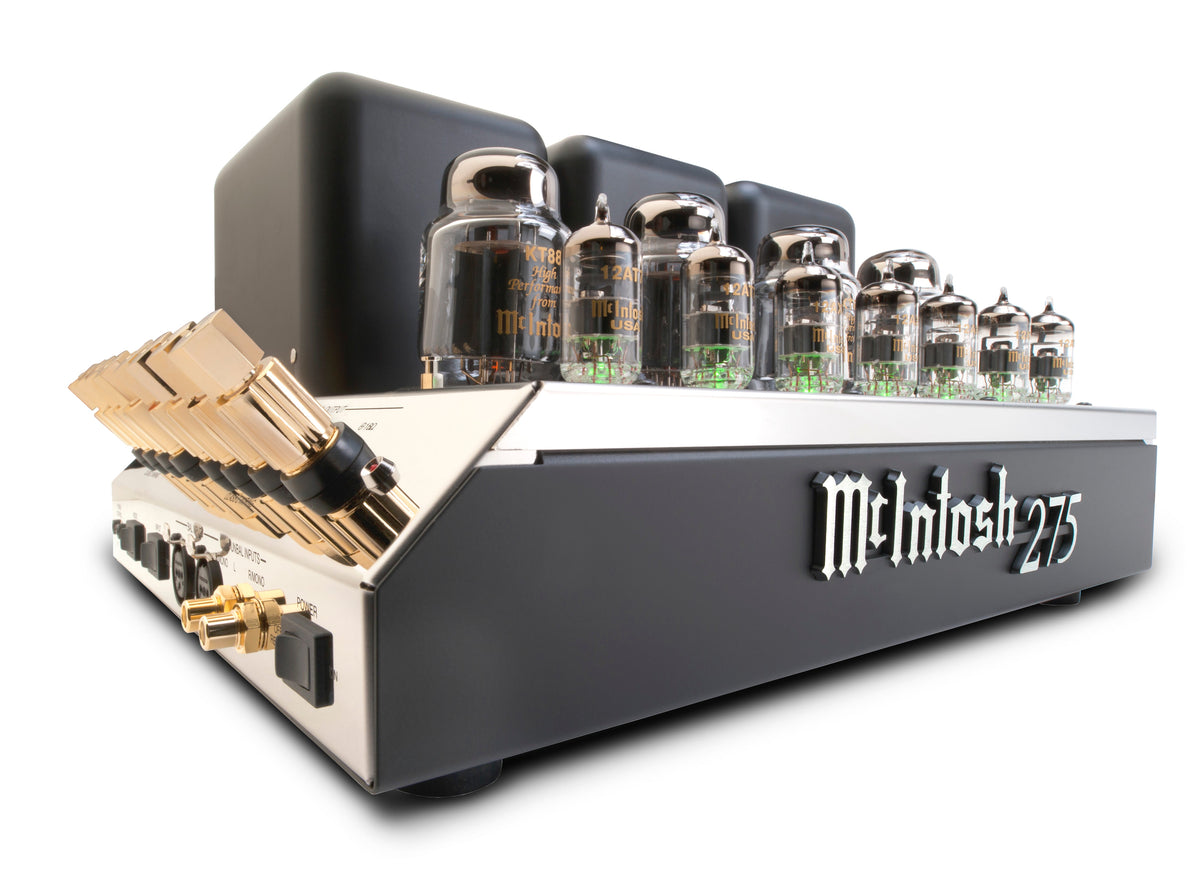
The division of labor is the point of the design. The tubes sit at the front of the signal path where source selection and volume take place and where their character shapes the signal; the transistor output stage behind them supplies the current and damping that reactive loudspeakers need, and the Autoformer isolates it from the load so the full rating is available at every tap. It is not an all-tube amplifier and does not use large output tubes like an MC275; it is a tube preamplifier and a big solid-state amplifier, closer in concept to a C2800 with an MC312 than to anything with KT88s.

The input count matches the ambition. Ten analog inputs include two balanced, six unbalanced and separate moving-coil and moving-magnet phono inputs: the moving-coil input selects 50, 100, 200, 400 or 1,000 ohms, and the moving-magnet input is fixed at 47 kΩ with capacitance adjustable from 50 to 400 pF in 50 pF steps, all from the Phono Trim controls, so two turntables or two tonearms stay connected and properly loaded. The factory-installed DA2 module adds two coaxial and two optical inputs, USB to 32-bit/384 kHz PCM, DXD and DSD512, an MCT input for CD and SACD audio from a McIntosh transport, and HDMI ARC, which folds Dolby and DTS television sound to stereo, offers separate CEC settings for volume and power, and adds a manual audio delay of 0 to 150 milliseconds for a stubborn video chain.

An eight-band analog equalizer, bypassable per input, Home Theater PassThru with a trigger input, balanced and unbalanced variable outputs, a fixed output and a High Drive headphone output with HXD give it the control set of a separate preamplifier. Output 2 carries balanced connections and its own 12-volt trigger, so the MA12000 can later run a second power amplifier or a second system while remaining the source selector, phono stage, DAC and volume control. The headphone output is specified for 100 to 600 ohm headphones. StereoNET gave the MA12000 an Applause Award in June 2021 and Haute Fidélité its Reference Award the same summer.

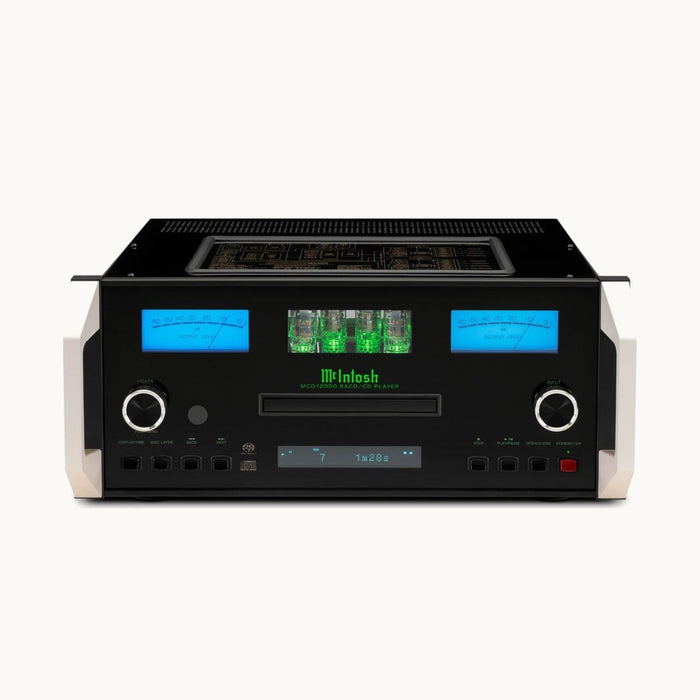
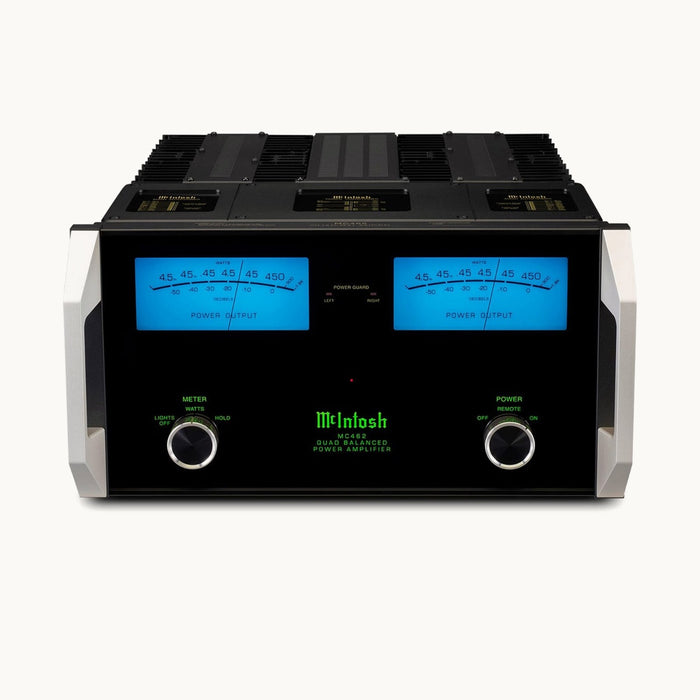
At 108 pounds the MA12000 wants a rigid, level surface with real load capacity, and McIntosh specifies 6 inches of clearance above it, 2 inches below and at each side, and 20 inches of depth behind the front panel in a custom cabinet; it should not sit directly above another heat-producing component. It is the integrated to choose when you want tube warmth in the preamplifier and solid-state reserve behind it without going to separates, and it has the composure for substantial loudspeakers: Pearl Audio pairs it with the Bowers & Wilkins 802 D5 and Sonus faber Amati Supreme, with the MCD12000 SACD/CD player and MT10 turntable, which were designed alongside it. For the same money in separates, see the C2800 tube preamplifier with an MC312 or MC462.

McIntosh MA12000 Lifestyle

Key technologies

  • Hybrid Drive. Four 12AX7A tubes, two per channel, in the preamplifier stage where source selection and volume take place; a solid-state Autoformer power amplifier behind them.
  • Autoformer output. McIntosh's output transformer delivers the full 350 W per channel into 2, 4 or 8 Ω and isolates the output transistors from the loudspeaker's reactive load.
  • Doubled filter capacity. Twice the power-supply storage of McIntosh's other integrated amplifiers, for low-frequency control and dynamic reserve.
  • DA2 Digital Audio Module. Eight-channel 32-bit/384 kHz Quad Balanced DAC with seven inputs including HDMI ARC and MCT, replaceable in future.
  • Two adjustable phono inputs. Moving coil selectable at 50, 100, 200, 400 or 1,000 Ω; moving magnet at 47 kΩ with 50 – 400 pF capacitance in 50 pF steps, set from the Phono Trim controls.
  • Eight-band analog equalizer. Bypassable per input; a small correction for a room or a recording without touching the rest of the band.
  • Power Guard and Sentry Monitor. Real-time anti-clipping and fuseless short-circuit protection.
  • Output 2 with trigger. Balanced and unbalanced variable outputs with a 12 V trigger, so an external amplifier or a second system follows the MA12000's power and volume.
Specifications
Type Stereo integrated amplifier, tube preamplifier with solid-state Autoformer power amplifier (Hybrid Drive)
Power output 350 W per channel into 2, 4 or 8 Ω (FTC rating 350 W), 20 Hz – 20 kHz
Total harmonic distortion 0.03% preamplifier; 0.005% power amplifier
Dynamic headroom 1.5 dB
Frequency response 20 Hz – 20 kHz, +0/−0.5 dB; 10 Hz – 100 kHz, +0/−3 dB
Signal-to-noise ratio 95 dB high level; 75 dB moving coil; 77 dB moving magnet; 114 dB power amplifier input
Sensitivity 600 mV balanced / 300 mV unbalanced (high level); 0.30 mV MC; 3.0 mV MM; 1.7 V power amplifier input
Input impedance 44 kΩ balanced / 22 kΩ unbalanced; MC 50, 100, 200, 400 or 1,000 Ω; MM 47 kΩ, 50 – 400 pF
Damping factor >40
Maximum output 16 V balanced; 8 V unbalanced
Tubes Four 12AX7A (preamplifier)
Analog inputs 2 balanced, 6 unbalanced, 1 moving-coil and 1 moving-magnet phono (both adjustable loading)
Digital inputs 2 coaxial and 2 optical (24-bit, 44.1 – 192 kHz); 1 USB (32-bit, 44.1 – 384 kHz PCM; DSD64 – DSD512; DXD 352.8 and 384 kHz); 1 MCT (CD and SACD DSD64); 1 HDMI ARC (audio only, 0 – 150 ms delay adjustment)
DAC DA2 Digital Audio Module, 8-channel 32-bit/384 kHz Quad Balanced, factory installed, replaceable
Outputs Solid Cinch gold-plated binding posts (2, 4, 8 Ω); 1 balanced variable, 1 unbalanced variable, 1 unbalanced fixed; ¼ in High Drive headphone output with HXD (100 – 600 Ω headphones)
Equalizer 8-band analog, bypass and input assign
Meters Two peak-responding blue watt meters
Control Home Theater PassThru; input level match; RS232; Power Control 1 main and 2 trigger; 4 data ports; IR sensor input; HDMI CEC; remote included
Chassis Dual-layer, polished stainless steel and black painted steel; McIntosh Monogrammed Heatsinks
Power requirement 120 V, 50/60 Hz, 6.6 A; standby under 0.25 W
Dimensions (W × H × D) 17½ × 9 7/16 × 19¾ in (44.5 × 24 × 50.2 cm)
Weight 108 lb (48.9 kg); shipping 141 lb (63.9 kg)
Ventilation McIntosh specifies 6 in above, 2 in below and at each side, and 20 in of depth behind the front panel in a cabinet
Warranty 3-year limited (McIntosh USA)

McIntosh MA12000 product page and specifications · Owner's manual (PDF) · Brochure (PDF)

Where it sits in the range

McIntosh's integrated amplifiers, from the 12-inch MA252 to the 350-watt MA12000.

  • McIntosh MA252: hybrid, four preamplifier tubes and 100 W direct-coupled solid-state output, 12 in wide, $5,000
  • McIntosh MA352: hybrid, four preamplifier tubes and 200 W direct-coupled output, all analog, five-band equalizer, $8,000
  • McIntosh MSA5500: 100 W direct coupled with network streaming, DAC and HDMI ARC built in, $8,000
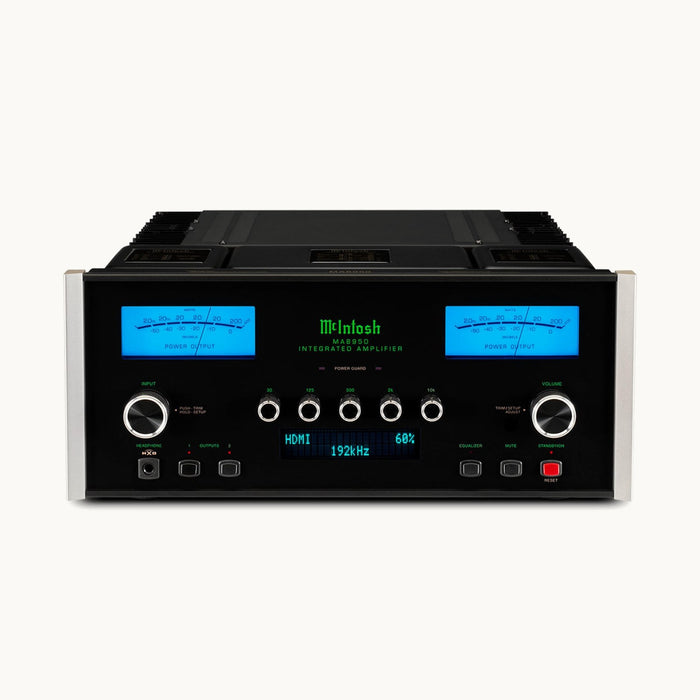
  • McIntosh MA8950: 200 W through Autoformers, two phono inputs, DA2 digital module, five-band equalizer, $10,500
  • McIntosh MA9500: 300 W through Autoformers, two adjustable phono inputs, DA2 module, eight-band equalizer, $14,000
  • McIntosh MA2375: all tube, 75 W from four KT88s through Unity Coupled transformers, configurable phono, $15,000
  • McIntosh MA12000 (this model): hybrid, four-tube preamplifier and 350 W Autoformer output, 17 inputs, eight-band equalizer, $17,500

The MCD12000 SACD/CD player and MT10 turntable were designed alongside it; in separates, the C2800 and MC462 are the closest equivalent.

Reviews

McIntosh purchases are completed in store or by phone or email after a consultation; ask us about delivery and installation. McIntosh products are not available for carrier shipment.

Plan your McIntosh system with Pearl Audio

Pearl Audio is an authorized McIntosh dealer. We will plan support and ventilation for it, select the loudspeaker tap, set both phono inputs for your cartridges, and arrange a listening appointment in our Portland showroom. Call (503) 222-2599 or email sales@pearlaudio.com.

Signature technologies

The engineering behind the McIntosh MA12000 Integrated Amplifier

McIntosh gives its technologies names because each one solves a specific problem. Here is what each does, where it came from, why it matters in a system, and what you may hear.

Signature technologySince 1967

Autoformer output

A single-winding output transformer between the transistors and the loudspeaker, so a McIntosh solid-state amplifier delivers its full rated power into 2, 4 or 8 ohm loads and the output devices always see the load they were designed for. Read the deep diveClose
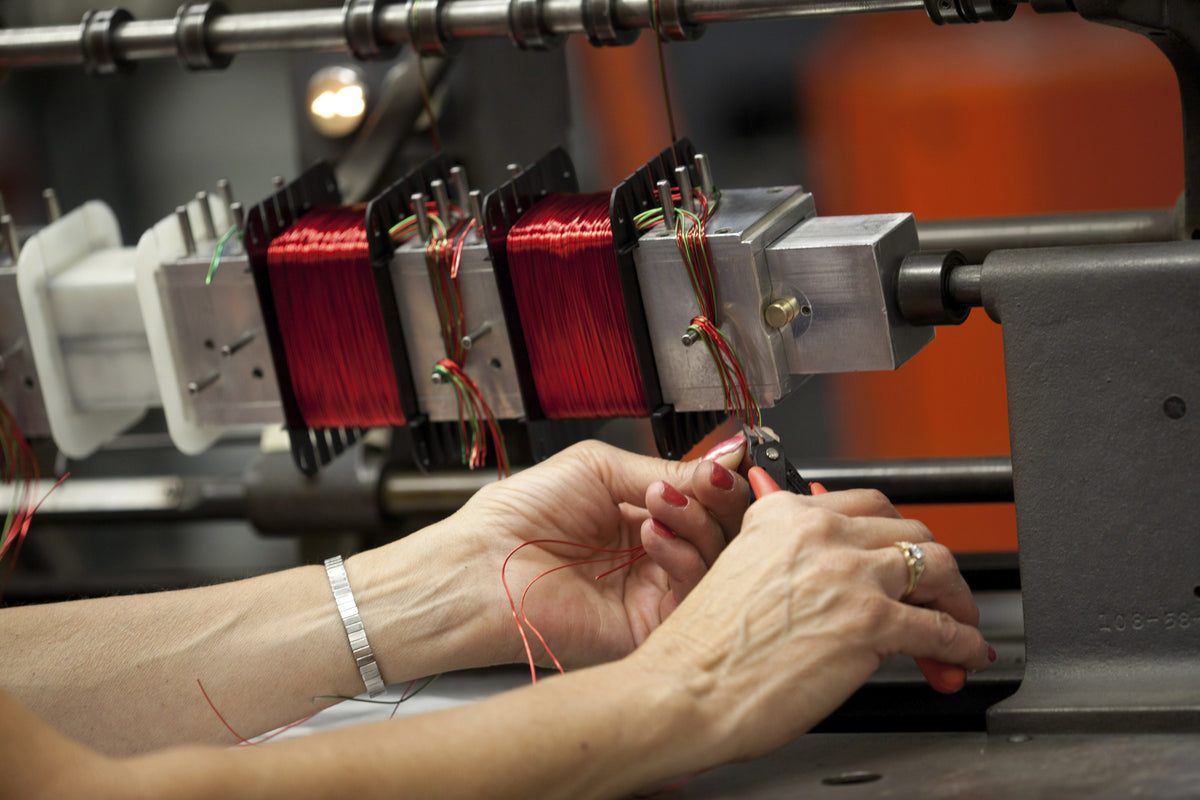
Winding an Autoformer coil by hand at McIntosh in Binghamton, New York

What it does

Most solid-state amplifiers connect the output transistors directly to the loudspeaker, which means the amplifier's power, distortion and heat all change with the loudspeaker's impedance: typically more power into 4 ohms than 8, and strain into 2. McIntosh instead passes the output through an Autoformer, its name for an autotransformer wound in Binghamton, with taps for 2, 4 and 8 ohms. The transistors work into one optimized load regardless of the loudspeaker connected, and the Autoformer transforms current and voltage to suit the tap in use. It also isolates the loudspeaker from DC, so a fault in the amplifier cannot push direct current into a woofer.

Why it matters in a system

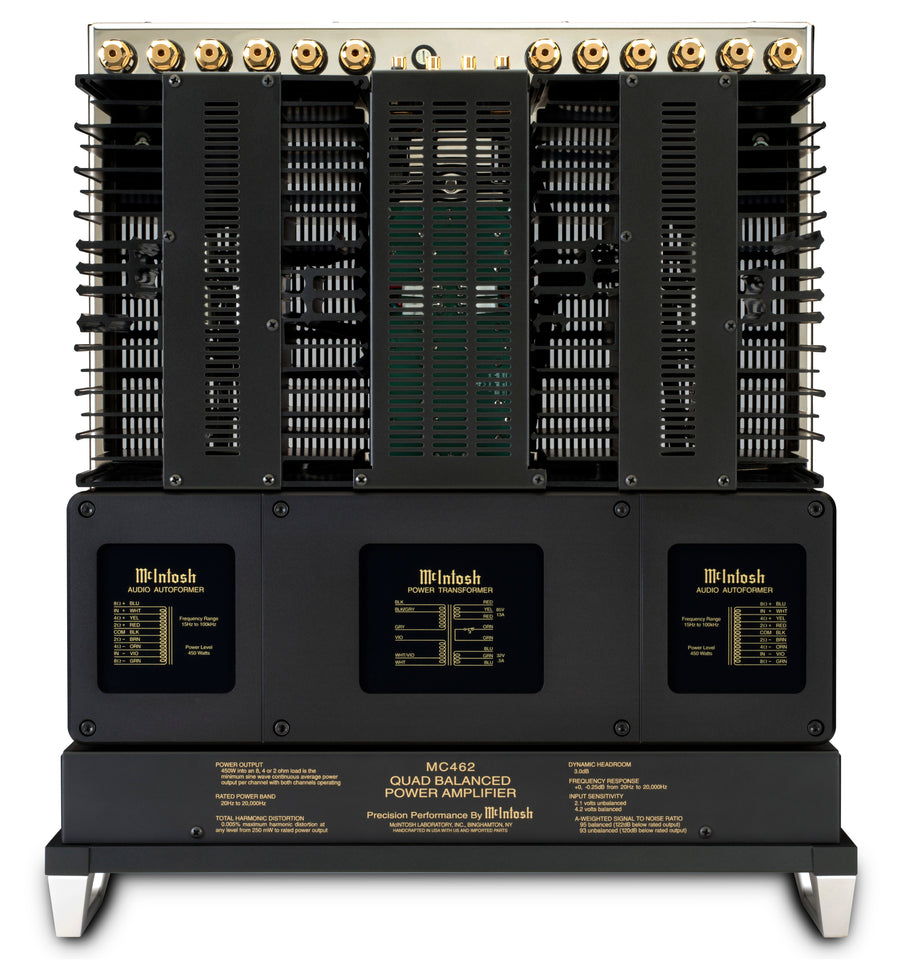
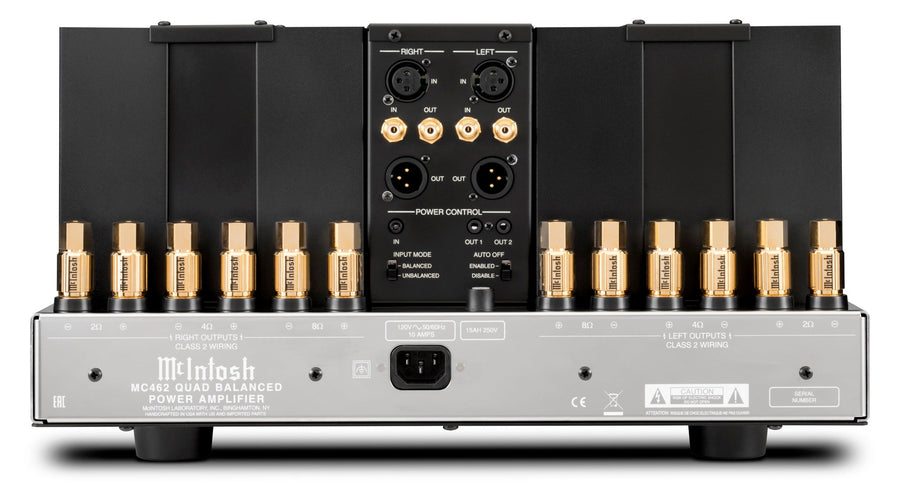
An amplifier whose output stage sees the same load every time is an amplifier whose character does not depend on the loudspeaker. The MC462 is rated at the same 450 watts per channel into 2, 4 and 8 ohms, and the MC1.25KW at 1,200 watts into all three, so a difficult load such as a large electrostatic or a four-ohm floorstander with a punishing impedance dip gets the full amplifier rather than a stressed one. In a system built around a McIntosh amplifier the loudspeaker choice opens up, and the amplifier runs cooler and longer because its transistors are never asked to work outside their design window.

What you may hear

Bass that stays the same weight and definition when you change loudspeakers, dynamics that do not compress into difficult loads, and a quiet composure at high volume. The Autoformer is also the reason a McIntosh amplifier can safely drive an unusual impedance that would trip a conventional design into protection.

Signature technologySince 1977

Power Guard

A comparator that watches the amplifier's input and output waveforms and eases the input drive, in real time, the moment the output begins to clip. Read the deep diveClose

What it does

Every amplifier has a point at which it runs out of clean output and the peaks of the waveform flatten. Power Guard compares the shape of the input signal with the shape of the output signal. The two match until the amplifier reaches its limit; when they diverge, the circuit drives a photo-optical attenuator at the input and reduces the drive just enough to keep the output within its clean range. It acts only when needed and only for as long as the overload lasts, and it does not add power: a 450-watt amplifier remains a 450-watt amplifier.

Why it matters in a system

Hard clipping produces harmonics that sound harsh and, sustained, can burn out tweeters; it is the most common way a good system is damaged at a party. Power Guard lets a McIntosh amplifier be driven to its limit without that risk, which matters most with low-sensitivity loudspeakers, large rooms and recordings with wide dynamic range. In a home theater it means a seven-channel MC257 or a Class D MI-series amplifier can be run hard on a film soundtrack without harm. Two amber indicators show when the circuit is working; if you see them often, the system needs more amplifier, not more volume.

What you may hear

Demanding peaks that stay musical instead of turning hard, and the confidence to listen at realistic levels. Most owners never see Power Guard act, which is the point. On the MA252 and MA352 the small-signal tubes flash amber when it does.

Signature technologySince 1967

Sentry Monitor

Fuseless protection that watches the output current and disengages the output stage before the current can reach a damaging level, then resets itself when the fault clears. Read the deep diveClose

What it does

A shorted loudspeaker cable, a failed driver or a brutal passage into a very low impedance can ask an output stage for more current than its devices can survive. Sentry Monitor measures the output current continuously and, at the threshold McIntosh sets for each model, disconnects the output stage in a fraction of a second. There is no fuse in the signal path to replace and nothing to degrade the sound; when the condition returns to normal the circuit re-engages on its own. On the tube amplifiers the small-signal tubes flash red when it has acted.

Why it matters in a system

Output protection is usually a fuse (slow, and audible as a resistance in the signal path) or a relay that trips late. Sentry Monitor is neither, and it has been on every McIntosh solid-state amplifier since the company's first transistor designs, which is one reason McIntosh amplifiers from the 1970s are still in daily use. In a system it is the insurance that lets you run long speaker cables, bi-wire, or drive a demanding loudspeaker without worrying about the one bad connection that ends an evening.

What you may hear

Nothing, unless something is wrong. If playback stops and the indicators show a fault, correct the cause, follow the reset instructions in the owner's manual for your model, and the amplifier is back. There is no fuse to find.

Signature technologySince 2000

Quad Balanced

Two complete balanced push-pull amplifiers per channel, combined at the Autoformer so that noise and distortion common to both cancel; the same principle runs McIntosh's eight-channel DAC in Quad Balanced mode. Read the deep diveClose
A rack of finished Autoformers, wound and wired in the McIntosh factory in Binghamton, New York

What it does

In a Quad Balanced McIntosh power amplifier each channel contains two matched, fully balanced amplifiers. Each handles half of the push-pull waveform and their outputs are summed in the Autoformer. Noise and distortion products that appear identically in both halves are common-mode and cancel in the summation, while the music, which is differential, adds. The idea scales down to digital: the DA2 Digital Audio Module's eight-channel, 32-bit converter runs four converter channels per stereo channel in Quad Balanced mode, averaging their output so random converter noise falls and the signal stays.

Why it matters in a system

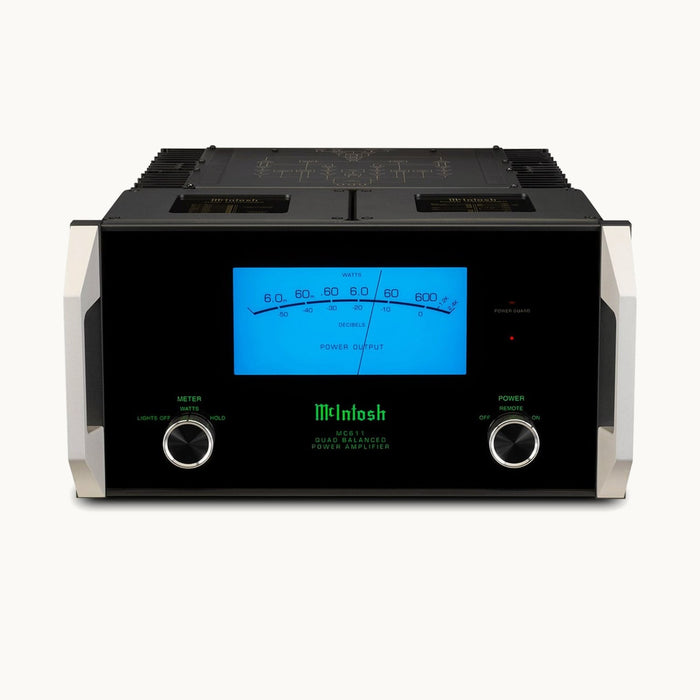
A big amplifier is only as good as its noise floor, and 1,200 watts of headroom is worth little if the background hisses. The MC1.25KW's 124 dB signal-to-noise ratio and the MC611's 124 dB are the measurable results of the architecture, and they are why these amplifiers can drive very sensitive loudspeakers, or horns, without audible hum or hiss. On the digital side the Quad Balanced DAC is what lets McIntosh preamplifiers, integrated amplifiers and the DS200 streamer take a 32-bit/384 kHz or DSD512 file and deliver it with a 100 dB or better dynamic range.

What you may hear

A black background behind quiet passages, instruments that emerge from silence rather than from a faint haze, and the same calm at high volume as at low. In digital sources, a smoothness that does not blur detail.

Signature technology

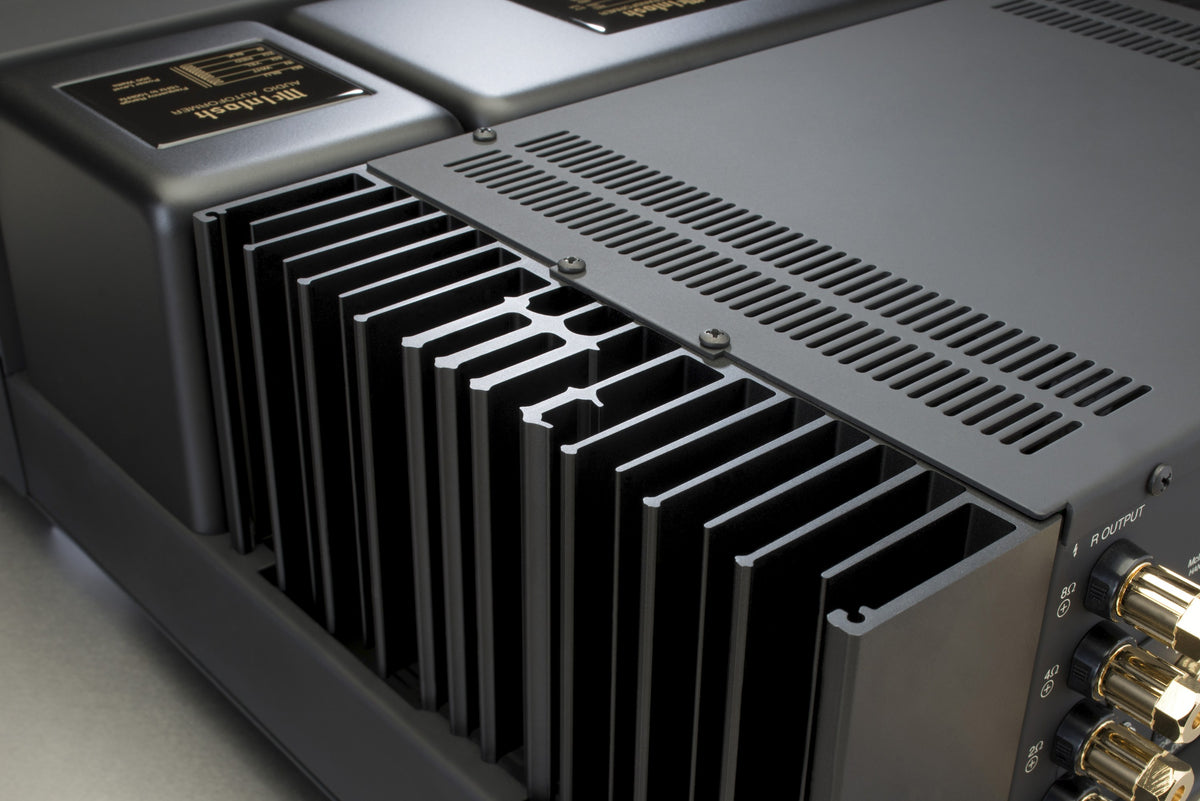
Monogrammed Heatsinks

Heatsinks cast in a highly conductive alloy, with the McIntosh initials formed by their fins, bolted directly to the high-current output transistors so the amplifier reaches and holds its operating temperature without thermal lag. Read the deep diveClose
A McIntosh Monogrammed Heatsink: the company initials are formed by the fins

What it does

An output transistor's behavior changes with temperature, and in a conventional amplifier the devices warm, the heatsink lags, and the bias wanders for the first half hour of listening. McIntosh's Monogrammed Heatsinks connect each bank of output transistors to a large casting of high-thermal-conductivity material, so heat moves out of the device immediately and the whole assembly settles quickly to a stable temperature. The fins are arranged to spell the company's monogram when seen from above, which is why the glass tops of the MC462 and MC611 let you look down on them.

Why it matters in a system

Thermal stability is sound-quality engineering, not decoration. An output stage at a steady temperature keeps its bias, its distortion and its channel match constant from the first track to the last, and runs the transistors well inside their ratings, which is why McIntosh amplifiers are known for decades of service. The heatsinks are also silent: there are no fans in an MC-series amplifier or an MC257 home theater amplifier, so nothing in the rack adds noise to a quiet room.

What you may hear

The first note sounding like the hundredth. A system that does not need to warm up for an hour before it is itself, and no fan noise in the pauses.

Signature technologySince 1967

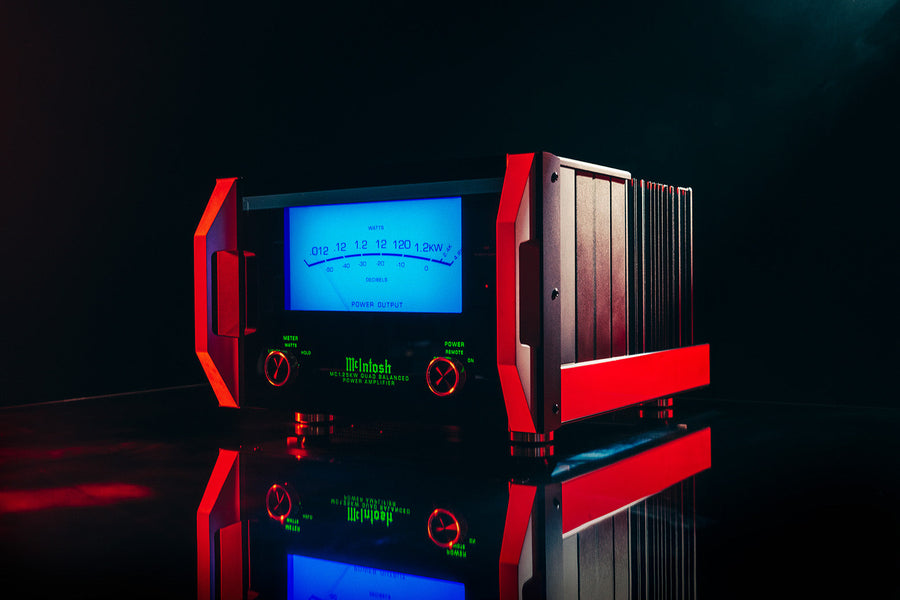
Blue Watt meters

Fast-responding, peak-reading meters that turn the amplifier's output into a visible reference, one per channel, scaled in watts and in decibels relative to rated power, lit McIntosh blue. Read the deep diveClose
Final test in Binghamton: every McIntosh amplifier is checked on the bench, meters included, before it ships

What it does

A McIntosh output meter reads the power the channel is delivering to the loudspeaker. Its face carries a watts scale and a decibel scale referenced to rated output: 0 dB is rated power, -10 dB is one tenth of it, -20 dB one hundredth. The movement is quick; McIntosh specifies that the MC462's meters indicate at least 95 percent of the power of a single cycle of a 2,000 Hz tone burst, fast enough to show a drum strike. A Hold mode on the power amplifiers locks the pointer at the highest peak and lets it fall at roughly 6 dB per minute so the peak can be read. On preamplifiers and the MCD12000 the meters show output level; on the MC257 a TripleView housing carries three mechanical meters for the front channels.

Why it matters in a system

The meters are an instrument before they are an ornament. They show how much of the amplifier a loudspeaker is using, which tells you whether the system has headroom or is living near its limit; they show the recording's balance when the left and right pointers diverge; and they make the dynamic range of a good recording visible, which is a quiet lesson in why power matters. Since the first solid-state McIntosh amplifiers of 1967 they have also been the company's signature, recognized across a room before a note is played, and the reason a McIntosh system has a presence other electronics do not.

What you may hear

Watch the needles rise with an orchestral swell and settle as the music relaxes, then listen for the same thing. Owners find the meters change how they hear dynamics. The blue glow is part of the McIntosh experience; the information is why it has lasted.

Design heritage, since the 1960s

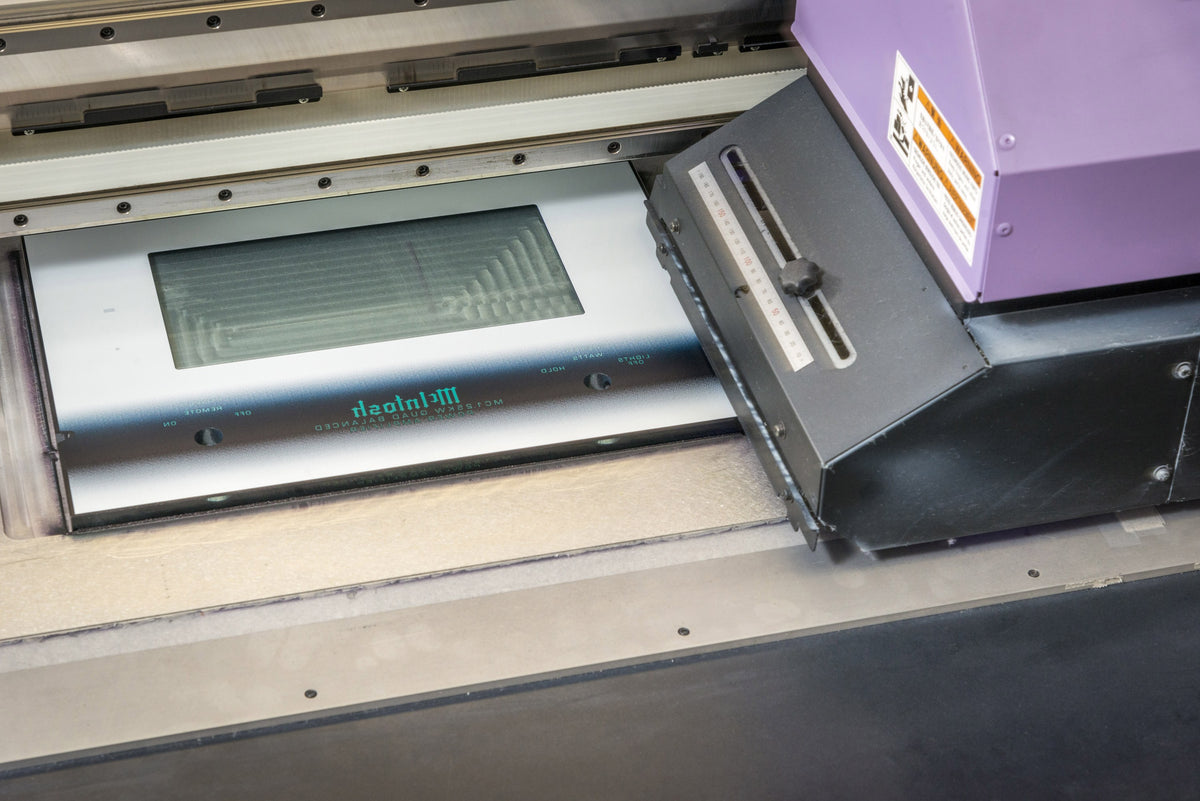
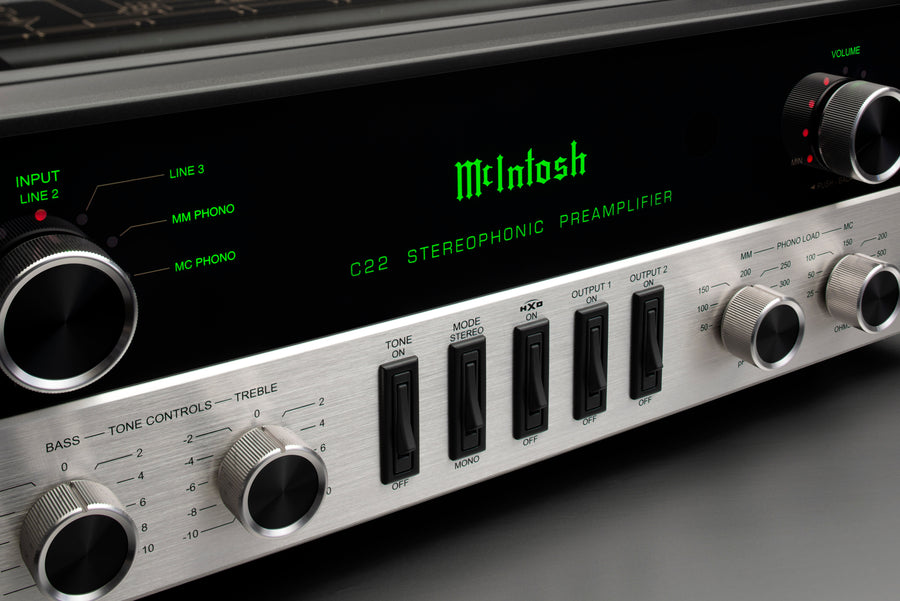
Black glass, gold lettering and the illuminated logo

The front panel is a sheet of glass, lettered from the back in McIntosh's own ink so the markings read gold in daylight and glow teal in a dim room, with the logo lit from behind. It has defined the look of a McIntosh since the 1960s and it is why a sixty-year-old C22 still reads as new. Read the deep diveClose
A McIntosh glass front panel leaving the printer, lettered from the back in the factory in Binghamton

What it does

Most front panels are painted or anodized metal with printed legends that wear. In the 1960s Gordon Gow suggested a different construction: a glass panel, screen-printed on its back face with an ink McIntosh developed itself. Because the lettering is behind the glass it cannot rub off, and because of the ink's pigment the markings read as gold under room light and as teal when lit from behind in a dim room. The lamps, now direct LEDs on current models, also illuminate the McIntosh name and the blue meter faces. Each panel is cut, printed and finished in Binghamton, and McIntosh describes every faceplate as a unique, handmade piece.

Why it matters in a system

Longevity, first: the panel of a 1963 C22 or a 1967 MC2505 looks today as it did when it was made, which is a large part of why McIntosh components hold their value and why a system can be built over decades from components of different ages that match. Coherence, second: a C2800 preamplifier, an MC462 amplifier and a DS200 streamer share the same glass, the same lettering and the same light, so a complete system reads as one instrument. It also places the engineering where you can see it, from the meters to the glass-topped transformer enclosures on the current amplifiers.

What you may hear

Nothing directly; this is the part of the design you see. What it changes is how a system lives in a room: lights low, the panels glowing gold and teal, the meters moving, the equipment itself part of the evening.

Signature technologySince 2017

Hybrid Drive

A vacuum-tube stage for the small signal followed by a solid-state stage for the power: one component, two circuit types, each placed where McIntosh believes its strengths matter. Read the deep diveClose
Output tubes and small-signal tubes glowing in a McIntosh vacuum-tube amplifier

What it does

A music signal and a loudspeaker ask very different things of an amplifier. At the input the signal is small and the job is to select, control level and add voltage gain without burying detail; at the output the job is to deliver the voltage and current a moving loudspeaker demands. Hybrid Drive divides the work. In the MA252, MA352 and MA12000 integrated amplifiers a vacuum-tube preamplifier (12AX7A and 12AT7 tubes) handles the first task and a solid-state power amplifier the second, in sequence and always both. The MA252 and MA352 use direct-coupled output stages; the MA12000 adds Autoformers. In the C12000 preamplifier and MCD12000 player the idea runs in parallel instead: each has both a tube and a solid-state output stage, and you choose which feeds the system.

Why it matters in a system

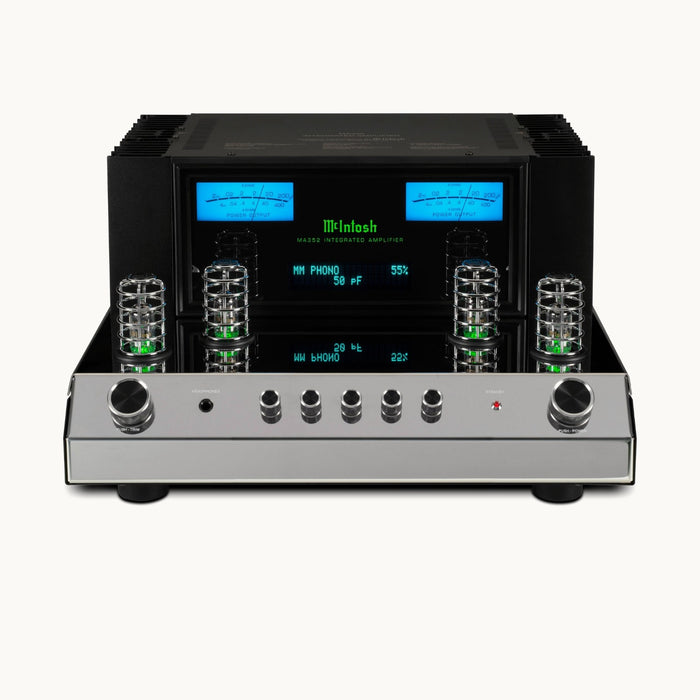
It is not a switch between a tube sound and a transistor sound, and it is not a tube buffer added for decoration. The tubes work where their harmonic behavior and low-level resolution are most audible, and the transistors work where current, control and durability count, so a hybrid McIntosh can drive a real loudspeaker in a real room while keeping the dimensionality and tonal color people buy tube equipment for. The three integrated amplifiers scale the same idea: the MA252 keeps a system simple, the MA352 adds power, meters and a five-band equalizer, and the MA12000 surrounds it with 350 watts through Autoformers and a full set of analog and digital inputs.

What you may hear

Image depth and an unforced musical flow from the tube stage, with the composure and loudspeaker control of a McIntosh solid-state amplifier. Loudspeakers, source, room and recording still decide most of what you hear; Hybrid Drive describes how the amplifier is built, not a sound preset.

Signature technologySince 2017

DA2 Digital Audio Module

The digital section of a McIntosh preamplifier or integrated amplifier lives on a replaceable module, so the analog component you buy can keep pace with digital formats; the current DA2 carries an eight-channel, 32-bit Quad Balanced DAC with DSD512 and HDMI ARC. Read the deep diveClose
A McIntosh preamplifier display reporting a 192 kHz HDMI ARC signal through its DA2 digital module

What it does

Digital audio changes faster than a well-built analog amplifier wears out. McIntosh's answer, introduced as the DA1 in 2017, was to put all of a component's digital inputs and its converter on one module that a dealer can replace. The DA2 of 2019 is the second generation: two coaxial and two optical inputs at 24-bit/192 kHz, a USB input for 32-bit/384 kHz PCM, DSD up to DSD512 and DXD, an MCT input for McIntosh SACD/CD transports, and an audio-only HDMI ARC input that lets a television's remote control the volume. At its heart is an eight-channel, 32-bit converter run in Quad Balanced mode, with better dynamic range and lower distortion than the DA1.

Why it matters in a system

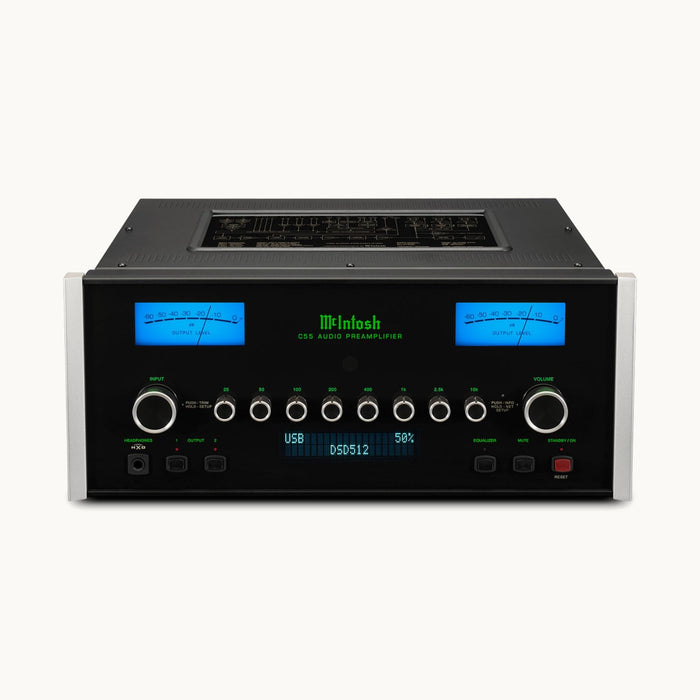
A McIntosh C55 or MA9500 is a thirty-year component. The module means its digital section does not have to be. Owners of DA1-equipped components (C49, MA5300 and others) can have the DA2 fitted by an authorized dealer rather than replacing the whole unit, and the next module will slot in the same way. The HDMI ARC input also folds the television into a two-channel system without a separate processor, which is how most people actually use a serious stereo today.

What you may hear

Files and streams at their full resolution through the same analog stage as your records, television sound through the main loudspeakers with the familiar remote, and a component that still sounds current years after purchase.

Signature technologySince 2014

Headphone Crossfeed Director (HXD)

A switchable circuit that feeds a controlled, time-shaped portion of each channel to the opposite ear, restoring to headphones some of the spatial character of listening to loudspeakers. Read the deep diveClose

What it does

With loudspeakers each ear hears both channels, the far one slightly later and softer, and the brain builds a stage in front of you from those differences. Headphones remove that: the left ear hears only the left channel. HXD adds a measured amount of the opposite channel to each earpiece, filtered and delayed to mimic what the far loudspeaker would have contributed, so instruments mixed hard to one side stop sitting inside the earcup and take a place in a shared space. It is switchable, so you can compare with it in and out.

Why it matters in a system

Headphone listening is where a preamplifier or integrated amplifier gets used late at night, and HXD is why a McIntosh C2800 or MA9500 is a complete headphone system rather than a jack on the back. It works with the High Drive headphone amplifier, which has the gain and current for demanding headphones, so a serious pair of planars or high-impedance dynamics needs no separate amplifier. The effect depends on the recording and the headphones; McIntosh leaves the choice to you.

What you may hear

Compare a familiar stereo recording with HXD on and off. Listen for a more cohesive sense of placement, less of the hole in the middle of the head, and instruments panned far left or right that feel connected to the rest of the band.

Signature technology

High Drive headphone amplifier

A dedicated headphone amplifier stage with the gain and current to drive demanding headphones from the quarter-inch jack of a McIntosh preamplifier, integrated amplifier or player. Read the deep diveClose

What it does

A headphone jack on most electronics is an afterthought: a resistor off the main output or a small op-amp with little current behind it, fine for efficient earbuds and short of breath with anything else. McIntosh's High Drive section is an amplifier designed for the job, with increased gain and output power compared with a conventional headphone output, and a low output impedance (47 ohms on the MCD600) so that the headphone, not the amplifier, sets the frequency balance. On most components it is paired with the Headphone Crossfeed Director.

Why it matters in a system

Planar-magnetic and high-impedance dynamic headphones need voltage swing and current that a passive jack cannot supply; underdriven, they sound thin and compressed. High Drive lets a C55, an MA8950 or a C8 double as a headphone system of real quality without a separate box, cable and power supply, which keeps the rack simple and the late-night listening serious. The MHA200, McIntosh's tube headphone amplifier, is the dedicated alternative when headphones are the main event.

What you may hear

Fuller bass and more dynamic range from difficult headphones, a sense of ease at volume, and the same tonal character as the loudspeaker system the component drives.

System integration

Home Theater PassThru

A fixed-gain input that lets a McIntosh two-channel preamplifier or integrated amplifier sit inside a surround system: the processor drives the front channels through the McIntosh at unity gain, and the two-channel system stays untouched for music. Read the deep diveClose

What it does

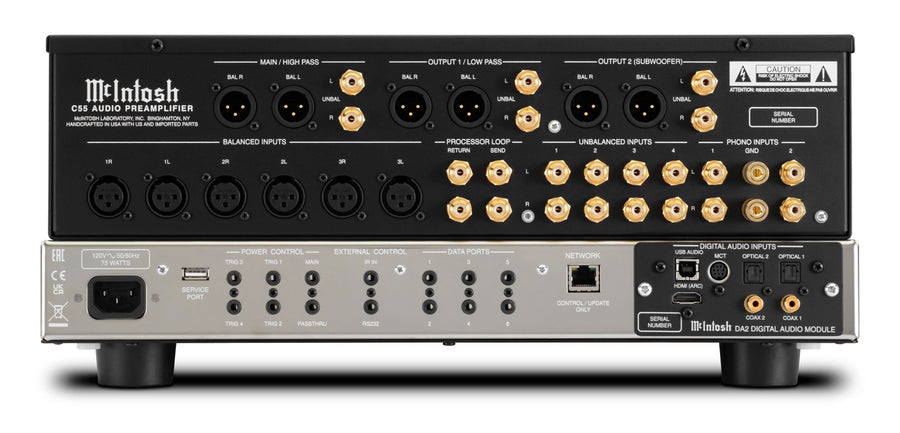
Mixing a serious stereo system with a home theater usually means compromising one of them. Home Theater PassThru assigns one input of the McIntosh preamplifier or integrated amplifier to the surround processor's front left and right outputs and passes it at a fixed level, so the processor's own volume control and calibration govern the front loudspeakers during a film. Select any other input and the McIntosh is a pure two-channel preamplifier again, with the processor out of the signal path. On the C55 and C2800 a Processor Loop adds a send and return for an external processor or equalizer.

Why it matters in a system

It lets one pair of main loudspeakers and one McIntosh amplifier serve both music and film without re-cabling or re-calibrating, which is how a C2800 and MC462 can anchor a theater built on an MX124 processor while remaining a reference stereo system at night. For a client building in stages it also means the stereo system can be bought first and the theater added later around it.

What you may hear

Film soundtracks through the main loudspeakers at the processor's calibrated level, and your records through the same loudspeakers with nothing from the theater in the way.

System integration

Power Control

A low-voltage control link between McIntosh components: switch the preamplifier on and the amplifier, player, turntable and streamer wake with it, with their meter lighting following along. Read the deep diveClose

What it does

Every McIntosh component carries Power Control jacks. A three-conductor cable runs from the preamplifier's POWER CONTROL MAIN (or a Trigger output) to the POWER CONTROL IN of the next component, and on down the chain; the power command and the meter-illumination command travel on that one cable. On a power amplifier a rear switch sets the behavior: REMOTE follows the preamplifier, ON keeps the amplifier on regardless, OFF keeps it off. The C55 and C2800 provide a Main output and four Trigger outputs so a complex system, or a second zone, can be sequenced; Data ports and IR inputs carry the remote-control commands alongside.

Why it matters in a system

A separates system is only as pleasant to live with as its first thirty seconds. Power Control turns a rack of McIntosh components into one instrument that comes to life from a single button and shuts down the same way, with the amplifiers' lighting switching with the rest. It also lets the Eco power-management feature on current amplifiers be used safely: an amplifier that has switched itself off after a period of silence returns the moment the preamplifier wakes it. The matching McIntosh Power Control Cables are available in several factory lengths; Pearl Audio can specify the right ones for your rack.

What you may hear

Nothing, by design; Power Control carries commands, not audio. What you notice is a system that behaves as one component, and meters that light together.

Signature technology

Solid Cinch speaker binding posts

Patented, gold-plated loudspeaker terminals whose clamping barrel presses straight down on the spade lug without turning it, so a heavy cable stays exactly where you set it and cannot work loose. Read the deep diveClose
Gold-plated Solid Cinch speaker binding posts on the rear panel of a McIntosh integrated amplifier

What it does

On an ordinary binding post the nut that tightens the connection also rotates against the spade lug, dragging it round, twisting a stiff cable and, over time, loosening under its own torque. Solid Cinch separates the two motions. Only the top turns; a separate clamping barrel moves straight down and presses the spade flat against the gold-plated contact surface. The lug stays at the angle you chose, neighboring connections stay clear of one another, and the contact is metal to metal under real pressure. On the MC611 each impedance tap has its own set of posts, spaced for cable management.

Why it matters in a system

The loudspeaker connection carries the most current in the system and is the one most often made badly. A spade that has crept round a post can touch its neighbor, and a short at the output of a 600-watt amplifier is exactly what Sentry Monitor exists to catch; Solid Cinch is the reason it rarely has to. With the large-gauge, stiff cables used in a serious system, the ability to clamp hard while keeping the cable straight is the difference between a connection you make once and one you check every month.

What you may hear

Nothing you would attribute to a terminal, which is the aim. You notice it with the cables in your hands: a large spade stays perfectly aligned as you tighten, and the connection does not change.

Made in the USASince 1951

Handcrafted in Binghamton, New York

McIntosh electronics are designed, built and tested at 2 Chambers Street in Binghamton, New York, where the company has been since 1951 and where its transformers are still wound by hand. Read the deep diveClose
The McIntosh factory at 2 Chambers Street, Binghamton, New York, from the air

What it does

McIntosh moved from Silver Spring, Maryland, to Binghamton in 1951 and built its present factory at 2 Chambers Street in 1956. The company still makes the parts that matter most to its sound on the premises. Output transformers and Autoformers are hand-wound and potted in the building; the glass front panels are cut, screen-printed and finished there; circuit boards are populated on the company's own surface-mount line, up to 7,000 boards a month, with temperature-sensitive and large components placed by hand, and every board is tested individually before it goes into a chassis. Every finished component goes through a bench test before it leaves.

Why it matters in a system

Keeping engineering, winding, assembly and test under one roof is how a company controls the consistency that lets a 1961 circuit and a 2026 amplifier sound like relatives. It is also what makes long-term service real: McIntosh maintains documentation and parts for decades of production, and a component bought today can go back to the people who built it. For an owner this is the practical meaning of heritage, a system that can be repaired, updated and handed on.

What you may hear

Consistency between units and across years, and the quiet confidence of equipment that was measured before it shipped. The glass-topped transformer enclosures on the current amplifiers let you see the work.

All McIntosh technologies

The McIntosh story

Seventy-seven years of American engineering you can see working: the Unity Coupled transformer, the Autoformer, the blue meter and the glass panel, still made in Binghamton.

Founded 1949 in Silver Spring, Maryland (in Binghamton, New York since 1951) by Frank H. McIntosh and Gordon J. Gow · mcintoshlabs.com

Milestones

  1. 1949 Founded on the Unity Coupled Circuit Frank H. McIntosh and Gordon Gow found McIntosh in Silver Spring, Maryland. U.S. Patent 2,477,074 covers the Unity Coupled Circuit; the 50W-1 is the first product, the AE2 preamplifier follows in 1950.
  2. 1951 Binghamton, New York The company moves to the second floor of 320 Water Street in Binghamton; Sidney Corderman joins as head of research, engineering and development and stays forty years. The factory at 2 Chambers Street, built in eight months in 1956, is still home.
  3. 1954 MC30, MC60 and the chrome chassis The MC30 and MC60 establish the chrome chassis as a McIntosh design element; the C8 preamplifier shows that industrial design matters; the MR55 of 1957 is the first McIntosh tuner.
  4. 1961 MC275 The MC275 stereo tube amplifier arrives with the MC225 and MC240. Discontinued in 1971, it returns in 1993 and has been in production since; today in its sixth generation.McIntosh MC275 Power Amplifier
  5. 1963 C22 and the illuminated glass panel The C22 tube preamplifier (1963-1972) pairs with the MC275. Through the 1960s McIntosh develops the back-printed glass front panel: gold lettering by day, teal by night.McIntosh C22 Preamplifier Mk V
  6. 1967 Solid state, with Autoformers The MC2505 and MC2105 are McIntosh's first transistor amplifiers: output Autoformers, Sentry Monitor protection, illuminated output meters and an all-glass front panel, the template for every McIntosh amplifier since.McIntosh MC462 Power Amplifier
  7. 1969 Woodstock McIntosh amplifiers, by most accounts about twenty MC3500 tube monoblocks, power the Woodstock festival.
  8. 1974 The Wall of Sound On March 23 the Grateful Dead unveil the Wall of Sound at the Cow Palace: 48 McIntosh MC2300 amplifiers, 28,800 watts. The MR78 FM tuner of 1972 belongs to the same years.
  9. 1977 Power Guard The MC2205 is the first amplifier with Power Guard, the anti-clipping comparator carried by every McIntosh amplifier since. Frank McIntosh retires; Gordon Gow becomes president.
  10. 1980 XRT20 line array and MC2500 The XRT20 brings line-array loudspeakers into the home and the MC2500 (1980-1990) becomes the big stereo amplifier of the decade; the MCD7000 is the first McIntosh CD player.McIntosh XRT2.1K Floorstanding Loudspeaker
  11. 1993 Gordon Gow Commemorative MC275 After Gow's death in 1989 and the 1990 sale to Clarion, the MC275 returns as a commemorative edition and never leaves the line again.
  12. 1999 50 years: the MC2000 Sidney Corderman comes out of retirement to design the MC2000, a limited-edition vacuum-tube amplifier for the company's fiftieth anniversary.
  13. 2000 Quad Balanced and a new president The MC1201 monoblock introduces the Quad Balanced architecture behind today's MC1.25KW, MC611 and MC462. In 2001 Charlie Randall, an engineer with the company since 1988, becomes president and CEO.McIntosh MC1.25KW Power Amplifiers (pair)
  14. 2007 MT10 turntable Two years after the Reference System of 2005, McIntosh introduces its first turntable, the MT10, with an illuminated speed meter and McIntosh green platter.McIntosh MT10 Precision Turntable
  15. 2017 Hybrid Drive and the digital module The MA252 is the first McIntosh hybrid integrated amplifier; the DA1 Digital Audio Module makes the digital section replaceable. Frank McIntosh and Gordon Gow enter the Consumer Technology Hall of Fame.McIntosh MA252 Integrated Amplifier
  16. 2019 70th anniversary The MC2152 amplifier and C70 preamplifier mark 70 years; the MC901 puts a tube and a solid-state amplifier on one chassis; the DA2 module arrives. The MC1502 and C22 Mk V carry the anniversary designs forward.
  17. 2024 75 years, and Bose McIntosh marks its 75th anniversary. In November, Highlander Partners (owner since 2022) sells McIntosh Group, parent of McIntosh and Sonus faber, to Bose Corporation. Manufacturing stays in Binghamton.
  18. 2026 MA2375 In June the MA2375 becomes the first McIntosh vacuum-tube integrated amplifier in more than a decade: Unity Coupled transformers, Sentry Monitor and Power Guard SGS in one 75-watt chassis.McIntosh MA2375 Vacuum Tube Integrated Amplifier
  19. Now McIntosh MA12000 Integrated Amplifier The MA12000 (2020) is McIntosh's most powerful integrated amplifier and the full-scale expression of Hybrid Drive: a four-tube preamplifier ahead of a 350-watt Autoformer-coupled solid-state amplifier, with the DA2 digital module.
Read the McIntosh story
McIntosh MC275 vacuum tube amplifier, low angle

McIntosh Laboratory was founded in 1949 in Silver Spring, Maryland, by Frank H. McIntosh, a radio engineer who had run a Washington consulting practice, and Gordon J. Gow, the young engineer he had hired in 1946 to help build an amplifier that did not yet exist: one that could deliver real power across the whole audible band with distortion below one percent. Their answer was the Unity Coupled Circuit, patented in 1949 as U.S. Patent 2,477,074, which wound the output transformer into the operating circuit of the tubes with paired plate and cathode windings. The 50W-1 amplifier that carried it was the company's first product, and the AE2 of 1950 its first preamplifier. In 1951 the company moved to the second floor of a building in Binghamton, New York, where Sidney Corderman joined as head of research, engineering and development; the factory McIntosh still occupies at 2 Chambers Street opened in 1956.

The 1950s and 1960s made the McIntosh look. The MC30 and MC60 of 1954 and 1955 established the chrome chassis, the C8 preamplifier showed that industrial design mattered, and the MR55 of 1957 was the first McIntosh tuner. Through the 1960s the company developed the front panel it is known for: a sheet of glass, screen-printed from the back in an ink McIntosh made itself, so the lettering reads gold under room light and glows teal in the dark and never wears off. The stereo tube amplifiers of the decade, the MC225, MC240 and MC275 of 1961, with the C22 preamplifier of 1963, are the designs collectors chase today; the MC275 has been back in production since 1993 and the C22 is in its fifth version. Dave O'Brien spent those years on the road running the McIntosh Performance Clinics, bench-testing customers' amplifiers of every make in dealers' stores, a tradition of measured proof that the company has never given up.

McIntosh's history runs through the music of the period. In 1969 McIntosh amplifiers, by most accounts about twenty MC3500 tube monoblocks, powered Woodstock. On March 23, 1974, the Grateful Dead unveiled the Wall of Sound at the Cow Palace with 48 McIntosh MC2300 solid-state amplifiers delivering 28,800 watts. The MC2300 belonged to the transistor generation McIntosh had begun in 1967 with the MC2505 and MC2105, the first solid-state amplifiers to keep output transformers, which McIntosh called Autoformers, so that the amplifier delivered full power into any loudspeaker impedance; the same amplifiers introduced Sentry Monitor protection, the illuminated output meters and the all-glass front panel. The MC2205 of the late 1970s added Power Guard, the anti-clipping circuit that has been on every McIntosh amplifier since. Frank McIntosh retired in 1977 and Gordon Gow became president; the XRT20 of 1980 brought line-array loudspeakers into the home, and the MCD7000 was the company's first CD player.

Gow died in 1989 and the company was sold to Clarion of Japan in 1990, the year Frank McIntosh also died; the MC275 returned in 1993 as the Gordon Gow Commemorative edition. D&M Holdings bought McIntosh in 2003; Fine Sounds of Milan, parent of Sonus faber and Audio Research, bought it in 2012; a management buyout in 2014 led to the group's renaming as McIntosh Group and its move to New York; Highlander Partners acquired the group in June 2022 and sold it to Bose Corporation in November 2024. Through all of it the company stayed in Binghamton, and since 2001 it has been led by Charlie Randall, an electrical engineer who joined in 1988 and rose through engineering to president. The MC1201 of 2000 brought the Quad Balanced architecture that defines today's big amplifiers; the Reference System of 2005, the MT10 turntable of 2007, the first hybrid integrated amplifier (the MA252 of 2017), the replaceable DA1 and DA2 digital modules, and the 70th-anniversary MC2152 and C70 of 2019 mark the modern era. Frank McIntosh and Gordon Gow were inducted into the Consumer Technology Hall of Fame in 2017.

The McIntosh of 2026 still winds its transformers by hand at 2 Chambers Street, still prints its glass panels in the building, and still tests every component on the bench before it ships. The MA2375 of June 2026, the first McIntosh vacuum-tube integrated amplifier in more than a decade, carries the Unity Coupled transformers of 1949, the Sentry Monitor of 1967 and a tube form of the Power Guard of 1977 in one chassis, which is as good a summary of the company as any. Pearl Audio holds the largest McIntosh inventory in Oregon.
The complete McIntosh story and technology library

McIntosh at Pearl Audio

Pearl Audio has represented McIntosh since 2005, the year the store was founded, and is the longest-running McIntosh dealer in the Northwest. We are a McIntosh Platinum dealer, and two decades on McIntosh remains the brand we know most thoroughly: we keep the core of the range on the floor in Portland, hold a deep inventory, and our staff are McIntosh factory trained. McIntosh components are sold for pickup at Pearl Audio, with local delivery and installation available within the Portland, Oregon service area; we do not ship them by carrier.

John's take

Why we carry the MA12000 Integrated Amplifier

The MA12000 is the biggest and most powerful integrated amplifier we’ve ever had in our store. It is for someone who wants the power, scale, and control of high-powered separates, but in one chassis. Conceptually, it is most like combining a C2800 tube preamplifier with an MC352 power amplifier: tube gain stages up front and 350 watts of solid-state power behind them.

Like the contemporary pairing of a C2800 and MC462, the MA12000 uses tubes where they can shape the preamplifier signal, then lets a very large solid-state output stage take care of the loudspeakers. It brings much of the authority and flexibility of big separates into a single component without making the system feel pared back. If that is what you want, this is the integrated amplifier I would start with.

Like the standalone C2800 tube preamplifier, the MA12000 provides tube gain stages, separate moving-magnet and moving-coil phono inputs, the DA2 Digital Audio Module, HDMI ARC, and an MCT input for a compatible McIntosh transport. It also includes an eight-band analog equalizer that is genuinely useful—and can be bypassed completely when you do not need it.

On the power-amplifier side, the MA12000 shares the MC352's 350-watt rating, McIntosh Autoformers, and balanced connectivity. It has the composure and control needed for substantial loudspeakers; the Bowers & Wilkins 802 and Sonus faber Amati immediately come to mind.

John, owner, Pearl Audio

The Pearl Audio experience

How we work with you

A system at this level should be heard, thoughtfully matched, and properly set up. From the first audition to long-term ownership, you work with the same people, in person.

  1. 01

    Listen first

    Hear the MA12000 Integrated Amplifier by appointment in one of our two purpose-designed demonstration rooms, with your own music and time to compare without pressure.

  2. 02

    Placement and setup advice

    Ask us about placement, connections, ventilation and system configuration, and about delivery.

  3. 03

    Support for as long as you own it

    We support everything we sell for as long as you own it, whether the answer comes by phone, in the shop, or through factory service.

  4. 04

    A path for what comes next

    Trade-in assistance and qualifying 100% Trade-Up options give you flexibility when your listening priorities or your system change.

Search