

← Back to your LP12 build

McIntosh · Phono Preamplifier

McIntosh MP100 Phono Preamplifier

$2,500

Signature technologiesThe McIntosh story

On demonstrationIn stock

On the floor at our Portland showroom. Ask and we will set it up for you to hear. New and sealed units are in stock.

McIntosh · Phono Preamplifier

The MP100 is McIntosh's standalone phono stage: a moving-coil and a moving-magnet input with six loading settings each, balanced and unbalanced outputs, and 24-bit/96 kHz digital outputs for archiving records.

McIntosh has scheduled the MP100 to end production in 2026; call for current availability. Half-width chassis, 11½ in wide.

MC + MM
one input each, six loading settings apiece
60 / 40 dB
gain, moving coil / moving magnet
24-bit/96 kHz
optical, coaxial and USB digital outputs
8.6 lb
3.9 kg; 11½ in wide, 3¾ in high

Authorized McIntosh Labs dealer · Delivery and installation by Pearl Audio · Trade-ins welcome

The story

The MP100 was McIntosh's first standalone phono preamplifier, and it exists for two situations: a system whose preamplifier or integrated amplifier has no phono input, and a record collection the owner wants to digitize. It has one moving-coil input with resistive loading selectable from 25 to 1,000 ohms and one moving-magnet input with capacitance selectable from 50 to 400 picofarads, both set by switches on the rear panel, with 60 and 40 dB of gain respectively. Balanced and unbalanced analog outputs feed any line input, and a mono switch sums the channels for mono pressings so that vertical groove noise cancels.

The RIAA circuit is solid state, specified at 0.005 percent distortion and ±0.3 dB from 20 Hz to 20 kHz, with 78 dB signal-to-noise on the moving-coil input and 80 dB on moving magnet. Those are figures that put the MP100 ahead of the phono stages built into many integrated amplifiers, and the loading options let a cartridge be matched properly rather than run into whatever the built-in stage happens to offer. The chassis is McIntosh's half-width format, 11½ inches wide and under four inches high, with a black glass front panel and the green-lit logo, and it uses Power Control to switch on with the rest of a McIntosh system.

What sets the MP100 apart is the digital side. Optical, coaxial and USB outputs carry the equalized signal at 24-bit/96 kHz, so the MP100 can feed a DAC-equipped preamplifier digitally, or rip records to a computer over USB with recording software. A clipping indicator on the front panel shows when a loud passage would overload the analog-to-digital converter, so the owner can lower the input before a transfer rather than discover the fault afterward, and the digital section can be switched off entirely for analog-only listening.

Hi-Fi News rated the MP100 Highly Commended in April 2017, eCoustics' Ian White reviewed it in October 2022 and found it detailed, clear and dynamic, and Positive Feedback's Gary Lea reviewed it in March 2023. McIntosh has scheduled the MP100 to end production in 2026, so availability should be confirmed before a system is planned around it.

The MP100 suits a MT5 or MT10 feeding a preamplifier without a phono stage, or a home theater processor such as the MX124; it also adds a second, adjustable phono input to a system whose preamplifier already has one, or a USB path for archiving to a system whose phono stage does not. The C22 Mk V, C2800 and C55 have phono stages built in and do not need it. Pearl Audio sets the loading for your cartridge before delivery.

Key technologies

  • Adjustable loading. Six resistance settings for moving coil, from 25 ohms to 1 kilohm, and six capacitance settings for moving magnet, from 50 to 400 picofarads, so the cartridge sees the load its maker specifies rather than a fixed value.
  • Separate gain paths. 60 dB for moving coil and 40 dB for moving magnet, each with its own input, so two turntables or two arms can stay connected at once.
  • Balanced output. A balanced XLR output alongside the unbalanced RCA pair rejects noise picked up on long runs to the preamplifier.
  • Digital outputs. Optical, coaxial and USB outputs at 24-bit/96 kHz feed a DAC-equipped preamplifier or a computer for recording records.
  • Clipping indicator. Shows when the analog-to-digital converter is being overloaded so the input can be adjusted before a transfer is spoiled.
  • Mono switch. Sums the channels for mono records so that vertical groove noise cancels.
  • Analog-only mode and Power Control. The digital circuitry can be switched off entirely, and Power Control input and output switch the MP100 with the rest of the system.
Specifications
Type Solid-state stereo phono preamplifier, RIAA equalization
Inputs 1 moving coil (25, 50, 100, 200, 400 or 1,000 Ω; 470 pF), 1 moving magnet (47 kΩ; 50, 100, 150, 200, 300 or 400 pF)
Voltage gain 60 dB moving coil; 40 dB moving magnet
Sensitivity 1 mV moving coil; 10 mV moving magnet
Maximum input 8 mV moving coil; 80 mV moving magnet
Analog outputs 1 balanced fixed (2 V rated, 200 Ω); 1 unbalanced fixed (1 V rated, 100 Ω); maximum 16 V balanced, 8 V unbalanced
Digital outputs 1 coaxial, 1 optical, 1 USB; PCM 24-bit/96 kHz
Total harmonic distortion 0.005%
Frequency response 20 Hz – 20 kHz, ±0.3 dB
Signal-to-noise ratio 78 dB moving coil; 80 dB moving magnet
Controls Mono switch; digital section on/off; clipping indicator
Control Power Control 1 input, 1 output
Power consumption 8 W
Dimensions (W × H × D) 11½ × 3 25/32 × 16¾ in (29.2 × 9.6 × 42.5 cm)
Weight 8.6 lb (3.9 kg); shipping 9.6 lb (4.4 kg)
Status Scheduled by McIntosh to end production in 2026; confirm availability
Warranty 3-year limited (McIntosh USA)

McIntosh MP100 product page and specifications · Owner's manual (PDF) · Brochure (PDF)

Where it sits in the range

McIntosh's analog front end: the MP100 phono stage and the turntables it serves, cheapest to dearest.

  • McIntosh MP100 (this model): phono preamplifier with adjustable MC and MM inputs and 24-bit/96 kHz digital outputs, $2,500
  • McIntosh MT2: belt-drive turntable with Sumiko Moonstone moving-magnet cartridge; listed by McIntosh among its retired products, availability limited to stock on hand, $6,000
  • McIntosh MTI100: turntable with built-in tube preamplifier, 50 W amplifier and Bluetooth, $8,000
  • McIntosh MT5: turntable with Sumiko Amethyst moving-magnet cartridge and magnetic platter bearing, $8,500
  • McIntosh MT10: flagship turntable with low-output moving-coil cartridge, magnetically suspended platter and illuminated speed meter, $14,000

The C22 Mk V, C2800, C55 and C12000 preamplifiers have phono stages built in; the MP100 adds one where none exists.

Reviews

McIntosh purchases are completed in store or by phone or email after a consultation, with pickup at Pearl Audio or delivery and installation within the Portland, Oregon area. McIntosh products are not available for carrier shipment.

Plan your McIntosh system with Pearl Audio

Pearl Audio is an authorized McIntosh dealer. We will confirm availability, set the loading and gain for your cartridge, show you the USB archiving path if you want it, and arrange a listening appointment in our Portland showroom. Call (503) 222-2599 or email sales@pearlaudio.com.

Signature technologies

The engineering behind the McIntosh MP100 Phono Preamplifier

McIntosh gives its technologies names because each one solves a specific problem. Here is what each does, where it came from, why it matters in a system, and what you may hear.

Design heritage, since the 1960s

Black glass, gold lettering and the illuminated logo

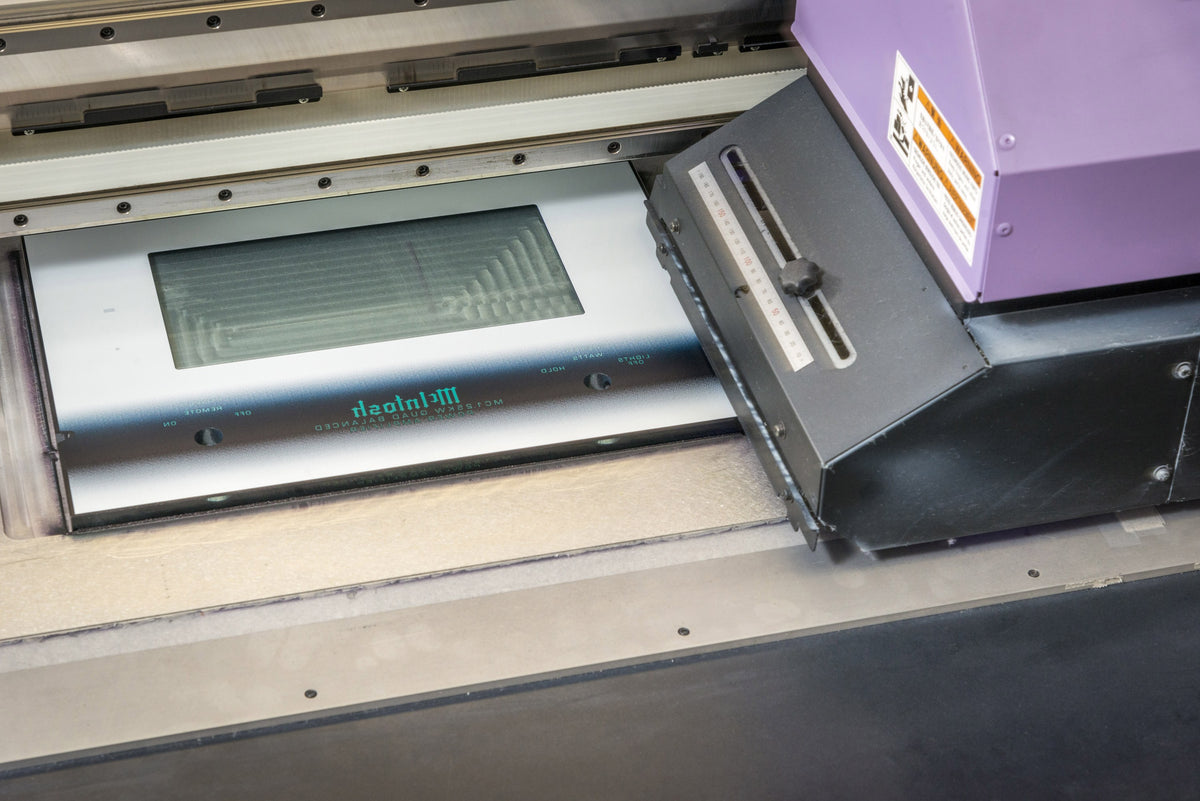
The front panel is a sheet of glass, lettered from the back in McIntosh's own ink so the markings read gold in daylight and glow teal in a dim room, with the logo lit from behind. It has defined the look of a McIntosh since the 1960s and it is why a sixty-year-old C22 still reads as new. Read the deep diveClose
A McIntosh glass front panel leaving the printer, lettered from the back in the factory in Binghamton

What it does

Most front panels are painted or anodized metal with printed legends that wear. In the 1960s Gordon Gow suggested a different construction: a glass panel, screen-printed on its back face with an ink McIntosh developed itself. Because the lettering is behind the glass it cannot rub off, and because of the ink's pigment the markings read as gold under room light and as teal when lit from behind in a dim room. The lamps, now direct LEDs on current models, also illuminate the McIntosh name and the blue meter faces. Each panel is cut, printed and finished in Binghamton, and McIntosh describes every faceplate as a unique, handmade piece.

Why it matters in a system

Longevity, first: the panel of a 1963 C22 or a 1967 MC2505 looks today as it did when it was made, which is a large part of why McIntosh components hold their value and why a system can be built over decades from components of different ages that match. Coherence, second: a C2800 preamplifier, an MC462 amplifier and a DS200 streamer share the same glass, the same lettering and the same light, so a complete system reads as one instrument. It also places the engineering where you can see it, from the meters to the glass-topped transformer enclosures on the current amplifiers.

What you may hear

Nothing directly; this is the part of the design you see. What it changes is how a system lives in a room: lights low, the panels glowing gold and teal, the meters moving, the equipment itself part of the evening.

System integration

Power Control

A low-voltage control link between McIntosh components: switch the preamplifier on and the amplifier, player, turntable and streamer wake with it, with their meter lighting following along. Read the deep diveClose

What it does

Every McIntosh component carries Power Control jacks. A three-conductor cable runs from the preamplifier's POWER CONTROL MAIN (or a Trigger output) to the POWER CONTROL IN of the next component, and on down the chain; the power command and the meter-illumination command travel on that one cable. On a power amplifier a rear switch sets the behavior: REMOTE follows the preamplifier, ON keeps the amplifier on regardless, OFF keeps it off. The C55 and C2800 provide a Main output and four Trigger outputs so a complex system, or a second zone, can be sequenced; Data ports and IR inputs carry the remote-control commands alongside.

Why it matters in a system

A separates system is only as pleasant to live with as its first thirty seconds. Power Control turns a rack of McIntosh components into one instrument that comes to life from a single button and shuts down the same way, with the amplifiers' lighting switching with the rest. It also lets the Eco power-management feature on current amplifiers be used safely: an amplifier that has switched itself off after a period of silence returns the moment the preamplifier wakes it. The matching McIntosh Power Control Cables are available in several factory lengths; Pearl Audio can specify the right ones for your rack.

What you may hear

Nothing, by design; Power Control carries commands, not audio. What you notice is a system that behaves as one component, and meters that light together.

Made in the USASince 1951

Handcrafted in Binghamton, New York

McIntosh electronics are designed, built and tested at 2 Chambers Street in Binghamton, New York, where the company has been since 1951 and where its transformers are still wound by hand. Read the deep diveClose
The McIntosh factory at 2 Chambers Street, Binghamton, New York, from the air

What it does

McIntosh moved from Silver Spring, Maryland, to Binghamton in 1951 and built its present factory at 2 Chambers Street in 1956. The company still makes the parts that matter most to its sound on the premises. Output transformers and Autoformers are hand-wound and potted in the building; the glass front panels are cut, screen-printed and finished there; circuit boards are populated on the company's own surface-mount line, up to 7,000 boards a month, with temperature-sensitive and large components placed by hand, and every board is tested individually before it goes into a chassis. Every finished component goes through a bench test before it leaves.

Why it matters in a system

Keeping engineering, winding, assembly and test under one roof is how a company controls the consistency that lets a 1961 circuit and a 2026 amplifier sound like relatives. It is also what makes long-term service real: McIntosh maintains documentation and parts for decades of production, and a component bought today can go back to the people who built it. For an owner this is the practical meaning of heritage, a system that can be repaired, updated and handed on.

What you may hear

Consistency between units and across years, and the quiet confidence of equipment that was measured before it shipped. The glass-topped transformer enclosures on the current amplifiers let you see the work.

All McIntosh technologies

The McIntosh story

Seventy-seven years of American engineering you can see working: the Unity Coupled transformer, the Autoformer, the blue meter and the glass panel, still made in Binghamton.

Founded 1949 in Silver Spring, Maryland (in Binghamton, New York since 1951) by Frank H. McIntosh and Gordon J. Gow · mcintoshlabs.com

Milestones

  1. 1949 Founded on the Unity Coupled Circuit Frank H. McIntosh and Gordon Gow found McIntosh in Silver Spring, Maryland. U.S. Patent 2,477,074 covers the Unity Coupled Circuit; the 50W-1 is the first product, the AE2 preamplifier follows in 1950.
  2. 1951 Binghamton, New York The company moves to the second floor of 320 Water Street in Binghamton; Sidney Corderman joins as head of research, engineering and development and stays forty years. The factory at 2 Chambers Street, built in eight months in 1956, is still home.
  3. 1954 MC30, MC60 and the chrome chassis The MC30 and MC60 establish the chrome chassis as a McIntosh design element; the C8 preamplifier shows that industrial design matters; the MR55 of 1957 is the first McIntosh tuner.
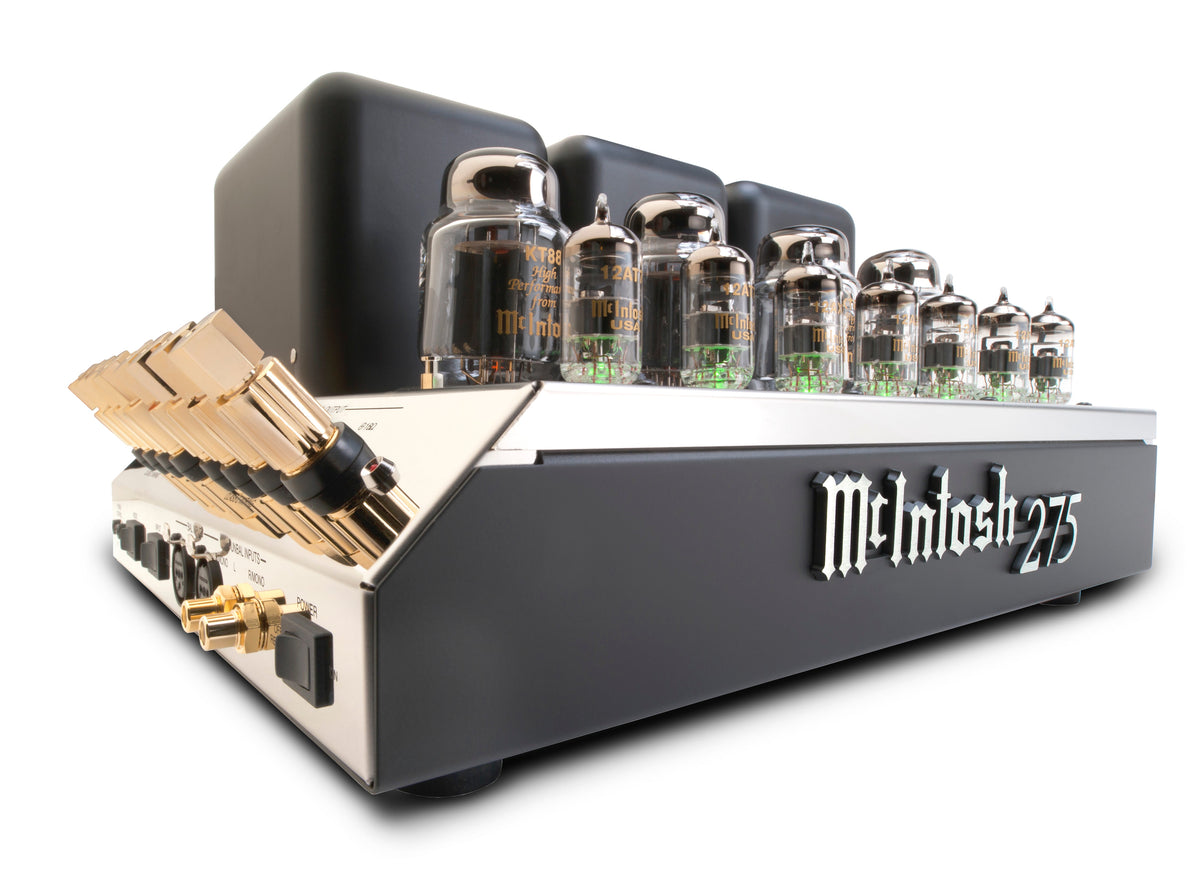
  4. 1961 MC275 The MC275 stereo tube amplifier arrives with the MC225 and MC240. Discontinued in 1971, it returns in 1993 and has been in production since; today in its sixth generation.McIntosh MC275 Power Amplifier
  5. 1963 C22 and the illuminated glass panel The C22 tube preamplifier (1963-1972) pairs with the MC275. Through the 1960s McIntosh develops the back-printed glass front panel: gold lettering by day, teal by night.McIntosh C22 Preamplifier Mk V
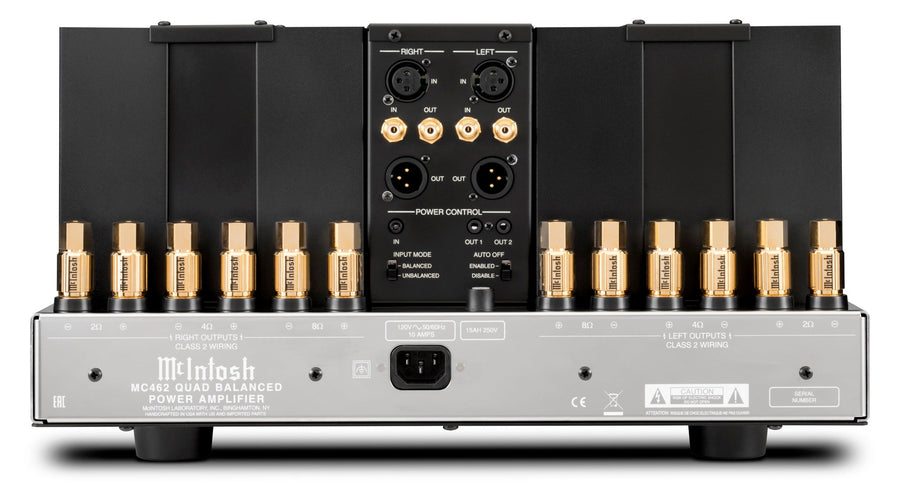
  6. 1967 Solid state, with Autoformers The MC2505 and MC2105 are McIntosh's first transistor amplifiers: output Autoformers, Sentry Monitor protection, illuminated output meters and an all-glass front panel, the template for every McIntosh amplifier since.McIntosh MC462 Power Amplifier
  7. 1969 Woodstock McIntosh amplifiers, by most accounts about twenty MC3500 tube monoblocks, power the Woodstock festival.
  8. 1974 The Wall of Sound On March 23 the Grateful Dead unveil the Wall of Sound at the Cow Palace: 48 McIntosh MC2300 amplifiers, 28,800 watts. The MR78 FM tuner of 1972 belongs to the same years.
  9. 1977 Power Guard The MC2205 is the first amplifier with Power Guard, the anti-clipping comparator carried by every McIntosh amplifier since. Frank McIntosh retires; Gordon Gow becomes president.
  10. 1980 XRT20 line array and MC2500 The XRT20 brings line-array loudspeakers into the home and the MC2500 (1980-1990) becomes the big stereo amplifier of the decade; the MCD7000 is the first McIntosh CD player.McIntosh XRT2.1K Floorstanding Loudspeaker
  11. 1993 Gordon Gow Commemorative MC275 After Gow's death in 1989 and the 1990 sale to Clarion, the MC275 returns as a commemorative edition and never leaves the line again.
  12. 1999 50 years: the MC2000 Sidney Corderman comes out of retirement to design the MC2000, a limited-edition vacuum-tube amplifier for the company's fiftieth anniversary.
  13. 2000 Quad Balanced and a new president The MC1201 monoblock introduces the Quad Balanced architecture behind today's MC1.25KW, MC611 and MC462. In 2001 Charlie Randall, an engineer with the company since 1988, becomes president and CEO.McIntosh MC1.25KW Power Amplifiers (pair)
  14. 2007 MT10 turntable Two years after the Reference System of 2005, McIntosh introduces its first turntable, the MT10, with an illuminated speed meter and McIntosh green platter.McIntosh MT10 Precision Turntable
  15. 2017 Hybrid Drive and the digital module The MA252 is the first McIntosh hybrid integrated amplifier; the DA1 Digital Audio Module makes the digital section replaceable. Frank McIntosh and Gordon Gow enter the Consumer Technology Hall of Fame.McIntosh MA252 Integrated Amplifier
  16. 2019 70th anniversary The MC2152 amplifier and C70 preamplifier mark 70 years; the MC901 puts a tube and a solid-state amplifier on one chassis; the DA2 module arrives. The MC1502 and C22 Mk V carry the anniversary designs forward.
  17. 2024 75 years, and Bose McIntosh marks its 75th anniversary. In November, Highlander Partners (owner since 2022) sells McIntosh Group, parent of McIntosh and Sonus faber, to Bose Corporation. Manufacturing stays in Binghamton.
  18. 2026 MA2375 In June the MA2375 becomes the first McIntosh vacuum-tube integrated amplifier in more than a decade: Unity Coupled transformers, Sentry Monitor and Power Guard SGS in one 75-watt chassis.McIntosh MA2375 Vacuum Tube Integrated Amplifier
  19. Now McIntosh MP100 Phono Preamplifier The MP100 is McIntosh's compact phono preamplifier, with moving-coil and moving-magnet inputs, adjustable loading and a USB output for archiving records, in the narrow chassis shared with the MXA80 and MHA150.
Read the McIntosh story
McIntosh MC275 vacuum tube amplifier, low angle

McIntosh Laboratory was founded in 1949 in Silver Spring, Maryland, by Frank H. McIntosh, a radio engineer who had run a Washington consulting practice, and Gordon J. Gow, the young engineer he had hired in 1946 to help build an amplifier that did not yet exist: one that could deliver real power across the whole audible band with distortion below one percent. Their answer was the Unity Coupled Circuit, patented in 1949 as U.S. Patent 2,477,074, which wound the output transformer into the operating circuit of the tubes with paired plate and cathode windings. The 50W-1 amplifier that carried it was the company's first product, and the AE2 of 1950 its first preamplifier. In 1951 the company moved to the second floor of a building in Binghamton, New York, where Sidney Corderman joined as head of research, engineering and development; the factory McIntosh still occupies at 2 Chambers Street opened in 1956.

The 1950s and 1960s made the McIntosh look. The MC30 and MC60 of 1954 and 1955 established the chrome chassis, the C8 preamplifier showed that industrial design mattered, and the MR55 of 1957 was the first McIntosh tuner. Through the 1960s the company developed the front panel it is known for: a sheet of glass, screen-printed from the back in an ink McIntosh made itself, so the lettering reads gold under room light and glows teal in the dark and never wears off. The stereo tube amplifiers of the decade, the MC225, MC240 and MC275 of 1961, with the C22 preamplifier of 1963, are the designs collectors chase today; the MC275 has been back in production since 1993 and the C22 is in its fifth version. Dave O'Brien spent those years on the road running the McIntosh Performance Clinics, bench-testing customers' amplifiers of every make in dealers' stores, a tradition of measured proof that the company has never given up.

McIntosh's history runs through the music of the period. In 1969 McIntosh amplifiers, by most accounts about twenty MC3500 tube monoblocks, powered Woodstock. On March 23, 1974, the Grateful Dead unveiled the Wall of Sound at the Cow Palace with 48 McIntosh MC2300 solid-state amplifiers delivering 28,800 watts. The MC2300 belonged to the transistor generation McIntosh had begun in 1967 with the MC2505 and MC2105, the first solid-state amplifiers to keep output transformers, which McIntosh called Autoformers, so that the amplifier delivered full power into any loudspeaker impedance; the same amplifiers introduced Sentry Monitor protection, the illuminated output meters and the all-glass front panel. The MC2205 of the late 1970s added Power Guard, the anti-clipping circuit that has been on every McIntosh amplifier since. Frank McIntosh retired in 1977 and Gordon Gow became president; the XRT20 of 1980 brought line-array loudspeakers into the home, and the MCD7000 was the company's first CD player.

Gow died in 1989 and the company was sold to Clarion of Japan in 1990, the year Frank McIntosh also died; the MC275 returned in 1993 as the Gordon Gow Commemorative edition. D&M Holdings bought McIntosh in 2003; Fine Sounds of Milan, parent of Sonus faber and Audio Research, bought it in 2012; a management buyout in 2014 led to the group's renaming as McIntosh Group and its move to New York; Highlander Partners acquired the group in June 2022 and sold it to Bose Corporation in November 2024. Through all of it the company stayed in Binghamton, and since 2001 it has been led by Charlie Randall, an electrical engineer who joined in 1988 and rose through engineering to president. The MC1201 of 2000 brought the Quad Balanced architecture that defines today's big amplifiers; the Reference System of 2005, the MT10 turntable of 2007, the first hybrid integrated amplifier (the MA252 of 2017), the replaceable DA1 and DA2 digital modules, and the 70th-anniversary MC2152 and C70 of 2019 mark the modern era. Frank McIntosh and Gordon Gow were inducted into the Consumer Technology Hall of Fame in 2017.

The McIntosh of 2026 still winds its transformers by hand at 2 Chambers Street, still prints its glass panels in the building, and still tests every component on the bench before it ships. The MA2375 of June 2026, the first McIntosh vacuum-tube integrated amplifier in more than a decade, carries the Unity Coupled transformers of 1949, the Sentry Monitor of 1967 and a tube form of the Power Guard of 1977 in one chassis, which is as good a summary of the company as any. Pearl Audio holds the largest McIntosh inventory in Oregon.

The complete McIntosh story and technology library

McIntosh at Pearl Audio

Pearl Audio has represented McIntosh since 2005, the year the store was founded, and is the longest-running McIntosh dealer in the Northwest. We are a McIntosh Platinum dealer, and two decades on McIntosh remains the brand we know most thoroughly: we keep the core of the range on the floor in Portland, hold a deep inventory, and our staff are McIntosh factory trained. McIntosh components are sold for in-store pickup or for local delivery and installation in the Portland area; we do not ship them by carrier.

The Pearl Audio experience

How we work with you

A system at this level should be heard, thoughtfully matched, and properly set up. From the first audition to long-term ownership, you work with the same people, in person.

  1. 01

    Listen first

    Hear the MP100 Phono Preamplifier by appointment in one of our two purpose-designed demonstration rooms, with your own music and time to compare without pressure.

  2. 02

    Delivery and installation

    We deliver and install throughout the Portland area, taking care of placement, connections, ventilation and system configuration ourselves.

  3. 03

    Support for as long as you own it

    We support everything we sell for as long as you own it, whether the answer comes by phone, in your home, or through factory service.

  4. 04

    A path for what comes next

    Trade-in assistance and qualifying 100% Trade-Up options give you flexibility when your listening priorities or your system change.

Search