
Linn · Sondek LP12
The Sondek LP12 platter
The platter looks like the simplest part of a Sondek LP12. It is two pieces of machined metal. A good deal of the turntable's engineering is in them.
Two pieces

The platter of a Sondek LP12 is made in two parts.
- The inner platter is the smaller disc. The spindle is part of it, and the drive belt runs around its edge.
- The outer platter is the one you see. It is twelve inches across, sits on the inner platter, and carries the felt mat and the record. Linn's service manual gives its weight as about nine pounds.
Linn puts most of that weight at the rim. Weight at the rim does the most to keep a platter turning at a steady speed, in the way a flywheel does.
The metal, and why Linn uses it
Both parts are die-cast in an alloy of zinc and aluminum that Linn names in its manual as Mazak 8.
Linn's own description stresses two things about it:
- It is non-magnetic. A cartridge is built around a magnet. A platter that attracted it would pull the stylus down harder than the tracking force you set.
- It is heavy. A zinc alloy is more than twice as dense as aluminum, so a slim platter can carry the weight of a much thicker one.
It also casts cleanly and takes a fine cut, which matters for what comes next.
How it is made
A casting is only the starting point. Linn machines every surface of the platter, and its manual gives the tolerance: within one thousandth of an inch.
The machining is done in stages, with time between them. Cutting into a casting releases stresses that were locked in when the metal cooled, and the shape moves by a tiny amount as they relax. So the platter is machined and then rested, to let the metal settle before it is machined again. SoundStage! Ultra's review of the Klimax LP12 gives the sequence: cast, machined, left for a few weeks to stabilize, machined a second time, rested once more, and only then cut to its final form and polished. The result is a more precise platter than a single pass could give.
It would be quicker to machine it once. The result would be a platter that was true on the day it was made and slightly less so a few months later.
Balance, cut into the metal
A platter has to be balanced. If one side is heavier, it pushes on the bearing once every turn, and on a suspended turntable it disturbs the suspension too.
There is more than one way to get there:
- Correct it afterward. The finished platter is spun, the heavy side is found, and a little metal is drilled out of the underside, or a weight is added, until it runs true.
- Machine it true. Every surface is cut around the same center, to a tolerance fine enough that the platter is balanced by its own shape.
Linn takes the second course. A Sondek platter has no balance holes drilled in it and no weights fixed to it. The balance is in the part itself, and so is the distribution of weight toward the rim.
A car wheel is a fair comparison. A forged wheel, machined all over, leaves the factory close to true and needs very little added to balance it. An inexpensive cast wheel, the kind many of us keep for snow tires, goes on the machine at the tire shop and comes away with weights stuck to the rim. Both will run smoothly down the road. One has its balance built in. The other has had it corrected.
A platter can lose its balance. Linn's service manual lists one knocked out of true by a drop among the faults a technician should look for, which is one reason the two platters are handled with care.
The finish, and why not to polish it
The platter leaves the factory with a clear protective lacquer over the metal.
Over the years the rim of an older platter darkens. Linn's manual explains that the alloy is slightly sensitive to light. It is not dirt and it does not come off with a cloth.
The temptation is to reach for metal polish. Linn's instruction is not to. Polishing takes the lacquer off, and once the bare alloy meets the air the finish deteriorates quickly. The manual's advice is short: "Clean only with a dry soft cloth."
Violin makers say the same of an old instrument. The varnish on a Stradivarius has darkened and worn over three centuries, and nobody who owns one would scrub it bright. The color of an older Sondek platter is the same kind of thing. It is a sign of age, and it is part of the turntable.
The bearing is half of the platter
We think of the main bearing as the part that defines the quality of a turntable. Everything the stylus reads depends on how quietly and how truly the platter turns, and that is decided at the bearing.
On a Sondek LP12 the bearing is not separate from the platter. The inner platter and the spindle are one piece. The tip of that spindle is the single point the whole platter rests on, and it turns in a bath of oil on a hardened thrust pad finished like a mirror.
So the bearing has two halves. One is the housing, fixed to the sub-chassis. The other is the spindle, which belongs to the inner platter. Linn has always replaced them together. Its service manual is plain about it: a new bearing means two parts, the housing and the inner platter with its spindle.
What a Karousel upgrade puts into your turntable


The Karousel is Linn's current bearing, introduced in 2020. These six photographs show what goes into your turntable when we fit one:
- A new bearing housing in stainless steel, held to the sub-chassis by a single large lock nut.
- A new thrust pad, with a diamond-like carbon coating to reduce friction.
- A new inner platter, with its spindle.
The new inner platter mates to the outer platter you already own. On an older turntable we check the two together when we do the work.
A Sondek LP12 that is ten years old, or thirty, leaves the workshop with a bearing that is new in every part.

The marker on the rim
With a Lingo or a Radikal power supply, the platter also tells the turntable how fast it is turning.
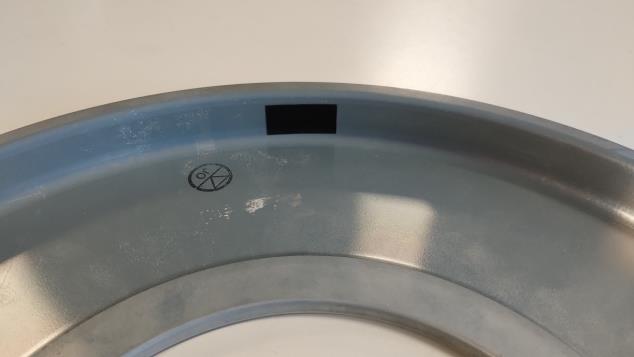
Linn's optical tachometer stands on the top plate, just inside the rim of the outer platter. It shines a light on the inner face of the rim. The bare metal reflects it. One small black marker does not, and each time the marker passes, the power supply knows the platter has made one turn.
When we fit a Lingo or a Radikal to a turntable that did not have one, we apply Linn's marker to the inside of the rim ourselves. It is matte black, it comes from Linn, and there is only one.

Optical speed control on the Sondek LP12 → How a turntable holds its speed →
Moving the turntable
When you carry a Sondek LP12 from one room to another, or lift it to clean the shelf, take the outer platter off first.
All of its weight rests on the single point of the bearing. With the platter lifted off, that load is gone, and a bump on the way does the bearing no harm. Lift it straight up, set it down on something soft, and lower it back on gently when the turntable is in place.
For a longer journey Linn's manual goes further. The inner platter comes out as well, the bearing is capped so the oil stays in, and the two platters travel in separate trays. Call us before you move house with one.
Over the years
The Sondek has had a two-piece platter from the beginning. What has changed is the bearing it turns on, and with it the inner platter.
- 1993: Cirkus. A new bearing, with a taller housing and liners set farther apart. It came with a new inner platter and spindle.
- 2009: Radikal. The marker and the tachometer made the outer platter part of the speed control.
- 2020: Karousel. The current bearing, again supplied with a new inner platter.
The platter itself is still two pieces of the same alloy, machined in the same way. None of this shows when a record is playing. It is why the platter turns at a steady speed with very little noise, and why a Sondek platter made decades ago can still be in use.
How the Sondek LP12 works → LP12 upgrades: plan the next step → The LP12 workshop → The Sondek LP12: history →