

Sondek LP12 · How it works
A sub-chassis hung on three springs
Everything that matters to the stylus rides on one suspended structure. Here is how the suspension, the single-point bearing, the drive and the arm each do their part, and why every upgrade since 1972 still fits.
How it works
A sub-chassis hung on three springs
Take the platter and the arm off an LP12 and what remains inside the plinth is a flat metal sub-chassis hanging from three springs that are bolted to the top plate. The platter bearing is fixed to the sub-chassis; so is the armboard, and therefore the arm. The motor is not. It is bolted to the top plate, outside the suspended system, and drives the inner platter through a flat belt that is the only physical link between the two.
The purpose is to make the stylus and the groove move together while everything else moves separately. Footfall, a slammed door, the loudspeakers' own output, and the motor's small vibrations all arrive at the plinth; the springs and their rubber grommets are tuned so that the sub-chassis bounces vertically at a few cycles per second and is very poor at passing anything faster. The belt, being elastic, filters the motor in the same way. Because arm and bearing share one rigid structure, the suspension can move without changing the geometry between the stylus and the record.
This is also why an LP12 depends on how it is set up. The three springs must be adjusted so the sub-chassis is level, sits at the right height, and bounces straight up and down without rocking, with the arm cable dressed so it neither pulls nor rubs. A deck that is fitted with the right parts and set up carelessly will sound worse than a lesser deck set up well, which is the reason Linn has always insisted the work is done by a trained retailer, and the reason our two technicians do it on the bench and again in your home.

How it works
The single-point bearing
The platter turns on a hardened steel spindle whose rounded tip rests on a single point at the bottom of an oil-filled bearing housing. Only that point carries the platter's weight; the walls of the housing, lined to very close tolerances, keep the spindle vertical. It is the oldest idea in the deck and the one Linn has guarded most closely: the original patent dispute of the 1970s was over this bearing, and the Cirkus of 1993 and the Karousel of 2020 are the two occasions on which Linn has replaced it outright.
The Karousel keeps the single point but rebuilds everything around it. The housing is stainless steel, the thrust-pad housing at the base is smaller and stiffer, and a substantial lock-nut clamps the bearing to the sub-chassis so that bearing, sub-chassis, spindle and platter behave as one piece. Linn describes the result as smoother rotation, greater stability and reproduction that is more accurate and detailed, and a bearing that bolts into any LP12 built since 1972, with two conditions: the outer platter on some older decks must be replaced, and the Karousel cannot be fitted to a deck that still carries a Valhalla, Wakonda or third-party supply inside the plinth.
What the bearing does for the sound is best understood by what it removes. Any play or roughness at the spindle becomes rumble beneath the music and a blurring of the quietest detail; the closer the spindle runs to true, the darker the background against which a record plays. The bearing is also where the inner platter meets the belt, so its precision sets the floor for everything the motor and power supply can do.

How the Karousel locks to the sub-chassis
Click a photograph to enlarge it; move over it to magnify.
How it works
Belt, motor and the power supply
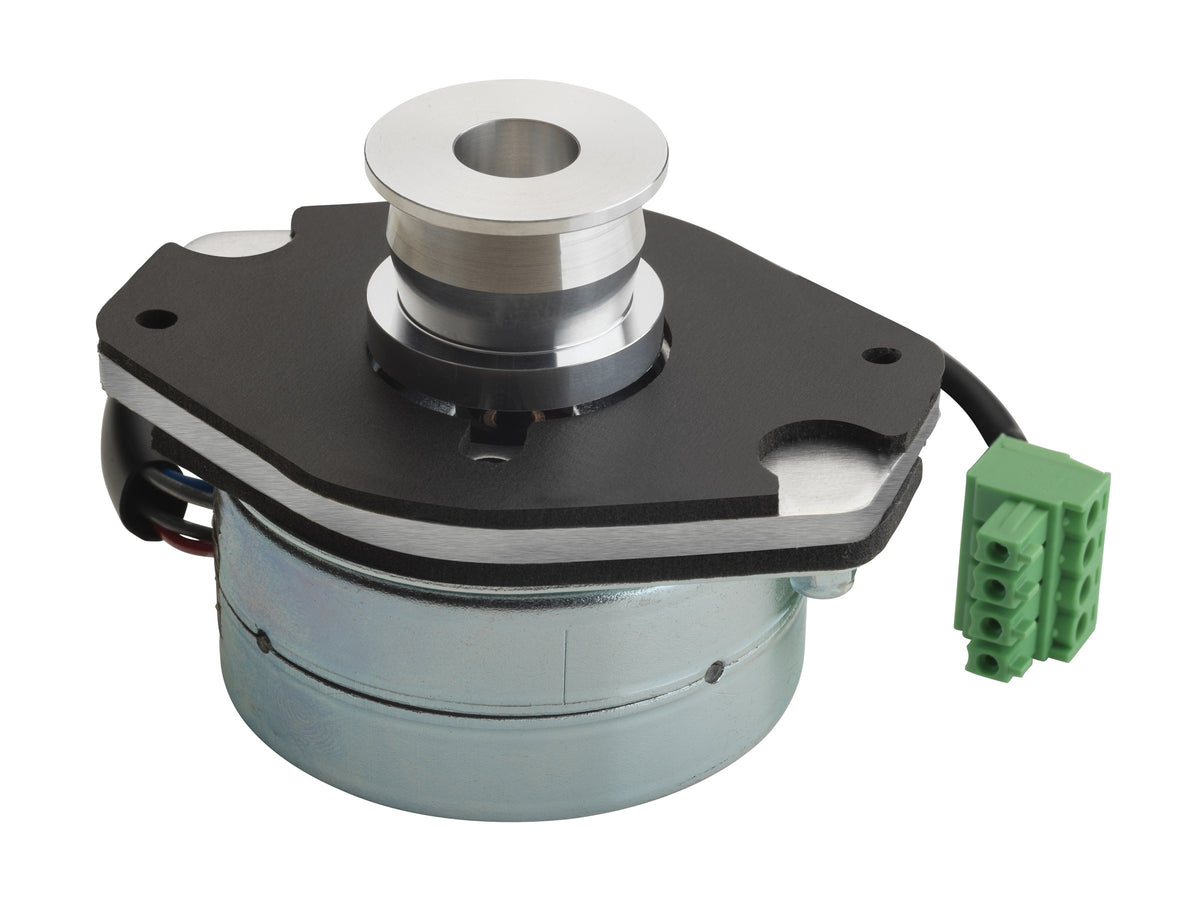
A record is cut at 33⅓ revolutions per minute and must be played at exactly that; anything else changes the pitch of every note. On the LP12 the motor sits on the top plate and turns a small pulley; a flat rubber belt runs from the pulley around the rim of the inner platter, which sits on the bearing and carries the heavy outer platter. The belt's job is to transmit torque while absorbing the motor's vibration, and its condition, clean, correctly tensioned and the right way round, is one of the small things a service visit attends to.
For most of the deck's life the motor has been an AC synchronous type that locks its speed to the frequency of the voltage feeding it. The Majik power supply inside today's entry deck filters the mains and drives a 110 V motor at 33⅓; 45 rpm comes from an adaptor over the pulley. The Lingo, now in its fourth generation, drives a 12 V AC motor from a sine wave it generates itself, in the digital domain, and uses a sensor near the motor that reads a mark on the platter to check speed on every rotation, recalibrating each time the deck is switched on and switching between 33⅓ and 45 at a touch.
The Radikal takes the other route. Its motor is a brushed DC type, in the current Klimax version a precious-metal brushed motor with a moving-coil rotor in an acoustically isolated housing, whose speed is managed by a controller that measures every rotation and corrects it; Linn claims rotation closer to 33⅓ than any other turntable. The Klimax Radikal of 2025 feeds that motor from a Utopik supply with two self-regulating rails, one for the motor and controller and one for a Urika phono stage, housed in a chassis machined from three pieces of solid aluminum and weighing nearly 14 kg. What you hear from a better supply is not louder or warmer; it is steadier. Notes hold their pitch to the end, and the music has what reviewers of the Lingo and Radikal have described as a tauter, more focused and more immediate quality.
How it works
Arm, cartridge and the first inch of signal
The tonearm has to hold the cartridge rigidly in every direction except the two it must move in, across the record and up and down with its warps, while adding as little of its own resonance to the signal as possible. Linn's three current arms answer that in three ways. The Krane is static-balanced, with a polished tungsten-and-sapphire vertical bearing and a pair of ceramic horizontal bearings, a laser-etched scale for arm height and a magnetic anti-skate. The Arko is a gimballed arm made entirely of 7075-grade aluminum, from the cold-drawn arm tube to the headshell and gimbal, on a single-piece polished stainless-steel spindle. The Ekos SE is hand-built with a titanium arm tube, a stainless-steel bearing housing, bearings with less than 20 mg of friction and temperature-compensated springs for downforce and anti-skate, so that the settings hold as the room warms and cools.
All three share Linn's effective length and offset angle, and on the Kore and Keel SE the arm collar bolts directly to the sub-chassis rather than to a separate board, so the arm and the bearing are coupled as rigidly as the structure allows. The cartridge is chosen to match: the moving magnet Adikt for the Majik LP12 MM, the entry moving coils Koil and Krystal, the Kendo, designed alongside the Arko with the same 7075 body so that energy drains from cartridge to arm without a boundary, and the Ekstatik, with a micro-ridge stylus on a sapphire cantilever in a honeycomb-machined, diamond-like-carbon-coated body.
A moving coil produces well under a millivolt. On a conventional system that signal leaves the deck through a tonearm cable and travels to a phono stage elsewhere in the rack; on an LP12 with a Radikal it can instead travel a few inches to a Urika mounted on the Trampolin inside the plinth, where it is amplified, or in the Urika II digitized at once, equalized to the RIAA curve in the digital domain with per-unit calibration, and sent losslessly over Exakt Link to a Linn DS or DSM. Linn's claim for the arrangement is lower noise, lower distortion and more music, and it is the final step that distinguishes the Klimax LP12 from everything below it.

The arms and a cartridge, close up
Click a photograph to enlarge it; move over it to magnify.
How it works
Why every upgrade fits
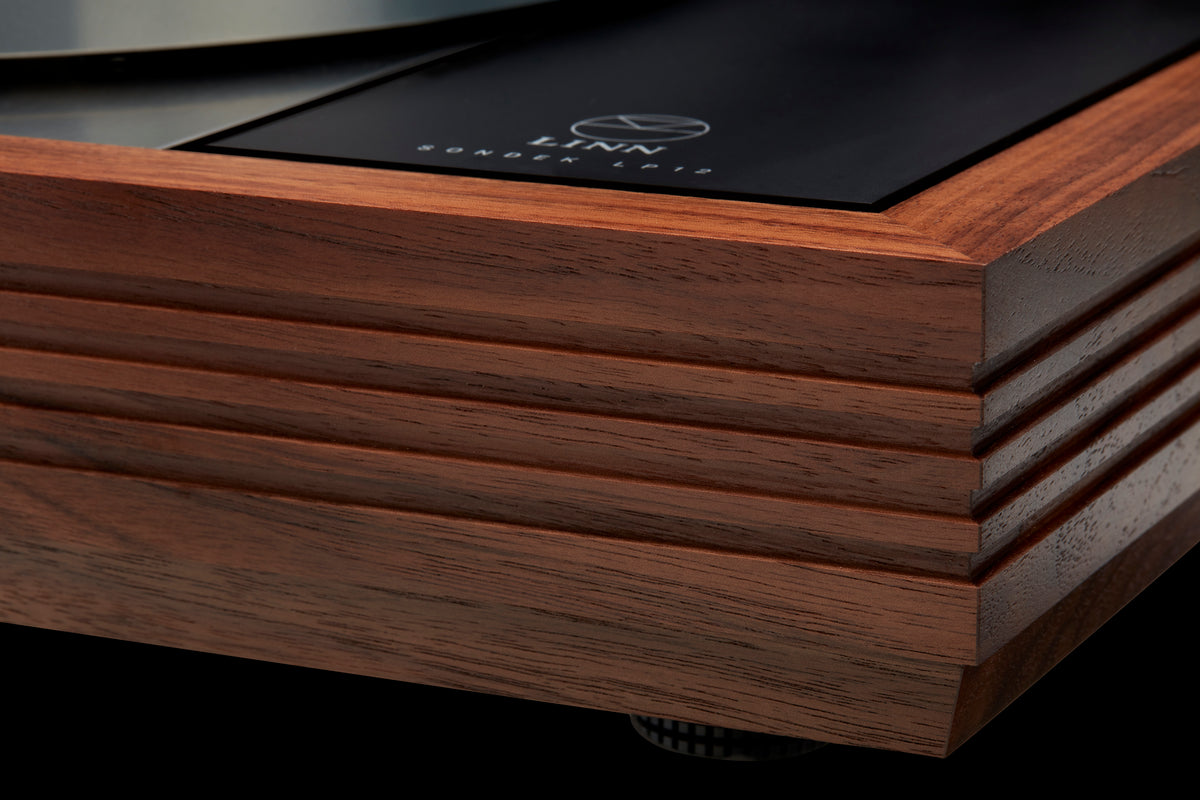
The LP12's plinth is a frame of kiln-dried hardwood, braced at the corners, with a stainless-steel top plate carrying the motor, the switch and the three suspension bolts. Those bolts, the cut-out for the arm, the position of the motor and the dimensions of the platter have not moved since 1972. Every sub-chassis, bearing, power supply board, base board and arm Linn has released since has been machined to that fixed geometry, which is the mechanical reason a 1970s deck and a 2026 Klimax LP12 can exchange parts.
There are a few boundaries. Linn says the Lingo 4 fits any plinth made after 1984; the Karousel cannot share a plinth with a Valhalla board; the Keel SE and Kore are made for Linn arms, with Kore versions for Rega, SME and Naim arms; the Urika needs a Radikal to power it and the Urika II needs an Exakt-enabled Linn player to receive it. Within those limits a deck can be improved in any order, in any decade, and the one part that most owners never replace, the plinth, now has a replacement of its own in Bedrok. Our technicians have rebuilt Sondeks from every era onto current parts, and the question we ask first is not what year the deck is but which bearing is in it.
A legend can be intimidating, especially when it's a classic, a revolutionary, an iconoclast, a survivor.
Hear it in Portland
The engineering, demonstrated.
Hear what a Lingo, a Kore, a Radikal or an Ekos SE adds, one part at a time, on the five LP12s in our rooms.
Arrange an LP12 auditionOr call (503) 222-2599 · sales@pearlaudio.com · Back to the LP12 overview