
Turntables · Technics
The SL-1200 and its pitch control
The slider on a Technics SL-1200 changes how fast the record turns. It began as a fine adjustment. DJs made it part of an instrument, and a new kind of music grew up around it.
What it does
Pitch control speeds the platter up or slows it down by a few percent. Tempo and pitch move together: faster is also higher.
On an SL-1200 the basic range is 8 percent either way, a little more than a semitone. At the center the turntable runs at its exact speed, and a strobe on the rim of the platter shows it.

The picture shows the control as it is made today. The slider runs along a scale marked in percent, with zero at the center. The round button beside it is the reset: press it and the turntable returns to its exact speed, wherever the slider sits. The small button above the scale doubles the range, from 8 percent to 16.
From a dial to a slider
- 1972: the first SL-1200. It had small dials for trimming the speed. Technics meant them for correcting it. DJs found another use, and turned them to match the tempo of one record to the next.
- The mid-1970s: Chicago. Technics sent its people to the clubs. They watched DJs at work on the SL-1200 and asked what they wanted changed.
- 1979: the SL-1200MK2. The dial became a long slider with a wider range, easy to set and easy to return to. Quartz lock held the exact speed at the center. A pop-up light showed the stylus in the dark, and the switches were lowered so a hand would not knock them.
- Later versions. A reset button returned the turntable to exact speed without moving the slider. A second range of 16 percent was added.

In the clubs
A DJ plays two records and moves from one to the other without a break. For that the two have to share a tempo. The DJ listens to the next record in headphones and moves its slider until the beats line up.
Direct drive made this practical. The platter comes up to speed at once, and returns to it the moment a hand lets go of the record.
By the 1990s DJs were playing a different club every night, and clubs wanted one turntable that every DJ already knew. It was the SL-1200. Technics and direct drive →
Hip-hop and the SL-1200MK2
On August 11, 1973, at a party in the Bronx, DJ Kool Herc played two copies of the same record on a pair of Technics SL-1100 turntables. He cut from one to the other to keep the drum break going. It needed turntables that started at once and could be spun backward by hand. Belt-drive turntables could not do it.
Others built on the idea:
- Grandmaster Flash worked out a way of cutting between two copies to repeat the best few seconds of a record again and again. He called it the Quick Mix Theory.
- Grand Wizzard Theodore, still a schoolboy in 1977, moved the record back and forth under the stylus and made the sound a rhythm of its own. It became known as scratching.
The SL-1200MK2 arrived in 1979, and it suited all of this. Theodore told XXL magazine in 1998 that once Technics made the 1200 the question was settled, because it was built for what DJs do.
Two museums now keep one. The Smithsonian's National Museum of American History has an SL-1200MK2 used by Grandmaster Flash. The Science Museum in London has a pair of SL-1210MK2 turntables.
The turntable became a studio tool as well. DJ Shadow made his 1996 album Endtroducing..... from records, with a sampler, a tape recorder and one Technics SL-1200. He used its pitch control to make samples from different records fit together.
Built to travel
A club turntable is carried, stacked, set up in the dark and played beside loud speakers. Technics built the MK2 for that life. Its top was die-cast aluminum over a base of heavy rubber, on large insulating feet, so that sound from the room did not shake the stylus.
The DJ A-Trak still owns the first pair he bought, secondhand. "It's built like a tank," he told Mixmag.
That sturdiness is still there, and it is why an SL-1200 is heavy:
- The SL-1200GR2 weighs 25.4 pounds. It has a die-cast aluminum chassis under a second, molded layer, and a 5.5-pound platter of aluminum backed with rubber.
- The SL-1200G weighs 39.7 pounds. Its cabinet has four layers, and its platter of brass, aluminum and rubber weighs nearly 8 pounds.
Mass and damping keep vibration away from the stylus. At home that means a quieter background. On the road it meant a turntable that kept working.
By the way, the heaviest Technics is not a club turntable at all. The SL-1000RE weighs 88.7 pounds, and its separate control unit adds 4.7 more. The platter alone, brass and aluminum with tungsten weights at its rim, is more than 17 pounds. That is about three and a half SL-1200GR2s in one turntable. It is a two-person lift, and the shelf has to be chosen for it.
Musicians and the SL-1200
- Questlove, the drummer of The Roots, first saw a DJ's pair of Technics 1200s in 1977, in a nightclub in Valley Forge, Pennsylvania.
- A-Trak won a gold pair at the DMC championship in 1997, at fifteen.
- DJ Shadow composed with one, as described above.
Pitch control matters to anyone who plays an instrument, because it changes the pitch of the record and not only the tempo.
- Tuning the record. Many older records do not play at concert pitch. A reviewer for The Absolute Sound used the pitch control of the SL-1200G to bring such records back into tune.
- Playing along. A piano cannot be retuned to suit a record. With a pitch control, the record is tuned to the piano.
- Learning by ear. Slowing the record slows a fast passage, though the pitch drops with it.
Pitch control on today's turntables
| Turntable | Pitch control |
|---|---|
| SL-1500C | None. It is the Technics for listening only. |
| SL-1200GR2, SL-1210GR2 | Slider, 8 or 16 percent either way, with strobe |
| SL-1200G, SL-1210G | Slider, 8 or 16 percent either way, with strobe |
| SL-1000RE, SP-10RE | 16 percent either way, set to two decimal places on the control unit's display |
The SL-1500C: an SL-1200 without the slider
The SL-1500C comes from the same family. It has a coreless direct-drive motor and the same kind of S-shaped arm. What it leaves out is the club equipment: there is no pitch slider and no strobe.
Leaving those out is part of why it costs less than an SL-1200GR2. In their place it has what a listener at home will use: a phono stage built in, a cartridge already fitted, and an arm that lifts at the end of the side.
If you play records at the speed they were cut, nothing is lost.
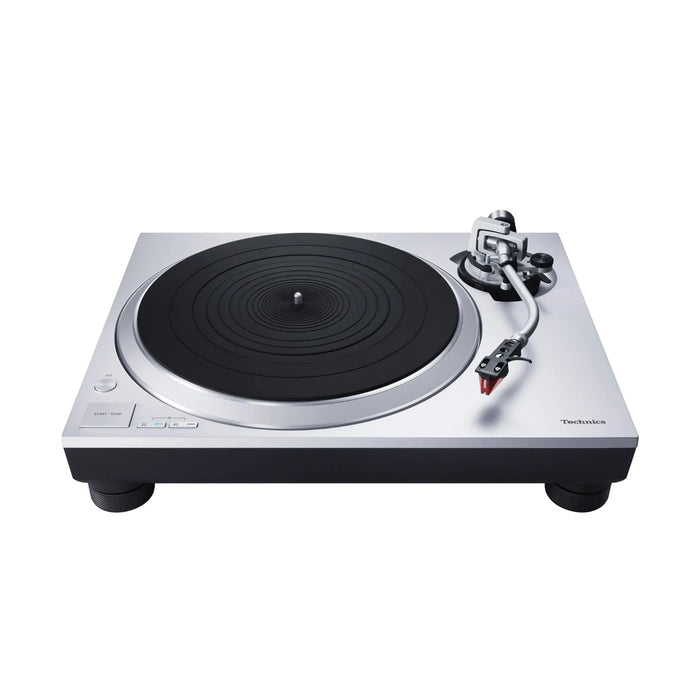 SL-1500C
From $1,500
No pitch control. Phono stage and cartridge included.
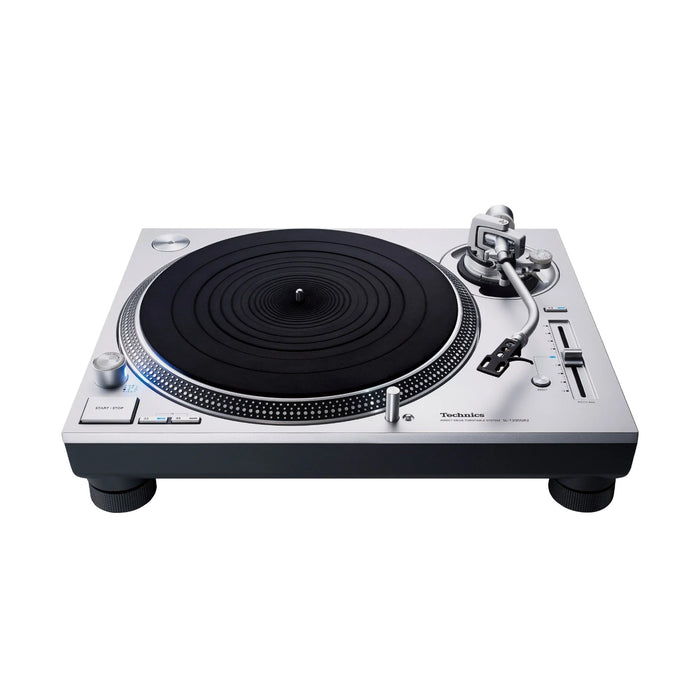 SL-1200GR2
$2,500
Pitch slider, strobe and electronic brake. Silver.
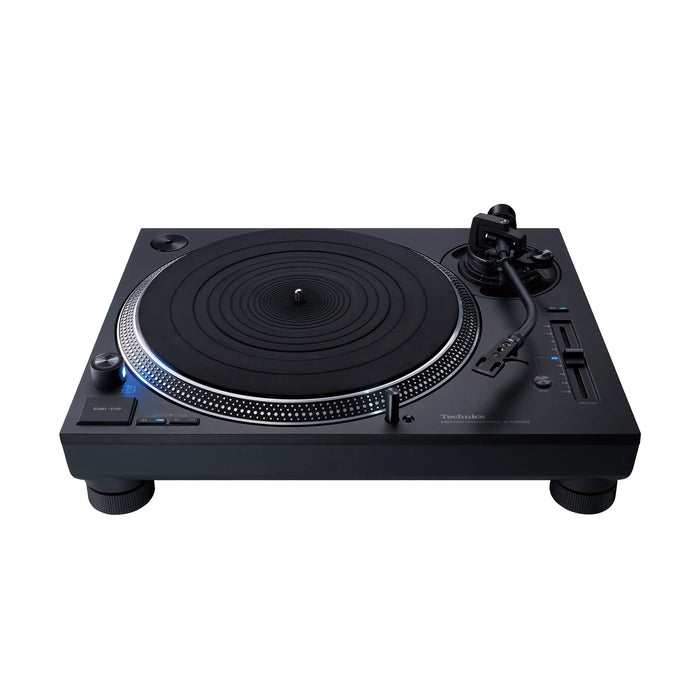 SL-1210GR2
$2,500
The same turntable in black.
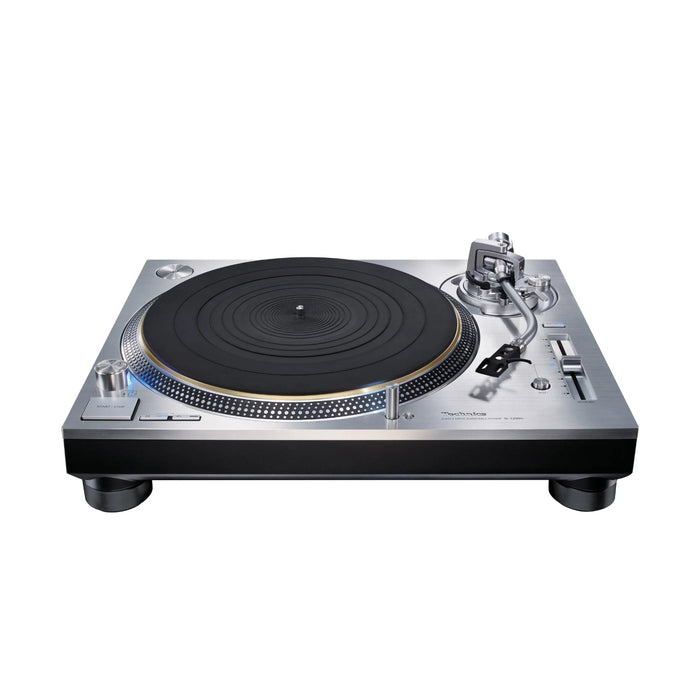 SL-1200G
$5,000
Pitch slider and strobe, on the twin-rotor motor. Silver.
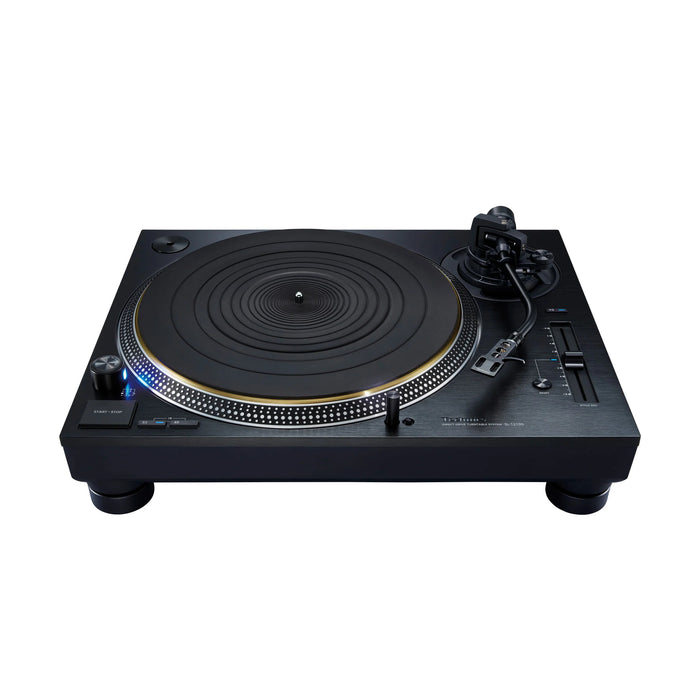 SL-1210G
$5,000
The same turntable in black.
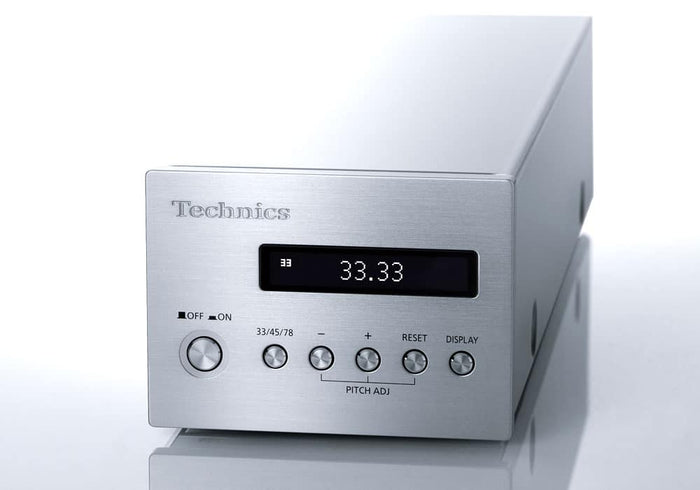 SL-1000RE
$24,700
Speed set to two decimal places.
Technics and direct drive → Technics turntables at Pearl → The Technics story →
Further reading
- Technics: History of the SL-1200
- Stereophile: a history of the Technics SL-1200
- Brian Coleman, XXL, 1998: The Technics 1200, Hammer of the Gods
- NPR: Grand Wizzard Theodore and the invention of scratching
- What Hi-Fi?: an interview with Grandmaster Flash
- Oxford University Press: twelve crucial moments in hip-hop DJ history
- Smithsonian: the Technics turntable used by Grandmaster Flash
- Science Museum Group: Technics SL-1210MK2
- DJ Mag: how DJ Shadow made Endtroducing.....
- Mixmag: A-Trak's journey with turntables
- DJ Times: an interview with Questlove
- The Absolute Sound: Technics SL-1200G