



Nelson Pass
Nelson Pass grew up with his mother's record collection and an AM radio. As a teenager he helped assemble a Heathkit, then put together his first system from a Garrard turntable, a Radio Shack amplifier and loudspeaker boxes he made himself, and soon had the amplifier apart to improve its cooling. By his second year of college he was building his own equipment. He studied physics at the University of California, Davis, taking his degree in 1974, and worked nights at the loudspeaker maker ESS, where he assisted Dr. Oskar Heil with crossovers, woofers and cabinets. A colleague there handed him a set of semiconductor application books, and from those he taught himself circuit design.
Threshold
In December 1974, with a partner from ESS, he founded Threshold Electronics in Sacramento. Money was short in the early years, but the first amplifier, the 800A of 1975, made the company's name: it used a new biasing scheme to deliver Class A performance at 200 watts. In 1978 came Stasis, a patented circuit that let an amplifier run without the corrective feedback other designs relied on. It carried Threshold through the 1980s and was licensed by Nakamichi.
Two habits from those years never left him. The first was a change of mind about measurement: having begun by chasing the best figures, he came to prefer circuits that are linear to start with and need little correction. The second was generosity. From 1978 he published simple Class A amplifiers for people to build at home, and he has gone on sharing designs with home builders ever since. In the mid-1980s he also designed the well-reviewed Adcom GFA-555.
How Pass Labs came to be
By 1991 he wanted to build something simpler. He left Threshold and started Pass Laboratories in his home shop in northern California. He and a colleague built their own milling machines to make the casework, and his next-door neighbor was hired to help build the amplifiers; she still helps run the company. The first product, the Aleph 0 monoblock, shipped in 1992: a single-ended Class A amplifier built around power MOSFETs, which he valued for behaving much as tubes do. Stereophile named it Amplification Component of 1995, and its reviewer called it “the solid-state amplifier of the decade.”
The Aleph
The idea behind the Aleph was that everything done to a musical signal leaves its mark, so the best circuit is the one that does the least. The second generation of 1994 had just two stages of amplification where conventional designs used as many as eight, needed no adjustment, and ran single-ended all the time, helped by a current source of his own invention. It asked listeners to think differently about power: a 200-watt amplifier sounds only about twice as loud as a 30-watt one, and the Aleph 3 offered 30 watts of a quality that made the trade worthwhile.
The Alephs looked like nothing else: black boxes with heatsink fins on every side and, on the larger models, a single blue light. They ran warm, and they were built to last, with input transistors chosen so strictly that only about one in ten passed. The family ran from the Aleph 3 through the Aleph 2 and the 200-watt Aleph 1.2 monoblocks to the Aleph P preamplifier. Reviewers of the day heard no electronic signature: ease, natural timbre, a three-dimensional soundstage, tuneful bass and a sweet top end.
Supersymmetry and the X amplifiers
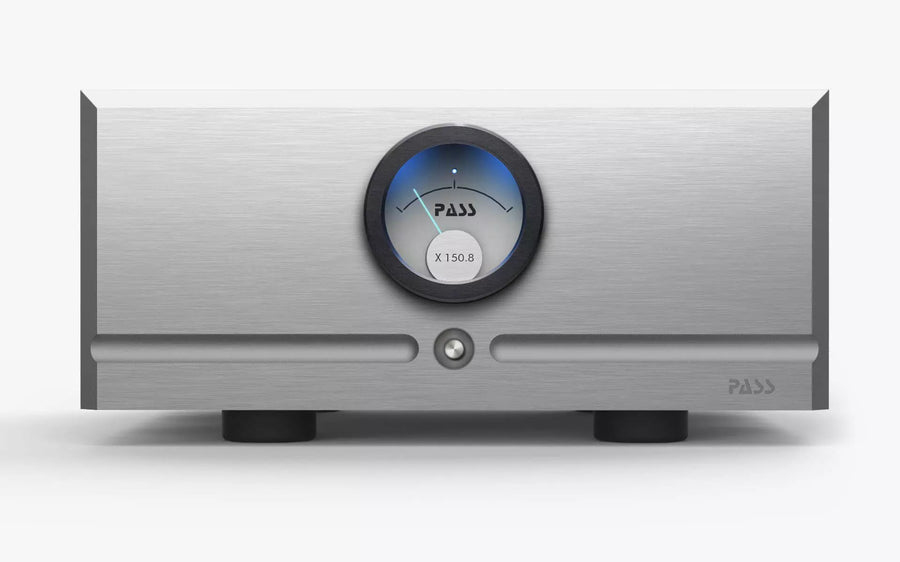
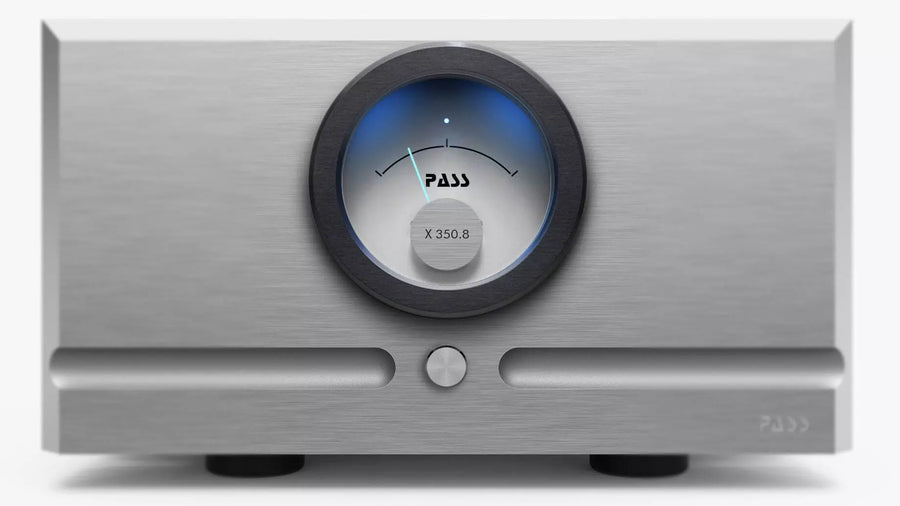
In 1994 Nelson Pass patented Supersymmetry, which pairs the two balanced halves of an amplifier so that their noise and distortion match and cancel at the output. It let the company build much larger amplifiers on the same simple principles. The X1000 of 1998 was the first amplifier built on it, and the X series that followed remains the mainstay of the company's power amplifiers. The XA series of 2002 joined that circuit to an Aleph-style output stage; he has described the aim as a warm, sweet X amplifier or, put the other way, a powerfully dynamic Aleph.
The amplifiers of today
The two-chassis Xs monoblocks of 2012 were developed over three years, led by listening, and what was learned from them went into the Point 8 generation of 2014: nine X and XA amplifiers, seven years in the making, with deeper Class A operation, larger heatsinks and bigger power supplies. Integrated amplifiers descended from them followed in 2015, and in 2017 the XA25, a 25-watt Class A amplifier with a single pair of output devices in each channel. These are heavy machines. The XA60.8 puts 60 watts in a chassis of 88 pounds, and Nelson Pass has said that the weight is in the heatsinks and power transformers and that, all else being equal, the amplifier with the bigger hardware seems to have the advantage.
The words reviewers use for the current amplifiers are touch, texture, delicacy and sweetness, with body, impact, authority and a huge, precise soundstage, and no hardness. Stereophile's measurements of the XA60.8 found it quiet, with far more usable power than its 60-watt rating suggests.
First Watt
Alongside Pass Labs, Nelson Pass runs First Watt, which he describes as a kitchen-table venture, where he builds small numbers of amplifiers of 25 watts or less to try ideas that fall outside the main range. What he learns there comes back. Work with unusual transistors at First Watt taught him how the character of an amplifier's distortion shapes the sense of depth in a recording, and that understanding went into the Pass Labs amplifiers.
Wayne Colburn
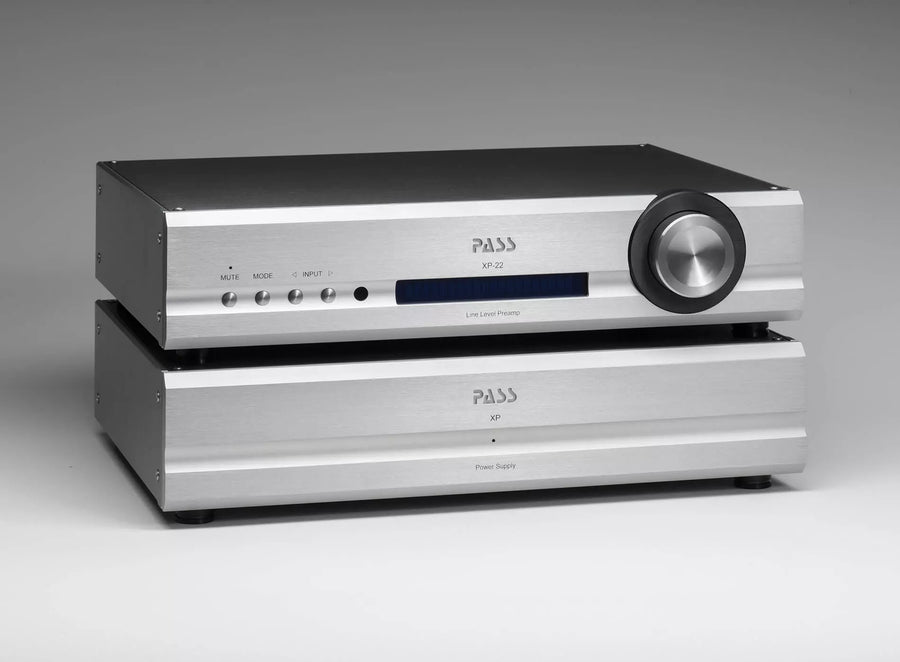
Wayne Colburn joined in 1994 to work on an improved preamplifier and a new phono stage, and he has designed the company's preamplifiers and phono stages ever since: the later Aleph P, the Xono, the XP line that began in 2008, and the Xs preamplifiers at the top of the range. Stereophile named his XP-22 its Amplification Product of the Year for 2019, the three-chassis XP-32 followed in 2021, and the Xs Pre 2 of 2025 is one he has called his best work. At Pearl Audio we think especially highly of his phono stages.
Built in California
Pass Labs moved from the home shop to Foresthill, California, in 1997, and in 2014 to a factory in Auburn nearly three times the size, with every operation under one roof; research stays in the original shop. Circuit boards are assembled and inspected by hand, front panels are machined nearby from solid aluminum, and every amplifier runs for three days at a constant temperature before its bias is set.
Kent English is one of the two people who manage the day-to-day running of the company, and Nelson Pass and Wayne Colburn still design the products. Pass Labs keeps parts for everything it has made, which matters for an amplifier bought to be kept.