(503) 222-25991038 NW Johnson St, Portland · Mon–Sat 10–5:30
The
Pass Labs story
Single-ended and Supersymmetric Class A amplification by Nelson Pass, built by hand in California since 1991.
Founded 1991 in Northern California; built in Auburn, California since 2014 by Nelson Pass ·
passlabs.com ↗
The history and technologies of Pass Laboratories of Auburn, California, and what Pearl Audio keeps on the floor.
Nelson Pass was born on June 27, 1951, and studied physics at UC Davis, taking his degree in 1974. While a student he worked at ESS, assisting Dr. Oskar Heil with crossover design, woofer selection and cabinetry for the Heil Air-Motion Transformer loudspeakers, and a colleague handed him the National Semiconductor application books, which is how he learned circuit design. On December 5, 1974 he and graphic designer René Besne incorporated Threshold Electronics in Sacramento; its first product, the 800A of early 1975, used a dynamic bias scheme for Class A performance at high power. His 1978 patent for the Stasis circuit, a current bootstrap that holds output current nearly constant so the amplifier can run without loop feedback, became Threshold's basis through the 1980s, and in 1985 Nakamichi licensed it for the PA-5 and PA-7. From 1978 he also published simple Class A amplifiers for home builders, the A20, A40, A75 and later the Zen series, and in the mid-1980s he designed the Adcom GFA-555. He left Threshold at the end of 1991 to build, as he put it, simpler amplifiers operated single-ended Class A.
Pass Laboratories was founded in 1991 in Pass's home shop, where he and Mike Burley built three CNC milling machines of their own and prototyped single-ended Class A amplifiers. The first product, the Aleph 0, shipped in 1992: a monoblock rated at 70 watts into 8 ohms through three gain stages of power MOSFETs, which Stereophile listed at $7,000 a pair in 1995. Elena Tong, Pass's next-door neighbor, was hired that year and manages much of the company to this day. The Aleph 1 followed in 1993, and in 1994 the circuit was simplified to two gain stages with a patented active current source, giving the Aleph 1.2, Aleph 2, Aleph 3, Aleph L and Aleph P. Wayne Colburn joined the same year to work on an improved preamplifier and a new phono stage, and has designed the company's preamplifiers ever since. Also in 1994 Pass was issued US patent 5,376,899 for Supersymmetry, which cross-couples two balanced amplifiers so that their noise and distortion match and cancel at the output. Stereophile's review of the Aleph 1.2 in 1997 ended with "Oh my God; they just showed me the magic."
The INT-60 and a pair of XA-160.8 monoblocks in our Small Room, January 2023. Photo: Pearl Audio.
The INT-60
→
Joe Sammut, Threshold's third partner, left Krell in 1995 to run operations, and Desmond Harrington joined as a designer in 1996 and did the mechanical design of the X1000. In 1997 the company moved from Pass's shop to a new facility in Foresthill, California, with research staying in the original shop, and produced a revised Aleph P, the Aleph Ono phono stage, the D1 DAC and the X0, X1 and Xono preamplifiers. The X1000 of 1998 was the first Supersymmetric amplifier, followed by the X600, X350, X250 and X150; Pass still calls the X series the mainstay of the company's amplifier products. Sammut became President in 1998, freeing Pass to spend all his time on design. The same year Pass started First Watt as a kitchen-table effort to explore low-power amplifiers of 25 watts or less that fall outside what suits Pass Labs, with commercial production from about 2000; he describes Pass Labs as his more commercial enterprise. The 2002 XA series, beginning with the XA200 and XA160, joined the X front end to an Aleph output stage, and the X150.5 of 2003 began the .5 revisions.
Harrington became President in 2007, with Sammut moving to sales and marketing and Tong and Kent English managing the rest of the company. In August 2008 the XA.5 series of five Class A amplifiers was announced, and in October the XP-10 and XP-20 preamplifiers began the XP line; the XP-15 phono stage and the SR1 loudspeaker came in 2009, the X260.5 monoblock in 2010. At CES in January 2012 Pass Labs showed the two-box Xs 150 and Xs 300 flagship monoblocks, at $65,000 and $85,000 a pair, after three years of listening-led development, and in 2013 the two-chassis Xs Preamp, with Colburn as lead designer. Reviewing the Xs Preamp and Xs 300 together in The Absolute Sound in May 2014, Anthony Cordesman called them the two best-sounding examples of a preamplifier and power amplifier he had yet heard, and the Xs 300 the first Class A amplifier he had heard that did not even slightly soften the upper midrange. What was learned in the Xs program went into everything that followed.
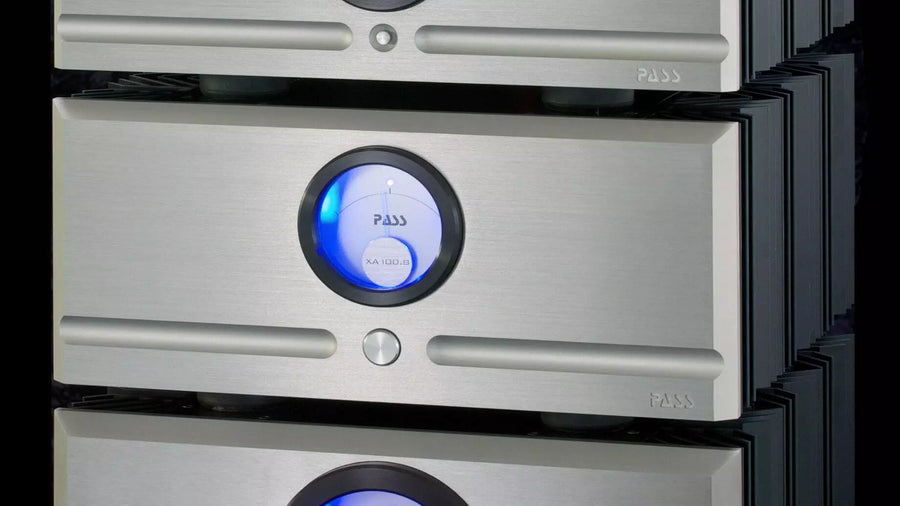
Pass Labs amplifiers on a rack at Pearl Audio, September 2024. Photo: Pearl Audio.
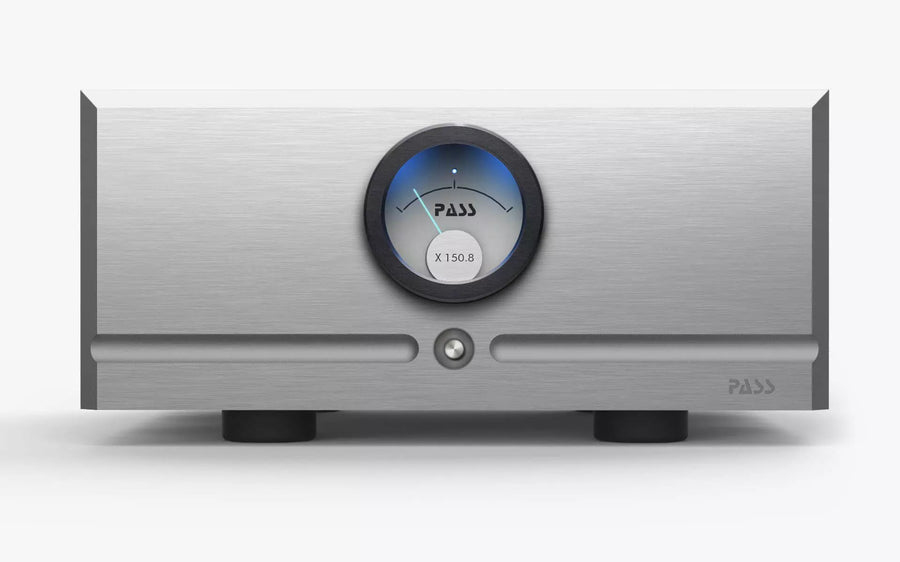
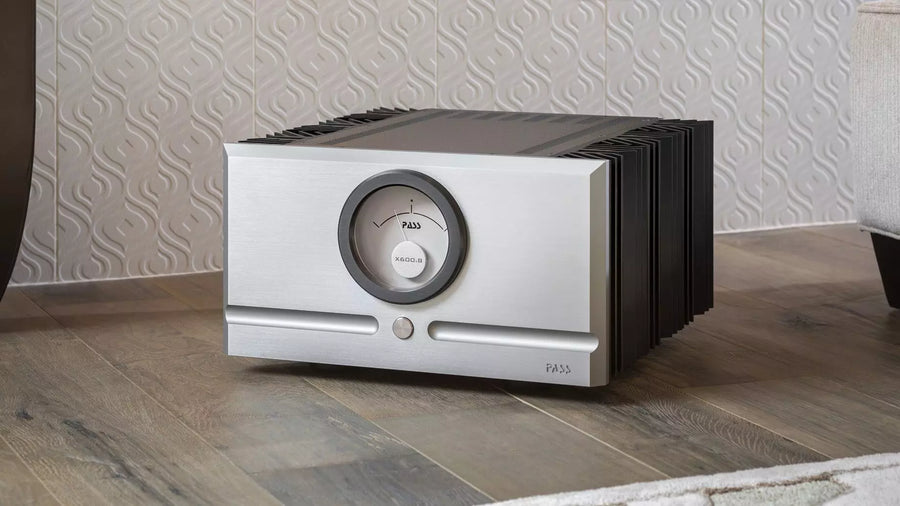
On January 7, 2014 the company announced the Point 8 generation: nine amplifiers, the X150.8, X250.8, X350.8, X600.8, XA30.8, XA60.8, XA100.8, XA160.8 and XA200.8, seven years in the making, with a DC-coupled current-feedback front end, deeper Class A bias, bigger heatsinks and a third more supply capacitance. On April 15 it moved from Foresthill into a new factory in Auburn, California, nearly three times the size, with every operation under one roof. The INT-60 and INT-250 integrateds, at $9,000 and $12,000, followed in January 2015, the HPA-1 headphone amplifier by Jam Somasundram in 2016, and in April 2017 the XA25, a 25-watt Class A amplifier with a single pair of 700-watt FETs per channel and no ballast resistors, at $4,900. Colburn's XP-12 line stage ($5,800) and XP-17 phono stage ($4,300) arrived in 2017, the XP-22 ($9,500) and XP-27 ($11,500) at AXPONA in April 2018, the INT-25 ($7,250) in May 2019, and the three-chassis XP-32 in 2020–21. Stereophile named the XP-22 its Amplification Product of the Year for 2019.
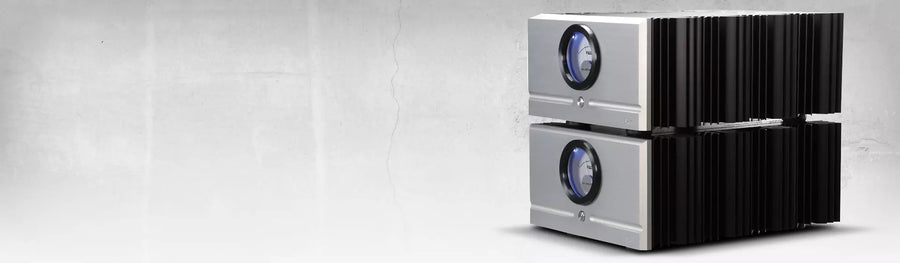
A stack of Pass Labs amplifiers in our Big Room, March 2025. Photo: Pearl Audio.
In Auburn today, circuit boards are assembled and inspected by hand, front panels are machined locally from a single slab of aluminum and anodized to match each chassis, and every amplifier runs for three days in a room held at constant temperature so that its bias can be set identically to every other. Harrington has said the company does not build test equipment and goes by sound, and that there has never been a Pass Labs product made that it does not have parts for. In 2025 Colburn's three-box Xs Pre 2 ($55,000) succeeded the Xs Preamp, with Colburn calling it the best work he had done in 35 years, and in September the HPA-1c, his revision of the HPA-1, arrived at $4,045. Pass Labs' About page names Harrington as President, Sammut in sales and marketing, Tong and English managing the rest, and Pass and Colburn still developing products. Stereophile's Fall 2026 Recommended Components lists the XA25, XA60.8, XP-32 and INT-25 in Class A, and the XP-27 was Class A+ in 2025.
MilestonesScroll →
1974ThresholdAfter a physics degree at UC Davis and two years assisting Oskar Heil at ESS, Nelson Pass and René Besne incorporate Threshold Electronics in Sacramento on December 5. The 800A follows in early 1975.
1978Stasis, and the first DIY amplifiersPass's patented Stasis circuit lets an amplifier run without loop feedback; Nakamichi licenses it in 1985. The same year he begins publishing simple Class A amplifiers for home builders, the A20, A40 and A75.
1991Pass Laboratories foundedPass leaves Threshold at the end of the year and starts the company in his home shop, where he and Mike Burley build three CNC milling machines and prototype single-ended Class A amplifiers.
1992Aleph 0The first product ships: a single-ended Class A monoblock, 70 watts into 8 ohms, three gain stages of power MOSFETs. Elena Tong is hired the same year and still manages much of the company.
1994Supersymmetry patented; Wayne Colburn joinsUS patent 5,376,899 cross-couples two balanced amplifiers so their errors cancel. The Aleph is simplified to two gain stages with a patented current source, and Colburn begins the preamplifier and phono work he leads to this day.
1997ForesthillThe company moves into a facility in Foresthill, California. A revised Aleph P, the Aleph Ono, the D1 DAC and the X0, X1 and Xono preamplifiers follow by 1999.
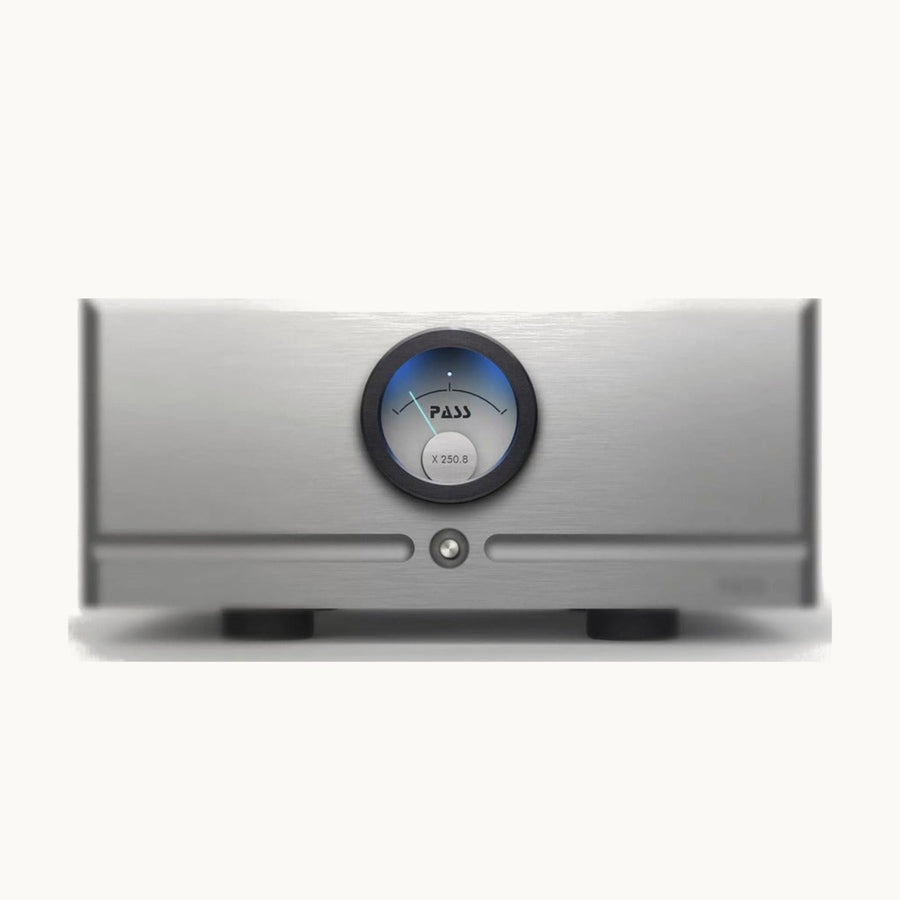
1998X1000; First WattThe first Supersymmetric amplifier, followed by the X600, X350, X250 and X150. Joe Sammut becomes President, and Pass starts First Watt as a kitchen-table outlet for amplifiers of 25 watts or less.Pass Labs X250.8 Amplifier
→
2008XA.5 and the XP preamplifiersDesmond Harrington has been President since 2007. Five XA.5 Class A amplifiers are announced in August, and the XP-10 and XP-20 in October begin the XP line; the XP-15 phono stage follows in 2009.Pass Labs XP-12 Preamplifier
→
2012Xs 150 and Xs 300Two-box flagship monoblocks, $65,000 and $85,000 a pair at CES, after three years of listening-led development. The two-chassis Xs Preamp follows in 2013 and the Xs Phono in 2014.
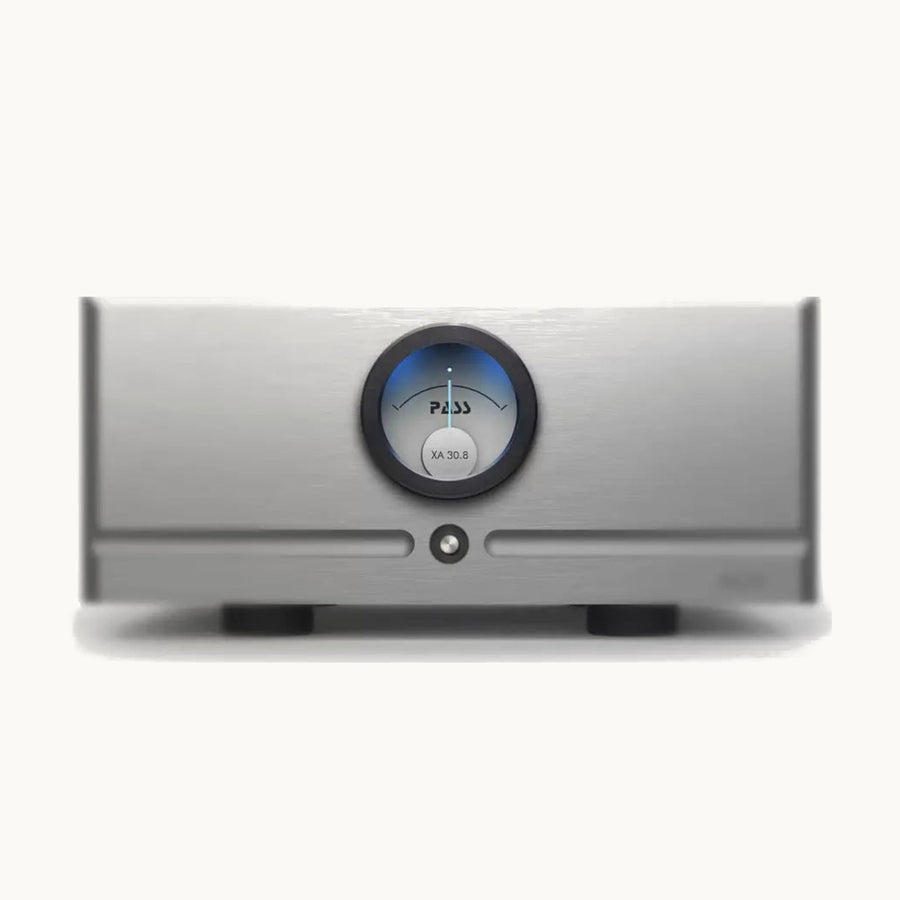
2014Point 8; the Auburn factoryNine .8 amplifiers announced on January 7 after seven years of development; on April 15 the company moves into a factory in Auburn, California nearly three times the size of Foresthill.Pass Labs XA-30.8 Stereo Amplifier
→
2015INT-60 and INT-250Integrated amplifiers descended from the Point 8 series, at $9,000 and $12,000. The HPA-1 headphone amplifier, by Jam Somasundram, follows in 2016.Pass Labs INT-60 Integrated Amplifier
→
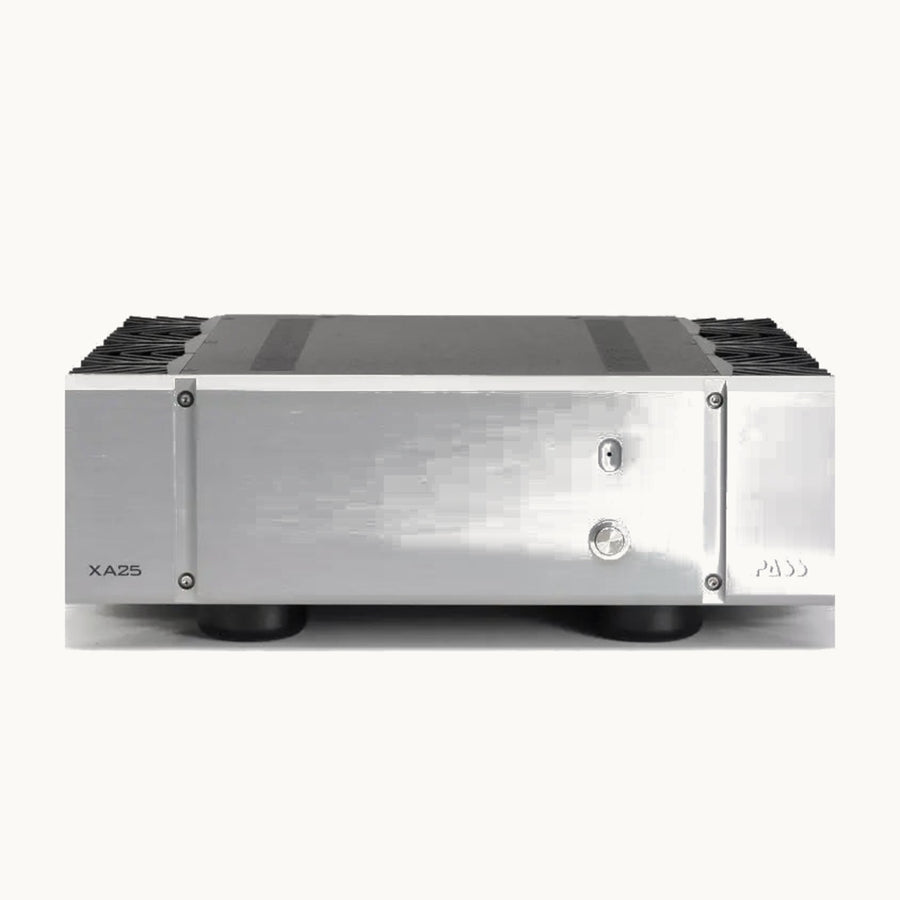
2017XA25, XP-12 and XP-17The XA25, $4,900, puts a single pair of 700-watt FETs per channel in undegenerated push-pull Class A. Colburn's XP-12 line stage ($5,800) and XP-17 phono stage ($4,300) arrive the same year.Pass Labs XA-25 Amplifier
→
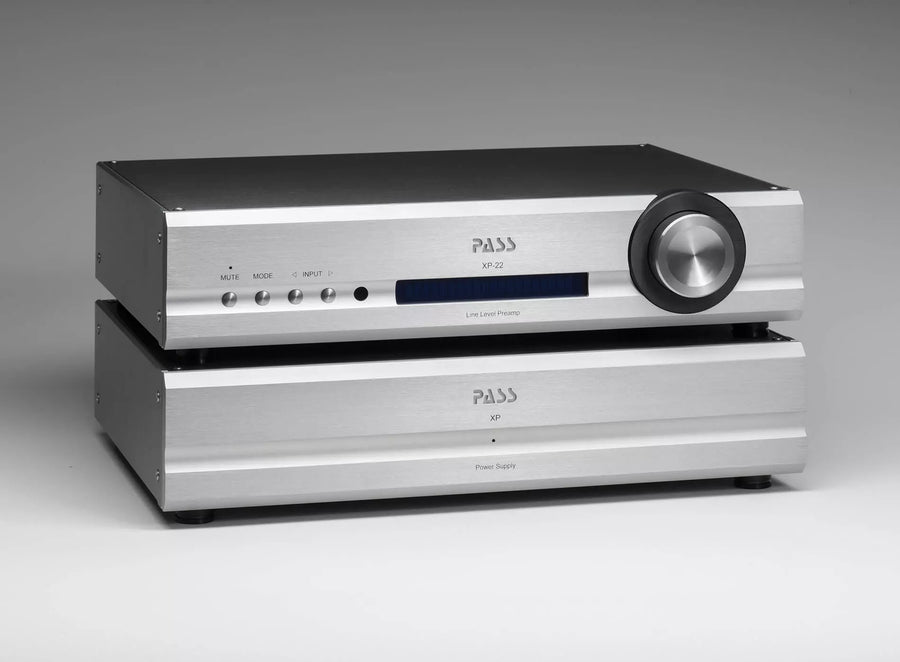
2018XP-22 and XP-27Introduced at AXPONA in April at $9,500 and $11,500. Stereophile names the XP-22 its Amplification Product of the Year for 2019; the INT-25 integrated follows in May 2019.Pass Labs XP-22 Preamplifier
→
2021XP-32The three-chassis line stage replaces the XP-30, with one chassis per channel and a third for control and power; John Atkinson reviews it in Stereophile in March 2021.Pass Labs XP-32 Reference Line Preamplifier
→
2025Xs Pre 2 and HPA-1cColburn's three-box Xs Pre 2 ($55,000), which he calls the best work of his 35 years, and in September the HPA-1c, his revision of the HPA-1 at $4,045.Pass Labs HPA-1c Headphone Amplifier
→
Pass Labs at Pearl Audio
Pearl Audio is an authorized Pass Labs dealer in Portland. We carry the XA and X .8 amplifiers, the XA25, the INT-60 and INT-250 integrateds, the XP line stages and phono stages and the HPA-1c, and we can order any current Pass Labs product in silver or black. Because a Class A amplifier's rating is its Class A envelope rather than its limit, we help match the model to the loudspeaker and the room, and we deliver, place and connect the heavier pieces ourselves. Pass Labs builds to order in Auburn, California, and the factory keeps parts for every product it has made.
Signature technologies
The engineering behind Pass Labs
Pass Labs gives its technologies names because each one solves a specific problem. Here is what each does, where it came from, why it matters in a system, and what you may hear.

Single ended amplification only comes in pure Class ASince 1992
Single-ended Class A
In a single-ended amplifier one device, or one bank of devices, carries the whole waveform, biased with a constant current so it never switches off. Pass Labs' first product, the Aleph 0 of 1992, was built this way, and the output stage of every XA amplifier descends from it.Read the deep diveClose
What it does
Nelson Pass left Threshold at the end of 1991 to build, in his words, simpler amplifiers operated single-ended Class A. The Aleph 0 shipped in 1992: a monoblock rated at 70 watts into 8 ohms through three gain stages of power MOSFETs, which Stereophile's 1995 specifications sidebar described as a single-ended class-A monoblock augmented by a class-A push-pull stage, at $7,000 a pair. In 1994 the circuit was simplified to two gain stages, with the output device biased from an active current source on the negative rail; that current source, US patent 5,710,522, underlies the whole Aleph line, from the Aleph 1.2, 2 and 3 through the Aleph L and Aleph P. Pass's argument for the topology is acoustic: the harmonic content of air itself is primarily second order, and its distortion products decrease smoothly as the level decreases, so an amplifier whose distortion behaves the same way sounds natural. His other rule comes from the same article: the fewer pieces in series with the signal path, the better. The XA amplifiers of 2002 and the current XA .8 series carry the Aleph output stage forward, and Pass describes the Xs 300's output as approaching pure single-ended Class A, with push-pull Class A biasing plus single-ended bias from constant current sources.
Why it matters in a system
Single-ended Class A is the least efficient way to make a watt, which is why Pass Labs amplifiers are large, warm to the touch and rated at modest power, and it is also why the output stage never crosses zero and never switches. A system built around one trades heat and weight for a presentation listeners describe as continuous and unforced, at any volume the rated power allows.
What you may hear
Stereophile's 1997 review of the Aleph 1.2 summed it up as "Oh my God; they just showed me the magic." Mark Craven of Hi-Fi News, on the XA30.8 in 2025, found that it "puts nothing between you and the music."
Two matched halves, cross-coupled so their errors cancelSince 1994
Supersymmetry
Supersymmetry, US patent 5,376,899, builds a balanced amplifier as two precisely matched halves and cross-couples them so that each half's distortion and noise appear identically on both outputs, where the balanced connection subtracts them while the music adds. It has been the basis of the X series since the X1000 of 1998.Read the deep diveClose
What it does
The patent, titled Amplifier with gain stages coupled for differential error correction, was issued in 1994, and Pass has described it to Stereophile as a circuit that cross-couples two balanced amplifiers so their noise and distortion match and cancel at the output. The point, in his own technical article, is not to reduce the distortion of each half: Su-Sy does not work by reducing the distortion per se. It is simply much easier to tweak the two halves of the circuit into symmetry than to make either half perfect, and once they are symmetrical their unwanted components cancel, which the article says can amount to as much as a 100:1 reduction. That lets a very simple circuit, with very little loop feedback, reach low distortion. The first product was the X1000 of 1998, followed by the X600, X350, X250 and X150; Desmond Harrington did the X1000's mechanical design. Pass calls the Super-Symmetric X series the mainstay of the company's amplifier products. The current X150.8, X250.8, X260.8, X350.8 and X600.8 are Supersymmetric Class AB amplifiers, and the same balanced front end feeds the XA .8 series and the INT-60 and INT-250 integrateds.
Why it matters in a system
Supersymmetry is how Pass Labs gets the low noise and low distortion of a balanced amplifier without the long feedback loops and extra gain stages that usually pay for them. For the owner it means the X amplifiers can be run balanced from source to loudspeaker, and that a 600-watt monoblock and a 30-watt Class A stereo amplifier share the same front end and the same family sound.
What you may hear
Dwayne Carter, reviewing the X260.8, wrote that the amplifiers "are as close to perfection as you can get" and that "It does everything very well, without drawing much attention to itself."
Like peanut butter and chocolateSince 2002
The XA series: X front end, Aleph output
The XA amplifiers join the Supersymmetric balanced front end to an Aleph-style single-ended Class A output stage. The signal passes through only two gain devices from input to output, and feedback is used only to set the gain and keep the two matched output halves symmetrical.Read the deep diveClose
What it does
Pass Labs' technical article on the XA is titled Like Peanut Butter and Chocolate, and it describes the amplifier as two balanced Aleph amplifiers sharing a single differential input pair of transistors, with a balanced pair of single-ended Class A power MOSFETs at the output. Like the Aleph, you can trace a path from input to output through only two gain devices; unlike the Aleph, the two halves are cross-coupled in the Supersymmetric manner, so feedback is used only to set the gain and correct for dissimilarities between the two matched output stages. The series began in 2002 with the XA200 and XA160, followed by the XA100.5, XA60.5 and XA30.5; the XA.5 revision of five Class A amplifiers was announced in August 2008, and the .8 generation on January 7, 2014. The current range runs from the XA30.8 stereo amplifier, which shares its 88-pound chassis with the XA60.8 monoblock, through the XA100.8 and XA160.8 to the XA200.8, rated at 200 watts into 8 ohms with 72 output devices per chassis. Above them, the two-box Xs 150 and Xs 300 of 2012 apply the same thinking with more of everything. The XA25 and INT-25 carry the XA name but use a different output stage.
Why it matters in a system
The XA is the Pass Labs amplifier for a listener who wants the Aleph character, second-harmonic distortion that falls smoothly with level, with the noise performance and balanced inputs of the X series and far more power than the original Alephs offered. Within the range the choice is about loudspeaker sensitivity and room size rather than sound, because the circuit is the same from 30 watts to 200.
What you may hear
Jim Austin, Stereophile, December 2017: "The Pass Laboratories XA60.8 monoblock is the best amplifier I've heard." Jason Victor Serinus, reviewing the XA200.8 for the same magazine, called it "a masterpiece of amplifier design, and proof of Nelson Pass's genius."
More power, fewer stages, lower distortion and less feedbackSince 2014
The Point 8 generation
Announced on January 7, 2014 after seven years of development, the .8 amplifiers kept the X and XA topologies and changed nearly everything around them: a DC-coupled current-feedback front end tailored to each output stage, deeper Class A bias, bigger heatsinks and a third more power-supply capacitance. Every current Pass Labs power amplifier except the XA25 belongs to it.Read the deep diveClose
What it does
The press release named nine amplifiers, the X150.8, X250.8, X350.8, X600.8, XA30.8, XA60.8, XA100.8, XA160.8 and XA200.8, seven years in the making, with more power, fewer stages, lower distortion and less feedback. The front ends are directly coupled, with 100 kHz open-loop bandwidth, and the input stage was changed from voltage feedback to current feedback; Stereophile described the XA200.8's front end as four each of complementary, discontinued Toshiba JFET, MOSFET and bipolar devices. The larger models are biased more deeply into the Class A region. Output-device counts are 40 on the XA30.8, XA60.8, X150.8 and X260.8, 56 on the X250.8 and XA100.8, and 72 on the X350.8, X600.8, XA160.8 and XA200.8, higher-power Toshiba MOSFETs run at a fraction of their ratings. The power supplies gained a third more storage capacitance and new CRC filtering, paralleled fast and soft rectifiers and large Plitron toroidal transformers, and output noise improved by more than 10 dB. The X260.8 monoblock joined the series later, with a spec sheet dated January 2022. The INT-60 and INT-250 of January 2015 are described by Pass Labs as descended from the series, and Pass has said the .8 amplifiers' weight is almost entirely chassis, heatsinks and power-supply transformer.
Why it matters in a system
The .8 series is why a Pass Labs amplifier bought today is larger and heavier than its .5 predecessor of the same rating: the XA60.8 weighs 22 pounds more than the XA60.5. Pass's explanation is that when all else is made equal, the amplifier with the bigger hardware seems to have the advantage, and the bigger supply and heatsinks are what let it hold its bias and its composure into difficult loudspeaker loads.
What you may hear
John Atkinson, measuring the XA200.8 for Stereophile, concluded that its performance "reveals some well-balanced audio engineering." Pete Davey of Positive Feedback wrote in September 2025 that the X350.8 "has reminded me why these big, heavy beasts are still so special."
A single pair of 700-watt FETs, wired straight to the speakerSince 2017
Undegenerated push-pull Class A: the XA25
Most transistor output stages put a small ballast resistor under each device to stabilize its bias, at the cost of another form of feedback. The XA25 of 2017 removes those resistors and uses a single pair of 700-watt FETs per channel in push-pull Class A, connected directly to the loudspeaker; Pass's argument is that matched square-law MOSFETs cancel distortion almost perfectly when undegenerated.Read the deep diveClose
What it does
Announced on April 21, 2017 at $4,900 as the most affordable power amplifier in the Pass Labs line, the XA25 is rated at 25 watts into 8 ohms and 50 into 4 in Class A, with 20 dB of gain and RCA inputs only. Its manual states that the output stage consists of a single pair of 700 watt new generation output transistors operating push-pull Class A, and that degeneration, the other form of feedback, has been eliminated. The press release describes a three-stage, direct-coupled design with no DC servos or frequency compensation and no negative feedback in the stages, the output FETs rated 700 W / 40 A and connected directly to the speaker without ballast resistors. Pass told 6moons that in their ideal state, matched push-pull FETs give perfect square-law cancellation of distortion, and that degeneration removed some of the organic quality to the sound. John Atkinson measured the XA25 clipping at 80 watts into 8 ohms and 130 into 4, with an output impedance of 0.08 ohm. The INT-25 of May 2019 is essentially the same amplifier with a simplified INT-60 front end, and the two are the only Pass Labs products with this output stage; the rest of the line uses large banks of devices.
Why it matters in a system
The XA25 is the smallest and simplest amplifier Pass Labs builds, the one Pass says follows the philosophy of PL amplifier design, still greater performance with still simpler circuitry, and 6moons placed it conceptually between First Watt and Pass. It suits loudspeakers of reasonable sensitivity and benign impedance, where its measured 80 watts of headroom go a long way, and it needs no balanced source.
What you may hear
Herb Reichert, Stereophile, February 2018: "Pass Laboratories' XA25 is reasonably priced, strong beyond its power rating, and positively revelatory," with a midrange force that "makes rhythms stronger, and exposes the flesh and blood of players and singers."
The meter reads current, not wattsSince 2002
Class A to rated power, and the bias meter
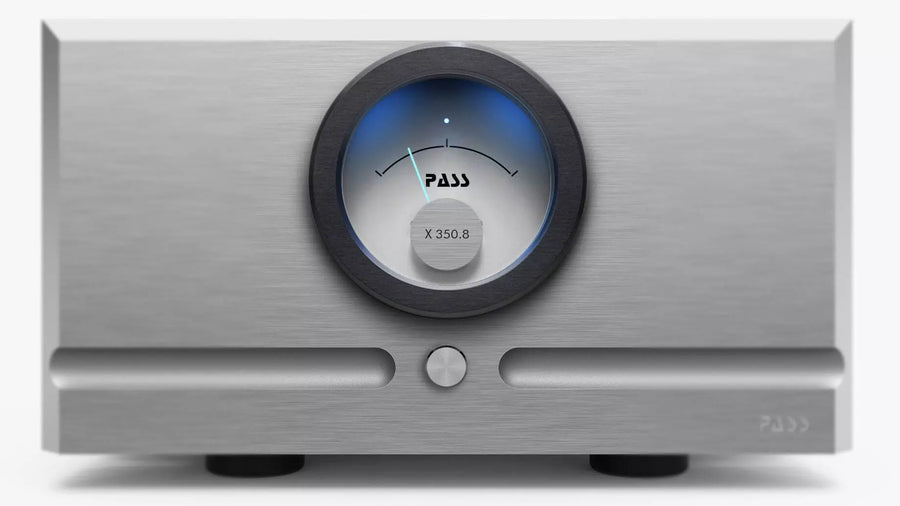
A Pass Labs Class A amplifier is biased so its idle current keeps it in Class A up to its rated 8-ohm output; past that it moves smoothly into Class AB and keeps going, so an XA30.8 delivers about 94 watts before clipping. The round meter on the front panel shows output-stage current draw, and only moves when the amplifier leaves Class A.Read the deep diveClose
What it does
Pass's technical article Leaving Class A explains that the meters on Pass amplifiers are different: they reflect the current consumption of the amplifier rather than its output power. A push-pull stage operates in Class A up to the point where the output current is twice the bias current; beyond that one half shuts off and the amplifier is in Class AB, with no separate circuit switching in and no audible click at the transition. The XA ratings are the Class A envelope, not the limit. The Hi-Fi News lab report on the XA30.8 measured 94 watts into 8 ohms and 156 into 4, with the transition probably at about 45 watts; John Atkinson measured the XA60.8 at 150 watts into 8 ohms, the XA200.8 at 258, 480 and 700 watts into 8, 4 and 2 ohms, and the XA25 at 80 watts into 8 ohms. On the Class AB X-series amplifiers the same meter shows the smaller Class A region, which Positive Feedback put at the first 34 watts for the X260.8, and the X350.8 is biased deeply into Class A for the first handful of watts. The integrateds follow suit: Pass says the INT-60 runs in Class A to somewhat less than half its rated 60 watts, and the INT-250 to about 15 watts.
Why it matters in a system
The practical result is that a Pass Labs amplifier can be chosen by its Class A rating with the knowledge that two to three times that power is available for peaks, and the meter tells the owner how often the music asks for it. A needle that rarely moves means the loudspeaker is living inside the Class A region; one that swings constantly suggests a larger model or a more sensitive loudspeaker.
What you may hear
Mark Craven, Hi-Fi News, July 2025, on the XA30.8: the asking price "looks like a bargain," and the amplifier "puts nothing between you and the music." Pass Labs' own line is that the XA30.8 is proof that 30 watts can feel limitless.
Smoother bends on the transfer curveSince 1978
Low feedback and low-order harmonics
Pass accepts a little second- and third-harmonic distortion in exchange for avoiding the high-order products and extra gain stages that heavy negative feedback brings. His stated preference is for 2nd and 3rd harmonic components over 4th, 5th, 6th, 7th and so on, and his designs have used little or no loop feedback since the Stasis amplifiers of 1978.Read the deep diveClose
What it does
Pass's technical article Audio Distortion and Feedback sets out the position: negative loop feedback creates higher order distortion harmonics, and while negative feedback can reduce the total quantity of distortion, it adds new components of its own. To get lower order harmonic character, he writes, we want smoother bends on the device's transfer curve, rather than a curve forced straight by feedback. He has described his own evolution from a focus on the best measurable performance toward Bart Locanthi's philosophy of making circuits as linear as possible and then applying modest feedback, which led by 1978 to the Stasis amplifiers without global feedback, built on his 1978 patent for a current bootstrap that holds output current nearly constant. At Pass Labs the same rule governs the Aleph, the Supersymmetric X series, where feedback around the front end sets the gain and the output stages are left alone, and the XA25, which has no negative feedback in its stages. Pass told Stereophile that negative-phase second harmonic tends to expand the perception of front-to-back space in the soundstage. John Atkinson's measurement of the INT-25 found its distortion at 10 watts dominated by a second harmonic at about -86 dB, which he called subjectively benign, with higher-order harmonics virtually absent.
Why it matters in a system
This is the design decision behind the Pass Labs sound: the amplifiers are not the lowest-distortion devices on a test bench, but what distortion remains is of the low-order kind that the ear tolerates and may even read as space. It also explains the simplicity of the circuits, since every gain stage removed is one less place for high-order products to arise, and the amplifiers' stability into awkward loads.
What you may hear
Pass put it plainly to Stereophile: "I don't think the audiophile wants technical perfection. He wants to be happy." Neil Gader, The Absolute Sound, on the XP-17: "Neither explicitly solid-state nor tube in character, it dishes out savory tastes of both."
MOSFETs love currentSince 1992
MOSFET output stages
Pass Labs uses power MOSFETs rather than bipolar transistors because their transfer curve resembles a triode's and suits high-bias Class A operation. The .8 amplifiers run banks of 40 to 72 Toshiba MOSFETs per chassis far below their ratings; the Xs 300 uses 112 per channel.Read the deep diveClose
What it does
Stereophile's 1997 review of the Aleph 1.2 noted that power MOSFETs serve as both gain stages because their transfer curve suits single-ended class-A operation, and Pass's summary to the same magazine was three words: MOSFETs love current. In the .8 generation the output devices are higher-power Toshiba MOSFETs operated at a fraction of their ratings, 40 per chassis on the XA30.8, XA60.8, X150.8 and X260.8, 56 on the XA100.8 and X250.8, and 72 on the XA160.8, XA200.8, X350.8 and X600.8; Hi-Fi News counted ten pairs of 20-amp FETs per channel in the XA30.8's current-feedback output stage. The INT-250 carries 20 per channel rated at 150 watts each, and the Xs 300 112 per channel. Running many devices well inside their limits is what allows the deep Class A bias, the low output impedance and the longevity; it is also the reason the XA200.8 weighs 157 pounds, most of it, in Pass's words, chassis, heatsinks and power-supply transformer. The XA25 goes the other way, with a single pair of 700-watt FETs per channel, and the HPA-1c headphone amplifier uses a direct-coupled MOSFET output stage with no ICs in the signal path. Pass's First Watt company has explored static induction transistors, which he says behave like a triode tube.
Why it matters in a system
Device choice sets how an amplifier behaves at the edges: into low impedances, at clipping, and after years of heat. A large bank of MOSFETs run gently gives a Pass Labs amplifier the current reserves that let an XA60.8 deliver 150 watts into 8 ohms at clipping and an XA200.8 700 watts into 2 ohms, and gives the owner an amplifier that does not need to be babied.
What you may hear
Jason Victor Serinus, Stereophile, on the XA200.8: "It is the most beautiful-sounding, color-rich amplifier ever to grace my system." John Atkinson's bench summary of the XA25: it "performed well on the test bench, as I've come to expect from Pass Labs."
Designed by Wayne Colburn since 1994Since 2008
The XP preamplifiers and phono stages
Pass Labs' line stages and phono stages are designed by Wayne Colburn, who joined the company in 1994. The current XP generation borrows the single-stage attenuator, high-bias Toshiba-FET gain stages and auto-biased output stages of the Xs flagships, with separate double-shielded toroidal supplies in the two- and three-chassis models.Read the deep diveClose
What it does
Colburn joined Pass Labs in 1994 to work on an improved preamplifier and a new phono stage, and The Absolute Sound states it simply: Wayne Colburn designs Pass preamps. The XP-10 and XP-20 of October 2008 began the line; the two-chassis Xs Preamp of 2013 and the Xs Phono of 2014 became the references from which the current models descend. The XP-12 of May 2017 is the single-chassis line stage, with the single-stage volume control borrowed from the Xs line preamp in 100 steps of 1 dB and a double-shielded toroidal supply. The XP-22 of April 2018 adds an outboard dual-mono supply and an output stage that is larger and higher-biased, like the Xs Preamp's, with auto bias; Colburn's reasoning is that noise is the most prominent part of THD+N at low levels, so lowering noise buys resolution and dynamics. The XP-32 of 2020–21 puts each channel's audio circuitry in its own chassis, with DC coupling, higher Class A bias and 0.5 dB steps. The XP-17 phono stage of 2017 takes the Xs Phono's gain structure and RIAA network with DIP-switch loading, and the two-chassis XP-27 of 2018 its input and gain circuitry with front-panel rotary loading. The Xs Pre 2 of 2025 is Colburn's three-box flagship, and he also revised the HPA-1 headphone amplifier into the HPA-1c.
Why it matters in a system
A preamplifier sets the noise floor and the gain structure of everything downstream, and the XP models are built to be matched to Pass Labs amplifiers: balanced throughout, with about 9.3 dB of gain and output impedances low enough to drive long runs. The choice among XP-12, XP-22 and XP-32 is a choice of how much power supply and chassis separation the system will reward; the sound is the same family.
What you may hear
Jim Austin, Stereophile, June 2022: "It took me no more than five minutes to decide to keep the XP-32," which "gets out of the way, yet it somehow makes the music sound better." On the XP-27 he wrote that it "is liquid and detailed—and of course very quiet."
Hand-assembled boards, three days in a constant-temperature roomSince 2014
Built, burned in and biased in Auburn, California
Every Pass Labs product is built in the company's factory in Auburn, California, which it moved into on April 15, 2014. Circuit boards are hand-assembled and inspected, front panels are machined from a single aluminum slab and hand-anodized to match each chassis, and every finished amplifier runs for three days in a room held at constant temperature so that its bias can be set identically to every other.Read the deep diveClose
What it does
Pass Laboratories began in 1991 in Nelson Pass's home shop, where he and Mike Burley built an in-house machine shop with three home-built CNC milling machines. The company moved to Foresthill, California by 1997, and on April 15, 2014 into a new factory in Auburn almost three times the size of the former space, with all operations under one roof; its address is now 13395 New Airport Road in Auburn. The Audio Beatnik's 2017 factory tour, led by Desmond Harrington and Kent English, described the process: circuit boards hand-assembled and inspected by technicians, front panels machined locally in Northern California from a single aluminum slab and hand-finished and hand-anodized to match their chassis, and finished amplifiers moved into a room kept at constant temperature year-round for burn-in and biasing, each running for three days so every unit's bias is identical. Harrington's description of the company's priorities was that it does not chase measured figures or build test equipment; it goes by sound. He also said there has never been a Pass Labs product made that the company does not have parts for. Amplifiers are built to order; Music Direct lists an eight-to-ten-week wait for an XA25.
Why it matters in a system
A Class A amplifier's bias is its sound, and setting it in a controlled room after three days of heat is why two XA60.8s built months apart behave as a pair. The parts policy matters more over time: a Pass Labs amplifier from the 1990s can still be serviced by the factory that built it, and the people who designed the current range still work there.
What you may hear
Consistency between the review sample and the one that arrives at home. Herb Reichert, writing in Stereophile about the INT-60, described "some of the best reproductions of music I've experienced this century."