


MOON · 610LP

MOON 610LP Phono Preamplifier

$8,500

Trade-up credit availableSignature technologiesThe MOON story

Not currently in our rooms. For a serious buyer we will often bring a piece in from the manufacturer for a private session — tell us about your system and what you are weighing it against, and we will advise.

MOON · 610LP

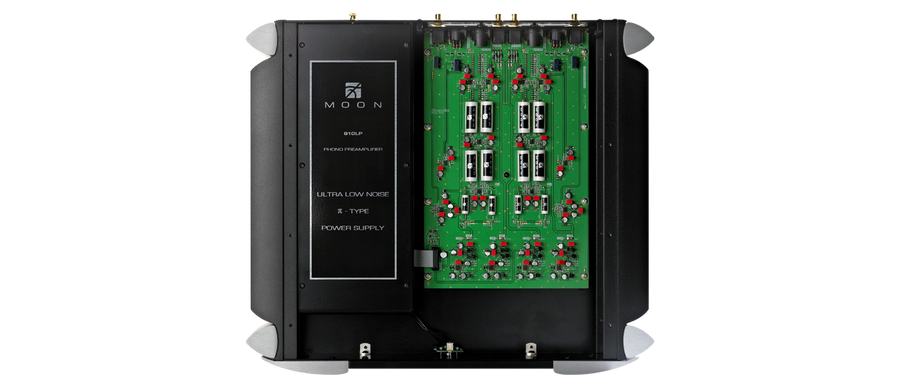
The 610LP brings the 810LP's dual-mono, fully balanced architecture and 24 stages of inductive DC filtering to a lower price: 16 gain, 64 loading and 16 capacitance settings, RIAA or IEC, balanced in and out.

Price is for one unit. Settings are made with DIP switches; a tool is supplied. 820S-compatible.

112 dBr
signal-to-noise at 40 dB gain (MOON spec)
24 stages
i²DCf inductive DC filtering
16 × 64 × 16
gain, loading and capacitance settings
40 lb
shipping weight (18 kg)
Options and pricing

Authorized MOON dealer · Delivery and installation by Pearl Audio · Trade-ins welcome

The story

Simaudio describes the 610LP as "heavily based on the reference grade MOON 810LP," and the description is literal: the same chassis, the same balanced XLR and RCA inputs and outputs, the same 16 gain settings from 40 to 70 dB, 64 resistive loads from 12.1 Ω to 47 kΩ and 16 capacitive loads from 0 to 1,120 pF, and the same 24 stages of i²DCf, one inductor-based filter for each integrated circuit in the signal path. The circuit is dual-mono and fully balanced differential from input to output, which keeps the two channels independent and lets a cartridge's balanced signal reach the first stage without a ground reference. The capacitors are metallized polypropylene film to 1% tolerance.

What the 610LP gives up to the 810LP is the five-point gel suspension and the last few decibels: 112 dBr of signal-to-noise at 40 dB gain against 115, 0.001% THD against 0.0008%. Everything else, including the −106 dB crosstalk, the 200 mV overload margin at 40 dB gain, the RIAA or IEC equalization, the 12-volt trigger in and out and the EXT. SUPPLY input for the 820S, is shared. The settings are made with DIP switches on the underside, using the supplied tool, and Simaudio's manual gives recommended loading for most cartridges.

Jeff Dorgay in Tone Audio called the 610LP "dead quiet" and "just a bit lusher than the 810LP," concluding that "for all but the most obsessed, this will be the last phonostage you need to buy." Jason Thorpe in SoundStage! Hi-Fi found it "a master of rhythm," "honest, neutral, but maybe leaning just the tiniest bit toward the safety of sweetness," and wrote that it "left me whimsical, satisfied, and peaceful."

In the range, the 610LP is the step above the 310LP ($2,300), which has a single-ended input, five loads and two i²DCf stages, and the step below the 810LP ($13,500), which adds the gel suspension and the lower noise floor. Choose the 610LP for a serious moving-coil front end with a 641, 791 or 891 downstream; the 820S supply lifts it later, and one 820S can power the 610LP and a MOON preamplifier together.

Pearl Audio carries Clearaudio and Rega turntables and Hana and Clearaudio cartridges, and we set the 610LP's gain, loading and capacitance for your cartridge before delivery. Its balanced output is the right connection to a 641, 791 or 891.

Key technologies

  • Dual-mono, fully balanced differential circuit. Independent channels from the balanced input to the balanced output; −106 dB crosstalk.
  • i²DCf, 24 stages. One inductor-based filter for each IC in the signal path, the same count as the 810LP. See the deep dive below.
  • 16 × 64 × 16 settings. Gain 40–70 dB in 16 steps, 64 loads from 12.1 Ω to 47 kΩ, 16 capacitances from 0 to 1,120 pF, RIAA or IEC equalization.
  • Balanced input and output. XLR and RCA inputs and outputs.
  • Precision parts. 1% metallized polypropylene film capacitors.
  • 820S-ready. An external-supply input for the MOON 820S; 12 V trigger in and out.
  • Made in Boucherville, Québec. Hand-assembled and tested; up to 10 years of warranty with registration within 30 days.

Finishes

  • Black black chassis with black bead-blasted aluminum cheeks
  • Silver silver anodized aluminum front and cheeks
  • 2-Tone black chassis with silver bead-blasted aluminum cheeks

Black, Silver and 2-Tone are the same price. Choose the finish under Options and pricing above.

Specifications
Type Dual-mono, fully balanced MM/MC phono preamplifier with i²DCf filtering
Inputs 1 pair balanced XLR, 1 pair RCA
Outputs 1 pair balanced XLR, 1 pair RCA
Gain 40 – 70 dB in 16 settings
Resistive loading 64 settings, 12.1 Ω – 47 kΩ
Capacitive loading 16 settings, 0 – 1,120 pF
Equalization RIAA or IEC (IEC curve effect −7 dB at 10 Hz)
Signal-to-noise ratio 112 dBr at 40 dB gain; 93 dBr at 70 dB gain (full scale)
THD 0.001% (20 Hz – 20 kHz)
Intermodulation distortion 0.002%
Crosstalk −106 dB at 1 kHz
Frequency response 20 Hz – 20 kHz (±0.1 dB)
Input overload 200 mV / 100 mV RMS (XLR / RCA) at 40 dB; 5 mV / 2.5 mV at 70 dB
Output impedance 50 Ω
Power supply Internal, with 24 stages of i²DCf; EXT. SUPPLY input for the 820S
Control DIP switches with supplied tool; 12 V trigger in and out
Power consumption Not published by MOON
Dimensions (W × H × D) 18.75 × 4.0 × 16.8 in (47.6 × 10.2 × 42.7 cm)
Shipping weight 40 lb (18 kg)
Warranty 1 year standard; up to 10 years with registration within 30 days (USA and Canada)

MOON 610LP product page and specifications

Where it sits in the range

MOON's phono preamplifiers, cheapest to dearest. The 610LP is the balanced stage below the reference 810LP.

The 820S Power Supply is its upgrade; it pairs naturally with the 641, 791 or 891.

Reviews

Plan your MOON system with Pearl Audio

Pearl Audio is an authorized MOON dealer. We can match it to the rest of your system, set it up in your room and arrange an audition in our Portland showroom. If you already own a current MOON component, ask about Simaudio's trade-up program. Call (503) 222-2599 or email sales@pearlaudio.com.

Signature technologies

The engineering behind the MOON 610LP Phono Preamplifier

MOON gives its technologies names because each one solves a specific problem. Here is what each does, where it came from, why it matters in a system, and what you may hear.

Design principle

Dual-mono configuration

Left and right channels built as two independent amplifiers in one chassis, each with its own power supply, so neither channel can disturb the other, and so two channels can become one monoblock. Read the deep diveClose

What it does

In a dual-mono MOON component the two channels share only the chassis and the mains inlet. Each has its own transformer or supply module, its own regulation and its own circuit board, laid out as a mirror image of the other. In the 461 that means two MHP supply modules; in the 761 and 861, two 700 VA or two 1,500 VA toroidal transformers and a rear-panel switch that bridges the channels into a single monaural amplifier (the left input is used and no adaptor is needed); in the 891 and 791 every stage is independently powered; in the 491 even the two converters run as a dual-mono pair; and the 610LP phono preamplifier is built as a dual-mono, fully balanced differential circuit.

Why it matters in a system

When one channel draws a surge of current for a bass note, a shared supply dips for both channels and the stereo image smears. Separate supplies keep the channels independent, which is why dual-mono designs measure so well for crosstalk: -114 dB on the 461, -116 dB on the 761, -119 dB on the 861, -125 dB on the 681, 791 and 891, -130 dB on the 850P. It is also what makes the mono mode on the 461, 761 and 861 credible: two complete amplifiers working together rather than a stereo amplifier straining. On Stereophile's bench the 861 delivered 1,150 watts into 8 ohms in mono.

What you may hear

Instruments that stay in place when the music gets loud, a wider and deeper stereo stage, and bass in one channel that does not cloud detail in the other.

Signature technologySince 2011

i²DCf (Independent Inductive DC Filtering)

A dedicated inductor filtering the DC supply of every integrated circuit in the signal path, so each gain stage draws from its own quiet reservoir of power. Read the deep diveClose

What it does

A phono preamplifier amplifies a signal measured in fractions of a millivolt, so any noise riding on its power rails ends up in the music. MOON's answer is to give each IC in the audio path its own inductor-based filter stage: 40 stages in the 850P preamplifier, 24 in the 810LP and 610LP phono stages, 2 in the compact 310LP, with the same inductive DC filtering principle in the 110LP v2. Behind the filters sits multi-stage voltage regulation, four stages of what Simaudio calls M-LoVo (MOON Low Voltage) in the 810LP, and in the top models a separate power supply board with a toroidal transformer. The optional 820S external supply takes the idea further for the 610LP, 810LP and the North players: two toroidal transformers, pi filtering with 40,000 µF and dual 20 mH chokes per supply, and four stages of discrete M-R2S regulation.

Why it matters in a system

With a moving-coil cartridge at 60 to 70 dB of gain the phono stage is the noisiest link in most systems, and its noise floor sets how much of the groove you hear. Independent filtering stops stages from modulating one another through the supply, and the result is the very low noise MOON's phono stages are known for: 115 dBr at 40 dB gain on the 810LP, 112 dBr on the 610LP, 110 dBr on the 310LP. It also makes the units unusually insensitive to the quality of the mains.

What you may hear

Black silence between tracks even with a low-output moving coil, and the small details of a record, room sound, decays, the texture of a bow, that noise would otherwise bury. Michael Fremer's verdict on the 810LP: "the 810LP was dead quiet."

Made in Canada

Hand-assembled in Boucherville, Québec

Every MOON component is designed, hand-assembled and tested in Simaudio's own factory in Boucherville, across the St. Lawrence from Montréal, as it has been since the company's founding in 1980. Read the deep diveClose

What it does

Simaudio has built its own products in Québec since Victor Sima founded the company in 1980. Under Jean Poulin, owner and chief executive for nearly two decades, the operation grew from a 3,000-square-foot shop to a 46,000-square-foot, vertically integrated factory in Boucherville, where engineering, assembly and quality control sit under one roof. When Poulin handed the company to three of its own people in 2013, their commitment was that MOON "will continue to be engineered and manufactured in-house, in Quebec." Boards are populated, chassis finished and every unit hand-assembled and measured before it leaves; a single 888 monoblock takes about a week to build.

Why it matters in a system

Keeping design and production together is how a small company controls quality at this level: the engineer who specified a matched set of transistors can walk to the bench where they are selected, and a change in a circuit can be made in production the same month. It is also what makes long-term service realistic. A MOON component bought today can go back to the people who built it, and the 10-year warranty program rests on that.

What you may hear

Consistency. Two 761s sound like two 761s, and the one you audition in Portland is built the same way as the one delivered to your home.

Ownership

10-year warranty

Register a new MOON component within 30 days of purchase from an authorized dealer and the one-year standard warranty is replaced by up to ten years of coverage against manufacturing defects. Read the deep diveClose

What it does

In Canada and the United States every MOON component carries a one-year parts-and-labor warranty. With a validated registration completed within 30 days of purchase from an authorized MOON dealer, that limited warranty is replaced by an extended warranty of up to ten years against manufacturing defects. Mechanical parts, the laser transport, volume control and switches, are covered for three years under the extended program. The coverage is not transferable from one private owner to another, which is one reason a MOON component bought new, from a dealer, holds its value. Outside Canada and the United States the dealer or distributor sets the terms.

Why it matters in a system

A ten-year commitment is a statement about how the products are built and how long the company expects to support them, and it changes how you plan a system: a 641 or 791 bought today is a component you can build around for a decade, with Simaudio's own factory behind it. Ask Pearl Audio to help with registration when your component is delivered; the 30-day window starts at purchase.

What you may hear

Peace of mind is not audible, but a system you are not worried about is one you listen to more.

All MOON technologies and the company story

The MOON story

Canadian engineering since 1980, devoted to revealing the recording: not spectacle, not excess.

Founded 1980 in Québec, Canada (today Boucherville, near Montréal) by Victor Sima · simaudio.com

Milestones

  1. 1980 Sima Electronics founded Engineer and musician Victor Sima founds the company in Québec; its early PW2000 amplifier is aimed first at professional users.
  2. 1990 Simaudio Ltd. and Celeste The company's timeline places the Simaudio Ltd. name and the Celeste series here; the Celeste i-5080 integrated amplifier earns a following.
  3. 1997 The MOON Series Simaudio launches MOON as its reference-grade line. The i-5 integrated amplifier, W-5 power amplifier and P-5 preamplifier define the period.
  4. 2010 30th anniversary Limited editions of the MOON 600i and the Evolution 750D converter in high-gloss red, each with a 30-year warranty.
  5. 2011 Evolution 850P The two-chassis flagship preamplifier is shown at CES: eight-point floating suspension, dual-mono supply and the M-Ray 530-step volume control.MOON 850P Preamplifier
  6. 2012 MiND The 180 MiND is Simaudio's first network streamer, built on MiND, the MOON intelligent Network Device. The 810LP reference phono preamplifier arrives the same year.MOON 810LP Phono Preamplifier
  7. 2013 New owners from within Jean Poulin, owner and CEO for nearly two decades, passes the company to Costa Koulisakis, Thierry Dufour and Louis Lemire. Production stays in-house in Québec.
  8. 2018 888 and MiND 2 The 888 monoblock ships (888 W into 8 ohms, 32 matched bipolar transistors, no global feedback) after its CES 2017 debut; MiND 2 is shown at HIGH END Munich.MOON 888 Power Amplifier
  9. 2022 EISA award for the ACE The MOON ACE all-in-one player wins the EISA High-End Stereo System 2022-2023 award.
  10. 2023 North Collection Unveiled at HIGH END Munich: 641, 681, 761, 791, 861 and 891, introducing MDCA, the MDE digital engines, M-RAY2 and M-VOL3 volume control, MOONLink and the BRM-1 remote.MOON 891 Network Player / Preamplifier
  11. 2025 Compass Collection The 371 Network Player / Amplifier opens a more accessible range built on MDCA and the MHP hybrid power supply, and wins EISA's Premium Integrated Amplifier 2026-2027; the 491, 461 and 341 follow in 2026.MOON 371 Network Player / Amplifier
  12. Now MOON 610LP Phono Preamplifier The 610LP carries the 810LP's dual-mono, fully balanced architecture and 24-stage i2DCf filtering into the 600 series, with 64 loading, 16 capacitance and 16 gain settings and 820S compatibility.
Read the MOON story
MOON 791 Network Player / Preamplifier from the North Collection in a living room (manufacturer photo)

Simaudio began in 1980, when Victor Sima, an engineer and musician, founded Sima Electronics in Québec to build amplifiers for people who found mass-market audio wanting; its early PW2000 amplifier was aimed first at professional users. The company's own timeline places the Celeste series and the Simaudio Ltd. name at 1990, and the Celeste i-5080 integrated amplifier, which brought the firm's preamplifier and power amplifier work into one chassis, gave it a following. In 1997 Simaudio introduced the MOON Series, a reference-grade line that moved the company into the high end. The MOON i-5 integrated amplifier, the W-5 power amplifier and the P-5 preamplifier defined the period and set the house values that still hold: amplifiers without global feedback, dual-mono construction, and a sound that reveals rather than flatters.

Under Jean Poulin, owner and chief executive for nearly two decades, the company grew from a 3,000-square-foot shop to a 46,000-square-foot, vertically integrated factory in Boucherville, across the St. Lawrence from Montréal, and MOON became a brand sold around the world. The 2000s added home theater, the MOON ROCK monoblock and the Attraction processor, and then the Evolution Series brought the brand into a new tier: the 750D, the fully balanced converter Simaudio counts as its digital milestone, and the Evolution 850P preamplifier, shown at CES in January 2011 with its two-chassis layout, eight-point floating suspension and M-Ray 530-step volume control, which became the reference for everything that followed. In 2012 Simaudio launched its first network streamer, the 180 MiND, and with it MiND, the MOON intelligent Network Device.

In September 2013 Poulin handed the company to three of its own people: Costa Koulisakis, who had spent thirteen years building its sales and customer relationships; Thierry Dufour, chief engineer for almost twenty years and the designer behind its award-winning products; and Louis Lemire, an engineer with a business background. Their commitment was that MOON would continue to be engineered and manufactured in-house in Québec. The 888 monoblock, shown as a prototype at CES 2017 and shipped in 2018, was their statement piece: 888 watts into 8 ohms, 32 hand-matched bipolar transistors mounted in cast heat sinks machined to a thousandth of an inch, no global feedback, and about a week on the bench for each one. MiND 2, the second-generation streaming platform, arrived the same year.

The modern MOON took shape over the following years. In 2022 the ACE all-in-one player won the EISA High-End Stereo System award, confirming that the company's streaming platform could carry a complete system. In May 2023 at HIGH END Munich the company unveiled the North Collection, six components (641, 681, 761, 791, 861, 891) that introduced MDCA distortion-cancelling amplification, the MDE digital engines, the M-RAY2 and M-VOL3 volume controls, MOONLink system control and the BRM-1 Bluetooth remote; Stereophile measured the 861 and called the result "one of the best I have encountered." In 2025 the Compass Collection followed, opening with the 371 Network Player / Amplifier, EISA's Premium Integrated Amplifier 2026-2027, and continuing with the 491, 461 and 341, bringing MDCA and the MHP hybrid power supply to a more accessible range. MOON International now carries the brand beyond North America.

The philosophy has not changed since the i-5. Simaudio describes its aim as bringing listeners "closer to the emotional truth of a performance," revealing the recording "with natural authority and emotional depth," and sums up the design brief as "Not spectacle. Not excess." Every MOON component is still designed, hand-assembled and tested in Boucherville, backed by a ten-year warranty with registration, and the company counts more than 400 awards worldwide. Pearl Audio keeps the Compass and North Collections on the floor in Portland.

The complete MOON story and technology library

MOON at Pearl Audio

Pearl Audio is an authorized MOON dealer and keeps the Compass and North Collections on the floor in Portland. Our MOON representative is Ari Margolis. Ask us about registering your MOON purchase for the 10-year warranty (registration must be completed within 30 days); we handle delivery and setup ourselves.

Reach for the MOON (RFTM) trade-up

Trade up to the 610LP

Trade up to this model under Simaudio's Reach for the MOON program: bring in your eligible MOON component bought within the last two years and receive 100% of what you paid (first year) or 75% (second year) as credit towards this purchase.

Estimate your trade-up

Original price of your unit
—
Trade-up credit
—
Your price after trade-in
$8,500

Choose the component you own and when you bought it. Credit is 100% of what you paid in the first year of ownership and 75% in the second year.

Ask us about this trade-up

How the program works

  • Your MOON unit must have been bought new or as a dealer demo from an authorized MOON retailer, and it must have been a current model at the time you bought it.
  • You must be the original owner, and you must have registered the product with Simaudio within 30 days of receiving it.
  • Trade-up within 2 years of your original purchase: 100% credit in the first year, 75% in the second year. The credit is calculated on what you actually paid (before tax and shipping); demo, discounted or special-order upcharges are credited accordingly.
  • The unit must be fully working and in excellent cosmetic condition, returned in its original packaging with all original accessories. Simaudio inspects every trade-in and may reduce the credit if the unit does not meet this standard.
  • A clean copy of your original retail bill of sale is required, and the traded-in unit must reach Simaudio within 30 days of the new unit shipping.
  • Not eligible: pre-owned, B-stock or Pre-Loved units, products bought after they were discontinued, or units that were not registered. Remotes, internal options and other small accessories cannot be traded on their own.
  • Trade-ups are to a higher model in the chart defined by Simaudio; Simaudio has the final say on which combinations qualify. Trade-up purchases cannot be combined with other promotions or discounts.
  • The credit is applied at Pearl Audio to the new purchase; shipping of the trade-in to Simaudio and applicable taxes are extra.

Figures shown are estimates based on the current MOON retail price of the component you are trading in; Simaudio sets the final credit from your original invoice after inspecting the unit. Program terms are set by Simaudio and may change without notice (program version 2026-05-01).

The Pearl Audio experience

How we work with you

A system at this level should be heard, thoughtfully matched, and properly set up. From the first audition to long-term ownership, you work with the same people, in person.

  1. 01

    Listen first

    The 610LP Phono Preamplifier is not in our rooms at present. When it is the right piece for a client we arrange a demonstration unit from the manufacturer and set it up for a private session.

  2. 02

    Delivery and installation

    We deliver and install throughout the Portland area, taking care of placement, connections, ventilation and system configuration ourselves.

  3. 03

    Support for as long as you own it

    We support everything we sell for as long as you own it, whether the answer comes by phone, in your home, or through factory service.

  4. 04

    A path for what comes next

    Trade-in assistance and qualifying 100% Trade-Up options give you flexibility when your listening priorities or your system change.

Search