
← Back to your LP12 build

Luxman · Moving coil cartridge

Luxman LMC-5 Moving Coil Cartridge

$2,995

The Luxman story

On demonstration

On the floor at our Portland showroom. Ask and we will set it up for you to hear.

Luxman · Moving coil cartridge

Luxman's own moving coil: a Shibata stylus on an aluminum cantilever, in a small body machined from aluminum and finished in Luxman red.

0.4 mV
output
Shibata
solid diamond stylus
2.2 g
tracking force
8.5 g
weight

Authorized Luxman dealer · Advice and support from Pearl Audio · Trade-ins welcome

How it sounds

Bass with definition, foundation and power, a rich, tactile midrange, and a clean, airy, extended top that does not tire.

The Absolute Sound Editors' Choice Award 2027.

The story

The LMC-5 is the first cartridge Luxman has designed in forty years, and it took two years to develop. Its predecessors were the LMC-1 and LMC-2 of the early 1980s. Luxman chose a moving coil generator with a samarium-cobalt magnet and coils of 30-micron wire, an aluminum cantilever, and a solid diamond Shibata stylus. The body is machined from aluminum and kept small, with smoothly curved surfaces, which Luxman says limits coloration from sound reflected off the record. Threaded holes in the top take the mounting screws directly.

The Absolute Sound, in its Editors' Choice list, describes bass with definition, foundation and power, a rich and tactile midrange, and a clean, airy, extended top that does not tire. Stereophile's reviewer was impressed by how it draws out detail without sounding analytical. We think it is superb value.

Output is 0.4 mV and the internal impedance is 4.7 Ω. Luxman recommends a load of 40 Ω or more into an active moving-coil input, or 2.5 to 10 Ω through a step-up transformer. Luxman's E-250 phono stage has both: a moving-coil high input at 40 Ω and a moving-coil low input at 2.5 Ω. In a Luxman system, with a PD-151 Mk II or PD-191A turntable, we pair the LMC-5 with a Luxman phono stage: the E-250, the E-07, or the phono stage built into a Luxman integrated amplifier. Matching a phono stage to a cartridge →

Specifications
Type Low-output moving coil (MC)
Output 0.4 mV (1 kHz, 3.54 cm/s)
Internal impedance 4.7 Ω at 1 kHz
Recommended load 40 Ω or more (active moving-coil input); 2.5 to 10 Ω (step-up transformer)
Tracking force 2.1 to 2.3 g (2.2 g standard)
Compliance 8 × 10⁻⁶ cm/dyne at 100 Hz
Weight 8.5 g
Stylus Solid diamond, Shibata
Cantilever Aluminum, 0.5 mm
Magnet Samarium-cobalt
Frequency response 10 Hz to 35 kHz
Channel separation / balance 28 dB at 1 kHz / within 0.5 dB
Vertical tracking angle 25°
Body Machined aluminum (A6063), red, with threaded M2.6 mounting holes
Dimensions 17.0 × 18.3 × 21.3 mm (W × H × D), excluding terminals
Supplied with Mounting screws in three lengths, washers, hex wrench, stylus cover

Luxman LMC-5 product page and specifications

Retipping

Luxman retips the LMC-5 for $1,495. The worn cartridge goes back to Luxman in its original packaging. Source: Luxman retail price list, May 2026.

Plan your Luxman system with Pearl Audio

Pearl Audio is an authorized Luxman dealer. Tell us your tonearm and phono stage and we will talk through the match. Call (503) 222-2599 or email sales@pearlaudio.com.

The Luxman story

Founded in Osaka in 1925 and built in Yokohama today: Class A, LIFES, LECUA and belt-drive turntables.

Founded 1925 in Osaka, Japan; headquartered and built in Yokohama, Kanagawa by T. Hayakawa and K. Yoshikawa · luxman.com

Milestones

  1. 1925 Founded in Osaka In June, the year radio broadcasting begins in Japan, T. Hayakawa and K. Yoshikawa start a radio department at the Kinsuido picture-frame store and incorporate it as Lux Corporation. The LUX-1730 and LUX-735 radios follow in 1928.
  2. 1958 MA-7A Luxman's first fully assembled post-war hi-fi power amplifier, a mono tube design with a patented NFB cross-over circuit, built on the OY output transformers developed in 1952.
  3. 1961 SQ-5A A vacuum-tube integrated with a center level meter and Luxman's own tone-control circuit. The company dates its unbroken run of tube amplifiers from it; the SQ-38 of 1964 follows.
  4. 1966 MQ-36 OTL An output-transformer-less tube power amplifier that stays in production until 1978. The MQ-60 of 1969 and CL-35 of 1970 are the models today's MQ-88uC and CL-38uC honor.
  5. 1975 Fiftieth anniversary: M-6000 A 300-watt stereo amplifier with the C-1000 preamplifier and T-110 tuner. The M-series amplifiers are designed by Tim de Paravicini; the Laboratory Reference Series follows in 1977.
  6. 1980 PD-300 A turntable with a vacuum disc stabilizer, a first for vacuum hold-down. Luxman stops building turntables after the PD-350 and does not return to them for 28 years.
  7. 1984 Alpine Electronics Alpine acquires the Luxman brand; Atsushi Miura leaves to found A&M and Air Tight in 1986. Co-badged products sold through mass retailers cost the brand its high-end dealers. Alpine sells in 1994.
  8. 1996 C-10 and B-10 Flagship separates that hold the top of the line for about ten years. The C-10's fixed-resistor Ultimate Attenuator is the ancestor of LECUA.Luxman C-10X Control Preamplifier
  9. 1999 ODNF The CM-2100 car amplifier is the first product with Only Distortion Negative Feedback, which feeds back the distortion rather than the whole signal. Versions 2.4 (2006) and 4.0 (2013) follow.
  10. 2007 Eightieth anniversary; back in the US The B-1000f monoblocks (2005) and C-1000f control amplifier (2006) introduce LECUA1000 and ODNF 2.4. On a Higher Note returns Luxman to the United States after roughly two decades away.
  11. 2009 International Audio Group Luxman joins IAG, which keeps it separate from its other brands and leaves design and manufacturing in Kanagawa. The eleventh-generation SQ-38u launches the same year.
  12. 2011 PD-171 Turntable development resumes 28 years after the PD-350, with a belt-drive design that leads to the PD-151 (2019), the PD-191A and the PD-151 Mk II.Luxman PD-191A Turntable
  13. 2020 D-10X The world premiere of ROHM's MUS-IC BD34301EKV converter, run one per channel, with the LxDTM-i transport. The D-07X of 2023 uses the same chip and mechanism.Luxman D-07X SACD Player/DAC
  14. 2022 LIFES in the M-10X The successor to ODNF ships first in the flagship stereo power amplifier, then in the L-507Z, L-509Z, C-10X and L-505Z.Luxman M-10X Power Amplifier
  15. 2025 Centennial The E-07 phono stage, Black Edition CENTENNIAL models, the D-03R, and the L-100 and D-100 CENTENNIAL on LIFES 1.1. Rhythm Audio becomes the North American distributor in February; Luxman enters the Hi-Fi Hall of Fame in May.Luxman L-100 Centennial Class A Integrated Amplifier
  16. 2026 Component of the Year Stereophile names the L-100 CENTENNIAL Joint Amplification Component of the Year and puts it on its October cover. The D-100 CENTENNIAL ships worldwide in April and the B-100 CENTENNIAL mono amplifier in September.Luxman D-100 Centennial SACD Player/DAC
Read the Luxman story
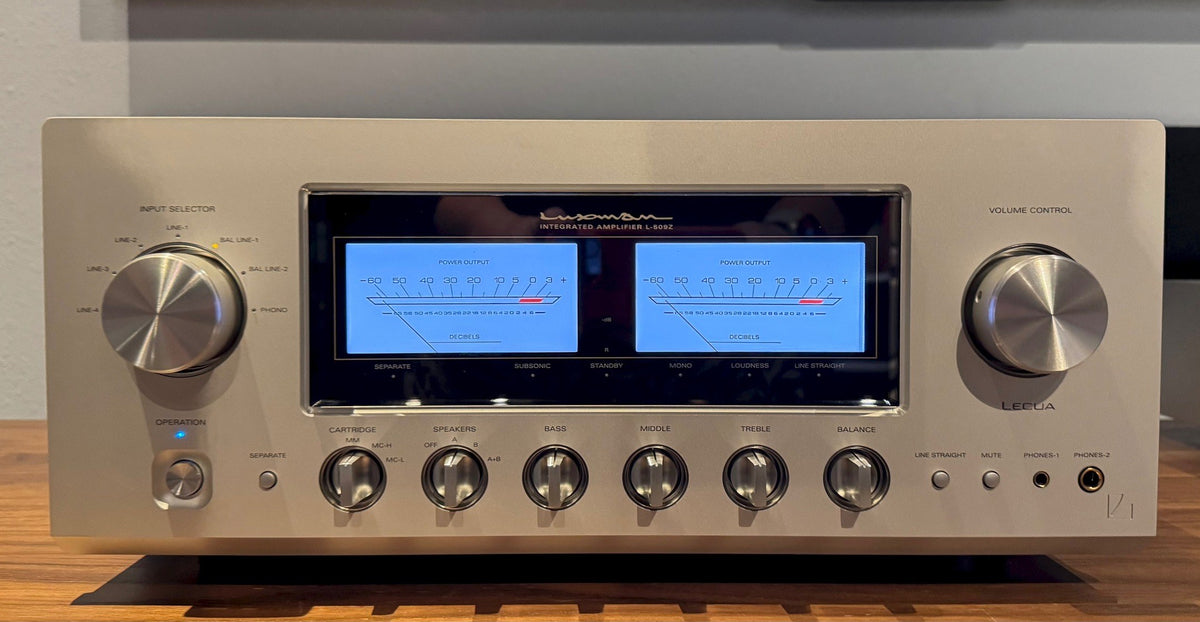
Luxman L-509Z integrated amplifier, front view

Luxman began in June 1925 as the radio-equipment department of Kinsuido, a painting and picture-frame dealer in Osaka, in the year radio broadcasting began in Japan. T. Hayakawa and his brother K. Yoshikawa incorporated the business as Lux Corporation; by the company's own account Kinsuido was the first in Japan to display and sell radio receivers in a store, and its radio manual, the first Japanese radio guidebook, ran to fourteen editions. The first products followed in 1928, the LUX-1730 and LUX-735 hi-fi radios sold with a magnetic-horn speaker, and in 1931 a magnetic pickup for the LUX-1730 electric phonograph. Through the 1930s the firm built its reputation on the parts it made itself, transformers and switches, and in 1952 it developed the OY-type output transformers that collectors still seek out and that Luxman's tube amplifiers carry in descendant form today.

The MA-7A of 1958, a mono vacuum-tube power amplifier with a patented NFB cross-over circuit, was Luxman's first fully assembled post-war hi-fi amplifier. The SQ-5A integrated of 1961, with its center-mounted level meter and Luxman's own tone-control circuit, was a hit, and the company dates its unbroken run of tube amplifiers from it. The SQ-65 of 1962 carried a motional-feedback patent, and the PZ-11 of the same year was Japan's first germanium-transistor phono equalizer. The SQ-38 of 1964 became a fixture of Japanese jazz cafés and began a series that reached its twelfth generation in the LX-380. The MQ-36 of 1966, an output-transformer-less tube amplifier, stayed in production until 1978; the SQ-505 and SQ-507 of 1968 preceded the 500 series; and the MQ-60 power amplifier of 1969 and CL-35 preamplifier of 1970 are the models the current MQ-88uC and CL-38uC are built to honor. By The Absolute Sound's account Luxman was the only major Japanese manufacturer still producing tube amplifiers through the 1970s and 1980s.

LUX Kit, a do-it-yourself brand, sold about seventy products between 1971 and 1980. For the fiftieth anniversary in 1975 Luxman introduced the 300-watt M-6000 stereo amplifier, the C-1000 preamplifier and the T-110 tuner; the M-3000, M-4000 and M-6000 were designed by Tim de Paravicini, whom Luxman employed for amplifier design. The Laboratory Reference Series of 1977 included a DC amplifier, and the PD-300 turntable of 1980 held the record down with a vacuum, a first. Atsushi Miura, who had married the eldest daughter of co-founder Yoshikawa and joined the company in 1956, was running it by the early 1980s. In 1984 Alpine Electronics acquired the Luxman brand; Miura and designer Masami Ishiguro founded A&M Limited in 1986, creating Air Tight. Under Alpine the products were co-badged Alpine/Luxman and sold through mass retailers such as Costco in the US; Stereophile later wrote that high-end dealers dropped the line because of the confusion, and Hi-Fi News that the fit was never an easy one. The engineering went on: the Fluency DA-07 converter and DP-07 transport of 1987, built on a University of Tsukuba professor's function-complementation theory, and the top-loading D-500X CD player of 1990 with a Philips CDM-3 mechanism.

Alpine sold the brand in 1994. The ownership that followed is not well documented, and the present Luxman Corporation was formed from the old Lux Corporation around 2000; what the company built in those years is clearer. The SQ-38s marked the seventieth anniversary in 1995. The C-10 preamplifier and B-10 power amplifier of 1996 remained the flagships for about ten years, and the C-10's Ultimate Attenuator, a fixed-resistor volume control, is the ancestor of LECUA. In 1999 the CM-2100 car amplifier became the first product with ODNF, the feedback circuit that fed back only the distortion. The DU-10 universal SACD player arrived in 2001, and the CL-88 and MQ-88 of 2004 were the first tube separates in eleven years. For the eightieth anniversary the B-1000f monoblocks of 2005, more than thirteen years in development, and the C-1000f control amplifier of 2006, at ¥2,100,000, introduced LECUA1000 and ODNF 2.4. In 2007 Philip O'Hanlon's On a Higher Note brought Luxman back to the United States after roughly two decades away, with the C-1000f at $30,000 and the B-1000f at $48,000 each; what struck O'Hanlon was that the technology really did trickle down to more realistically priced models.

In 2009 Luxman became part of the International Audio Group, which kept it separate from its British brands, Quad and Wharfedale among them, and left design and manufacturing in Kanagawa. The SQ-38u, eleventh of its line, launched the same year. The PD-171 of 2011 revived turntable development 28 years after the PD-350; the P-700u headphone amplifier followed in 2012, and the C-900u and M-900u of 2013, at ¥1,155,000 each, brought ODNF 4.0 and New LECUA1000. The MQ-300 of 2015, with two Japanese-made 300B tubes, marked the ninetieth anniversary. The X generation renewed the integrateds, the L-505uXII and L-507uXII in November 2017 and the L-509X in January 2018, and the CL-38uC and MQ-88uC tube separates of April 2018 reproduced the OY15 output transformers in their original shape. The PD-151 turntable arrived in February 2019 and the CL-1000 tube preamplifier in January 2020. In July 2020 the D-10X gave the world premiere of ROHM's MUS-IC BD34301EKV converter, run as a pair in dual mono, and the same year the L-595A LIMITED reissued the 1990s L-570 Class A design in 300 units each for Japan and overseas.

LIFES, the successor to ODNF, shipped first in the M-10X power amplifier, announced in the US in January 2022 at $19,995, then in the L-507Z of August 2022, the L-509Z that December, and the C-10X of November 2023, the first new flagship preamplifier in ten years. The D-07X SACD player arrived in February 2023 and the PD-191A turntable, with the SAEC-developed LTA-710 arm, reached the US that April; the NT-07 network transport and L-505Z followed in 2024. The centennial year of 2025 brought the E-07 phono stage, Black Edition CENTENNIAL versions of four models, the D-03R, and the L-100 and D-100 CENTENNIAL, the first pure Class A integrated and the first disc player built on LIFES 1.1. In February 2025 Rhythm Audio of Upland, California took over distribution for the United States and Canada, and in May Luxman was inducted into the Hi-Fi Hall of Fame. The B-100 CENTENNIAL mono amplifier followed in September 2026, and in October Stereophile put the L-100 on its cover and named it Joint Amplification Component of the Year. Luxman is headquartered and still manufactures in Yokohama under president Tatsuya Sueyoshi, and each L-100 is built by hand by a team of four.

The complete Luxman story and technology library

Luxman at Pearl Audio

Pearl Audio is an authorized Luxman dealer in Portland. We carry the full line, from the L-505Z, L-507Z, L-509Z and L-100 CENTENNIAL integrateds and the C-10X and M-10X separates to the PD-151 Mk II and PD-191A turntables, the E-250 and E-07 phono stages, the D-03R, D-07X and D-100 CENTENNIAL players and the NT-07 network transport. We match Luxman amplification to loudspeakers, set up the turntables and arms, fit and align cartridges, and configure the D-series players and NT-07 as a system. Ask us about delivery and setup. Service runs through Rhythm Audio, Luxman's distributor for the United States and Canada.

The Pearl Audio experience

How we work with you

A system at this level should be heard, thoughtfully matched, and properly set up. From the first audition to long-term ownership, you work with the same people, in person.

  1. 01

    Listen first

    Hear the LMC-5 Moving Coil Cartridge by appointment in one of our two purpose-designed demonstration rooms, with your own music and time to compare without pressure.

  2. 02

    Placement and setup advice

    Ask us about placement, connections, ventilation and system configuration, and about delivery.

  3. 03

    Support for as long as you own it

    We support everything we sell for as long as you own it, whether the answer comes by phone, in the shop, or through factory service.

  4. 04

    A path for what comes next

    Trade-in assistance and qualifying 100% Trade-Up options give you flexibility when your listening priorities or your system change.

Search