Clearaudio Master Innovation Wood Turntable

The Clearaudio story

Symmetrical moving coils, magnetic bearings and Panzerholz: turntables and cartridges built in Erlangen since 1978.

Founded 1978 in Erlangen, Germany, where every turntable, tonearm and cartridge is still built by Peter Suchy · clearaudio.de

The history and technologies of Clearaudio of Erlangen, Germany, and what Pearl Audio keeps on the floor.

Peter Suchy left Prague for West Germany in 1969, the year after the Prague Spring. He was a trained nuclear physicist and, by What Hi-Fi?'s account, had played in a rock band in Prague; in Erlangen he worked in the power-plant division of Siemens before going out on his own. Clearaudio was founded in 1978, and the company dates its first product to that year: a moving-coil cartridge whose coils and magnets were arranged symmetrically about the cantilever's pivot, patented, and fitted with an ultralight boron cantilever. What Hi-Fi?'s history places the symmetrical system in 1980 and records that the company's official debut was a pair of loudspeakers, the Delta and Sigma stand-mounts. In the same period Suchy worked with Dr. Ernst Weinz on the Paroc stylus, which the magazine credits as the first to use a boron cantilever, and produced a parabolic stylus called the Trygon. Suchy's own summary of the founding patent, given decades later, was that it was about balance: electrical, magnetic and mechanical.

The company settled in Erlangen's Meilwald, a nature reserve on the edge of the city near the Fraunhofer and Max Planck institutes and the university, in a former Siemens building where X-ray film had been made until the early 1980s; What Hi-Fi? dates the move to 1983. In 1984 Clearaudio claimed the world's smallest high-end phono preamplifier, and in 1985 it patented the Optimal Connection System for audio cables. Around 1989, as the compact disc arrived, it started the clearaudio Music label to press vinyl, and it still issues audiophile recordings and reissues of classical discs originally made for Deutsche Grammophon. Robert Suchy, who had begun as a precision-mechanics apprentice, joined officially in 1991, and by the company's own account Clearaudio took on the tangential-tonearm work of the American maker Souther around that time, refining the arms that became the Statement TT1. In 1993 came the Reference, the first Clearaudio turntable: a V-shaped chassis in acrylic with brass parts, later stainless steel, a separate mass-loaded motor housing and an 80 mm acrylic platter when contemporaries were near 25 mm. Later Master Reference versions added three motors and the Master TQI tonearm.

The Goldfinger of 2003 put a moving-coil generator in a body of 14-karat gold, and the Statement, launched in the middle of the decade, was a turntable of about 350 kilograms without tonearm that drove its platter through magnets and leveled itself with a pendulum. In 2005 Peter Suchy stepped back from daily operations and handed management to his children, Veronika, Patrick and Robert, and within months the company had moved into a larger facility; Enjoy the Music's visit in February 2006 found a machining room making parts to a thousandth of an inch. The Ceramic Magnetic Bearing, which carries the platter on opposing magnets, was patented in the same years, in 2006 by one account and 2008 by another, and became standard in the top series. The Innovation of 2009, a chassis of Panzerholz laminated between aluminum plates with the magnetic bearing and Optical Speed Control, won a Red Dot design award and a HiFi-Stars award; The Absolute Sound reviewed the Innovation Wood at $10,000 in 2010 and gave it a Golden Ear, Jim Hannon writing that it raised the bar on what a $10,000 turntable can do.

The Concept, a deck shipped with counterweight, tracking force and anti-skating set at the factory, was reviewed by Michael Fremer in Stereophile in June 2011 at $1,400 with its Verify arm; he wrote that there was no reason a buyer could not be playing records within a few minutes of opening the box. The Ovation, the smallest deck with the magnetic bearing, the optical speed control and the Panzerholz sandwich, was The Absolute Sound's Turntable of the Year for 2011 and won a Red Dot in 2012, and that year both the Ovation at $4,300 and the Goldfinger Statement at $14,999 were runners-up for Stereophile's Analog Source Component of the Year. The Master Innovation of November 2013 stacked two Innovation chassis and borrowed the Statement's magnetic drive. The Absolute Phono concept of 2014 put a preamplifier inside the headshell. In January 2016 the Statement V2 arrived with microprocessor speed control, an improved gyroscopic bearing over a 95-kilogram pendulum and a POM platter in place of acrylic, and in August the Innovation Basic opened the Innovation line at its lowest price.

Clearaudio turned forty in 2018. Fidelity gave Peter Suchy its Lifetime Achievement Award that year, the company employed around 50 people, and its German company report recorded turntable sales rising from about 2,000 to about 20,000 a year over the previous decade and exports to more than 80 countries. The Reference Jubilee, a limited run of 250 numbered turntables reviving the triangular shape of the 1993 Reference in Panzerholz and aluminum, was shown at High End Munich in May 2018; Robert Suchy said the original shape was kept and everything else was new. The Jubilee MM and MC cartridges in Panzerholz bodies, the V2 moving-magnet range and the Smart Power battery supplies followed in June 2019, and the Basic V2 and Balance V2 phono stages in March 2020. The Reference Jubilee went on sale in April 2021; Stereophile's specifications box listed it at $30,000 with the Universal 9-inch tonearm. For its 45th anniversary in the spring of 2023 the company skipped its usual Munich exhibit and held a party for its distributors at the factory, which Michael Fremer attended and wrote up for The Absolute Sound.

In 2024 the Concept Signature introduced Tacho Speed Control, and a US-only Signature edition followed in March; Jonathan Valin reviewed the Goldfinger Statement V2.1, the current flagship cartridge with the new Prime Line diamond, at $17,500 and called it his current favorite moving coil. What Hi-Fi?'s visit in May 2025 found Robert Suchy as chief executive and Veronika Suchy as chief operating officer, almost all components made on site, and cartridges assembled by hand under a microscope at two or three a day. The company says it sells in more than 80 countries, keeps spare parts for at least ten years after a product's launch, generates more than 70 percent of its daily electricity from its own photovoltaic system and has built products for other brands, among them McIntosh and Marantz. The family's credo is printed on its own pages: take the best, make it better, then it is just good enough. Peter Suchy, now retired, was still visiting the Erlangen headquarters regularly at the time of his award.

Milestones

  1. 1969 Peter Suchy leaves Prague A trained nuclear physicist and guitarist, Suchy leaves Czechoslovakia for West Germany after the Prague Spring and works in the power-plant division of Siemens in Erlangen.
  2. 1978 Clearaudio founded; the symmetrical moving coil Suchy and his team found the workshop in Erlangen and develop and patent a fully symmetrical moving-coil cartridge with a boron cantilever. The Delta and Sigma loudspeakers are the company's official debut.Clearaudio Concerto V2.1 MC Cartridge
  3. 1984 The smallest phono preamplifier, and a cable patent Clearaudio claims the world's smallest high-end phono preamplifier in 1984 and patents its Optimal Connection System for audio cables in 1985.Clearaudio Nano V2 Phono Stage
  4. 1989 clearaudio Music As the compact disc arrives, the company starts its own label to press vinyl; it still issues audiophile recordings and reissues of classical discs made for Deutsche Grammophon.
  5. 1993 Reference: the first turntable A V-shaped acrylic chassis with brass parts, a separate mass-loaded motor housing and an 80 mm platter. Robert Suchy has joined the company, and the tangential tonearms taken on from Souther are refined into the TT line.Clearaudio Reference Jubilee Turntable
  6. 2003 Goldfinger A moving-coil cartridge in a body of 14-karat gold, the ancestor of today's Goldfinger Statement V2.1.Clearaudio Goldfinger Statement v2.1 MC Phono Cartridge
  7. 2005 The second generation, and a larger factory Peter Suchy steps back from daily operations and hands management to his children. The Statement, a 350-kilogram turntable on a magnetic drive and a self-leveling pendulum, is launched in the middle of the decade, and the company moves into a new, larger facility months before Enjoy the Music's visit in February 2006.Clearaudio Statement V2 Turntable
  8. 2009 Innovation Panzerholz laminated between aluminum plates, the Ceramic Magnetic Bearing patented in the preceding years and Optical Speed Control: a Red Dot design award in 2009 and a Golden Ear from The Absolute Sound for the $10,000 Innovation Wood in 2010.Clearaudio Innovation Wood Turntable
  9. 2011 Concept and Ovation Michael Fremer reviews the factory-set Concept at $1,400 in Stereophile; the Ovation is The Absolute Sound's Turntable of the Year and, with the Goldfinger Statement, a Stereophile runner-up for Analog Source Component of 2012.Clearaudio Ovation Turntable
  10. 2013 Master Innovation Two stacked Innovation chassis and the Statement's non-contact magnetic drive, announced in November; existing Innovation owners can upgrade.Clearaudio Master Innovation Wood Turntable
  11. 2016 Statement V2 Microprocessor speed control, an improved gyroscopic bearing over a 95-kilogram pendulum, a POM platter and room for four tonearms; the Innovation Basic opens the Innovation line in August.Clearaudio Statement V2 Turntable
  12. 2018 Forty years; the Reference Jubilee Fidelity gives Peter Suchy its Lifetime Achievement Award. The Reference Jubilee, 250 numbered turntables reviving the 1993 Reference's shape in Panzerholz and aluminum, is shown at High End Munich; it goes on sale in 2021 at $30,000 with the Universal 9-inch arm.Clearaudio Reference Jubilee Turntable
  13. 2019 Jubilee cartridges, V2 moving magnets and Smart Power The Panzerholz-bodied Jubilee MM and MC, the ebony V2 moving-magnet range and the battery-powered Smart Power supplies are announced in June.Clearaudio Jubilee Panzerholz V2.1 MC Cartridge
  14. 2020 Basic V2 and Balance V2 The two larger phono stages are reissued in V2 form in March, the Balance V2 as a two-chassis, fully balanced design with its own volume control.Clearaudio Balance V2 Phono Stage
  15. 2024 Signature and the V2.1 Goldfinger The Concept Signature introduces Tacho Speed Control and a US-only Signature edition follows in March; Jonathan Valin reviews the Goldfinger Statement V2.1 with its Prime Line diamond at $17,500.Clearaudio Signature Turntable
  16. 2025 Robert and Veronika Suchy What Hi-Fi?'s factory visit finds Robert Suchy as CEO and Veronika Suchy as COO, almost all components made on site, and cartridges assembled by hand under a microscope at two or three a day.

Clearaudio at Pearl Audio

Pearl Audio is an authorized Clearaudio dealer in Portland. We can supply the full line, from the Signature and Performance DC AiR turntables through the Innovation series to the Reference Jubilee and Statement V2, with Clearaudio's tonearms, moving-magnet and moving-coil cartridges, phono stages, power supplies, record-cleaning machines and clamps available to order. Analog setup is done in-house: we mount and align the cartridge, set tracking force, anti-skating and arm height, match the cartridge to the phono stage's gain and loading, and deliver and set up the larger decks in your room. We can also arrange for you to hear a cartridge or tonearm before you commit to it.

On demonstration in Portland now

All Clearaudio at Pearl Audio

Signature technologies

The engineering behind Clearaudio

Clearaudio gives its technologies names because each one solves a specific problem. Here is what each does, where it came from, why it matters in a system, and what you may hear.

Absolute Pivot Point Symmetry, since 1978Since 1978

The fully symmetrical moving-coil generator

Clearaudio's first product, in 1978, was a moving-coil cartridge whose two coils and magnet system are arranged symmetrically around the cantilever's pivot, so that the electrical, magnetic and mechanical loads on the stylus are balanced. The company calls the geometry Absolute Pivot Point Symmetry today, and it carried a boron cantilever from the start. Read the deep diveClose

What it does

In a moving-coil cartridge the stylus sits at the end of a cantilever, and the cantilever carries tiny coils that move in a magnetic field to generate the signal. Peter Suchy's 1978 patent placed the two channel coils and the magnet system symmetrically about the pivot of the cantilever, so that each channel sees the same magnetic field, the same electrical path and the same mechanical load. The company describes the result as fully symmetrical, and its current specification sheets call it Absolute Pivot Point Symmetry on the Titanium V2.1 and Absolutely Pivot-Symmetrical on the Concerto V2.1. The other half of the 1978 design was the cantilever: boron, a material both stiffer and lighter than the aluminum of the day. What Hi-Fi?'s history credits Suchy's work with Dr. Ernst Weinz on the Paroc stylus as the first to use a boron cantilever, and dates the fully symmetrical system with independent coils per channel and a fulcrum-balanced suspension to 1980, two years later than the company's own date. Every Clearaudio moving coil built since follows the same layout: the Concept MC with copper coils, and the Talismann V2.1 Gold, Concerto, Stradivari, Jubilee, Da Vinci, Titanium and Goldfinger Statement with coils of 24-karat gold inside a ring of neodymium magnets.

Why it matters in a system

A cartridge whose two channels are mechanically and magnetically identical tracks the groove without pulling to one side or favoring one channel, which is where channel balance, separation and stable imaging begin. Suchy's own description of the design was that it was about balance, electrical, magnetic and mechanical, and that balance is why Clearaudio's moving coils from the Talismann up quote separation of 25 to 32 dB and track at a moderate 2.8 grams.

What you may hear

Stable, centered images and an even balance between the channels. Roy Gregory wrote in Hi-Fi+ that the Goldfinger Statement was one of the best cartridges ever; Jonathan Valin in The Absolute Sound found the V2.1 unquestionably top rank among moving coils.

The V2.1 generationSince 2022

Boron cantilevers and the Prime Line diamond

The V2.1 generation, introduced across the moving-coil range from 2022, replaced Clearaudio's Micro HD line-contact diamond with the Prime Line stylus, a hybrid-parabolic line-contact profile cut by Ogura in Japan and bonded rather than glued to the boron cantilever. The Charisma V2.1 moving magnet carries the same tip on a diamond-coated boron rod. Read the deep diveClose

What it does

A stylus profile determines how much of the groove wall the diamond touches and how far into the high-frequency detail it can reach. Clearaudio's earlier moving coils used the Micro HD cut, a line-contact profile from the Swiss maker Gyger; the V2.1 generation, whose Concerto manual is dated October 2022, moved to the Prime Line, which Jonathan Valin described as a hybrid-parabolic line-contact profile made by Ogura in Japan. The diamond is bonded to the boron cantilever rather than glued, which keeps the joint stiff and the tip mass low. Boron itself has been Clearaudio's cantilever material since the beginning; every moving coil uses it, as do the two top moving magnets, the Maestro V2 with a Shibata tip and the Charisma V2.1, whose boron rod is diamond-coated and described by Clearaudio as the same type used in the Goldfinger Statement. The V2.1 models are otherwise the V2 generators in the same bodies: Talismann V2.1 Gold, Concerto, Stradivari, Jubilee, Da Vinci, Titanium and Goldfinger Statement. Each cartridge is aligned by hand under a microscope that magnifies up to 200 times, and a good day at the factory yields two or three finished cartridges.

Why it matters in a system

The stylus is the only part of the system that touches the record, and a line-contact profile that follows the groove wall closely reads more of the high-frequency information the cutting stylus put there while spreading the load over a larger area, which lowers record wear and distortion toward the inner grooves. A stiff, bonded joint between diamond and cantilever means the coils move exactly as the stylus does.

What you may hear

Jonathan Valin found the Goldfinger Statement V2.1 more honest and less forgivingly gemütlich than its predecessors. Hi-Fi News found the Jubilee MC a strong tracker, clearing an 80-micron test band with low distortion.

From the Concept MC to the Goldfinger StatementSince 2003

24-karat gold coils and the moving-coil range

Every Clearaudio moving coil above the Concept MC winds its two air-core coils from 24-karat gold inside a ring of neodymium magnets, on a boron cantilever, and the models differ in their bodies: satiné wood, aged ebony, Panzerholz, ceramic-coated aluminum, one-piece titanium and, on the Goldfinger Statement, 14-karat gold. Read the deep diveClose

What it does

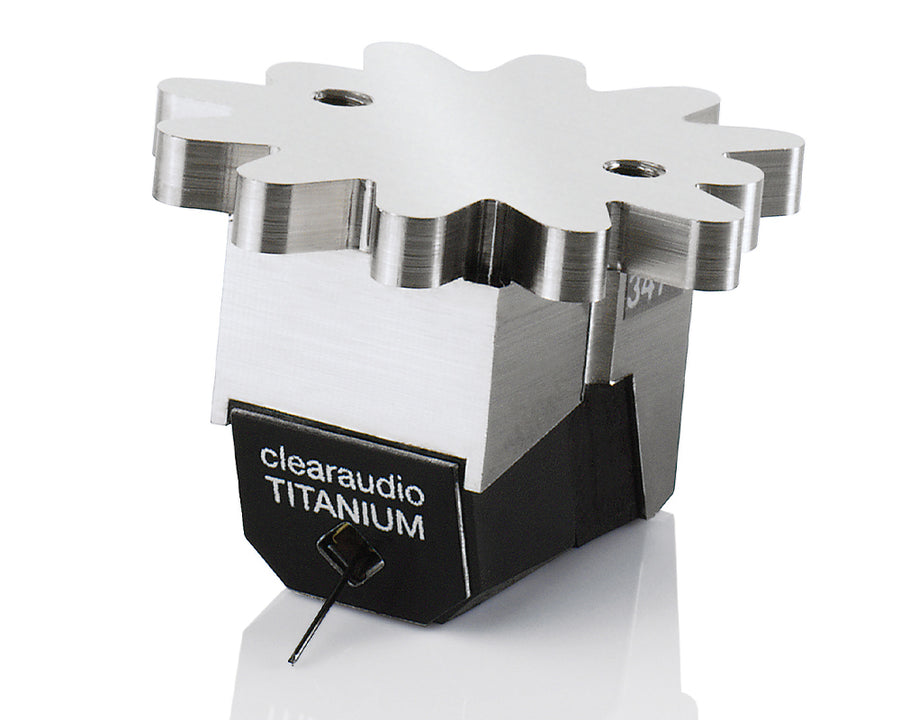
The Concept MC is the entry point: an aluminum-magnesium body with a ceramic surface, copper coils, a boron cantilever and 0.4 mV of output. From the Talismann V2.1 Gold upward the generator changes to dual air-core coils of 24-karat gold in a ring of eight neodymium magnets, with 0.5 mV of output, and the range becomes a progression of bodies tuned for resonance rather than simply made rigid. The Talismann is hand-polished ebony over a metal-alloy structure. The Concerto introduces the twelve-finger mounting plate, in which each finger has a different radius so that no single resonance dominates, under a body of satiné wood; the Stradivari puts the same plate under long-aged ebony, the Jubilee under Panzerholz with a finish borrowed from violin makers, the Da Vinci under aluminum with a 30-micron ceramic coating, and the Titanium under a body machined from one piece of titanium that weighs eight grams. The Goldfinger Statement, descended from the Goldfinger of 2003 with its 14-karat gold body, is the top of the line, with integrated high-frequency shielding and a diamond set in its faceplate as a cueing aid; the factory takes four to five days to align one. Clearaudio claims a dynamic range of 95 dB for the Titanium and 100 dB for the Goldfinger.

Why it matters in a system

The generator stays the same from the Talismann to the Goldfinger Statement, so moving up the range buys a quieter body, tighter selection and more careful alignment rather than a different design. It also means the sound of the family is consistent: a listener who starts with a Talismann on a Performance DC can move to a Stradivari or a Da Vinci on an Innovation without a change of character, and the phono stage settings carry over.

What you may hear

Roy Gregory in Hi-Fi+ called the Goldfinger Statement not just the best Clearaudio by far but one of the best cartridges ever, and wrote of the Da Vinci V2 that it delivers real energy while harnessing it to the shape and structure of the music. Stereophile said the original Goldfinger Statement goes where no cartridge has gone before.

From the Concept MM to the Charisma and JubileeSince 2019

The V2 moving-magnet range and its ebony bodies

Clearaudio's moving magnets share one generator, measured and hand-selected into four performance levels, and from the Performer upward sit in hand-polished ebony bodies chosen for resonance resistance. The Maestro adds a boron cantilever and Shibata stylus, the Charisma V2.1 a diamond-coated boron cantilever and the Prime Line tip, and the Jubilee MM a Panzerholz housing. Read the deep diveClose

What it does

The V2 moving magnets, announced alongside the Jubilee cartridges in June 2019, are built around a common generator: 0.66 kilohms of coil resistance, 400 millihenries of inductance, a 47-kilohm and 100-picofarad load and a tracking force of 2.2 grams, with roughly 3.3 to 3.6 mV of output. Clearaudio measures each one and sorts them into four performance levels, which is how the Performer, Artist, Virtuoso and Maestro differ: channel separation rises from 24 dB on the Artist to 26 dB on the Virtuoso, and channel balance tightens from 1.5 dB on the Performer to 0.4 dB on the Virtuoso. The Concept MM V2 at the bottom of the line has an aluminum body; everything above it is ebony, which Clearaudio uses as a resonance-resistant body material. The Maestro V2 is the only model with a boron cantilever and a Shibata stylus, and dealers describe it as Clearaudio's best-selling moving magnet. The Charisma V2.1 at the top adds a German-silver inlay to the ebony, a diamond-coated boron cantilever of the type used in the Goldfinger Statement and the Prime Line diamond, tracking at 2.4 grams; the Charisma V2 won a Golden Ear award from The Absolute Sound in 2022. The 40th-anniversary Jubilee MM sits in a multi-layered Panzerholz housing and tracks a 90-micron test band.

Why it matters in a system

A moving magnet runs into a standard 47-kilohm phono input and needs no step-up, so these cartridges work with any phono stage from the Nano V2 up, and they let a listener move through four levels of the same design as a system grows. The ebony and Panzerholz bodies apply the same thinking as the moving coils: control the resonance of the body rather than let it color the generator.

What you may hear

Neil Gader of The Absolute Sound called the Charisma a moving-magnet masterpiece and wrote that it has no tonal dead spots and tracks unshakably. Stereophile said of the Aurum Beta S, the ancestor of the Virtuoso, that it had the most neutral tonal balance of any cartridge its reviewer had heard.

Bullet-proof wood between aluminum platesSince 2009

Panzerholz and the aluminum-sandwich chassis

Panzerholz is a German industrial laminate of compressed, resin-bonded wood veneers dense enough for ballistic protection. Clearaudio laminates it between aluminum plates to make turntable chassis that are rigid but internally damped, from the Ovation to the Statement, and uses it for the TT1 tonearm, the Jubilee cartridge bodies and the Statement clamp. Read the deep diveClose

What it does

A turntable chassis has to hold the bearing, the motor and the tonearm in fixed relation while absorbing, rather than storing, the energy that reaches it from the motor, the stylus and the room. Aluminum is stiff but rings; wood is damped but moves. Clearaudio's answer, introduced on the Innovation of 2009, is a sandwich: a core of Panzerholz, the compressed birch laminate that What Hi-Fi? called bullet-proof manufactured wood, enclosed between two aluminum plates and cut to what the company calls a resonance-optimized shape. The Innovation Wood stacks two of these decoupled plinths with a stainless-steel sub-platter between them; the Innovation Compact uses a single tier and the Master Innovation two full Innovation chassis. The Ovation's sandwich also contains around 100,000 small metal balls to absorb resonance, and the Statement V2's chassis is built from layers of aluminum, stainless steel and Panzerholz, with thousands of metal balls in the top layer of its stand. The Reference Jubilee revived the triangular shape of the 1993 Reference with Delignit Panzerholz laminated to aluminum in place of the original acrylic. The same material forms the Statement TT1 tonearm's body, the Jubilee MM and MC cartridge housings and the Statement clamp, which is built with separate grounding paths to each material layer.

Why it matters in a system

Garth Leerer of Musical Surroundings, Clearaudio's US distributor, put the aim simply: the company chooses materials and construction to lower resonances and reveal more of the low-level information in the music. A chassis that neither rings nor flexes keeps the stylus and the groove in a fixed relationship, and what the listener gains is the quiet between and behind the notes.

What you may hear

Jim Hannon of The Absolute Sound wrote that the Innovation Wood, with its two stacked, decoupled Panzerholz plinths, set new price and performance standards in several areas. Hi-Fi News measured the Master Innovation's rumble at minus 73.5 dB through the bearing.

The platter's weight carried by magnetsSince 2006

Ceramic Magnetic Bearing

The Ceramic Magnetic Bearing carries the platter's weight on opposing magnets, so there is no ball and thrust pad grinding under the load; a polished ceramic shaft in a sintered-bronze bushing only keeps the platter centered. Patented in the mid-2000s, it is on every Clearaudio deck from the Performance DC upward. Read the deep diveClose

What it does

A conventional turntable bearing rests the full weight of the platter on a single ball against a thrust pad, and that contact point, under several kilograms of load, is a source of friction and noise that the stylus can hear through the record. Clearaudio's CMB removes the contact. Opposing magnets, one in the bearing housing and one in the platter assembly, lift the platter so that its weight is carried by the magnetic field; a ceramic spindle running in a sintered-bronze bushing centers the platter but carries no load. Stereophile described it as magnets levitating the upper bearing housing, removing the need for a ball bearing and thrust pad, with a ceramic spindle reducing friction. Clearaudio says the platter rotates in a virtually friction-free environment; Hi-Fi News wrote that it effectively floats on a cushion of air. The company's own sources date the patent to 2006 or 2008. The bearing is standard on the Performance DC AiR, the Ovation, the Innovation Compact, Innovation and Master Innovation, the Reference Jubilee and the Statement V2, where it is paired with an inverted drive bearing on ceramic balls. The Concept-derived Signature decks use a sintered-bronze bearing with a hardened steel shaft and a Teflon thrust pad instead.

Why it matters in a system

Bearing noise is the floor beneath everything a turntable does; it travels straight up the spindle into the platter and the record. Alan Sircom of Hi-Fi+ noted that conventional thrust bearings create noise at the physical contact point, and a bearing with no contact under load has no such noise to make. Lower friction also means the motor works less and speed holds more steadily.

What you may hear

A quieter background and more low-level detail. What Hi-Fi? wrote of the Ovation that the platter part just floats in air above the plinth section; Hi-Fi News measured the Master Innovation's wow and flutter at 0.02 percent and called it an excellent result.

Infrared on an etched strobe ringSince 2009

Optical Speed Control, decoupled DC motors and outboard power

Every current Clearaudio deck is belt-driven by a DC motor isolated from the chassis, and on the Ovation and above an infrared sensor reads an etched strobe ring under the platter and corrects the motor in real time. The Reference Jubilee and the Signature decks hang a coreless AiR motor from O-rings, and the Professional Power and Smart Power supplies take the power supply out of the deck. Read the deep diveClose

What it does

Optical Speed Control works by watching the platter rather than trusting the motor. On the Master Innovation the lowest platter carries a stroboscope ring of 1,500 etched bars and an infrared sensor reads it thousands of times per second; on the Reference Jubilee a sensor in the plinth reads the ring on the sub-platter and a 12-bit converter sets the reference voltage for an analog motor controller. Clearaudio quotes speed accuracy within 0.05 percent on the Innovation and 0.03 percent on the Ovation and Statement. The motors are 24-volt DC units made for Clearaudio, decoupled within the chassis with a damping device on the Innovation, Ovation and Statement; the Reference Jubilee, Performance DC AiR, Concept Signature and Signature use an air-core, non-magnetic coreless motor with no cogging torque, hung from eighteen O-rings on the Jubilee in what the company calls Innovative Motor Suspension. The Signature decks use Tacho Speed Control, a development of the optical system in which a belt runs to a second pulley on a detector, self-calibrating at power-up. Power comes from a separate box: the Professional Power, a linear supply with a toroidal transformer in 12-volt and 24-volt versions, or the Smart Power 24V, which runs the deck from two 5,000 mAh nickel-metal-hydride battery packs and recharges itself.

Why it matters in a system

Pitch stability is the first thing a turntable owes the music, and a motor whose speed is measured at the platter and corrected continuously holds it against belt stretch, bearing drag and stylus load. Isolating the motor on O-rings and feeding it from a clean outboard supply keeps its vibration and its mains noise out of the chassis and away from the cartridge.

What you may hear

Jim Hannon found the Innovation Wood's speed stability surpassed every turntable he had had in his room except a Technics SP-10 MkII. Andrew Harrison of Hi-Fi+ called the Smart Power 24V the single choice for the best-sounding way to power the Innovation, and described the Professional Power's effect as decluttering.

The motor never touches the platterSince 2013

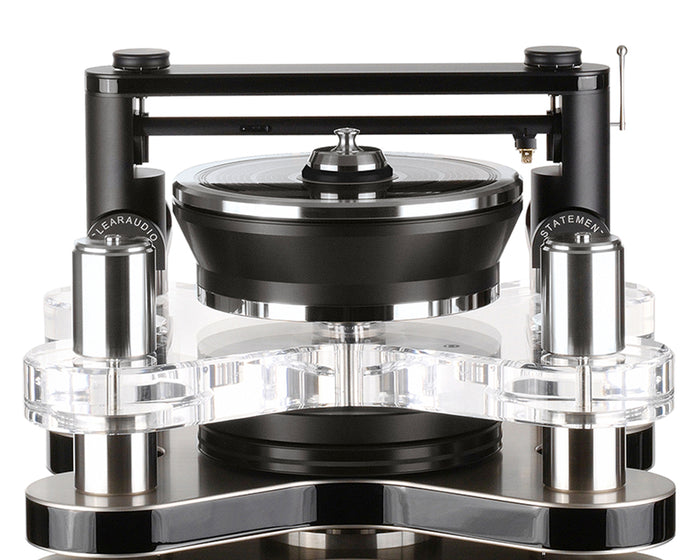
Magnetic drive: the Statement and the Master Innovation

On the Statement V2 and the Master Innovation the belt turns a lower drive platter, and rings of neodymium magnets carry the rotation across an air gap to the platter above it, so nothing mechanical connects the motor to the record. The Statement adds a self-leveling chassis hung from a gyroscopic bearing over a 95-kilogram pendulum. Read the deep diveClose

What it does

A belt already filters a motor's vibration; Clearaudio's magnetic drive removes the belt from the platter altogether. On the Master Innovation, two stacked Innovation chassis hold two platters: the belt drives the lower one, whose underside carries twenty neodymium magnets facing twenty more in the platter above. Magnetic attraction holds the two together across a small air gap and pulls the upper platter round, with the lower platter acting as a flywheel; a 70 mm platter on a 15 mm stainless-steel sub-platter doubles the Innovation's inertia. A reviewer of the original Statement slid a sheet of paper between the two platters while they turned. The Statement V2 of 2016 uses the same coupling at a different scale: about 350 kilograms without tonearm, a chassis of aluminum, stainless steel and Panzerholz, a 98 mm POM platter dynamically balanced on a 15 mm stainless sub-platter, an inverted drive bearing on ceramic balls, and room for up to four tonearms. Its upper chassis hangs from a gyroscopic bearing with a damped stainless-steel pendulum of 95 kilograms below it, so the platter and arms stay level without air pumps or compressors. The 2016 revision added microprocessor speed control, the improved gyroscopic bearing and a POM platter in place of acrylic. Existing Innovation owners can upgrade to the Master Innovation.

Why it matters in a system

Motor noise is the last mechanical path into the record once the bearing is quiet, and a drive that crosses an air gap cannot carry it. The flywheel mass of the second platter steadies speed between the corrections of the optical control, and on the Statement the pendulum keeps a third of a ton of turntable level without the pumps that an air suspension would need.

What you may hear

Hi-Fi News wrote of the Master Innovation that the special bearing and drive system seem to give it a sound with exceptional detail retrieval, and measured wow and flutter at 0.02 percent with a sound-quality score of 87 percent.

Jewel bearings, magnetic anti-skating and the tangential armSince 2009

The tonearms: Satisfy, Tracer, Unity, Universal and TT1

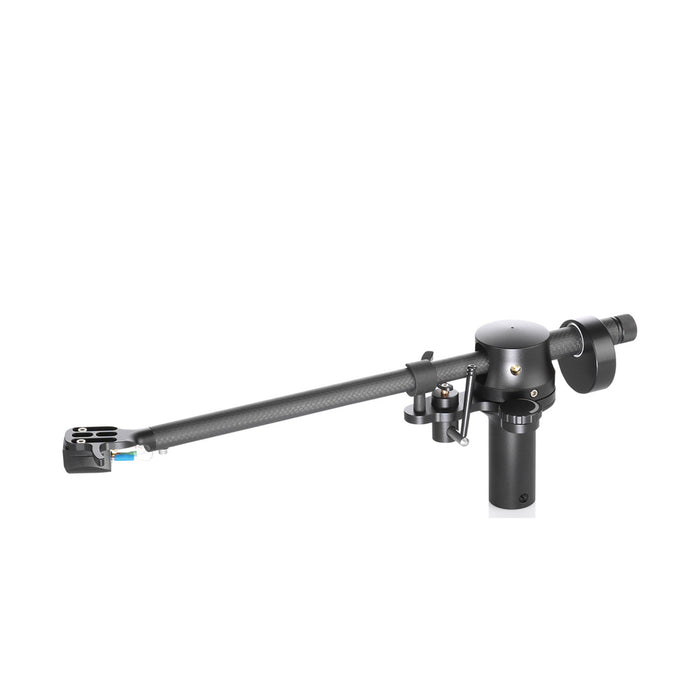
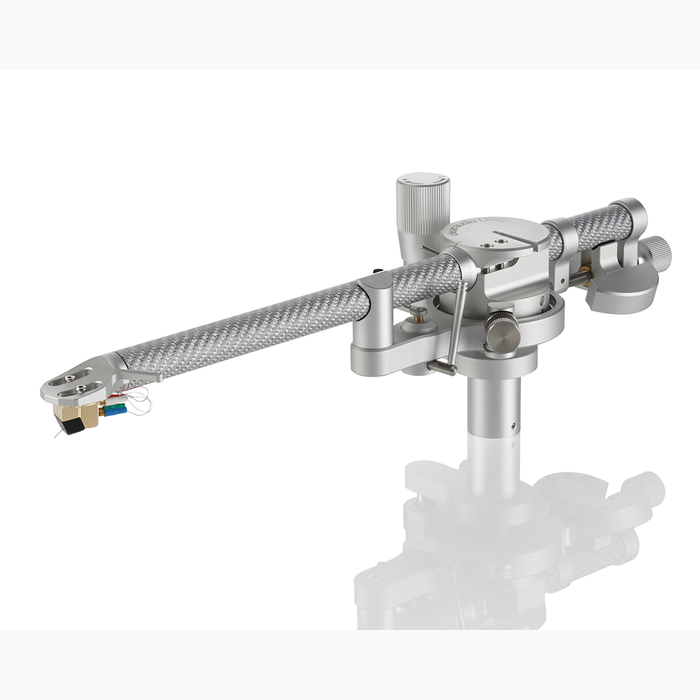
Clearaudio's pivoted arms run on Swiss watch-industry sapphire and tungsten bearings with anti-skating applied by a magnet instead of a thread and weight; the Unity is a magnetically stabilized single-point arm and the Universal a carbon arm of three diameters. The TT1 and TT1-MI are tangential arms that move the cartridge in a straight line across the record, pulled by the groove itself. Read the deep diveClose

What it does

The Satisfy, in Black aluminum and Carbon versions, is a dual-point design with handmade Swiss vertical and lateral bearings of polished sapphire, a tungsten shaft whose polished ends run in sapphire watch bearings, magnetic anti-skating and a two-piece headshell with azimuth adjustment. The Tracer adds a horizontal sapphire bearing and a vertical ball bearing on an angled tungsten axle, a carbon tube and an underslung counterweight on the plane of the stylus, with the magnetic anti-skating built into the pivot axis. The Unity 10-inch is Clearaudio's single-point bearing with a newly developed magnetic stabilization, on a monocoque carbon tube; The Ear reported that one takes two days to assemble. The Universal, in 9-inch and 12-inch lengths, uses precision ball bearings in both axes and a carbon tube of three sections and three diameters to break up resonance; it is the standard arm on the Reference Jubilee. The TT1 is different in kind: a tangential arm whose carriage rides on dry ball bearings inside a polished glass tube and is pulled across the record by the groove, with no air pump or servo motor, for zero tracking error and no skating force. By the company's own account the design descends from the tangential arms of the American maker Souther. The TT1-MI is the version offered on the Master Innovation.

Why it matters in a system

A pivoted arm sweeps an arc and is tangent to the groove at only two points, and its bearings and anti-skating decide how freely the cartridge can follow the groove without adding friction or drag of their own; jewel bearings and magnetic anti-skating lower both. A tangential arm removes tracking error and skating altogether, and Robert Suchy has said that tangential arms are by nature theoretically the better solution.

What you may hear

Alan Sircom described the Clarify, the Unity's lighter sibling, as an inverted-wire unipivot with very low friction. Stereophile characterized the Tracer as a decoupled, dropped-offset design that places mass on the stylus plane, and listed it at $3,300 in December 2024.

Four stages, all with outboard suppliesSince 2020

Phono stages: Nano V2 to Balance V2

Clearaudio has built phono preamplifiers since 1984, when it claimed the world's smallest high-end phono stage. The current four run from the palm-sized Nano V2 through the Smart Phono V2 and the Basic V2 to the two-chassis, fully balanced Balance V2, each powered from a separate supply. Read the deep diveClose

What it does

The Nano V2 measures 85 by 106 by 25 millimeters, offers 34 dB of gain for moving magnets and 65 dB for moving coils, loads moving coils by plug-in links, has a switchable subsonic filter and runs from an external plus-and-minus 18-volt supply, with RIAA accuracy within 0.4 dB; a version with a headphone jack is offered. The Smart Phono V2 adds a top-panel wheel that raises its 34 or 54 dB base gain by up to 18 dB, moving-coil loads of 50, 100, 500, 1,000 and 5,000 ohms, capacitance of 150, 250 and 400 picofarads and a signal-to-noise ratio of 85 dB on moving magnet. The Basic V2 of March 2020, successor to the Basic Plus, provides 46 or 66 dB of gain, a passive RIAA network accurate to 0.1 dB, a 20 Hz subsonic filter per channel and distortion below 0.002 percent. The Balance V2, announced the same day, is two chassis, one of them the power supply, with fully balanced amplification per channel, XLR and RCA outputs, a 6.3 mm headphone output, a volume control that lets it feed a power amplifier directly, distortion below 0.001 percent and channel separation above 92 dB. Clearaudio calls the Basic V2 the all-rounder for audiophiles and music lovers.

Why it matters in a system

A phono stage amplifies the smallest signal in a system, half a millivolt from a moving coil, by a factor of a thousand or more while applying the RIAA curve, and its noise, its loading options and its gain decide whether a cartridge is heard at its best. Keeping the power supply in a separate box keeps transformer hum away from that signal, and the Balance V2's balanced topology cancels what noise remains.

What you may hear

Less noise behind the music, and a cartridge loaded correctly: a Talismann at 50 ohms does not sound like one at 500. The Balance V2 with its own volume control can also drive a power amplifier directly in an all-analog system.

Both sides in one passSince 2010

Record cleaning and clamps: the Double Matrix and the Statement clamp

The Double Matrix Professional Sonic clamps a record by its label and washes and vacuums both sides in one pass, with cleaning pads that vibrate to loosen dirt; the Smart Double Matrix and Smart Matrix Silent bring the same approach down in size. Clearaudio's clamps, from the Clever Clamp to the Panzerholz Statement clamp, hold the record flat and give its energy a path out. Read the deep diveClose

What it does

The Double Matrix Professional Sonic grips the record by its label, applies fluid automatically with an LED showing the level, and cleans and vacuums both faces at once, running in both directions, with anti-static brushes and vibrating Sonic pads that loosen dirt without immersing the record in a tank; it weighs 16 kilograms, is designed for continuous operation, and the company has reported a backlog of about 200 units a year. The Smart Double Matrix, inspired by it, cleans both sides at once in a 5.4-kilogram machine with a slider for 7-, 10- and 12-inch records. The Smart Matrix Silent cleans one side at a time, starts its cycle when the arm swings over, and insulates its vacuum turbine; Hi-Fi Choice found it not entirely silent but among the quietest. The clamps run from the lightweight Clever Clamp, designed by Lou Souther for low-mass decks, through the aluminum Concept clamp, the POM Twister with its stainless twist lock, the stainless Quadro and the low-profile Quadro Low for linear arms and suspended decks, to the Innovation clamp of metal and wood and the Statement clamp of Panzerholz or ebony and stainless steel, built with separate grounding paths to each material layer. A diamond stylus brush, a carbon-fiber record brush and the Elixir of Sound fluid complete the care range.

Why it matters in a system

A clean record is the least expensive upgrade in analog, and a machine that vacuums the fluid off rather than letting it dry leaves nothing behind in the groove. A clamp flattens a warped record against the platter and couples it to the mat, so the energy the stylus puts into the vinyl drains away instead of being reflected back to the stylus.

What you may hear

Less surface noise and fewer ticks from a washed record, and from a clamp a firmer bass and a steadier image, most audibly on records that are not perfectly flat.

Machined, wound and assembled in the MeilwaldSince 1978

The Erlangen factory

Clearaudio makes almost everything itself in a former Siemens building at the edge of Erlangen's Meilwald nature reserve: bearings and metalwork from its own machining room, coils wound in-house, cartridges assembled by hand under a microscope. Only circuit boards and anodizing go out, and only to local firms. Read the deep diveClose

What it does

The company's premises at Spardorfer Strasse 150 in Erlangen occupy a building where Siemens made X-ray film until the early 1980s, near the Fraunhofer and Max Planck institutes and the Friedrich-Alexander University. Enjoy the Music's visit in February 2006 found a new, larger facility with a machining room making parts to a thousandth of an inch; What Hi-Fi?'s visit in May 2025 reported that almost all components are made at the factory and that research, design, development and production happen on site. Cartridges are assembled mostly by hand under a microscope that magnifies up to 200 times, and a good day yields two or three finished cartridges; a Goldfinger Statement takes four to five days to align. Robert Suchy has described Clearaudio as a true manufactory rather than an assembler of supplied parts; circuit boards and anodizing are the exceptions, sourced locally. The company builds its own measuring devices when standard ones are insufficient, keeps spare parts for at least ten years after a product launch, generates more than 70 percent of its daily electricity from its own photovoltaic system, and employed around 50 people in 2018, when it reported exports to more than 80 countries. It has also built products for other brands, among them McIntosh and Marantz.

Why it matters in a system

A company that cuts its own bearings, winds its own coils and builds its own test gear controls tolerances that an assembler cannot, which is why a Clearaudio bearing or cartridge from one year matches the next and why parts remain available a decade on. For an owner that means a turntable that can be serviced and upgraded rather than replaced; an Innovation can become a Master Innovation.

What you may hear

Consistency: the cartridge in the box measures like the one in the review. The Ear's visitor summed the place up as very much a family affair, run by the second generation on the credo Peter Suchy set: take the best, make it better, then it is just good enough.

Search