DS Audio

DS Audio technology

The engineering behind DS Audio

DS Audio gives its technologies names because each one solves a specific problem. Here is what each does, where it came from, why it matters in a system, and what you may hear.

Light in place of magnets and coilsSince 2013

The optical generator

A DS Audio cartridge has no magnet and no coil in its moving system. The cantilever carries a shading plate 100 microns thick between an LED and a photodiode; as the stylus moves the plate, the light reaching the photodiode changes, and the photodiode's output follows the stylus. The signal is analog from groove to equalizer. Read the deep diveClose

What it does

In a moving-magnet or moving-coil cartridge the cantilever has to drag a magnet or a coil through a magnetic field, and the field pulls back. DS Audio's generator replaces both with light: an LED shines past a light-shading plate fixed to the cantilever onto a photodiode, and the plate's shadow grows and shrinks with the stylus motion. DS Audio describes the system as capturing shadow changes, brightness changes, with LEDs and photocells, and says no magnetic resistance is generated when the vibration system moves; the moving part is a plate only 100 microns thick. The idea is older than the company. Philco sold a record player in 1941 that played mono 78s with a bulb and a mirror on the cantilever, and in the 1970s Toshiba, Sharp, Trio and Kenwood sold photoelectric cartridges, the best known being Toshiba's C-100P. Those designs used an incandescent bulb whose heat warmed the damper rubber and shifted the cartridge's compliance over time, and they disappeared when research money moved from analog to CD. Tetsuaki Aoyagi's first prototype, built after dismantling a C-100P, used an LED and a photodetector bought in Akihabara; because the LED is not a heat source, as he put it, it can be positioned very close to the shutter, and DS Audio pairs it with photodiodes selected for matching sensitivity.

Why it matters in a system

Jonathan Valin of The Absolute Sound summarized the case: magnets and coils create magnetic resistance that impedes tracking and add mass the cantilever must move, and a light beam avoids both. With less moving mass the stylus follows the groove more closely, and with no magnetic drag there is nothing pulling against it. The equalizer that completes the system is covered separately; the cartridge itself is a purely analog transducer, a point Aoyagi has had to make repeatedly.

What you may hear

Michael Trei, reviewing the DS-W3 for Stereophile, wrote that the cartridge is not bright or dark, warm or rich, but can be all those things when the recording demands it. Reviewers of every generation describe the same absence of a fixed character, and a sense of ease in difficult passages.

Why every DS Audio cartridge needs its own phono stageSince 2013

Amplitude-proportional output and the optical equalizer

A magnetic cartridge generates voltage in proportion to stylus velocity, so its output rises with frequency; an optical cartridge's output follows stylus displacement and is essentially flat. The RIAA correction it needs is different and far simpler, and the equalizer also supplies power to the LEDs through the tonearm's ground conductors. That is why a DS Audio cartridge cannot plug into an MM or MC phono stage, and why the equalizer is part of the system. Read the deep diveClose

What it does

The RIAA curve applied when a record is cut is largely a velocity-domain curve, and a magnetic cartridge needs the full inverse of it. An optical cartridge reads how far the stylus has moved rather than how fast, so, in DS Audio's words, it outputs flat from the low frequencies to the high, and the correction circuit becomes overwhelmingly simple: Hi-Fi News describes only a fairly modest high-frequency boost for a flat response from RIAA-equalized LPs. The other half of the equalizer's job is to power the cartridge. The LED supply travels from the equalizer over the two negative conductors of a standard four-conductor tonearm cable, so the tonearm's four cables must be properly independent; no special cable is needed. Because amplitude reading boosts the lowest frequencies, every DS Audio equalizer carries selectable low-frequency roll-off: four points on the DS 003, DS-W3 and TB-100, six on the Master3 and Grand Master, and a 20 Hz subsonic filter on the DS-E3's second output. The equalizers scale with the cartridges, from the op-amp DS-E3 unit to the discrete, point-to-point DS 003, the balanced DS-W3, the 23 kg dual-mono Master3 with three transformers, and the two-chassis Grand Master with 2.34 million and 2.97 million microfarads of capacitance in its equalizer and power supply. Any DS Audio cartridge works with any DS Audio equalizer.

Why it matters in a system

The equalizer is not an accessory; it is the second half of the generator, and it sets how much of the cartridge you hear. Because the cartridges and equalizers are mix-and-match across the range, the usual path is to start with a matched system and upgrade one half at a time, and the bass-filter choices let the same cartridge be tuned to a warped record, a suspended turntable or a full-range system without changing anything else.

What you may hear

Jonathan Valin, moving from the Master1 equalizer to the Grand Master equalizer, found it better in every conceivable way. Jason Thorpe of SoundStage! called the DS 003 cartridge and equalizer together, at their 2022 price of $6,000, an absolute steal.


From the Grand Master of 2020 to the DS-E3Since 2020

Third-generation optics: one LED per channel, beryllium shading plates

The first two generations of DS Audio cartridges used one shading plate and shared optics for both channels. From the Grand Master of October 2020, each channel has its own LED and photodetector, output rises from 40 mV to 70 mV, and the shading plate is 99.9 percent beryllium at half the mass of the old aluminum one. Every current DS Audio cartridge, down to the entry DS-E3, is built this way. Read the deep diveClose

What it does

The Grand Master was the first third-generation DS Audio cartridge, and its two changes to the generator have since reached the whole range. Giving the left and right channels independent LEDs and photodetectors raised output from 40 mV to 70 mV and, in DS Audio's words, eliminated crosstalk between the channels, with high-frequency separation improved by 10 dB. The light-shading plate was changed from aluminum to 99.9 percent pure beryllium and made smaller, which took its mass from 1.56 mg to 0.74 mg; DS Audio puts that at under one-tenth the moving mass of a typical moving-coil coil assembly. The internal wiring was made 1.6 times thicker. The DS 003 of 2021 to 2022, whose dual-mono generator DS Audio describes as derived from the Grand Master, brought the design to an aluminum-cantilever, line-contact cartridge in an A5052 aluminum body with 27 dB of separation; the DS-W3 of September 2022 added a boron cantilever; the Master3 and Grand Master EX of 2023 carried diamond cantilevers; and the DS-E3 of July 2024 put the same independent optics and beryllium plate into the entry model, with an aluminum cantilever, a solid elliptical stylus, more than 70 mV of output and more than 26 dB of separation at 1 kHz. Mono versions of the stereo cartridges, on brass bases, followed in May 2025.

Why it matters in a system

Separation and output are where a cartridge either preserves or loses the space in a recording, and the third generation improved both at once while cutting the mass the stylus has to move. Because the change reached the DS-E3, the entry cartridge now has the same generator architecture as the flagship; what you pay for above it is the cantilever, the stylus profile, the body and the equalizer.

What you may hear

Jason Thorpe of SoundStage! proclaimed the DS 003 an astonishing value; Tom Martin of The Absolute Sound found its sound all gain and essentially no pain, and called it his favorite cartridge at the time. Chris Frankland of hi-fi+ gave the DS-E3 a superb performance and his recommendation.

Master3, Grand Master and Grand Master EXSince 2020

Diamond cantilevers and the one-piece diamond stylus

The Grand Master of 2020 was DS Audio's first cartridge with a diamond cantilever and MicroRidge stylus. The Master3 of 2023 uses a square-pillar diamond cantilever with a bonded MicroRidge tip, and the Grand Master EX of the same year carves cantilever and stylus from a single 0.22 mm-square diamond, so there is no glue joint between the groove and the generator. Read the deep diveClose

What it does

DS Audio's cantilevers step up with the range: aluminum on the DS-E3 and DS 003, boron on the DS-W3, and diamond from the Master3 upward. The Grand Master, announced in October 2020, was the first DS Audio cartridge to feature a diamond cantilever with a MicroRidge stylus, in an Ultra Duralumin body at 7.7 g. The Master3, announced in Japan in May 2023 and on sale in the UK that November as the successor to the 2016 Master1, uses a square-pillar diamond cantilever with a MicroRidge tip, a beryllium shading plate and an Ultra Duralumin body, with output raised from the Master1's 40 mV to more than 70 mV; Hi-Fi News's lab measured 29 dB of separation at 1 kHz, compliance of 11 cu vertical and 15 cu lateral and a 24-degree vertical tracking angle, and called its tracking the most secure of any DS Audio cartridge yet. The Grand Master EX, launched in June 2023, keeps the Grand Master's optics and body and replaces the bonded assembly with a cantilever and MicroRidge tip cut from one 0.22 mm-square diamond in a stainless-steel holder. Musical Surroundings' description is that the one-piece cantilever more accurately transmits the groove modulation to the third-generation generator. Styli and cantilevers come from Namiki and Ogura.

Why it matters in a system

A cantilever carries the groove's motion to the shading plate, and every joint and every gram along the way blurs it. Diamond is the stiffest material available for the job, and removing the glue line between stylus and cantilever on the EX removes the last discontinuity. The result is the quietest background and the most secure tracking in the range, which is why the EX is the cartridge against which the others are judged.

What you may hear

The Absolute Sound, naming the Grand Master EX its 2025 Phono Cartridge of the Year, wrote that the new cantilever delivers a silent background reminiscent of tape playback. Of the original Grand Master, Ken Kessler of Hi-Fi News wrote that it may be the best cartridge he had ever heard.

Circuits published, no license feeSince 2021

The open optical-equalizer standard

In February 2021 DS Audio published its optical-equalizer circuit diagrams and offered a free design review to any manufacturer, with no license or consultancy fee. Equalizers from Soulution, EMM Labs, Esoteric, Aavik, Ayre, Soulnote, Westminster Lab and others are now listed by DS Audio as compatible, and any of them will drive any DS Audio cartridge. Read the deep diveClose

What it does

Tetsuaki Aoyagi's stated goal is that optical cartridges move from being unique to being popular, and his route to it was to give the equalizer away. The first third-party unit came in September 2020, when Ed Meitner of EMM Labs designed the DS-EQ1 in direct collaboration with Aoyagi; in February 2021 DS Audio made the program public, releasing its circuit diagrams and promising to review any manufacturer's design free of charge and to list approved products as compatible. Aoyagi has said that manufacturers kept asking what the license fee was, and that he never asked for one, because the market has to be built together and he does not regard other makers as competitors. As of November 2026 DS Audio's compatibility list includes the Soulution 757, shown at Munich in 2023; the Esoteric E1; Aavik's R-880 and R-x88 series; the Engström M-Optic; Reed; EMM Labs' DS-EQ1 and DS-EQ2 and their Meitner Audio versions; Soulnote's E-3 and E-2 ver.2; the Ayre PX-8; the Uesugi UB220R; Phasemation; the Wattson Madison; Westminster Lab's Quest and Monologue; Mavis Lab; the Thivan Labs Ultimate 300; the Exposure 5510; and the Keces S4 and EP+. Michael Trei noted in Stereophile that cartridges and equalizers can now be mixed and matched across brands, and that Meitner will no longer make phono preamps for conventional cartridges.

Why it matters in a system

A cartridge that only works with its maker's phono stage is a closed system; a format with a dozen independent equalizer makers behind it is a third standard beside moving magnet and moving coil. For an owner it means a DS Audio cartridge can be paired with the electronics house whose amplification they already use, and that the choice of equalizer can be made on sound rather than necessity.

What you may hear

Jason Thorpe of SoundStage! wrote that the EMM Labs DS-EQ1 stacks up as one of the best components he had come across; the point of the program is that such a unit and a DS Audio equalizer can be compared on the same cartridge.

Current in, tubes outSince 2025

Tube equalization: TB-100 and TB-50

The TB-100 is DS Audio's all-tube equalizer: a photodiode is a current source, so the TB-100 converts current to voltage at a wideband transformer input and then amplifies with quad-matched 12AU7 tubes in a twin-mono layout. The TB-50, announced May 26, 2026, keeps solid-state gain and equalization and adds a single ECC82 output buffer. Read the deep diveClose

What it does

The TB-100 made its US debut at the Florida International Audio Expo in February 2025 at $20,000. Its input is a transformer that takes the photodiode's current and turns it into voltage, flat within 1 dB from 10 Hz to 70 kHz; from there each channel runs through one ECC82/12AU7 voltage amplifier and one cathode-follower buffer, four tubes in all, quad-matched within 1 percent, or 0.1 dB. The layout is fully twin-mono, with independent grounds and separate power transformers for each channel and a dedicated low-noise supply for the cartridge's LEDs and photodetectors. Four bass curves are offered, with 50 Hz or 30 Hz turnover and a 20 Hz subsonic filter at 6 dB per octave; output is 500 mV at 700 ohms on RCA, in a chassis of 44 by 15 by 48.2 cm weighing 18.7 kg. The TB-50, announced on May 26, 2026 at 660,000 yen for a July 2026 release in Japan, is the hybrid: solid-state gain and RIAA with a current-drive input, a single ECC82 as output buffer, dimmable tube lighting and a heat duct, 500 mV output at about 700 ohms, 420 by 120 by 320 mm and 11.3 kg. DS Audio's description of it is precise solid-state amplification with the harmonic expression of vacuum tubes.

Why it matters in a system

Converting current to voltage at the input, rather than loading the photodiode with a resistor, is how the TB-100 gets a transformer and tubes into a format whose source is a photodiode. The two models give the range a choice of character at two price levels, and both share the bass filtering and the LED supply of the solid-state equalizers, so either can be dropped into an existing DS Audio system.

What you may hear

The TB-100 is new enough that no full review appears in our sources; DS Audio's claim is that the tube stage adds the harmonic expression only tubes provide without giving up the precision of its solid-state designs.

ES-002, ION-001, PH-001 and HS-001Since 2022

Eccentricity detection, and the record-side accessories

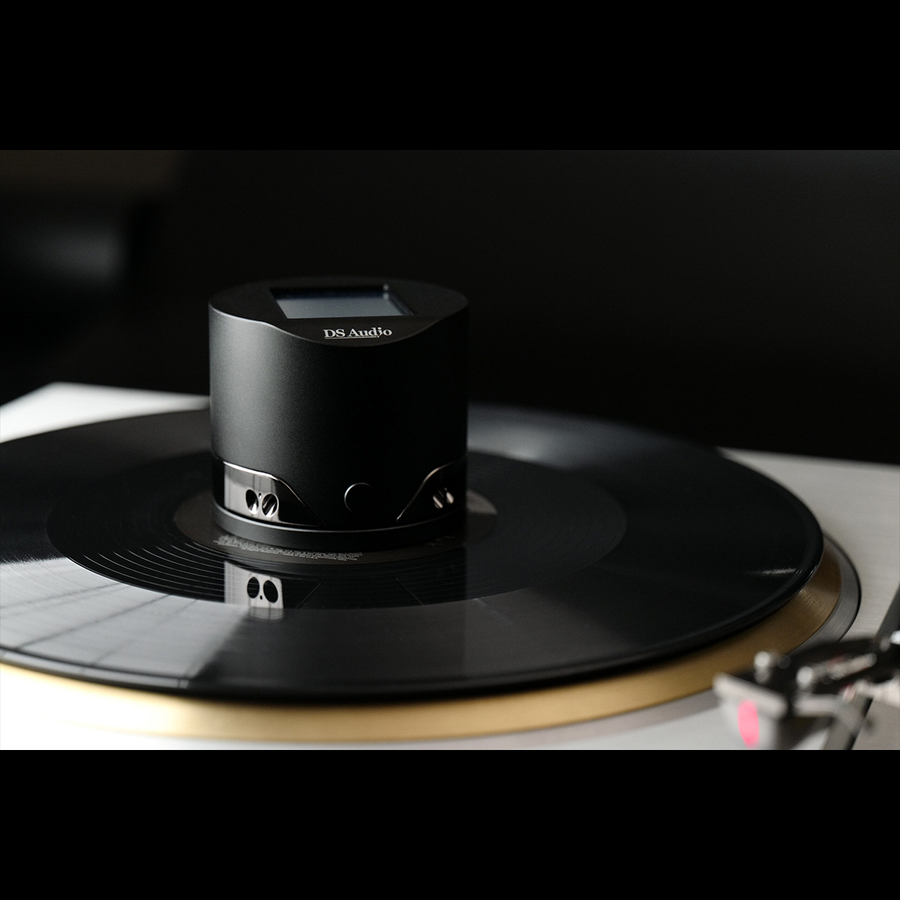
The ES-002 is a battery-powered record weight that reads the run-out groove optically while the platter spins, shows how far off-center the record is, and guides you to nudge it true. DS Audio's position is that an off-center pressing, not the turntable, is the dominant cause of wow and flutter. The ION-001 ionizer, PH-001 phono cable and HS-001 headshell complete the accessory line. Read the deep diveClose

What it does

The ES-001 of July 2022 was described by DS Audio as a world first, and the ES-002 of May 2025 replaced it in two versions. Set on the spindle, it reads the run-out groove in about two seconds and shows the off-center distance on a touch display with a color-coded cross mark; you then push the record until the mark centers, the target being under 20 microns. DS Audio's figure is that an eccentricity of 0.34 mm produces about 0.15 percent speed error at the inner grooves. The ES-002 Reference is A5052 aluminum on a non-magnetic tungsten base at 640 g; the Core replaces tungsten with brass and uses resin internals, with what DS Audio calls the same detection performance. The ION-001 of November 2019 is a fanless tower with two positive and two negative ionizers aimed at the platter and an ozone-suppressing supply, placed beside the turntable with its ports about an inch above the record. The PH-001 phono cable of December 2023 is built for optical cartridges, whose cold conductors carry LED power, so hot and cold sides are made identically from 37 silver-plated copper strands under a silver-plated braid, and it also serves MM and MC. The HS-001 headshell of March 2019 is machined from solid duralumin with hand-soldered Litz leads and fits any cartridge.

Why it matters in a system

Pitch stability is the one thing a cartridge cannot fix, and most of it is lost before the stylus reaches the groove. Centering the record on the spindle is the direct cure, and the ES-002 makes it a two-second check rather than a guess; the ionizer, cable and headshell address static, LED power delivery and cartridge mounting on the same turntable.

What you may hear

Michael Fremer reviewed the ES-001 for The Absolute Sound; Hi-Fi News wrote that, for anyone with the ears and the gear, it would prove as indispensable as a dust brush. Michael Corsentino of Positive Feedback called the ION-001 the most effective anti-static device he had used.

Search