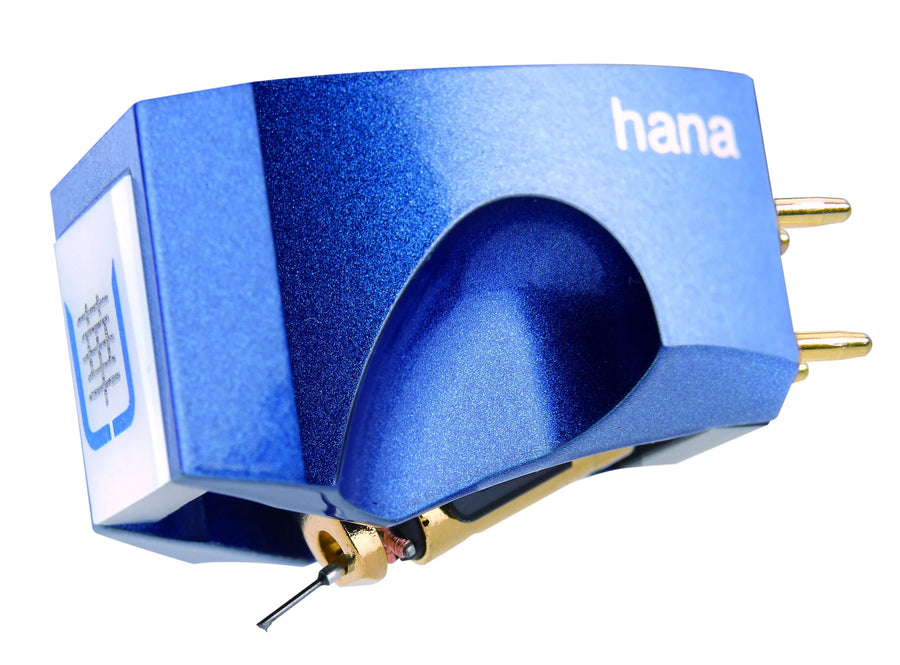
Hana technology

The engineering behind Hana

Hana gives its technologies names because each one solves a specific problem. Here is what each does, where it came from, why it matters in a system, and what you may hear.

Elliptical, Shibata, Microline; aluminum, boron, diamondSince 2015

The stylus and cantilever ladder

Each step up the Hana range changes the two parts that touch the record: the diamond and the rod that carries it. The E Series uses an elliptical stylus on an aluminum cantilever, the S a nude Shibata on tapered aluminum, the M a nude Microline on aluminum, the Umami Blue and Red a Microline on solid boron, and the Umami Black a Microline on a diamond cantilever. Read the deep diveClose

What it does

The stylus profile decides how much of the groove wall the diamond reads. The E Series carries a synthetic elliptical, the simplest shape and the one most tolerant of setup. The S Series moves to a nude natural-diamond Shibata, a line-contact profile with a taller, narrower footprint; Hi-Fi News credits Excel Sound with mounting a Shibata on a crimped, stiffened alloy cantilever to lower tip mass. The M Series and the three Umami models use a nude Microline, the narrowest line contact, which Hana describes as mimicking the cutting stylus and fitting more precisely into the groove. The cantilever ladder runs alongside. The E and M use aluminum pipe; the S Series MK II of 2024 and the E Series MK II of 2026 use a tapered aluminum rod that Hana says is stiffer and has less effective mass at the tip, and Masao Okada called it the biggest change in the SL MK II. The Umami Blue and Red carry the Microline on solid boron, which Hana's brochure describes as about as hard as diamond and able to carry fine detail and micro-dynamics to the generator without loss. The Umami Black of 2025 is the first Hana with a diamond cantilever. The cantilever and stylus assemblies come from Orbray, formerly Adamant Namiki.

Why it matters in a system

A stiffer, lighter cantilever bends less between the stylus and the coils, so more of what the diamond traces reaches the generator and less is lost as flex or stored as resonance. A narrower line contact reads more of the high-frequency detail cut into the groove and wears records less, provided it is aligned with care. Line-contact profiles reward a well-set tonearm and clean records, which is part of what Pearl does at installation.

What you may hear

Andre Jennings of The Absolute Sound found the Shibata SL and SH to be models of sonic purity with very low perceived distortion. Herb Reichert of Stereophile wrote that the SL excavated more microscale information than the EL, especially in the high frequencies, and The Absolute Sound heard the tapered-cantilever SL MK II move a few steps closer to neutral.

And the OKD generator of the Umami BlackSince 2015

Alnico, samarium-cobalt and neodymium magnets

Most Hanas are built around Alnico, the aluminum-nickel-cobalt magnet of classic cartridges, chosen for its tonal character rather than its strength. The Umami Red moves to samarium-cobalt, and the Umami Black to a neodymium magnet inside a new generator, named OKD for Masao Okada, whose yoke both shapes the field and supports the diamond cantilever. Read the deep diveClose

What it does

A moving-coil cartridge is a tiny generator: coils on an armature swing in the field of a fixed magnet, and the magnet's material sets both the strength and the shape of that field. Hana's E, S and M Series and the Umami Blue use Alnico, which Musical Surroundings describes as less powerful than modern magnets, and which Hana keeps for the way it sounds; The Absolute Sound called the result a meeting of old and new. The EL MK II of 2026 retains the classic Alnico magnet behind its updated coil. The Umami Red of 2020 is the first Hana to use a rare-earth magnet, samarium-cobalt, in a pure-iron magnetic circuit with a square-plate Permalloy armature. The Umami Black of 2025 goes further: a neodymium N40 magnet, a 2 mm square hybrid carbon-permalloy armature hand-wound with 30-micron 4N copper, and the OKD generator, in which the rear pole piece and yoke are made as a single part and an inverted-U front yoke supports the cantilever while aligning the field, so that the mechanical path from the stylus and the magnetic path through the coils are handled by the same structure. Hana says the Black is much more than an Umami Red with a diamond cantilever, and its output is 0.3 mV at 5 ohms.

Why it matters in a system

The magnet decides how much signal the coils make for a given motion and how linear that field is across the coil's travel. Alnico gives Hana a sound many listeners associate with the great cartridges of the 1960s and 1970s at a modest price; rare-earth magnets give the Umami Red and Black more field from the same space, and the OKD yoke brings resonance control and field alignment into one part.

What you may hear

Herb Reichert of Stereophile linked the Alnico SL to a black background, seductively rendered top octaves and exquisite inner detail. Andre Jennings of The Absolute Sound found the Umami Black neither warm nor rolled-off, leaning toward clarity, resolution and tone color rather than ultimate bass slam.

Yokes, pole pieces and pins frozen near absolute zeroSince 2018

Cryogenic cold annealing

Since the M Series of 2018, Hana has frozen the iron parts of the magnetic circuit, the front yoke, pole pieces and rear magnetic parts, and the gold-plated terminal pins, to near absolute zero. Hana calls the process cold annealing and says it gives a more even magnetic field and better conductivity. It now covers the entire range. Read the deep diveClose

What it does

Cryogenic treatment takes a finished metal part down to a temperature near absolute zero and brings it back slowly. Hana's description is that the process restructures the metal at the molecular level, relaxing the stresses left by machining and forming so that the grain is more uniform. In a cartridge the parts that matter are the ones that carry magnetic flux, the yokes and pole pieces around the coils, and the ones that carry the signal out, the terminal pins. Hana introduced the treatment on the ML and MH in October 2018, applying it to the front yoke and the center and rear magnetic parts, and the press release claimed a more precise and controlled flux field for greater linearity. The Umami Red of 2020 extended it to the yokes, the pole piece and the 24-karat gold-plated pins, and the Umami Black treats the whole generator and its gold-plated brass pins. The S Series MK II of 2024 brought cryo-treated yokes, pole pieces and pins to the SL, SH and SL Mono, and the E Series MK II of 2026 completed the range; Hana's own page for the EL MK II says the same treatment is used across the Umami Series and the entire Hana range.

Why it matters in a system

The field in the gap is what the coils move through, and any unevenness in it becomes distortion that no phono stage can remove. A yoke with a more uniform grain carries flux more evenly, and a pin with better conductivity loses less of a signal that is only a few tenths of a millivolt. The treatment is one reason the M Series and everything after it measure and sound more alike across the range.

What you may hear

Alan Sircom of hi-fi+ found the ML and MH brilliant in detail resolution and beautiful in tonal balance, and Herb Reichert of Stereophile called the ML a stunning-sounding, artfully engineered phono invention. In the Umami Black, AnalogPlanet reported the treated pins are intended for enhanced conductivity and reduced distortion.

Thicker wire, fewer turns, quieter signalSince 2018

The 8-ohm pure-copper generator

The original Hana coils were 15-micron copper wound to 30 ohms. With the ML in 2018 Hana rewound the generator with 30-micron, 4N high-purity copper and fewer turns, dropping impedance to 8 ohms at 0.4 mV. The same generator went into the Umami Blue, the SL MK II and the EL MK II, and it lets the cartridge be loaded at 80 to 100 ohms. Read the deep diveClose

What it does

A moving-coil cartridge's output and impedance are both set by the coil: more turns of thinner wire give more voltage but more resistance, and the resistance is a noise source in its own right. The 2015 EL and SL were wound with 15-micron four-nines copper to 30 ohms and 0.5 mV. For the ML of October 2018, Hana doubled the wire diameter to 30 microns, kept the purity, and reduced the turns, so the coil measures 8 ohms and delivers 0.4 mV. Garth Leerer of Musical Surroundings told Stereophile that the 8-ohm coil improves signal-to-noise and allows loading of 80 to 100 ohms, where most moving-coil phono stages are happiest. Hana describes the ML's generator as the same low-impedance unit used in the Umami Blue, wound with very high-purity copper, and its page for the EL MK II says the 8-ohm coil design was first developed for the ML and later used in the SL MK II. The Umami Red and Black use their own windings of 30-micron 4N copper at 6 and 5 ohms. Across the current low-output models the recommended minimum loads fall between 50 and 100 ohms, which also suits current-drive and transimpedance phono inputs that want a low source impedance.

Why it matters in a system

Impedance is the number that decides how a cartridge and a phono stage get along. A 30-ohm coil wants a load above 400 ohms and gives up some noise floor; an 8-ohm coil runs quieter, works into a wider range of inputs, including step-up transformers and current-mode stages, and keeps the loading question simple. It is why the SL MK II and EL MK II specify 0.4 mV where their predecessors specified 0.5.

What you may hear

Herb Reichert of Stereophile wrote that the ML presented a dazzling display of avant-garde invention with unusual force and extremely pure transients, and he found the Umami Blue so persuasive that after a week he was ready to propose marriage.

Search