
← Back to your LP12 build

Luxman · Reference Separates

Luxman M-10x Stereo Amplifier

$19,995

Signature technologiesThe Luxman story

On demonstration

On the floor at our Portland showroom. Ask and we will set it up for you to hear.

Luxman · Reference Separates

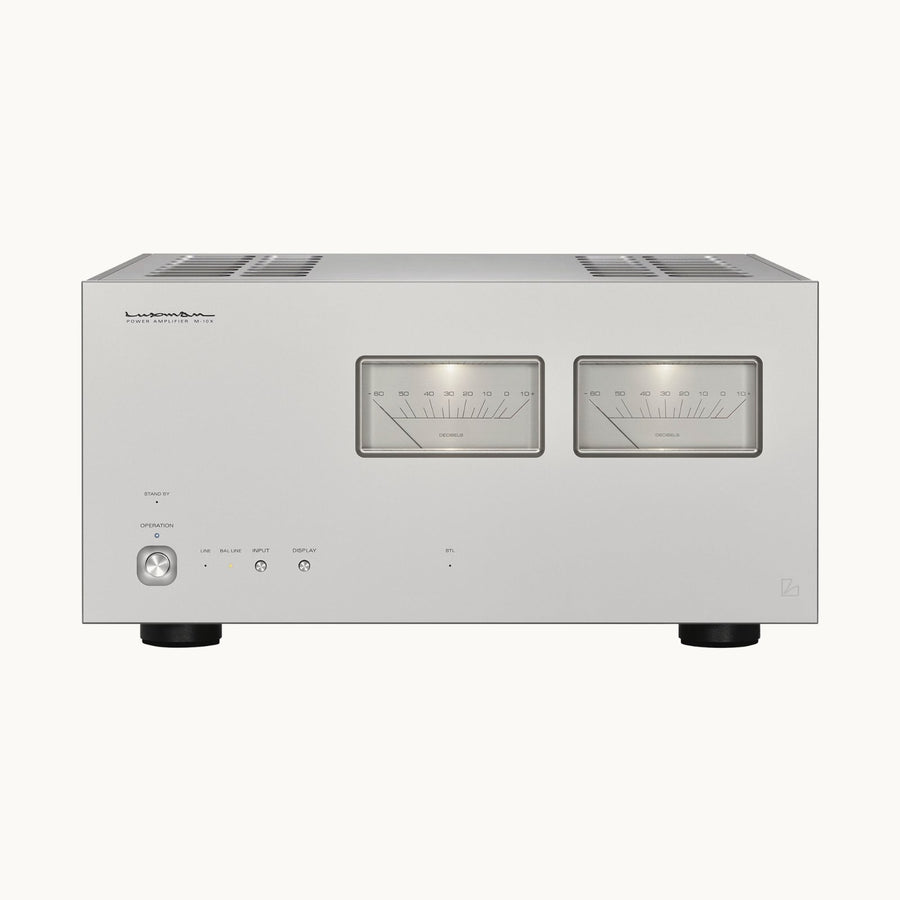
Luxman's flagship stereo power amplifier and the first with the LIFES feedback circuit: 150 W per channel into 8 Ω and 300 W into 4 Ω from a four-parallel push-pull output stage running in class A to 12 W, bridgeable to a 600 W monoblock, with a 1,250 VA transformer, a damping factor of 600 and Luxman's illuminated needle meters.

Price is for one stereo amplifier. Two M-10Xs in BTL mode make a pair of 600 W monoblocks.

150 W
per channel into 8 Ω; 300 W into 4 Ω; 1,200 W instantaneous into 1 Ω
600 W
bridged mono into 8 Ω; 2,400 W into 2 Ω
600
damping factor; 0.003% THD at 1 kHz into 8 Ω
48.4 kg
weight (107 lb); 1,250 VA transformer

Authorized Luxman dealer · Delivery and installation by Pearl Audio · Trade-ins welcome

The story

The M-10X was the amplifier Luxman chose to introduce its hundredth year, launched at the end of 2021 as the successor to the M-900u and the first product to carry LIFES, the Luxman Integrated Feedback Engine System. Luxman's amplifiers since the 1990s have used ODNF, a feedback scheme that extracts only the distortion components from the output and feeds those back, leaving the music signal itself out of the loop; the company's argument is that this gives the stability and low distortion of feedback without the sound it associates with global feedback. LIFES is ODNF rebuilt from the ground up: a simpler circuit with, Luxman says, half the number of parallel elements, lower distortion and a wider bandwidth, so that the amplifier behaves like a non-feedback design while measuring like a feedback one. In the M-10X, LIFES 1.0 drives an output stage of two three-stage Darlington circuits, each with four paralleled push-pull pairs, a 4 × 2 configuration Luxman chose to hold its performance into difficult loads, and the stage runs in pure class A up to 12 W before crossing into class AB.

The ratings are 150 W per channel into 8 Ω and 300 W into 4 Ω, with an instantaneous capability of 1,200 W per channel into 1 Ω, and a BTL switch bridges the two channels into a 600 W monoblock into 8 Ω or 2,400 W into 2 Ω; many owners begin with one M-10X and add a second. The power supply is an EI-core transformer rated at 1,250 VA continuous and 2,500 VA instantaneous, wound with flat copper, feeding four 20,000 µF capacitors in left and right banks. Distortion is 0.003% or less at 1 kHz into 8 Ω and 0.04% across the band, the signal-to-noise ratio 117 dB, the frequency response within 0.1 dB from 20 Hz to 20 kHz and −3 dB at 130 kHz, and the damping factor 600, which is the figure that tells you the M-10X will hold a large woofer still. John Atkinson's measurements for Stereophile found clipping at 202 W into 8 Ω and 350 W into 4 Ω, THD+N of 0.002% at 50 W into 8 Ω, an output impedance of 0.06 Ω and a signal-to-noise ratio of 115.6 dB referred to full power, and he concluded that "the Luxman M-10X offers superb measured performance".

Stereophile's listening review found that "the midrange was clean, uncolored, and detailed", that "the Luxman's presentation was so compelling and so richly detailed" that the reviewer kept returning to it, and closed with "highly recommended". That is consistent with what Luxman has been building toward for thirty years: an amplifier that is quiet and controlled but not clinical, with the slight warmth and generous midrange that Luxman owners recognize, and the power to drive anything a domestic room will hold. The casework carries the cues of Luxman's separates: a blasted white finish, beveled front edges and two needle-movement level meters with LED illumination that can be dimmed or switched off; in BTL mode the left meter reads for the mono channel.

Connection is through one pair of copper-alloy RCA inputs and one pair of balanced XLR inputs with a phase-invert switch for sources wired pin 2 cold, selected from the front panel; input sensitivity is 1.24 V for full output, a gain of 29 dB, into 51 kΩ unbalanced or 28 kΩ balanced. A 12 V trigger input and output and a 3.5 mm control link switch the M-10X on and off with the C-10X preamplifier or another compatible component. The M-10X draws 290 W at idle and 540 W at full output, runs warm rather than hot, and at 48.4 kg needs a shelf or amplifier stand rated for it.

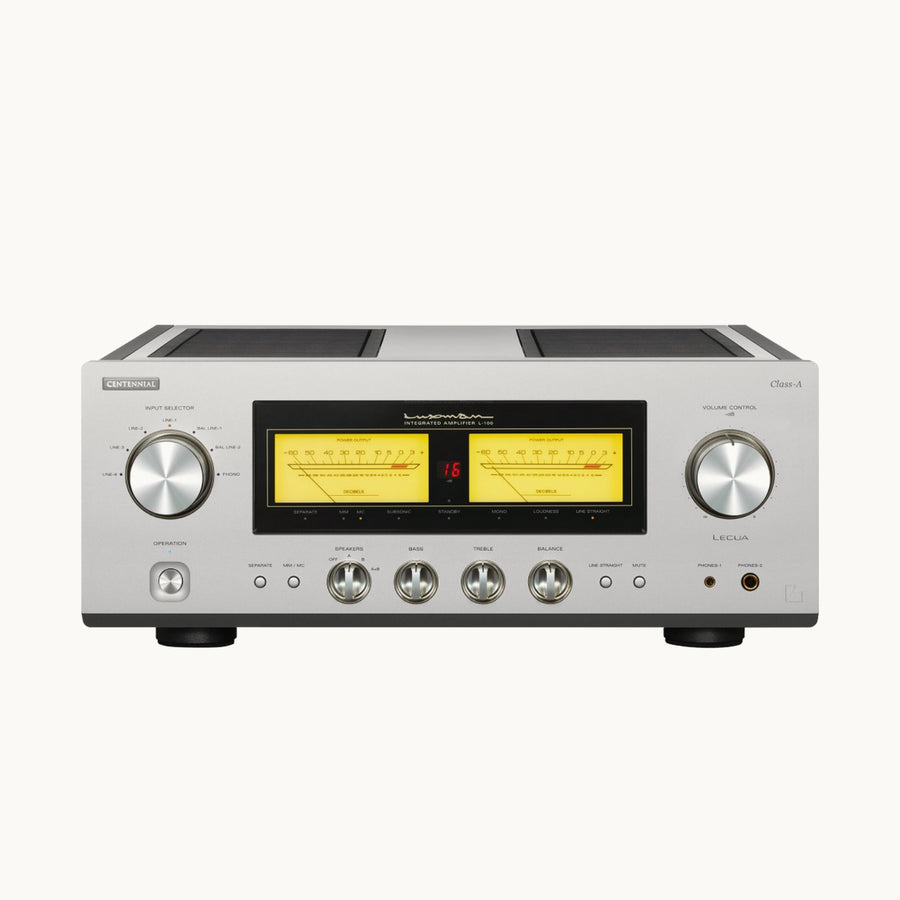
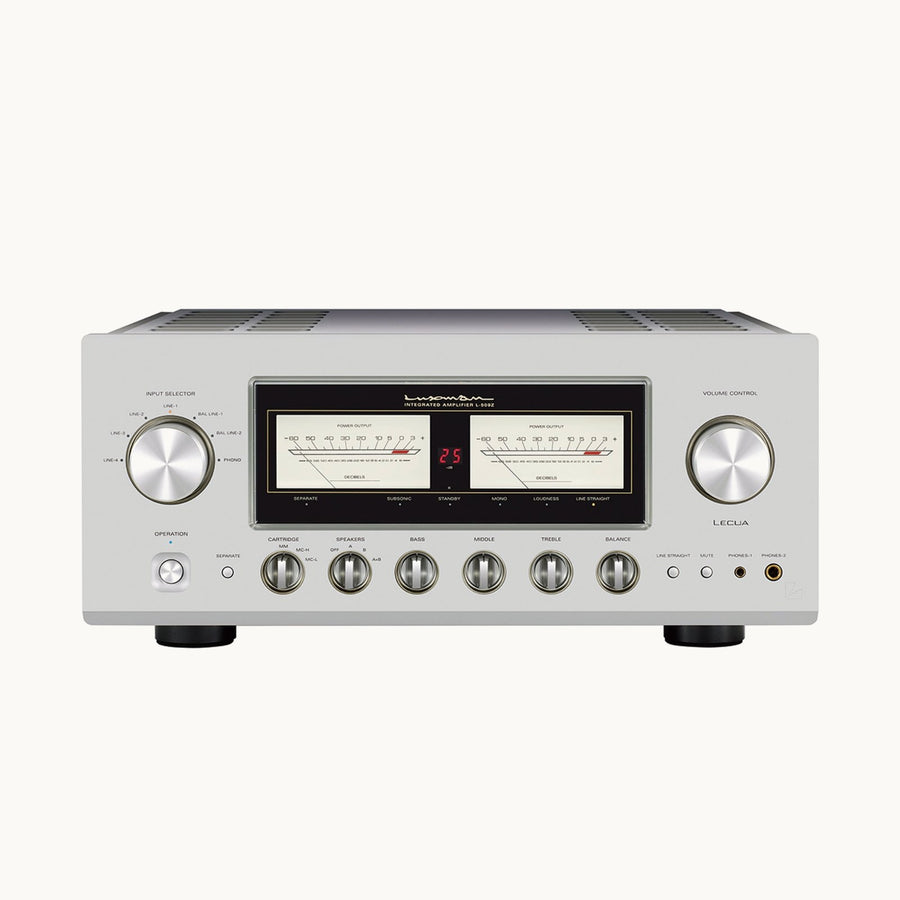
Within Luxman's amplifiers the L-509Z is the flagship integrated, with the same LIFES circuit at 120 W per channel, and the L-507Z and L-505Z sit below it; the L-100 is the class A integrated. The M-10X is the step to separates, and its partner is the C-10X Control Amplifier, which shares its chassis design, meters and control link. Sources from the same family are the D-100 and D-07X SACD players and DACs, the NT-07 network transport and the PD-191A turntable with the E-07 phono stage.

We plan the M-10X with the C-10X or a dCS Bartók driving it directly from the DAC's volume control, into loudspeakers such as the Magico A5 and S3, Sonus faber Amati G5 and Serafino G2, Bowers & Wilkins 802 D5 and Harbeth Monitor 40.3; a pair in BTL mode suits the Magico S5 and Sonus faber Amati Supreme. Arrange an audition in our Portland showroom and ask us to compare one M-10X in stereo with two bridged.

Luxman began in Osaka in June 1925 as the radio department of a picture-frame store, and its separates have marked its anniversaries since the 300-watt M-6000 and the C-1000 preamplifier of 1975. The C-10 and B-10 of 1996 were the flagships for a decade; the M-10X of 2022 and the C-10X of 2023, the first products with LIFES, are their successors, built in Yokohama. Read the Luxman story →

Key technologies

  • LIFES 1.0 feedback. The Luxman Integrated Feedback Engine System, successor to ODNF, feeds back only distortion components and never the music signal; a simpler circuit with half the parallel elements, lower distortion and wider bandwidth than ODNF.
  • 4 × 2 output stage. Two three-stage Darlington circuits, each with four paralleled push-pull transistor pairs, for stability into difficult loads; pure class A to 12 W.
  • BTL bridged mode. A rear switch bridges the channels into a 600 W monoblock into 8 Ω (2,400 W into 2 Ω); the left meter reads for the mono channel.
  • 1,250 VA power supply. An EI-core transformer with flat copper winding, 2,500 VA instantaneous, feeding four 20,000 µF capacitors in independent left and right banks.
  • Damping factor 600. A low output impedance, measured by Stereophile at 0.06 Ω, for control of large low-frequency drivers.
  • Balanced and unbalanced inputs. Copper-alloy RCA and XLR inputs with a phase-invert switch for the balanced input; 12 V trigger in and out and a control link to the C-10X.
  • Needle level meters. Two LED-illuminated moving-needle meters, dimmable and switchable, in a blasted white chassis with beveled edges.

The M-10X's partner is the C-10X Control Amplifier; the L-509Z carries the same LIFES circuit in one chassis.

Specifications
Type Stereo power amplifier, class AB with class A operation to 12 W; bridgeable (BTL) to mono
Rated output, stereo 150 W + 150 W into 8 Ω; 300 W + 300 W into 4 Ω; 1,200 W + 1,200 W instantaneous into 1 Ω
Rated output, bridged mono 600 W into 8 Ω; 2,400 W into 2 Ω
Measured (Stereophile) Clipping at 202 W into 8 Ω and 350 W into 4 Ω (1% THD+N); 0.002% THD+N at 50 W into 8 Ω; 0.06 Ω output impedance
THD 0.003% or less (1 kHz, 8 Ω); 0.04% or less (20 Hz–20 kHz, 8 Ω)
Frequency response 20 Hz – 20 kHz, +0/−0.1 dB; 1 Hz – 130 kHz, +0/−3 dB
Signal-to-noise ratio 117 dB (IHF-A); Stereophile measured 115.6 dB ref. full power
Damping factor 600
Input sensitivity / gain 1.24 V for 150 W into 8 Ω; 29.0 dB
Input impedance 51 kΩ unbalanced; 28 kΩ balanced
Inputs 1 pair RCA (copper alloy); 1 pair balanced XLR (pin 3 hot, phase-invert switch); 12 V trigger in/out; 3.5 mm control link
Amplifier circuit LIFES 1.0; three-stage Darlington, four paralleled push-pull, 4 × 2 configuration
Power supply EI-core transformer, 1,250 VA continuous, 2,500 VA instantaneous; 20,000 µF × 4 filter capacitors, L/R independent
Power consumption 540 W; 290 W no signal; 1.0 W standby
Dimensions (W × H × D) 440 × 224 × 488 mm (17.3 × 8.8 × 19.2 in), depth including terminals
Weight 48.4 kg (107 lb)
Finish Blasted white aluminum with beveled front edges; LED-illuminated meters
Warranty Not published by Luxman on the product page; ask us for current Rhythm Audio terms

Luxman M-10X brochure and specifications (Luxman PDF)

Where it sits in the range

Luxman's amplifiers, cheapest first.

  • Luxman L-505Z: integrated, 100 W per channel into 8 Ω, LIFES
  • Luxman L-507Z: integrated, 110 W per channel into 8 Ω, LIFES
  • Luxman L-100: class A integrated
  • Luxman L-509Z: flagship integrated, 120 W per channel into 8 Ω, LIFES
  • Luxman M-10X (this model)

Its partner is the C-10X Control Amplifier; the D-100 and PD-191A are the matching sources.

Reviews

Plan your Luxman system with Pearl Audio

Pearl Audio is an authorized Luxman dealer. Arrange an audition of the M-10X with the C-10X in our Portland showroom, and ask us to compare one amplifier in stereo with two in BTL mode. Call (503) 222-2599 or email sales@pearlaudio.com.

Signature technologies

The engineering behind the Luxman M-10x Stereo Amplifier

Luxman gives its technologies names because each one solves a specific problem. Here is what each does, where it came from, why it matters in a system, and what you may hear.

Feed back only the distortionSince 2021

LIFES

LIFES, the Luxman Integrated Feedback Engine System, is the amplifier circuit in every current Luxman amplifier. It descends from ODNF, which fed back only the distortion rather than the whole signal, and rebuilds that idea as a fully discrete error-detection circuit with about half the distortion of ODNF 4.0 and a 3 dB better signal-to-noise ratio. Read the deep diveClose

What it does

LIFES descends from ODNF, Only Distortion Negative Feedback, which Luxman first used in the CM-2100 car amplifier of 1999 and developed through ODNF 2.4 in the C-1000f of 2006, ODNF 4.0 in the C-900u and M-900u of 2013 and ODNF-u in the D-10X of 2020. Conventional negative feedback returns a slice of the output to the input, music included; ODNF compared input and output, extracted only the difference, the distortion, and fed back just that, so the main signal path behaved more like a feedback-free amplifier. LIFES keeps the idea and rebuilds the error-detection circuit as a fully discrete design, conceived, in Luxman's words, from first principles using simulation technology, with a new input FET, new voltage regulation and better thermal stability. Luxman claims roughly half the distortion of ODNF 4.0 and a 3 dB improvement in signal-to-noise ratio. LIFES 1.0 shipped first in the M-10X power amplifier, in Japan in 2021 and in the US in February 2022, then in the L-507Z, L-509Z, C-10X and L-505Z. LIFES 1.1 of 2025 parallels the input FETs of the error-detection stage; Phile-web measured the L-100's distortion at 0.002 percent at 1 kHz against 0.003 percent for the previous circuit.

Why it matters in a system

Feedback that carries the whole signal around the loop can trade clarity for a low distortion figure; feeding back only the error lets Luxman keep distortion and noise low while tuning the amplifier for its sound. Masakazu Nagatsuma, Luxman's head of development, said LIFES reduced distortion and improved signal-to-noise and gave the company more freedom in sound tuning. It is also why the Z-series integrateds, the C-10X and the M-10X share one character.

What you may hear

Quiet backgrounds and low distortion that John Atkinson confirmed on Stereophile's bench, where the L-509Z offered, in his words, excellent measured performance, especially its low-noise, low-distortion. Ken Micallef, listening to the same amplifier, called it an amp of brilliant purity and fluid communication.

From the L-570 to the L-100 CENTENNIALSince 1990

Pure Class A

Luxman has kept a pure Class A integrated amplifier in its line for decades, from the 1990s L-570 through the L-550 and L-590 families to the L-100 CENTENNIAL, its first Class A integrated built on LIFES. The M-10X and B-100 power amplifiers run in Class A for their first 12 and 25 watts. Read the deep diveClose

What it does

In a Class A output stage the transistors conduct the full waveform continuously, which removes crossover distortion at the cost of heat and efficiency. Luxman has kept a pure Class A integrated in its line for decades: the L-570 of the 1990s, which Luxman calls its best-selling model of that decade; the L-550A and L-590A MkII, sold in the US in 2007 at $4,500 and $9,000; the L-550AX and L-590AX of 2011; the L-590AX MkII; and the 300-unit L-595A LIMITED of 2020, which reissued the L-570 design, followed by the L-595ASE in 2021. The L-100 CENTENNIAL, announced in Japan in September 2025 and worldwide on February 10, 2026, is the first update of the regular-line Class A flagship since the L-590AX II, about ten years, and the first pure Class A integrated built on LIFES: 20 watts per channel into 8 ohms and 40 into 4 from a bipolar three-parallel push-pull stage, LIFES 1.1, LECUA1000, a custom EI transformer with 80,000 µF of capacitance, and 210 watts drawn at idle. The power amplifiers keep the tradition at low levels: the M-10X runs in pure Class A up to 12 watts, the B-100 CENTENNIAL mono amplifier up to 25 watts into 8 ohms.

Why it matters in a system

A Class A amplifier spends its power on linearity rather than efficiency: there is no transition between output devices for the music to cross, so the smallest signals are handled by the same conducting stage as the loudest. Twenty watts of Class A is enough for a sensitive or moderately sized loudspeaker in most rooms, and on Stereophile's bench the L-100 clipped at about 72 watts into 8 ohms and 122 into 4 before its Class AB margin ran out.

What you may hear

Ken Micallef, reviewing the L-100 for Stereophile's October 2026 cover, called it the best Luxman he had heard and wrote that it seemed to float images into the room, not simply between the speakers. Dylan Wahl's measurements found a product designed with care in every technical aspect.

The housekeeping behind the soundSince 2017

Loop-less chassis, Beeline routing and peel-coat boards

Every Luxman amplifier shares a set of practices beneath the circuit: a chassis grounded so no loops form between panels, the shortest possible signal routing with curved traces, boards with the solder mask peeled from the signal area, oxygen-free copper wiring, oversized power supplies and cast-iron feet. They are built in Yokohama. Read the deep diveClose

What it does

Beneath the circuits, every Luxman amplifier and player shares a set of mechanical and electrical practices. The chassis is loop-less: panels and boards are grounded so that no ground loop forms between them, and the C-10X goes further with 100-micron gold-plated boards. Signal routing follows what Luxman calls the Beeline layout, the shortest path between stages, with curved rather than angled traces. On the L-507Z, L-509Z, L-100 and C-10X the printed boards are peel-coat types: the solder mask is removed from the signal area because, Luxman says, it can have a smearing effect on audio signals. Internal wiring is oxygen-free copper. Power supplies are oversized, with a 600 VA EI transformer and eight 10,000 µF capacitors in the L-509Z, a 1,250 VA transformer with flat copper windings in the M-10X, and a CI-core transformer in the C-10X. The units stand on density-gradient cast-iron insulator feet. Stereophile credited the L-509Z's design to three engineers: Masakazu Nagatsuma for its tonal qualities, Kunihiko Koki for the electronics and Takeharu Sato for the mechanicals. Luxman still manufactures in Yokohama, and each L-100 is built by hand by a team of four specialists.

Why it matters in a system

None of these details is a headline technology, and together they are much of why a Luxman sounds like a Luxman. Ground loops, long traces and resonant panels add noise and hash below the level of the specifications; removing them is what lets the low distortion of LIFES and the silence of LECUA reach the loudspeaker. It is also why the amplifiers weigh what they do: the L-509Z is 29.4 kg, the M-10X 48.4 kg.

What you may hear

Ken Micallef in Stereophile: the Luxman L-509Z never shouts, barks, or begs. Chris Kelly in Hi-Fi+ found its voicing perfectly judged, with incredible detail retrieval and no loss of musicality, and The Ear called it the yardstick by which future visiting amplifiers would be measured.

All Luxman technologies and the company story

The Luxman story

Founded in Osaka in 1925 and built in Yokohama today: Class A, LIFES, LECUA and belt-drive turntables.

Founded 1925 in Osaka, Japan; headquartered and built in Yokohama, Kanagawa by T. Hayakawa and K. Yoshikawa · luxman.com

Milestones

  1. 1925 Founded in Osaka In June, the year radio broadcasting begins in Japan, T. Hayakawa and K. Yoshikawa start a radio department at the Kinsuido picture-frame store and incorporate it as Lux Corporation. The LUX-1730 and LUX-735 radios follow in 1928.
  2. 1958 MA-7A Luxman's first fully assembled post-war hi-fi power amplifier, a mono tube design with a patented NFB cross-over circuit, built on the OY output transformers developed in 1952.
  3. 1961 SQ-5A A vacuum-tube integrated with a center level meter and Luxman's own tone-control circuit. The company dates its unbroken run of tube amplifiers from it; the SQ-38 of 1964 follows.
  4. 1966 MQ-36 OTL An output-transformer-less tube power amplifier that stays in production until 1978. The MQ-60 of 1969 and CL-35 of 1970 are the models today's MQ-88uC and CL-38uC honor.
  5. 1975 Fiftieth anniversary: M-6000 A 300-watt stereo amplifier with the C-1000 preamplifier and T-110 tuner. The M-series amplifiers are designed by Tim de Paravicini; the Laboratory Reference Series follows in 1977.
  6. 1980 PD-300 A turntable with a vacuum disc stabilizer, a first for vacuum hold-down. Luxman stops building turntables after the PD-350 and does not return to them for 28 years.
  7. 1984 Alpine Electronics Alpine acquires the Luxman brand; Atsushi Miura leaves to found A&M and Air Tight in 1986. Co-badged products sold through mass retailers cost the brand its high-end dealers. Alpine sells in 1994.
  8. 1996 C-10 and B-10 Flagship separates that hold the top of the line for about ten years. The C-10's fixed-resistor Ultimate Attenuator is the ancestor of LECUA.Luxman C-10X Control Amplifier
  9. 1999 ODNF The CM-2100 car amplifier is the first product with Only Distortion Negative Feedback, which feeds back the distortion rather than the whole signal. Versions 2.4 (2006) and 4.0 (2013) follow.
  10. 2007 Eightieth anniversary; back in the US The B-1000f monoblocks (2005) and C-1000f control amplifier (2006) introduce LECUA1000 and ODNF 2.4. On a Higher Note returns Luxman to the United States after roughly two decades away.
  11. 2009 International Audio Group Luxman joins IAG, which keeps it separate from its other brands and leaves design and manufacturing in Kanagawa. The eleventh-generation SQ-38u launches the same year.
  12. 2011 PD-171 Turntable development resumes 28 years after the PD-350, with a belt-drive design that leads to the PD-151 (2019), the PD-191A and the PD-151 Mk II.Luxman PD-191A
  13. 2020 D-10X The world premiere of ROHM's MUS-IC BD34301EKV converter, run one per channel, with the LxDTM-i transport. The D-07X of 2023 uses the same chip and mechanism.Luxman D-07x SACD / DAC
  14. 2022 LIFES in the M-10X The successor to ODNF ships first in the flagship stereo power amplifier, then in the L-507Z, L-509Z, C-10X and L-505Z.
  15. 2025 Centennial The E-07 phono stage, Black Edition CENTENNIAL models, the D-03R, and the L-100 and D-100 CENTENNIAL on LIFES 1.1. Rhythm Audio becomes the North American distributor in February; Luxman enters the Hi-Fi Hall of Fame in May.Luxman L-100 Class A Integrated
  16. 2026 Component of the Year Stereophile names the L-100 CENTENNIAL Joint Amplification Component of the Year and puts it on its October cover. The D-100 CENTENNIAL ships worldwide in April and the B-100 CENTENNIAL mono amplifier in September.Luxman D-100 SACD/DAC
Read the Luxman story
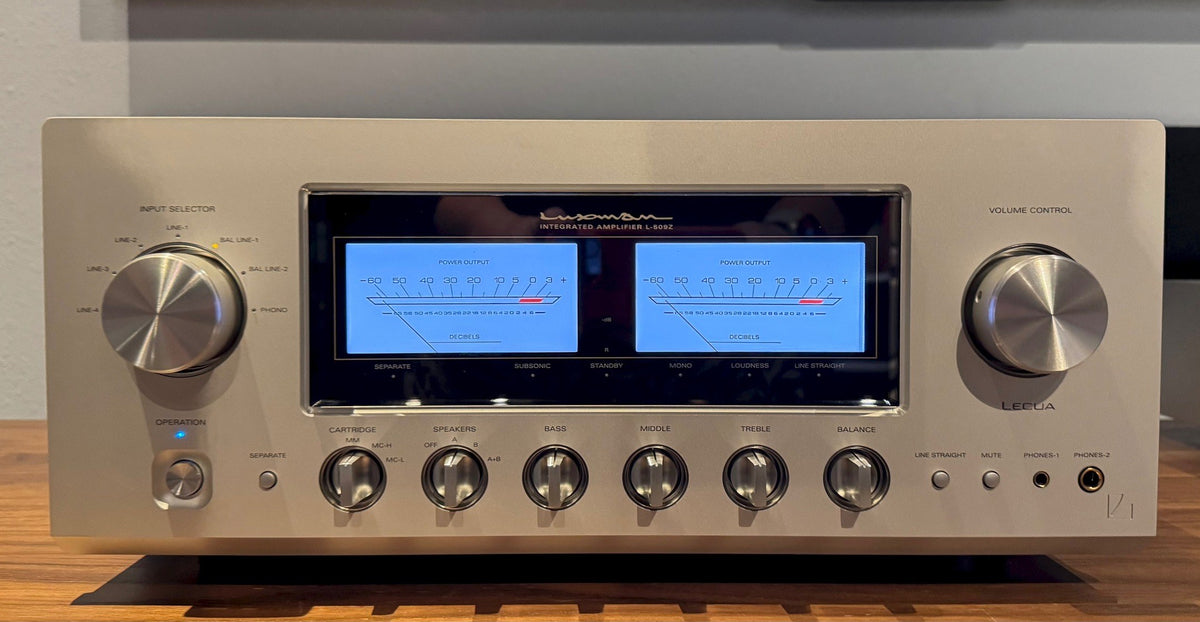
Luxman L-509Z integrated amplifier, front view

Luxman began in June 1925 as the radio-equipment department of Kinsuido, a painting and picture-frame dealer in Osaka, in the year radio broadcasting began in Japan. T. Hayakawa and his brother K. Yoshikawa incorporated the business as Lux Corporation; by the company's own account Kinsuido was the first in Japan to display and sell radio receivers in a store, and its radio manual, the first Japanese radio guidebook, ran to fourteen editions. The first products followed in 1928, the LUX-1730 and LUX-735 hi-fi radios sold with a magnetic-horn speaker, and in 1931 a magnetic pickup for the LUX-1730 electric phonograph. Through the 1930s the firm built its reputation on the parts it made itself, transformers and switches, and in 1952 it developed the OY-type output transformers that collectors still seek out and that Luxman's tube amplifiers carry in descendant form today.

The MA-7A of 1958, a mono vacuum-tube power amplifier with a patented NFB cross-over circuit, was Luxman's first fully assembled post-war hi-fi amplifier. The SQ-5A integrated of 1961, with its center-mounted level meter and Luxman's own tone-control circuit, was a hit, and the company dates its unbroken run of tube amplifiers from it. The SQ-65 of 1962 carried a motional-feedback patent, and the PZ-11 of the same year was Japan's first germanium-transistor phono equalizer. The SQ-38 of 1964 became a fixture of Japanese jazz cafés and began a series that reached its twelfth generation in the LX-380. The MQ-36 of 1966, an output-transformer-less tube amplifier, stayed in production until 1978; the SQ-505 and SQ-507 of 1968 preceded the 500 series; and the MQ-60 power amplifier of 1969 and CL-35 preamplifier of 1970 are the models the current MQ-88uC and CL-38uC are built to honor. By The Absolute Sound's account Luxman was the only major Japanese manufacturer still producing tube amplifiers through the 1970s and 1980s.

LUX Kit, a do-it-yourself brand, sold about seventy products between 1971 and 1980. For the fiftieth anniversary in 1975 Luxman introduced the 300-watt M-6000 stereo amplifier, the C-1000 preamplifier and the T-110 tuner; the M-3000, M-4000 and M-6000 were designed by Tim de Paravicini, whom Luxman employed for amplifier design. The Laboratory Reference Series of 1977 included a DC amplifier, and the PD-300 turntable of 1980 held the record down with a vacuum, a first. Atsushi Miura, who had married the eldest daughter of co-founder Yoshikawa and joined the company in 1956, was running it by the early 1980s. In 1984 Alpine Electronics acquired the Luxman brand; Miura and designer Masami Ishiguro founded A&M Limited in 1986, creating Air Tight. Under Alpine the products were co-badged Alpine/Luxman and sold through mass retailers such as Costco in the US; Stereophile later wrote that high-end dealers dropped the line because of the confusion, and Hi-Fi News that the fit was never an easy one. The engineering went on: the Fluency DA-07 converter and DP-07 transport of 1987, built on a University of Tsukuba professor's function-complementation theory, and the top-loading D-500X CD player of 1990 with a Philips CDM-3 mechanism.

Alpine sold the brand in 1994. The ownership that followed is not well documented, and the present Luxman Corporation was formed from the old Lux Corporation around 2000; what the company built in those years is clearer. The SQ-38s marked the seventieth anniversary in 1995. The C-10 preamplifier and B-10 power amplifier of 1996 remained the flagships for about ten years, and the C-10's Ultimate Attenuator, a fixed-resistor volume control, is the ancestor of LECUA. In 1999 the CM-2100 car amplifier became the first product with ODNF, the feedback circuit that fed back only the distortion. The DU-10 universal SACD player arrived in 2001, and the CL-88 and MQ-88 of 2004 were the first tube separates in eleven years. For the eightieth anniversary the B-1000f monoblocks of 2005, more than thirteen years in development, and the C-1000f control amplifier of 2006, at ¥2,100,000, introduced LECUA1000 and ODNF 2.4. In 2007 Philip O'Hanlon's On a Higher Note brought Luxman back to the United States after roughly two decades away, with the C-1000f at $30,000 and the B-1000f at $48,000 each; what struck O'Hanlon was that the technology really did trickle down to more realistically priced models.

In 2009 Luxman became part of the International Audio Group, which kept it separate from its British brands, Quad and Wharfedale among them, and left design and manufacturing in Kanagawa. The SQ-38u, eleventh of its line, launched the same year. The PD-171 of 2011 revived turntable development 28 years after the PD-350; the P-700u headphone amplifier followed in 2012, and the C-900u and M-900u of 2013, at ¥1,155,000 each, brought ODNF 4.0 and New LECUA1000. The MQ-300 of 2015, with two Japanese-made 300B tubes, marked the ninetieth anniversary. The X generation renewed the integrateds, the L-505uXII and L-507uXII in November 2017 and the L-509X in January 2018, and the CL-38uC and MQ-88uC tube separates of April 2018 reproduced the OY15 output transformers in their original shape. The PD-151 turntable arrived in February 2019 and the CL-1000 tube preamplifier in January 2020. In July 2020 the D-10X gave the world premiere of ROHM's MUS-IC BD34301EKV converter, run as a pair in dual mono, and the same year the L-595A LIMITED reissued the 1990s L-570 Class A design in 300 units each for Japan and overseas.

LIFES, the successor to ODNF, shipped first in the M-10X power amplifier, announced in the US in January 2022 at $19,995, then in the L-507Z of August 2022, the L-509Z that December, and the C-10X of November 2023, the first new flagship preamplifier in ten years. The D-07X SACD player arrived in February 2023 and the PD-191A turntable, with the SAEC-developed LTA-710 arm, reached the US that April; the NT-07 network transport and L-505Z followed in 2024. The centennial year of 2025 brought the E-07 phono stage, Black Edition CENTENNIAL versions of four models, the D-03R, and the L-100 and D-100 CENTENNIAL, the first pure Class A integrated and the first disc player built on LIFES 1.1. In February 2025 Rhythm Audio of Upland, California took over distribution for the United States and Canada, and in May Luxman was inducted into the Hi-Fi Hall of Fame. The B-100 CENTENNIAL mono amplifier followed in September 2026, and in October Stereophile put the L-100 on its cover and named it Joint Amplification Component of the Year. Luxman is headquartered and still manufactures in Yokohama under president Tatsuya Sueyoshi, and each L-100 is built by hand by a team of four.

The complete Luxman story and technology library

Luxman at Pearl Audio

Pearl Audio is an authorized Luxman dealer in Portland. We carry the full line, from the L-505Z, L-507Z, L-509Z and L-100 CENTENNIAL integrateds and the C-10X and M-10X separates to the PD-151 Mk II and PD-191A turntables, the E-250 and E-07 phono stages, the D-03R, D-07X and D-100 CENTENNIAL players and the NT-07 network transport. We match Luxman amplification to loudspeakers in our rooms and yours, set up the turntables and arms, fit and align cartridges, and configure the D-series players and NT-07 as a system. Delivery and in-home setup are part of how we sell Luxman, and service runs through Rhythm Audio, Luxman's distributor for the United States and Canada.

The Pearl Audio experience

How we work with you

A system at this level should be heard, thoughtfully matched, and properly set up. From the first audition to long-term ownership, you work with the same people, in person.

  1. 01

    Listen first

    Hear the M-10x Stereo Amplifier by appointment in one of our two purpose-designed demonstration rooms, with your own music and time to compare without pressure.

  2. 02

    Delivery and installation

    We deliver and install throughout the Portland area, taking care of placement, connections, ventilation and system configuration ourselves.

  3. 03

    Support for as long as you own it

    We support everything we sell for as long as you own it, whether the answer comes by phone, in your home, or through factory service.

  4. 04

    A path for what comes next

    Trade-in assistance and qualifying 100% Trade-Up options give you flexibility when your listening priorities or your system change.

Search