
← Back to your LP12 build

DS Audio · PH-001

DS Audio PH-001 Phono Cable

$2,500

Signature technologiesThe DS Audio story

Not currently in our rooms. For a serious buyer we will often bring a piece in from the manufacturer for a private session — tell us about your system and what you are weighing it against, and we will advise.

DS Audio · PH-001

The PH-001 is a phono cable designed around the way an optical cartridge uses its tonearm lead, with identical silver-plated copper hot and cold conductors, a braided shield and pure copper RCA plugs.

1.2 m. Specify straight DIN, right-angle DIN or RCA at the tonearm end; RCA at the equalizer end. Extra length is a special order.

1.2 m
length
1.964 mm²
conductor cross-section
37 × 0.26 mm
silver-plated copper strands
15 mm
outer diameter

Authorized DS Audio dealer · Delivery and installation by Pearl Audio · Trade-ins welcome

The story

An optical cartridge uses its phono cable differently from a magnetic one. The cold conductor, which only carries ground in a moving-magnet or moving-coil setup, also carries power to the cartridge's LEDs. To keep that supply stable, DS Audio builds the hot and cold sides of the PH-001 from the same material and construction: 37 strands of 0.26 mm silver-plated copper, 1.964 mm² in all. The light-receiving elements are relatively high in impedance and can pick up interference, so a braided silver-plated copper shield keeps outside noise out.

FEP fluoropolymer insulates the conductors, and the RCA plugs are machined from pure copper, gold-plated, in aluminum bodies; DS Audio says the copper connectors bring out more detail, texture and openness. It comes in three versions to suit the tonearm: straight DIN, right-angle DIN or RCA at the arm end, all with RCA at the equalizer end, and DS Audio says it works equally well with moving-magnet and moving-coil cartridges.

DS Audio describes it as the best phono cable for its optical cartridges, and it is the one we fit when a DS system goes onto a tonearm with a DIN socket. Tell us which arm you have and we will specify the right termination.

DS Audio's accessories grew out of the same optical-engineering background as its cartridges: Digital Stream Corporation, founded in Kanagawa in the late 1980s by Tetsuji Aoyagi, built optical pickups and developed optical mice before his son Tetsuaki established DS Audio in 2013. The HS-001 headshell and ION-001 ionizer arrived in 2019, the ES-001 eccentricity stabilizer, described by DS Audio as a world first, in 2022, and the PH-001 cable in 2023, with the ES-002 replacing the ES-001 in 2025. Read the DS Audio story →

Key technologies

  • Matched hot and cold conductors. Identical silver-plated copper on both sides keeps the LED supply stable.
  • Braided shield. Silver-plated copper mesh against interference at the high-impedance photodetectors.
  • FEP insulation. Fluoropolymer dielectric around each conductor.
  • Pure copper RCA plugs. Machined, gold-plated, with aluminum bodies.

The HS-001 Solid Head Shell is DS Audio's other tonearm accessory, for arms with a detachable headshell.

Specifications
Length 1.2 m (3.9 ft); extra length special order
Terminations Straight DIN, right-angle DIN or RCA at the tonearm end; RCA at the equalizer end
Conductors Silver-plated copper, 37 × 0.26 mm strands, 1.964 mm²
Shield Braided silver-plated copper
Insulation FEP fluoropolymer
Connectors Machined pure copper RCA, gold-plated, aluminum body
Outer diameter 15 mm
Compatibility DS Audio optical cartridges; also MM and MC cartridges

DS Audio PH-001 product page and specifications

Where it sits in the range

DS Audio's accessories for optical playback.

Plan your DS Audio system with Pearl Audio

Pearl Audio is an authorized DS Audio dealer. Tell us your tonearm and equalizer and we will specify the right termination. Call (503) 222-2599 or email sales@pearlaudio.com.

Signature technologies

The engineering behind the DS Audio PH-001 Phono Cable

DS Audio gives its technologies names because each one solves a specific problem. Here is what each does, where it came from, why it matters in a system, and what you may hear.

Light in place of magnets and coilsSince 2013

The optical generator

A DS Audio cartridge has no magnet and no coil in its moving system. The cantilever carries a shading plate 100 microns thick between an LED and a photodiode; as the stylus moves the plate, the light reaching the photodiode changes, and the photodiode's output follows the stylus. The signal is analog from groove to equalizer. Read the deep diveClose

What it does

In a moving-magnet or moving-coil cartridge the cantilever has to drag a magnet or a coil through a magnetic field, and the field pulls back. DS Audio's generator replaces both with light: an LED shines past a light-shading plate fixed to the cantilever onto a photodiode, and the plate's shadow grows and shrinks with the stylus motion. DS Audio describes the system as capturing shadow changes, brightness changes, with LEDs and photocells, and says no magnetic resistance is generated when the vibration system moves; the moving part is a plate only 100 microns thick. The idea is older than the company. Philco sold a record player in 1941 that played mono 78s with a bulb and a mirror on the cantilever, and in the 1970s Toshiba, Sharp, Trio and Kenwood sold photoelectric cartridges, the best known being Toshiba's C-100P. Those designs used an incandescent bulb whose heat warmed the damper rubber and shifted the cartridge's compliance over time, and they disappeared when research money moved from analog to CD. Tetsuaki Aoyagi's first prototype, built after dismantling a C-100P, used an LED and a photodetector bought in Akihabara; because the LED is not a heat source, as he put it, it can be positioned very close to the shutter, and DS Audio pairs it with photodiodes selected for matching sensitivity.

Why it matters in a system

Jonathan Valin of The Absolute Sound summarized the case: magnets and coils create magnetic resistance that impedes tracking and add mass the cantilever must move, and a light beam avoids both. With less moving mass the stylus follows the groove more closely, and with no magnetic drag there is nothing pulling against it. The equalizer that completes the system is covered separately; the cartridge itself is a purely analog transducer, a point Aoyagi has had to make repeatedly.

What you may hear

Michael Trei, reviewing the DS-W3 for Stereophile, wrote that the cartridge is not bright or dark, warm or rich, but can be all those things when the recording demands it. Reviewers of every generation describe the same absence of a fixed character, and a sense of ease in difficult passages.

Why every DS Audio cartridge needs its own phono stageSince 2013

Amplitude-proportional output and the optical equalizer

A magnetic cartridge generates voltage in proportion to stylus velocity, so its output rises with frequency; an optical cartridge's output follows stylus displacement and is essentially flat. The RIAA correction it needs is different and far simpler, and the equalizer also supplies power to the LEDs through the tonearm's ground conductors. That is why a DS Audio cartridge cannot plug into an MM or MC phono stage, and why the equalizer is part of the system. Read the deep diveClose

What it does

The RIAA curve applied when a record is cut is largely a velocity-domain curve, and a magnetic cartridge needs the full inverse of it. An optical cartridge reads how far the stylus has moved rather than how fast, so, in DS Audio's words, it outputs flat from the low frequencies to the high, and the correction circuit becomes overwhelmingly simple: Hi-Fi News describes only a fairly modest high-frequency boost for a flat response from RIAA-equalized LPs. The other half of the equalizer's job is to power the cartridge. The LED supply travels from the equalizer over the two negative conductors of a standard four-conductor tonearm cable, so the tonearm's four cables must be properly independent; no special cable is needed. Because amplitude reading boosts the lowest frequencies, every DS Audio equalizer carries selectable low-frequency roll-off: four points on the DS 003, DS-W3 and TB-100, six on the Master3 and Grand Master, and a 20 Hz subsonic filter on the DS-E3's second output. The equalizers scale with the cartridges, from the op-amp DS-E3 unit to the discrete, point-to-point DS 003, the balanced DS-W3, the 23 kg dual-mono Master3 with three transformers, and the two-chassis Grand Master with 2.34 million and 2.97 million microfarads of capacitance in its equalizer and power supply. Any DS Audio cartridge works with any DS Audio equalizer.

Why it matters in a system

The equalizer is not an accessory; it is the second half of the generator, and it sets how much of the cartridge you hear. Because the cartridges and equalizers are mix-and-match across the range, the usual path is to start with a matched system and upgrade one half at a time, and the bass-filter choices let the same cartridge be tuned to a warped record, a suspended turntable or a full-range system without changing anything else.

What you may hear

Jonathan Valin, moving from the Master1 equalizer to the Grand Master equalizer, found it better in every conceivable way. Jason Thorpe of SoundStage! called the DS 003 cartridge and equalizer together, at their 2022 price of $6,000, an absolute steal.

ES-002, ION-001, PH-001 and HS-001Since 2022

Eccentricity detection, and the record-side accessories

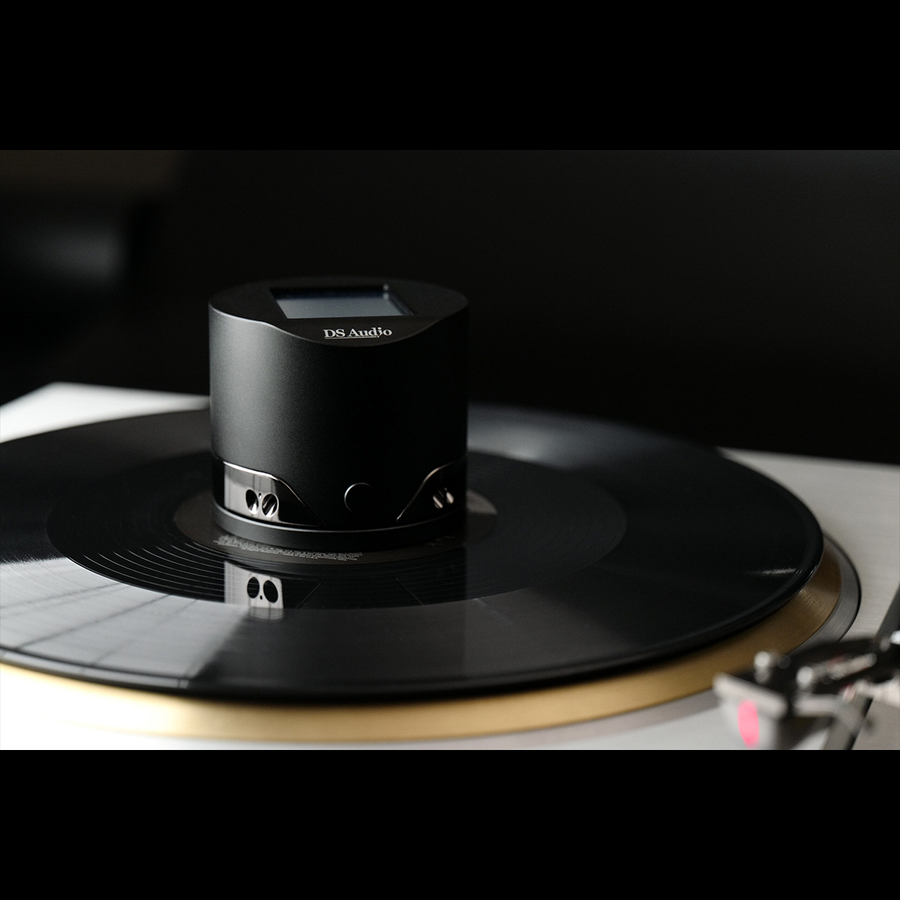
The ES-002 is a battery-powered record weight that reads the run-out groove optically while the platter spins, shows how far off-center the record is, and guides you to nudge it true. DS Audio's position is that an off-center pressing, not the turntable, is the dominant cause of wow and flutter. The ION-001 ionizer, PH-001 phono cable and HS-001 headshell complete the accessory line. Read the deep diveClose

What it does

The ES-001 of July 2022 was described by DS Audio as a world first, and the ES-002 of May 2025 replaced it in two versions. Set on the spindle, it reads the run-out groove in about two seconds and shows the off-center distance on a touch display with a color-coded cross mark; you then push the record until the mark centers, the target being under 20 microns. DS Audio's figure is that an eccentricity of 0.34 mm produces about 0.15 percent speed error at the inner grooves. The ES-002 Reference is A5052 aluminum on a non-magnetic tungsten base at 640 g; the Core replaces tungsten with brass and uses resin internals, with what DS Audio calls the same detection performance. The ION-001 of November 2019 is a fanless tower with two positive and two negative ionizers aimed at the platter and an ozone-suppressing supply, placed beside the turntable with its ports about an inch above the record. The PH-001 phono cable of December 2023 is built for optical cartridges, whose cold conductors carry LED power, so hot and cold sides are made identically from 37 silver-plated copper strands under a silver-plated braid, and it also serves MM and MC. The HS-001 headshell of March 2019 is machined from solid duralumin with hand-soldered Litz leads and fits any cartridge.

Why it matters in a system

Pitch stability is the one thing a cartridge cannot fix, and most of it is lost before the stylus reaches the groove. Centering the record on the spindle is the direct cure, and the ES-002 makes it a two-second check rather than a guess; the ionizer, cable and headshell address static, LED power delivery and cartridge mounting on the same turntable.

What you may hear

Michael Fremer reviewed the ES-001 for The Absolute Sound; Hi-Fi News wrote that, for anyone with the ears and the gear, it would prove as indispensable as a dust brush. Michael Corsentino of Positive Feedback called the ION-001 the most effective anti-static device he had used.

All DS Audio technologies and the company story

The DS Audio story

Japanese cartridges that read the groove with light, each with an equalizer to match.

Founded 2013 in Sagamihara, Kanagawa, Japan, where every cartridge is assembled and aligned by Tetsuaki Aoyagi · ds-audio-w.biz

Milestones

  1. 1941 A beam of light Philco's record player reads the stylus with light. In the 1970s Toshiba and other Japanese makers revive the idea, but their lamps run hot and the optical cartridge is set aside when the compact disc arrives.
  2. 2013 DS Audio established Tetsuaki Aoyagi founds DS Audio within Digital Stream Corporation, an optical-engineering firm in Sagamihara, to build an optical cartridge with an LED and modern parts.
  3. 2014 DS-W1 The first DS Audio cartridge to be offered outside Japan.
  4. 2016 Master1 A flagship with a sapphire cantilever, shown at High End Munich.
  5. 2020 Grand Master: the third generation A separate LED and sensor for each channel, a stronger output and a beryllium shading plate.DS Audio Grand Master Equalizer
  6. 2021 The equalizer circuit made public DS Audio publishes its equalizer circuits for any maker to use, without a license fee. The DS 003 brings the third generation to the middle of the range.DS Audio DS 003 Optical Phono Cartridge
  7. 2022 DS-W3 and ES-001 The DS-W3 arrives with a boron cantilever, and the ES-001 shows how far off-center a record sits so that it can be centered.DS Audio DS-W3 Optical Phono Cartridge
  8. 2023 Master3 and Grand Master EX The Grand Master EX is the first cartridge with cantilever and stylus cut from a single diamond.DS Audio Grand Master Extreme Optical Phono Cartridge
  9. 2024 DS-E3 The third generation reaches the first model in the range.DS Audio DS-E3 Optical Phono Cartridge
  10. 2025 TB-100 and the mono cartridges DS Audio's first tube equalizer, and mono versions of the stereo cartridges.DS Audio TB-100 Tube Phono Equalizer
  11. 2026 TB-50 A second tube equalizer joins the range.DS Audio TB-50 Tube Phono Equalizer
Read the DS Audio story
DS Audio

Music on a beam of light

The optical cartridge is older than DS Audio. In 1941 the American maker Philco offered a record player that read the movement of its stylus with a beam of light, and then turned to war work. In the 1970s Toshiba and other Japanese makers revived the idea. Their cartridges were admired for their sound, but the small lamps inside ran hot and made them fragile, and when the industry's attention moved to the compact disc the optical cartridge was set aside.

Tetsuaki Aoyagi

DS Audio takes its initials from Digital Stream Corporation, an optical-engineering firm in Sagamihara, Kanagawa. Tetsuaki Aoyagi was working there, and was not yet a record listener, when he heard an LP played through one of those 1970s Toshiba cartridges. The clarity and life of it surprised him, and he reasoned that the same idea built with modern parts should be better still: a cool-running LED in place of the lamp, and Digital Stream's experience with light sensors behind it. DS Audio was established in 2013, and its first cartridge to reach listeners outside Japan, the DS-W1, followed in early 2014.

How it works

Two questions come up first: does it read the groove with light, and is the signal digital? No to both. A diamond stylus on a cantilever rides the groove exactly as in any cartridge, and the signal stays analog from groove to loudspeaker. The difference is inside. Where a moving-magnet cartridge carries magnets on its cantilever and a moving-coil carries coils of wire, an optical cartridge carries only a tiny shading plate. An LED shines past the plate onto a light sensor, and as the stylus moves, the light reaching the sensor rises and falls with the music.

Two things follow. The moving parts are far lighter, so the stylus is freer to follow the groove. And because the cartridge reads how far the stylus moves, where a magnetic cartridge reads how fast, it needs its own equalizer in place of a phono stage. The cartridge itself mounts and aligns like any other, in most tonearms.

Three generations

The Master1 of 2016, with a sapphire cantilever, was the cartridge that fulfilled the promise of the first design. The third generation began with the Grand Master of 2020: a separate LED and sensor for each channel, a stronger output, and a shading plate of pure beryllium at half the weight of the one before. That design has since come to the whole range, to the DS 003, the DS-W3 and the Master3, and in 2024 to the DS-E3. At the top, the Grand Master EX of 2023 has its cantilever and stylus cut from a single diamond.

An open design

DS Audio's stated aim is to make the optical cartridge a lasting part of record playing, and not only its own product. In 2021 it published its equalizer circuits for any maker to use, without a license fee, and a number of respected electronics makers now build optical equalizers of their own. Any DS Audio cartridge works with any of these equalizers, so the cartridge and the equalizer can be chosen, and later improved, separately. DS Audio's own equalizers now include tube designs, the TB-100 and TB-50.

Made in Sagamihara

Every cartridge is assembled and aligned by hand in Sagamihara, checked under a microscope, and given its own record. The company also makes accessories for record playing, among them a device that shows how far off-center a record sits on the platter so that it can be centered, and an ionizer that removes static.

How they sound

Reviewers return to the same words: clarity, speed and transparency, against a very quiet, black background and without grain. They describe dense recordings opened up so that each instrument has its own place, a deep, three-dimensional picture, and tonal richness with little character added by the cartridge itself.

The complete DS Audio story and technology library

DS Audio at Pearl Audio

Pearl Audio is an authorized DS Audio dealer in Portland. An optical cartridge needs its own equalizer in place of a phono stage, so we choose the two together with you, confirm that the cartridge suits your tonearm, and install and align it ourselves.

The Pearl Audio experience

How we work with you

A system at this level should be heard, thoughtfully matched, and properly set up. From the first audition to long-term ownership, you work with the same people, in person.

  1. 01

    Listen first

    The PH-001 Phono Cable is not in our rooms at present. When it is the right piece for a client we arrange a demonstration unit from the manufacturer and set it up for a private session.

  2. 02

    Delivery and installation

    We deliver and install throughout the Portland area, taking care of placement, connections, ventilation and system configuration ourselves.

  3. 03

    Support for as long as you own it

    We support everything we sell for as long as you own it, whether the answer comes by phone, in your home, or through factory service.

  4. 04

    A path for what comes next

    Trade-in assistance and qualifying 100% Trade-Up options give you flexibility when your listening priorities or your system change.

Search