
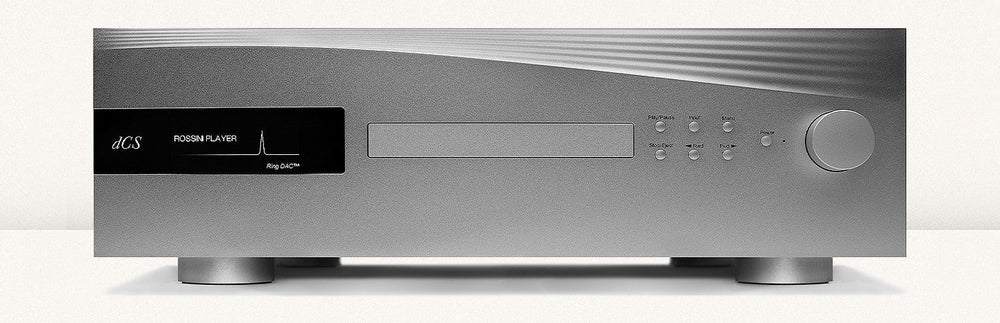
One box
Rossini APEX Player
Ring DAC APEX, streaming and a CD drive in one chassis.
$38,600 with the Rossini Master Clock, $50,700
One box or three?
The dCS Rossini comes two ways: as the Rossini APEX Player, one box with a CD drive inside, or as the Rossini stack, the APEX DAC with the Master Clock and the Transport in their own chassis. The converter is identical. What differs is what plays your discs, where it lives, and what it costs.
One box
Ring DAC APEX, streaming and a CD drive in one chassis.
$38,600 with the Rossini Master Clock, $50,700
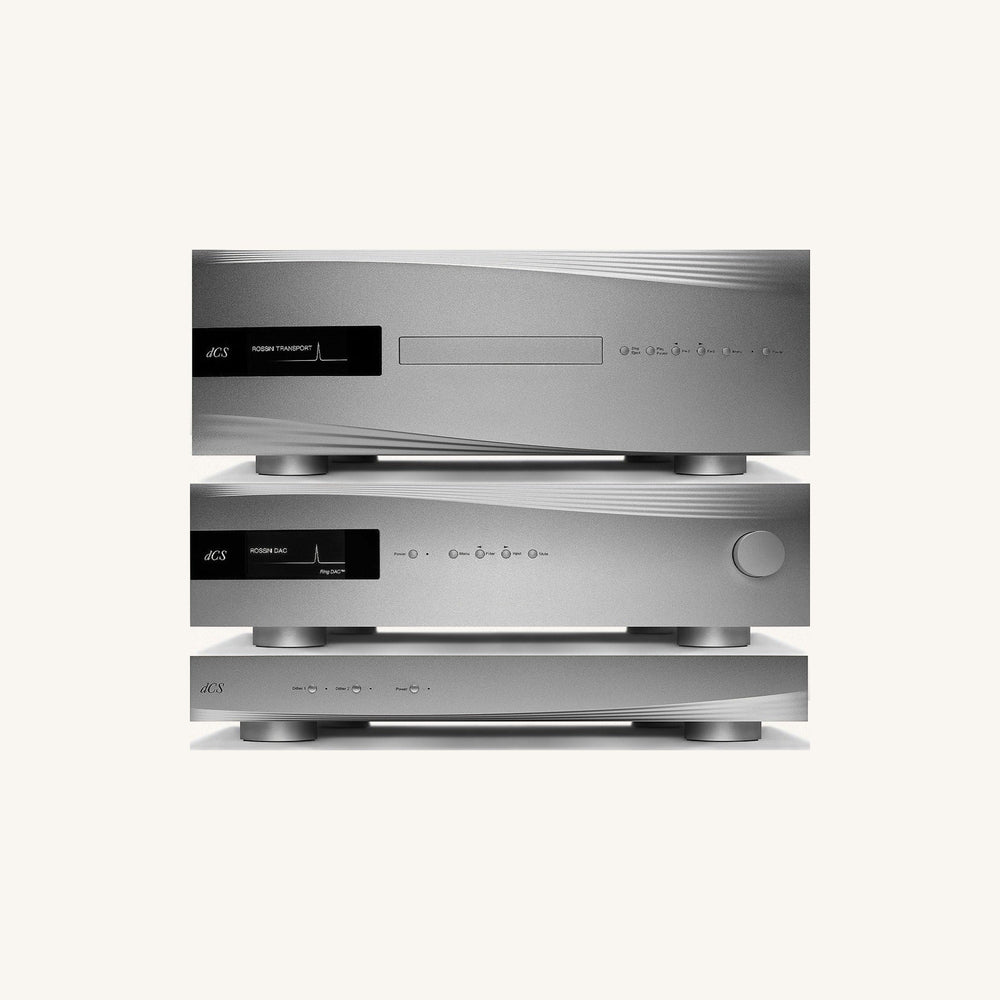
Three boxes
Rossini APEX DAC, Master Clock and Transport: the same converter, SACD, and the drive in its own box.
$76,500 DAC $34,500 + Clock $12,100 + Transport $29,900
| Comparison | Rossini APEX Player | Rossini stack |
|---|---|---|
| BoxesEvery chassis the signal path leaves is one less source of noise sharing a power supply with the converter. | One: Ring DAC APEX, streamer and CD drive in a 151 mm chassis. Two with the Master Clock. | Three: Rossini APEX DAC (125 mm), Master Clock (64 mm), Transport (178 mm). |
| The converterIdentical. This is the part that is not in question. | Ring DAC APEX, the same board, output stage and Digital Processing Platform as the DAC. | Ring DAC APEX in the Rossini APEX DAC. |
| DiscsThe biggest difference between the two, and the one most people miss. | CD only, on a compact Stream Unlimited loader with an aluminum tray. An SACD plays its CD layer. | CD and SACD, on a dual-laser mechanism in a 2 mm steel frame with a cast aluminum tray, in its own 20.6 kg chassis. SACD leaves as native DSD; CD can be upsampled to DXD or DSDx2 before it leaves the drive. |
| Streaming and inputsWhere the network board, USB and AES inputs live. | In the chassis: Mosaic, Roon Ready, Qobuz, TIDAL, Spotify, UPnP, AirPlay; USB, Dual AES, S/PDIF. | In the DAC, identically. |
| ClockingA separate reference, and whether every box can share it. | Internal clock; the Rossini Master Clock can be added, two outputs to the Player. | Rossini Master Clock to the DAC on two outputs and to the Transport on the third, so every box converts from one reference. |
| IsolationMotors, servos and loaders are noisy neighbors for a converter. | The disc motor and its loader share the chassis and supplies with the Ring DAC. | The drive, its servos and its supplies are in a separate box, isolated from the DAC by a Dual AES cable. |
| Shelf spaceWorth knowing before the rack is chosen. | One shelf; two with the clock. | Three shelves, about 37 cm of height in all. |
| CablesNot included with either; we quote Nordost. | A network cable; two 75 Ω clock cables if the clock is added. | A Dual AES pair, three 75 Ω clock cables and a network cable. |
| As listed at PearldCS's current US list. | $38,600; $50,700 with the Master Clock. | $76,500: DAC $34,500, Master Clock $12,100, Transport $29,900. |
| LaterWhere each one can go. | A Rossini Transport can be added over Dual AES for SACD and the bigger drive; the Player's own loader then goes unused. Player, Clock and Transport come to $80,600. | Already the complete Rossini system. The next step is the Vivaldi, which moves streaming and upsampling into their own boxes. |
Prices are dCS's current US list; neither includes cables. Both are on demonstration in Portland, and we can play the same CD through each in the same system.
Both are built on the Rossini APEX DAC: the Ring DAC APEX board that Stereophile called a major advance in digital sound reproduction and John Atkinson measured at 0.00026 percent THD+N, the same streaming front end running dCS Mosaic, the same upsampling, filters and three Mappers, the same digital volume control, the same 0.2 to 6 V outputs. Played from the network or from USB, a Rossini APEX Player and a Rossini APEX DAC are the same machine. The question is only how you want to play discs, and how much of a disc player you want.
SACD, first. The Player reads CDs on a compact loader that dCS chose to fit the chassis; it cannot read the SACD layer. The Rossini Transport uses a dual-laser mechanism on a steel frame, in a 20.6 kg chassis of its own, and passes SACD as native DSD over Dual AES, encrypted so that only a dCS DAC can decode it. It is the only way into a Ring DAC at native DSD for a disc. Second, the drive is out of the DAC: motors, servos and their supplies stop sharing a box with the converter. Third, CD can be upsampled to DXD or DSDx2 in the transport before it leaves, and with the Master Clock's third output the transport converts from the same reference as the DAC. Stereophile's John Atkinson, reviewing the Transport with the Rossini DAC, loved how it made both SACDs and CDs sound; owners on the dCS forum who have heard the Player with and without a Transport on the same CD report a clear difference in the Transport's favor.
One box, one shelf, one set of cables, and $37,900 less than the three-box stack before cables. For a collection that is mostly streamed with a shelf of CDs, the Player is the sensible Rossini: it is the same converter, and its drive is the one dCS fitted and tuned for it. Add the Rossini Master Clock and it is a two-box system most owners never feel the need to move beyond. Reviewers at Mono & Stereo found the clock brought further order, finer detail and greater density to the APEX Player. If SACD matters later, a Transport can still be added over Dual AES; the Player's own loader simply goes unused.
Choose the Player if
You want the Rossini APEX in one chassis, with the option of the Master Clock as a second box. You have a few hundred CDs and no SACDs, or you are happy to hear an SACD's CD layer. Rack space and cabling matter to you. $38,600, or $50,700 with the clock.
Choose the stack if
You own SACDs and want them played as DSD, you want the heaviest, best-isolated disc mechanism dCS makes below the Vivaldi, or you simply want each job in its own box with every box on one clock. It is also the configuration that leads most naturally to the Vivaldi later. $76,500 for the three.