
← Back to your LP12 build

Boulder · 1100 Series

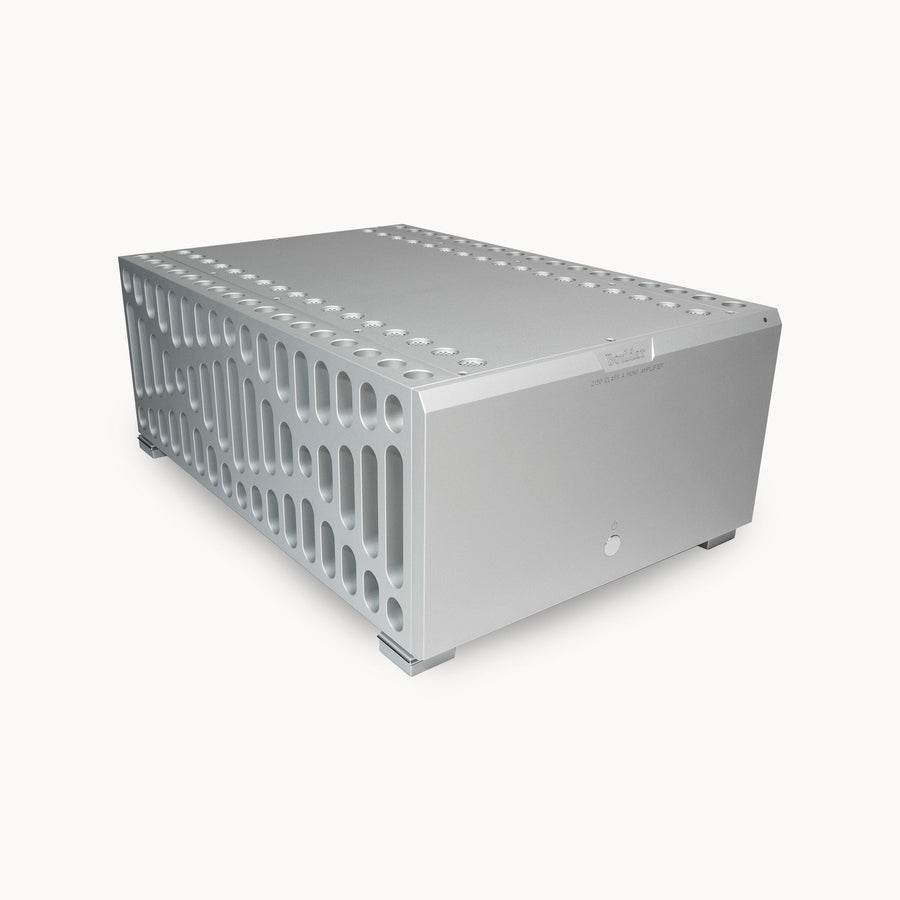
Boulder 1108 Phono Preamplifier

$22,000

Signature technologiesThe Boulder story

Not currently in our rooms. For a serious buyer we will often bring a piece in from the manufacturer for a private session — tell us about your system and what you are weighing it against, and we will advise.

Boulder · 1100 Series

A fully balanced two-input phono preamplifier with plug-in loading cards and the EMI, FFRR and Columbia curves for records made before 1955.

Loading is set on removable Personality Cards (PERS1), configured for your cartridge.

70 dB
MC gain at 1 kHz; 44 dB MM
±0.10 dB
RIAA accuracy, 20 Hz – 20 kHz
98 nV
equivalent input noise, MC, flat
-100 dB
crosstalk or better, 20 Hz – 20 kHz

Authorized Boulder dealer · Delivery and installation by Pearl Audio · Trade-ins welcome

The story

The 1108 is the phono preamplifier of Boulder's 1100 Series, between the 800 Series 808 and the two-chassis 2108. The signal stays balanced from the cartridge to the output, which is how a phono cartridge naturally works, and the gain comes from the 985, a discrete gain stage Boulder designed for this product and houses in a case machined from solid aluminum. The interlocking casework is designed to damp vibration and shield the low-level signal. Rather than banks of DIP switches, cartridge loading lives on removable Personality Cards that plug into the rear panel; each card is configured for a cartridge's resistive and capacitive load and swapped when the cartridge changes.

Two balanced input pairs accept two tonearms or two turntables, and two balanced output pairs can serve a preamplifier and a recorder at the same time. Along with RIAA, the 1108 offers the EMI, FFRR (London/Decca) and Columbia equalization curves for LPs cut before 1955, and a low-cut filter deals with rumble and warped records. The numbers are what Boulder owners expect: RIAA accuracy within ±0.10 dB, 98 nV equivalent input noise at the MC setting, 0.01% THD, crosstalk better than -100 dB and a 16 Vrms maximum output.

With 70 dB of MC gain and 44 dB of MM gain, the 1108 handles most moving-coil and moving-magnet cartridges. It suits a serious analog system with one or two arms, especially a collection that spans mono, early stereo and modern pressings and benefits from the right curve. The two-chassis 2108 adds a third input, selectable gain, a separate power supply and a demagnetizer pass-through.

Each technology below is explained in depth in the Boulder technology library; the Boulder story follows the company from Jeff Nelson's studio work and the 500 of 1984 to Smart Current.

Key technologies

  • Fully balanced phono circuit. The cartridge's balanced output is kept balanced through the whole preamplifier to reject noise.
  • 985 gain stage. A proprietary discrete gain stage designed for the 1108, housed in a case machined from a solid aluminum block.
  • Personality Cards. Removable rear-panel cards set resistive and capacitive loading for MC or MM cartridges.
  • Historic equalization. EMI, FFRR (London/Decca) and Columbia curves alongside RIAA for pre-1955 records.
  • Low-cut filter. Reduces turntable rumble and the low-frequency output of damaged or warped records.

The 1108's partner is the 1110 Preamplifier; the 2108 is the two-chassis step up.

Specifications
Type Solid-state MM/MC phono preamplifier, fully balanced, single chassis
Inputs 2 pairs balanced XLR (adaptable to unbalanced with the PHRCA adapter)
Outputs 2 pairs balanced XLR, usable as main or record
Gain (1 kHz, RIAA) MC 70 dB; MM 44 dB
Loading Resistive and capacitive, set on Personality Cards; up to 1,000 Ω MC, 47 kΩ MM
Equalization RIAA, EMI, FFRR (London/Decca), Columbia
RIAA accuracy ±0.10 dB, 20 Hz – 20 kHz
Noise (EIN), MC 98 nV flat, 20 Hz – 20 kHz
Distortion (THD) 0.01%
Crosstalk -100 dB or better, 20 Hz – 20 kHz
Maximum output 16 Vrms
Output impedance 100 Ω balanced
Features Low-cut filter
Power 100 – 240 V AC, 50 – 60 Hz; 32 W maximum
Dimensions (W × D × H) 18 × 15.83 × 5.73 in (45.7 × 40.2 × 14.6 cm)
Weight 37 lb (16.8 kg)

Boulder 1108 product page and specifications

Where it sits in the range

The 1100 Series phono preamplifier.

  • Boulder 1108 (this model)
  • Boulder 2108: three-input, two-chassis reference phono preamplifier

The matching line preamplifier is the Boulder 1110.

Plan your Boulder system with Pearl Audio

Pearl Audio is an authorized Boulder dealer. Bring your cartridge details and we will configure the Personality Cards; arrange an audition in our Portland showroom. Call (503) 222-2599 or email sales@pearlaudio.com.

Signature technologies

The engineering behind the Boulder 1108 Phono Preamplifier

Boulder gives its technologies names because each one solves a specific problem. Here is what each does, where it came from, why it matters in a system, and what you may hear.

From the 990 to the 99H2Since 1984

The discrete gain stage

Instead of an off-the-shelf op-amp chip, Boulder builds each amplifying block from individual transistors and resistors, hand-assembles and calibrates it, pots it in a machined metal shell and plugs it in as a module. The family descends from Deane Jensen's JE-990 discrete op-amp of the studio world, which Jeff Nelson refined and has developed through four generations. Read the deep diveClose

What it does

Deane Jensen of Jensen Transformers was Jeff Nelson's mentor, and his 990 was the discrete operational amplifier of the professional console era: a gain block built from selected transistors rather than a chip, with far more current and headroom than an integrated circuit. Boulder's 500 of 1984 used two of them per channel with about 100 dB of feedback applied locally rather than around the whole amplifier, and every Boulder since has been built on a descendant: the 993 in the 2000 Series of 1995, the 99H, high-voltage, in the 3050 and 3060, the 99H2 that replaced the 993 in the 2100 Series amplifiers in 2013 as a surface-mount, fully discrete, high-current design on 32-volt rails, the 993S, twelve of them, in the 2110 preamplifier, the 993SD in the 3010, the 995S in the 2108 phono stage, and the 983 and 985 in the 1100 Series. Each is potted and housed in a machined shell for thermal stability and shielding, and each is calibrated by hand before it is fitted.

Why it matters in a system

The gain stage is where a Boulder's noise, linearity and drive are decided, and building it as a replaceable module means every product in a series shares the same character and can be serviced for decades. It is also why Boulder can claim measured performance that reviewers describe as the best they have seen.

What you may hear

John Atkinson called the 2110 the best-measuring preamplifier he had encountered; Jacob Heilbrunn called the 3010 a proverbial straight wire with gain.

Studio practice since the first amplifierSince 1984

Fully balanced, dual mono, XLR only

Every Boulder carries the music as a pair of mirror-image signals from input to output, which cancels the noise picked up along the way, and gives the left and right channels their own boards, or in the 2100 and 3000 Series their own chassis. There are no unbalanced connections anywhere in the line. Read the deep diveClose

What it does

Boulder came out of broadcast and recording, where balanced lines are the only kind, and Jeff Nelson has used fully balanced circuit design from the start. Each balanced input gets a high-impedance buffer stage matched for common-mode rejection; the circuits use bipolar transistors rather than FETs, for a simpler topology, better thermal behavior and ruggedness. The 1110 isolates its channels on dual-mono boards in one chassis; the 2110 and 3010 preamplifiers are four chassis, left audio, right audio, user interface and power supply, and the 2110 of 2013 was the first 2000-series preamplifier balanced from input to output. The power amplifiers are two-stage, fully balanced designs, and the 866 integrated and 812 DAC preamplifier take XLR analog inputs only. A cartridge is itself a balanced source, so the phono stages keep it balanced from the input.

Why it matters in a system

Balanced operation cancels the noise between boxes, doubles the signal swing and removes the ground loops that plague unbalanced systems; an all-Boulder chain is balanced from the phono input to the loudspeaker terminals. It asks for balanced sources, which we take into account when we build a system around a Boulder preamplifier.

What you may hear

The black backgrounds and stability that reviewers hear as neutrality. Michael Fremer called the 2150 about as tonally neutral a piece of electronics as he had heard, neither warm nor cool.

Transformer hum is not permittedSince 1995

Linear power supplies, potted and sealed

Boulder uses only linear supplies, never switch-mode: custom American-wound toroidal transformers, DC-filtered, potted in epoxy and sealed in welded steel or machined cases so they cannot hum, feeding banks of many small, fast filter capacitors. The 2160 holds 48 of them; the 3050 carries four transformers in a 100-pound assembly. Read the deep diveClose

What it does

A power amplifier is a power supply that is modulated by the music, and Boulder's supplies are built on that premise. The 2160's two toroids, one per channel, float in a nickel-plated steel tube that is magnetically shielded and mass-loaded, more than 30 kilograms of it; a DC-elimination circuit blocks up to three volts of DC on the mains, the cause of transformer hum, and 48 electrolytic capacitors feed the output stage, because many smaller capacitors respond faster than a few large ones. The 3050 and 3060 carry four and five transformers in machined, potted housings; the 2150 puts dual toroids in a welded steel enclosure; the 1162's transformers are DC-filtered in a welded case. At full output the 2160 draws 5,000 watts and the 3000 Series 6,000, which is why the 2160 and 1162 take a 32-amp inlet and the 3050 and 3060 are built for 240-volt mains only. The 2110, 3010 and 2108 take their power from a separate chassis with independent supplies for left, right, control and standby; the power amplifiers keep their transformers inside.

Why it matters in a system

Dynamics come from the supply's ability to deliver current instantly and quietly, and a potted, shielded transformer with DC blocking is why a Boulder is silent at idle and unshakable at full power. Everything Boulder can make in America it does, including the transformers.

What you may hear

Alan Sircom found the 2160 one of a select handful of top-end powerhouses that can sound tiny when required and vast when called for; Anthony Cordesman was convinced the 2150 could get the best out of any real-world loudspeaker.

Five CNC centers and no sheet metalSince 1998

Machined from solid, in Louisville

Boulder cuts its chassis, heat sinks, knobs and even its buttons from solid aluminum blocks on its own CNC machining centers in Louisville, Colorado. The heat sinks have no fins, because fins ring; the interlocking panels are tuned so they do not share resonances; and the 1100 Series faceplate carries the contour lines of Flagstaff Mountain. Read the deep diveClose

What it does

Boulder bought its first Haas machining center in 1998, when production moved from the farmhouse in Superior to Boulder's industrial area, and it now runs five. Parts are machined from 6061-T6 aluminum at spindle speeds up to 65,000 rpm and held to half a thousandth of an inch; the 2160's heat sink is cut from an 80-pound billet, has no fins, and is damped by mounting to panels of differing resonant frequencies, while its output transistors are held by a machined clamp bar rather than individual screws, its top cover is damped as a constrained layer and its feet are four-piece damped assemblies. There is no sheet metal anywhere. The 1100 Series front panel is machined with the topographical map of Flagstaff Mountain, the peak above the town of Boulder, and the finish throughout is bead-blasted and clear-anodized. Anodizing, transformer winding and bare circuit boards are the only things done outside; everything else, every board and every piece of metalwork, is made in the Louisville factory, which Boulder describes as the last audio manufacturer in North America to hold this degree of control over its own designs.

Why it matters in a system

A chassis that does not resonate adds nothing to the music, and a company that machines its own parts can design a heat sink or a bracket for the circuit rather than the circuit for the parts available. It is why Boulder components look and feel as they do, and why a thirty-year-old one still works.

What you may hear

Jerry Del Colliano's summary was that Boulder builds audio equipment like no other company; Fremer noted the absence of standalone heat-sink fins, which Boulder says can resonate.

Bought as an act of self-defenseSince 2009

Circuit boards built in-house

Boulder places and solders its own surface-mount components on its own pick-and-place line, and tracks every board by barcode, so it knows exactly which board is in every product it has built. Read the deep diveClose

What it does

Surface-mount construction, tiny components soldered directly to the board, gives shorter signal paths and more consistent circuits than hand-wired parts, but only if the assembly is done to a high standard. Boulder's first surface-mount designs were the 1000 Series of 1999, and in 2009 it installed its own surface-mount manufacturing system rather than depend on a contractor; Jeff Nelson said the machine was bought as an act of self-defense, to ensure quality. The 1110's boards are built entirely on that line, the 2160's gain stages and output boards are surface-mount, and the 1162 and 1163 of 2025 required nearly every board in the 1160 to change, which is why the older amplifiers could not be converted. Each board is barcoded and logged, so a unit's history can be traced years later.

Why it matters in a system

The circuit is only as good as the board it is built on, and a company that assembles its own boards controls the one variable most high-end makers outsource. It is of a piece with the in-house machining: Boulder makes what it can and checks the rest.

What you may hear

Consistency from unit to unit, and the measured performance that John Atkinson has repeatedly called superb on Boulder amplifiers.

Balanced from the cartridge, with four curvesSince 2002

Phono stages and Personality Cards

A phono cartridge is a balanced source, and Boulder's phono stages keep it balanced all the way through. Gain and loading are set by small plug-in Personality Cards at the rear panel rather than by switches in the signal path, and four equalization curves, RIAA, EMI, FFRR and Columbia, let records cut before 1955 play as intended. Read the deep diveClose

What it does

The 2008 of 2002 earned Stereophile's A+ rating and a waiting list, and its descendants are the 2108 and 1108. The 2108, released in 2019 after three years of concept work, is fully balanced from input to output on the 995S gain stage, with three balanced inputs, each with its own Personality Card setting moving-magnet or moving-coil operation, loading, gain and a demagnetizing pass-through, 70 dB of moving-coil gain, a three-position low-cut filter and the separate 2100 Power Supply with four independent supplies. The 1108 puts the 985 gain stage in a machined aluminum block, with two balanced inputs, Personality Cards, the four curves and logic control instead of a microprocessor so that nothing digital runs near the highest-gain stage in the system; its equivalent input noise is 98 nanovolts. The 808 of 2026 brings the Personality Card system to the 800 Series.

Why it matters in a system

A phono stage amplifies the smallest signal in the system by a factor of thousands, so its noise and its grounding matter more than anywhere else; balanced input and cards outside the path are how Boulder keeps the stage quiet. The curves matter to anyone with early mono records, and we set the cards up for your cartridge on our bench.

What you may hear

Fremer found the 2108 produced both soaring exultation in the upper registers and gritty drama in the lowest, and told Boulder's detractors to give it a listen; Atkinson measured its RIAA response as almost perfect.

A sound room on its own foundationSince 2016

Every unit listened to before it ships

Every Boulder is played in one of the factory's three listening rooms before it leaves Louisville. The main room is isolated from the factory on its own foundation, with an ambient noise level measured at 28.5 dB, and the standard applied is the one Jeff Nelson brought from the studio: your gear will never be used again if it destroys a recording. Read the deep diveClose

What it does

Boulder bought three acres in Louisville, Colorado in 2015 and moved into its 23,000-square-foot factory on August 1, 2016, more than twice the size of the previous building. Besides the machining centers and the board line it holds three listening spaces, the largest built on a separate foundation so that the factory floor cannot be heard in it. Every finished unit is auditioned there, and the company offers tours by appointment. Nelson's background in broadcast and recording, where producers valued neutral, transparent performance, set the house standard: Boulder tries to design neutral rather than voiced, on the principle that every recording should sound different because every recording is different. The company has been independently owned since 1984, with Nelson as president and chief designer.

Why it matters in a system

A product that has been listened to is a product whose sound is known, and Boulder's test is the recording rather than a house flavor. It is why the brand is the choice of listeners who want the loudspeaker and the recording to be what they hear.

What you may hear

Rich Maez's description of the goal: neutral instead of voiced or flavored. Reviewers who expected analytical cool have, from the 2108 to the 1151, reported warmth and freshness instead.

All Boulder technologies

The Boulder story

America's reference in solid-state amplification: balanced, machined from solid, and built to the studio's standard since 1984.

Founded 1984 in Superior, Colorado; machined and built in Louisville, Colorado since 2016 by Jeff Nelson · boulderamp.com

Milestones

  1. 1984 Boulder founded; the 500 Jeff Nelson, from Pacific Recorders & Engineering and the studio world, moves to Colorado, names the company for the town and releases the 500 power amplifier on Deane Jensen's 990 gain stage. Studios buy it; the 500AE is the home version.
  2. 1989 M Series The AE electronics behind a new aluminum fascia: the L5M, 102M and 500M, the first Boulders styled for the living room.
  3. 1995 2000 Series The 2010 preamplifier, 2050 mono and 2060 stereo amplifiers, with the 2020 converter in 1996: the 993 gain stage, potted toroids and sliding-bias class A. Boulder's first full high-end line.
  4. 1998 The first machining center Production moves from the Superior farmhouse into Boulder's industrial area, and the company buys its first Haas CNC machine. The 1000 Series follows in 1999, the 1012 is Stereo Sound's Component of the Year in 2000, and the 2008 phono stage earns Stereophile's A+ in 2002.
  5. 2005 800 Series The first Boulder line designed in CAD; the 865 integrated of 2007 draws more review requests than any Boulder before it. In 2009 the company installs its own surface-mount board line.
  6. 2011 3000 Series The 3050 monoblocks, 1,500 watts each, open the reference line; the 3060 stereo of 2013 is the most powerful amplifier Boulder has built.Boulder 3050 Mono Power Amplifiers (pair)
  7. 2013 2100 Series The 2110 preamplifier and 2150 monoblocks, with the 99H2 gain stage, become Boulder's highest-performing continuously produced line; the 2160 stereo follows in 2014 and the 2120 converter in 2015.Boulder 2150 Mono Power Amplifiers (pair)
  8. 2016 The Louisville factory On August 1 Boulder moves into a 23,000-square-foot plant in Louisville, Colorado, with five machining centers and three listening rooms, the main one on its own foundation. Every unit is auditioned there.
  9. 2017 1100 Series; the 2150's award The 1110 preamplifier and 1160 amplifier, with Flagstaff Mountain machined into their faceplates, sweep the 2018 awards; the 3010 preamplifier arrives; Stereophile names the 2150 Amplification Product of the Year.Boulder 1110 Preamplifier
  10. 2019 2108, 1108 and the 866 Two new phono stages with Personality Cards and four equalization curves, and the 866 integrated, Roon Ready in 2020, which renews the 800 Series.Boulder 2108 Phono Preamplifier
  11. 2022 812 and 861 The 812 DAC preamplifier and headphone amplifier in April 2022, and the 50-watt 861 in November 2023: a complete Boulder system in two small boxes.Boulder 812 DAC Preamplifier
  12. 2024 Smart Current: the 1151 A class-A output stage that watches the loudspeaker's current instead of running hot, introduced on the 1151 monoblocks. Stereophile lists them in Recommended Components for 2025 and 2026.Boulder 1151 Mono Power Amplifiers (pair)
  13. 2025 1162 and 1163 Smart Current comes to the 1100 Series stereo amplifiers in February, replacing the 1160 and 1161.Boulder 1162 Stereo Power Amplifier
  14. 2026 808 and 851 at Vienna The 808 phono stage with Personality Cards and the 851 mono with Smart Current bring the newest ideas to the 800 Series at High End Vienna; Nelson's Smart Current white paper is published in June.
Read the Boulder story
The Boulder Amplifiers factory in Louisville, Colorado

Jeff Nelson built his first amplifier in high school and owned a recording studio before he built equipment for other people's. In the 1970s, at Pacific Recorders & Engineering in California, he helped develop the Tomcat broadcast cart machine, of which more than three thousand were sold, and then amplifiers, microphone preamplifiers and mixing consoles for broadcast and recording; audiophiles began seeking out the amplifiers. His mentor was Deane Jensen of Jensen Transformers, whose JE-990 discrete operational amplifier, a gain block built from selected transistors rather than a chip, Nelson refined and made the core of everything he has designed since. In 1984 he moved to Colorado, housed the company in an old farmhouse in Superior, south of Boulder, named it Boulder Amplifiers, and released the 500 power amplifier, which went into recording studios, broadcast facilities and loudspeaker companies' labs; the 500AE, the Audiophile Edition with the meters removed and only a power switch left, was the version for the home.

For a decade Boulder was mostly a professional company, selling first in Asia and then worldwide, and its principles were set by that work: fully balanced circuits, because studios use nothing else; bipolar transistors for their ruggedness and thermal behavior; linear power supplies; and a standard Nelson has stated plainly, that your gear will never be used again if it destroys a recording. The M Series of 1989 put the AE electronics behind a new aluminum fascia, and the 2000 Series of 1995, the 2010 preamplifier, 2050 mono and 2060 stereo amplifiers, with the 2020 converter the following year, was the first full high-end line, with the 993 gain stage, potted twin toroids and the sliding-bias class A that still runs the 2100 and 3000 Series. In 1998 production moved into Boulder's industrial area and the company bought its first CNC machining center; it has cut its own chassis, heat sinks and knobs from solid aluminum ever since. The 1000 Series followed in 1999, the 1012 DAC preamplifier was Stereo Sound's Component of the Year in 2000, and the 2008 phono stage earned Stereophile's A+ rating and a waiting list in 2002.

The 800 Series of 2005 was the first Boulder line designed in CAD, and its 865 integrated of 2007 drew more review requests than anything the company had made. In 2009 Boulder installed its own surface-mount circuit board line, which Nelson described as an act of self-defense to ensure quality. The 3000 Series arrived in 2011 as the reference, beginning with the 3050 monoblocks, 1,500 watts each on four potted transformers, and the 3060 stereo of 2013, the most powerful amplifier the company had made. In August 2013 the 2100 Series, the 2110 preamplifier with its twelve 993S gain stages and the 2150 monoblocks with the new 99H2, became what Boulder calls its highest-performing continuously produced line; the 2160 stereo followed in 2014 and the four-chassis 2120 converter in 2015. Stereophile named the 2150 its Amplification Product of the Year for 2017.

In 2015 Boulder bought three acres in Louisville, Colorado, and on August 1, 2016 it moved into a 23,000-square-foot factory more than twice the size of the old one, with five machining centers, the board line and three listening rooms, the main one built on its own foundation; every unit the company makes is auditioned there before it ships. The 1100 Series of 2017, the 1110 preamplifier and 1160 amplifier with their faceplates machined with the contour lines of Flagstaff Mountain, won The Absolute Sound's solid-state preamplifier and amplifier of the year and hi-fi+'s preamplifier of the year for 2018, and the 1110 has collected more product-of-the-year awards than any other Boulder. The 3010 preamplifier arrived in 2017, the 508 phono stage in 2018, the 2108 and 1108 phono stages in 2019, and the 866 integrated the same year, with the 812 DAC preamplifier in 2022 and the 861 in 2023 completing a new 800 Series with streaming, Roon and an app.

The newest idea is Smart Current. Introduced on the 1151 monoblocks in 2024 as a proof of concept and published in a white paper by Nelson and his engineers in 2026, it is an output stage that monitors the current the loudspeaker draws and keeps both halves conducting through the zero crossing, so that crossover distortion falls to inaudibility without the heat of conventional class A; the 1162 and 1163 stereo amplifiers of February 2025 replaced the 1160 and 1161 with it, Stereophile put the 1151 in its Recommended Components for 2025 and 2026, and at High End Vienna in June 2026 the 851 mono brought it to the 800 Series alongside the 808 phono stage. Boulder remains independently owned, with Nelson as founder, president and chief designer; it describes itself as the last audio manufacturer in North America to hold this degree of control over its own designs, and everything it can make in America, including the transformers, it does.

What Boulder stands for is neutrality. The company describes its aim as designing neutral instead of voiced or flavored, on the principle that every recording should sound different because every recording is different; reviewers who arrive expecting the dry sound that reputation implies have, from the 2108 to the 1151, reported warmth and freshness instead. At Pearl Audio, Boulder is what we reach for when the goal is to hear the loudspeaker and the recording, with nothing of the amplifier in between.

The complete Boulder story and technology library

Boulder at Pearl Audio

Pearl Audio is an authorized Boulder dealer in Portland. Boulder is balanced-only, so we plan the sources and cabling around it; we deliver and install the heavier pieces ourselves, set up phono loading for your cartridge, and configure Boulder Link and the network control so the system turns on in the right order from one button. Ask us what is on demonstration and what can be ordered.

The Pearl Audio experience

How we work with you

A system at this level should be heard, thoughtfully matched, and properly set up. From the first audition to long-term ownership, you work with the same people, in person.

  1. 01

    Listen first

    The 1108 Phono Preamplifier is not in our rooms at present. When it is the right piece for a client we arrange a demonstration unit from the manufacturer and set it up for a private session.

  2. 02

    Delivery and installation

    We deliver and install throughout the Portland area, taking care of placement, connections, ventilation and system configuration ourselves.

  3. 03

    Support for as long as you own it

    We support everything we sell for as long as you own it, whether the answer comes by phone, in your home, or through factory service.

  4. 04

    A path for what comes next

    Trade-in assistance and qualifying 100% Trade-Up options give you flexibility when your listening priorities or your system change.

Search