Lyra

Lyra technology

The engineering behind Lyra

Lyra gives its technologies names because each one solves a specific problem. Here is what each does, where it came from, why it matters in a system, and what you may hear.

No housing between stylus and headshellSince 2000

The direct-mounted cantilever and yokeless dual-magnet motor

Most moving-coil cartridges build a self-contained motor and then fit it into a housing. Lyra bolts the cantilever and coil assembly straight into the machined metal body, between two disc magnets with no iron yoke, so vibration drains directly from the stylus to the headshell and the magnetic field around the coils is the same from front and back. Lyra says it remains the only cartridge maker to build this way. Read the deep diveClose

What it does

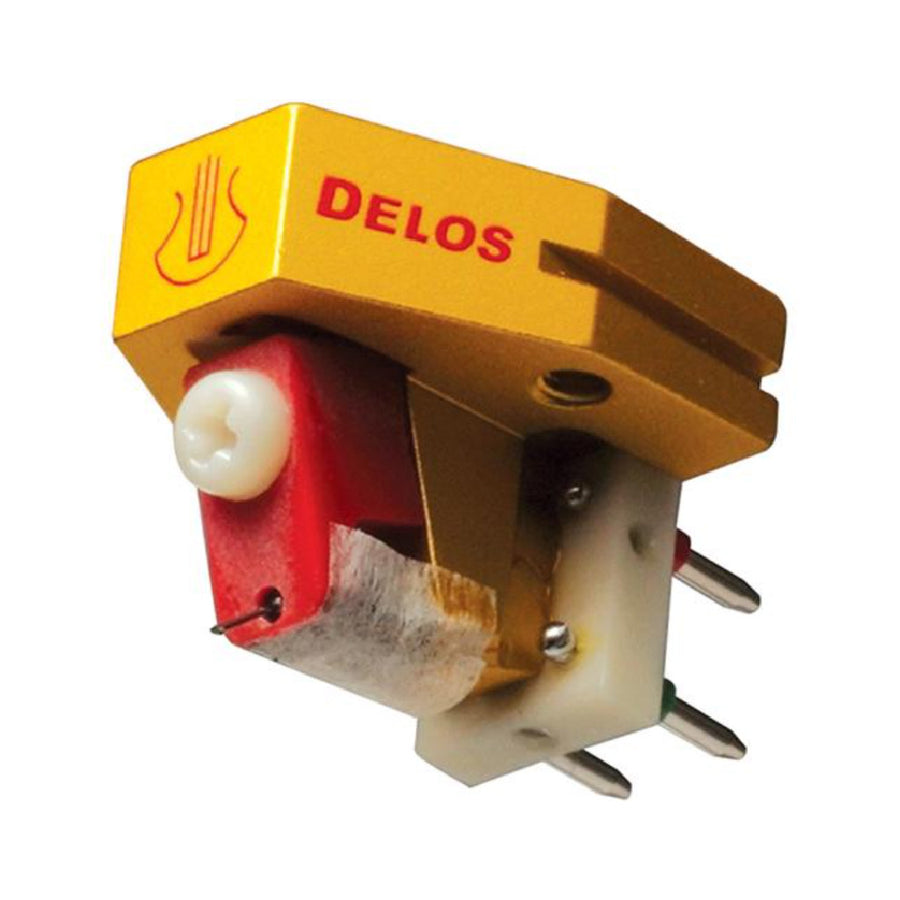
In a conventional moving-coil the generator is an assembly of its own: an iron yoke carries flux from a magnet to the gap, the coils swing in that gap, and the whole unit is glued or potted inside a shell. Lyra's design dispenses with both the yoke and the shell. Two disc magnets of equal diameter sit in front of and behind the coils, so the field the coils move in is symmetrical, and the rear of the cantilever assembly is bolted, not glued, into the main structure of the body. The Helikon of 2000 introduced the arrangement, and the Titan of 2003 took it to its conclusion: a generator mounted directly to a one-piece body machined from titanium alloy, with the cantilever exposed under a transparent stylus guard. Jonathan Carr's stated principle is a direct energy path from stylus to tonearm, with no plastic in the way to interrupt it. Every current Lyra is built this way, from the Delos, whose solid boron rod is mounted directly into its aluminum body, to the Atlas λ Lambda, which keeps the yokeless dual-magnet system inside its titanium billet. The assemblies are built by hand in Tokyo by Yoshinori Mishima and Akiko Ishiyama.

Why it matters in a system

A cartridge is a very small vibration machine, and whatever energy the stylus puts into the cantilever has to go somewhere. Glue and plastic store it and give it back late; a bolted metal path hands it on to the headshell and the arm, where it can be dissipated. The equal magnets mean the coils see the same flux moving up as moving down, which keeps the signal linear. What is left is the groove rather than the housing.

What you may hear

Michael Fremer, reviewing the Titan in 2003, called it the least mechanical-sounding Lyra he had heard, and wrote later that even Lyra's critics agree the line's strongest suit is timbral neutrality: instruments with their own tone rather than the cartridge's.

Ogura-built, slot-mountedSince 2003

Diamond-coated boron cantilevers and the 3 by 70 micron line-contact stylus

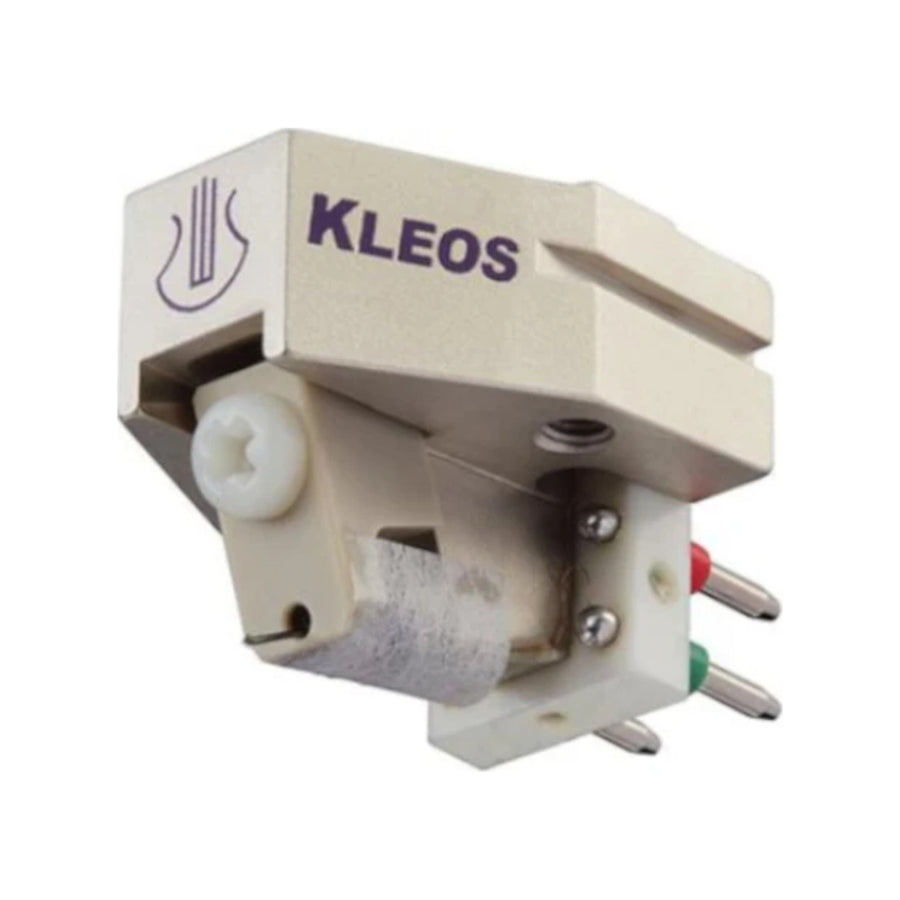
The cantilever is a solid boron rod, coated with diamond on the Etna and Atlas, held on a very short one-point wire suspension and pressed into the body through a knife-edge mount. The stylus on the Kleos, Etna and Atlas is Lyra's own long-footprint line-contact shape, a nude diamond with a 3 micron minor radius and a 70 micron major radius, set into a slot in the cantilever rather than glued to a flat. Read the deep diveClose

What it does

Boron is among the stiffest materials that can be drawn into a rod, and a solid boron cantilever carries the stylus's motion to the coils with less flexing than aluminum. On the Titan of 2003 Lyra added a diamond coating to the boron, inside a metal jacket, and the diamond-coated rod has marked the top models since: the Atlas and Etna use it with a short one-point wire suspension mounted through a high-pressure knife-edge system. The Kleos uses the uncoated boron rod and coil system made by Ogura, and Lyra calls it the lowest-cost model to carry the full Ogura assembly; the Delos uses a solid boron rod of its own. The stylus on the Kleos, Etna and Atlas is a Lyra design, a variable-radius line-contact nude diamond of 3 by 70 microns whose long, narrow footprint rides a tall slice of the groove wall; it is slot-mounted, set into the cantilever rather than cemented to a flat. The Delos instead carries a Namiki microridge diamond of 2.5 by 75 microns, surface-mounted. Carr's reasons for the shape, as he explained them to Stereophile, were tracking, detail retrieval and reduced groove wear, and as early as 1996 he told Michael Fremer that the damper and the cantilever material have the single biggest effect on a cartridge's final sound.

Why it matters in a system

The stylus is the only part that touches the record, and the cantilever is the only path from it to the coils. A long, narrow contact patch reads the fine detail cut into the groove and spreads the tracking force over more diamond, which is why Lyra's styli are gentle on records at the same time as they are revealing. A stiffer cantilever keeps that detail intact on the way to the generator, and a slot-mounted diamond cannot rock on its mount.

What you may hear

Michael Fremer heard in the Delos ultra-fast, detailed and pristine transients and microdynamics beyond its price; Dennis Davis of The Audio Beat wrote that the Atlas "simply extracts more information and assembles it better than any cartridge I have heard."

Coils aligned while playing, not at restSince 2008

New Angle

In most moving-coils the coils sit square to the magnets when the cartridge is at rest, and go out of square the moment tracking force bends the cantilever. Lyra angles the coil former and shapes the dampers so that the coils are tilted at rest and come into alignment with the magnets only under the recommended tracking force, which is to say while a record is playing. Every current Lyra is a New Angle design. Read the deep diveClose

What it does

Tracking force deflects a cantilever by a small but real angle. A cartridge aligned on the bench, with no force on the stylus, therefore plays with its coils tilted relative to the magnets, and the flux through them is no longer symmetrical. Jonathan Carr's answer, first built into the Delos of 2008, was to pre-bias the generator: the coil former is set at an angle and the dampers are made asymmetric, tapered so that they hold the coils and core upright when the cartridge is at rest and deform into a symmetrical shape when the tracking force is applied. At that moment the magnetic circuit, the coils and the core line up, and because the geometry is now symmetrical, vertical and horizontal compliance become equal. The Delos was the first New Angle cartridge; the Kleos of 2010 followed with a dual neodymium disc magnet and coil system that, as Michael Fremer put it, produces symmetrical flux lines during play rather than at rest, and the Atlas of 2012 and Etna of 2013 were designed around the same principle. Lyra's product pages refer to the whole line since 2008 as New Angle models, and the λ Lambda suspension of 2020 is a refinement of the same idea.

Why it matters in a system

A generator that is only correct on the bench is wrong every time it plays. Aligning it under tracking force means the output is linear and the two channels behave alike through the whole excursion, which shows up as separation, tracking and a tonal balance that stays put as the cutting level rises. It also makes a Lyra less fussy about small variations in force and loading than its specifications might suggest.

What you may hear

SoundStage! explained that most cartridges' coils are no longer parallel to the magnets at 1.8 grams; Herb Reichert of Stereophile found the Delos "sounded like a fine-tuned supercartridge under a wide range of loading conditions."

Nonparallel surfaces, nonmultiple dimensionsSince 2012

The asymmetric titanium bodies of the Atlas and Etna

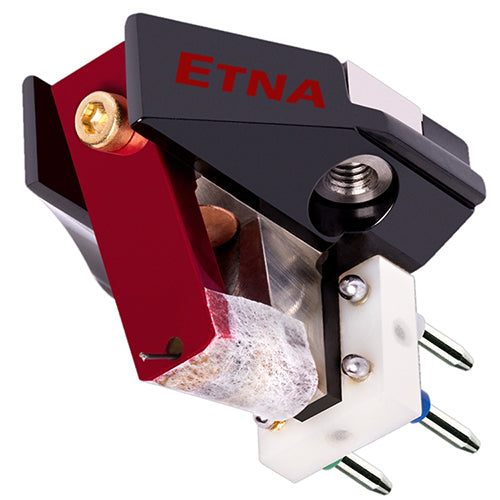
The Atlas is carved from a single titanium billet and the Etna is built around a titanium core inside a black duralumin shell. The two sides of each body are deliberately different shapes, no surfaces are parallel, no dimension is a multiple of another, and the front magnet carrier is moved off to one side so that its screw does not sit in the path from cantilever to headshell. The aim is a body in which standing waves cannot form. Read the deep diveClose

What it does

A cartridge body is a small block with a vibrating assembly bolted to it, and a block whose faces are parallel and whose dimensions are even multiples of one another rings at related frequencies. For the Atlas of 2012 Jonathan Carr set out to build a body that could not: curves balanced against angles, nonparallel surfaces, nonmultiple dimensions, in his words to Stereophile, with proportions based on 3, 5, 7, 11 and 13 rather than 2, 4, 6 and 8. The Atlas is cut from solid titanium, its exterior contact-machined and its internals non-contact-machined, with left and right sides of different shapes, a pre-stressed phase-interference resonance system, a narrowed mounting area and a front magnet carrier offset from the cantilever so that the cantilever assembly has a direct path to the headshell. The Etna of 2013 applies the same geometry at lower cost: a solid titanium core with non-parallel surfaces inside an asymmetric, mirror-black anodized duralumin outer body, with bronze and stainless-steel resonance-control rods, a constrained-layer construction that Lyra says reduces each material's individual resonance. The Etna's body is slightly smaller than the Atlas's and its front screw is moved all the way forward; at 9.2 grams it is lighter than the 11.6-gram Atlas.

Why it matters in a system

Everything the stylus does not turn into signal becomes vibration in the body, and a body that stores that vibration at a few favored frequencies feeds it back into the generator as coloration. Spreading the resonances across unrelated frequencies and giving the cantilever a straight path to the headshell lets the arm absorb the energy instead. It is why the top two Lyras are built from titanium rather than the aluminum of the Kleos and Delos.

What you may hear

Dennis Davis of The Audio Beat on the Atlas: it "simply extracts more information and assembles it better than any cartridge I have heard." Lyra's own distinction is that the Atlas has a refined, elegant and voluptuous sound while the Etna's personality is more outgoing.


Each channel on its own armsSince 2012

The X-shaped coil former

From the Atlas on, Lyra winds its signal coils on a cross-shaped former of chemically purified iron instead of a square one, so each channel's coil sits on its own pair of arms. The Atlas and Etna use 22 percent less wire than the Titan i and put out 12 percent more voltage; the Kleos and Delos keep square formers. Read the deep diveClose

What it does

A moving-coil generator carries two coils, one per channel, at right angles to each other on a former that swings in the magnetic gap. On a conventional square former the two windings share the same plate; on the cross-shaped former Lyra introduced with the Atlas in 2012 each coil has its own arms of the X, so the two channels interact less and the former can be lighter. Lyra used the gain in efficiency two ways at once: the Atlas's coils use 78 percent of the wire of the Titan i's and still produce 12 percent more output. The specification on the Atlas λ Lambda and Etna λ Lambda is two layers of 6N copper, 99.9999 percent pure, on a cross-shaped chemically purified iron former, for 0.56 mV output, 4.2 ohms self-impedance and 11 microhenries of inductance; the single-layer SL versions wind one layer on the same former for 1.52 ohms and 0.25 mV. The Kleos keeps two layers of 6N copper on a square chemically purified iron former, 0.5 mV and 5.4 ohms, and the Delos three layers on a square permalloy former, 0.6 mV and 6.3 ohms. The Mono versions use a square former of their own, lying parallel to the record.

Why it matters in a system

Less wire means less moving mass and lower impedance, which is the direction every low-output moving-coil wants to go, but it usually costs output. The X former recovers that output through geometry, so the Atlas and Etna can be both lighter in the gap and easier for a phono stage to amplify than the Titan they replaced. Putting the two coils on their own arms is part of what makes the separation and tracking of the upper models possible.

What you may hear

Stereophile's 2014 review found that in a few crucial ways the Etna's sound seemed to surpass the Atlas, particularly in the midrange, and Michael Fremer later called the Etna SL Jonathan Carr's best work yet; TONEAudio's Jeff Dorgay wrote that the Atlas pulls every molecule of detail from the grooves.

Flat damper discs and a separate pillowSince 2020

The λ Lambda suspension

The original New Angle cartridges used single tapered dampers that did two jobs at once: damp the cantilever and push it into position at rest. The λ Lambda generation of 2020 splits the jobs between a stack of flat elastomer discs and a separate support pillow, so each part can be made of the material best suited to its own task and the cantilever lands in its intended position more consistently. The Atlas and Etna families are Lambda models; the Kleos and Delos are not. Read the deep diveClose

What it does

A damper in a moving-coil cartridge sits behind the coils and controls how the cantilever moves; in Lyra's New Angle designs it was also tapered so as to pre-load the cantilever and bring the coils into alignment under tracking force. Asking one piece of elastomer to do both meant compromising on each. In the spring of 2020 Lyra introduced the λ Lambda versions of the Atlas and Etna, in which the tapered damper is separated into flat elastomer discs for damping and a support pillow for pre-loading. Jonathan Carr has said the flat design keeps the pre-loading entirely in the vertical domain, which allows greater consistency from cartridge to cartridge, and he credits the revised design and new materials with better tracking, dynamics and a lower noise floor. The stylus, cantilever, coils and electrical specifications were unchanged; the nose piece changed to a more rigid polymer, and its color from green to a purple or olive shade. Lyra offers a rebuild to Lambda specification for earlier Atlas and Etna cartridges, and Stereophile notes that the Lambda enhancements are now added at no extra charge when an Atlas is sent in for rebuild. The Kleos and Delos remain as they were.

Why it matters in a system

The damper is the component Carr has said has the single biggest effect on a cartridge's sound, after the cantilever material. Separating its two functions lets Lyra tune the damping with one material and the preload with another, and build to tighter tolerances, so that the New Angle alignment is reached more exactly on every cartridge. It is the reason a 2020 Etna sounds different from a 2013 Etna with the same generator.

What you may hear

Michael Trei of Stereophile found with the Atlas λ Lambda that "the improvement in resolution and lucidity was instantly obvious"; Alan Taffel of The Absolute Sound called the Etna λ Lambda an unquestionably worthwhile upgrade, with images even more solid and fleshed out than before.

Choosing the Lyra for the phono stageSince 2016

SL coils, Mono coils and loading

Each Lyra above the Delos comes in three windings. The standard version has two coil layers; the SL winds one, for half the output and a third of the impedance, and is meant for very high-gain, low-noise or current-input phono stages or a matched step-up transformer; the Mono winds two separate coils on a former parallel to the record, so it reads only lateral groove motion. Lyra publishes wide loading ranges and says they are to be finalized by listening. Read the deep diveClose

What it does

The Atlas SL and Etna SL arrived in 2016; the Kleos SL is built to order at a ten percent premium. One coil layer instead of two gives about 0.25 mV, impedances of 1.52 ohms on the Etna and Atlas SL and 2.7 ohms on the Kleos SL, and lower moving mass. Lyra's own advice is that the SL may offer extra pure and pristine sound but with less energy and power, that it is for expert users with very high-gain, low-noise phono stages or step-up transformers, and that the regular version is the one to choose if in doubt. The Mono versions wind two isolated coils on a square former lying parallel to the record rather than at 45 degrees, so they generate a signal only from horizontal stylus movement and ignore the vertical axis where mono-record noise lives; the coils can be run in parallel, singly, or in series for more output. Loading is specified as a range, 104 to 887 ohms for the Atlas, 95.3 to 816 for the Kleos, 97.6 to 806 for the Delos, with a transformer rating of 3 to 6 ohms for standard models and 1 to 3 ohms for SLs. Lyra's Erodion EVO step-up gives 26 dB of gain for 2 to 10 ohm cartridges and is named for the SL models.

Why it matters in a system

Jonathan Carr's explanation of loading is that the resistor mainly damps an ultrasonic resonance between the cartridge's inductance and the capacitance of the cable and phono input, so that the phono stage stays linear; he suggests phono stage input terminator is the more accurate term, and that minimizing capacitance first lets a wider range of values work. Which winding to buy therefore depends on the phono stage: a transimpedance input or a matched transformer rewards the SL, and most voltage-gain stages are happier with the standard coil.

What you may hear

Michael Fremer called the Atlas SL and Etna SL two of the world's great cartridges; Roy Gregory of The Audio Beat found that with most phono stages the standard Etna λ Lambda "simply sounded bigger, more confident and significantly more entertaining," and concluded there is no best Lyra, only the best Lyra for you.

Search