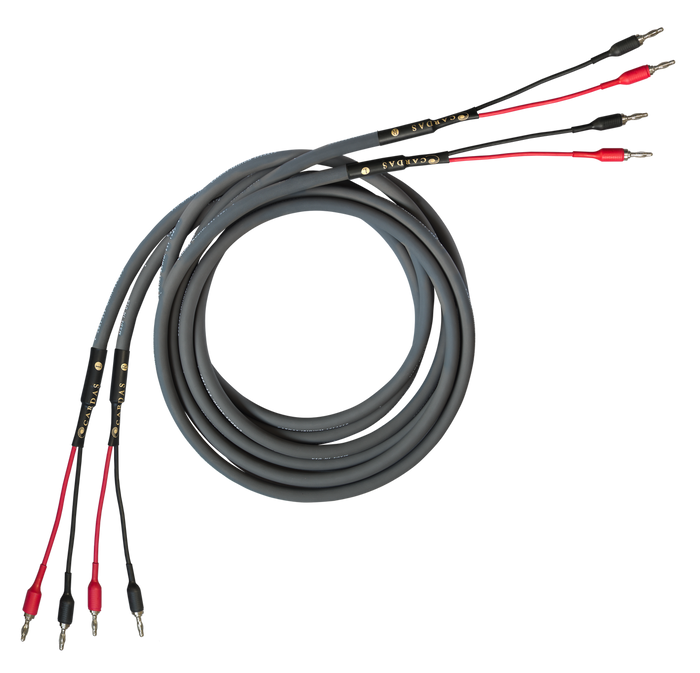
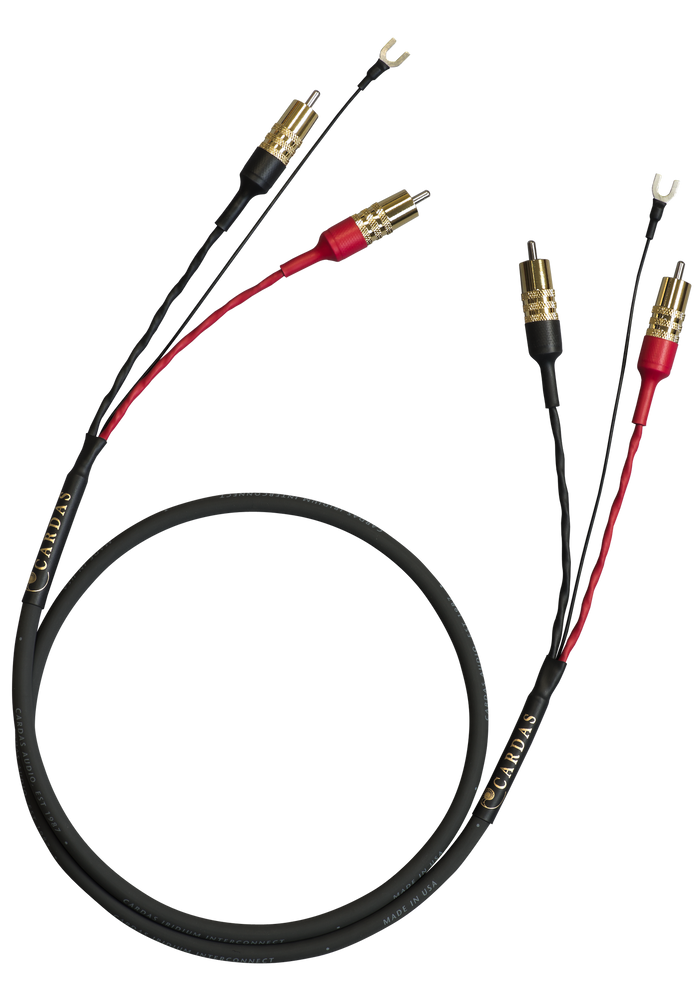
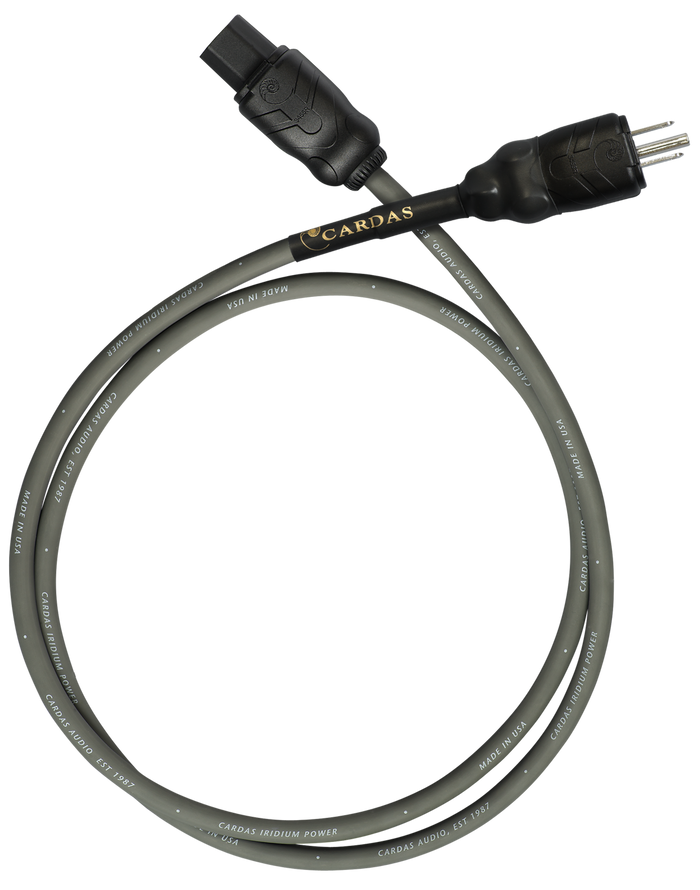
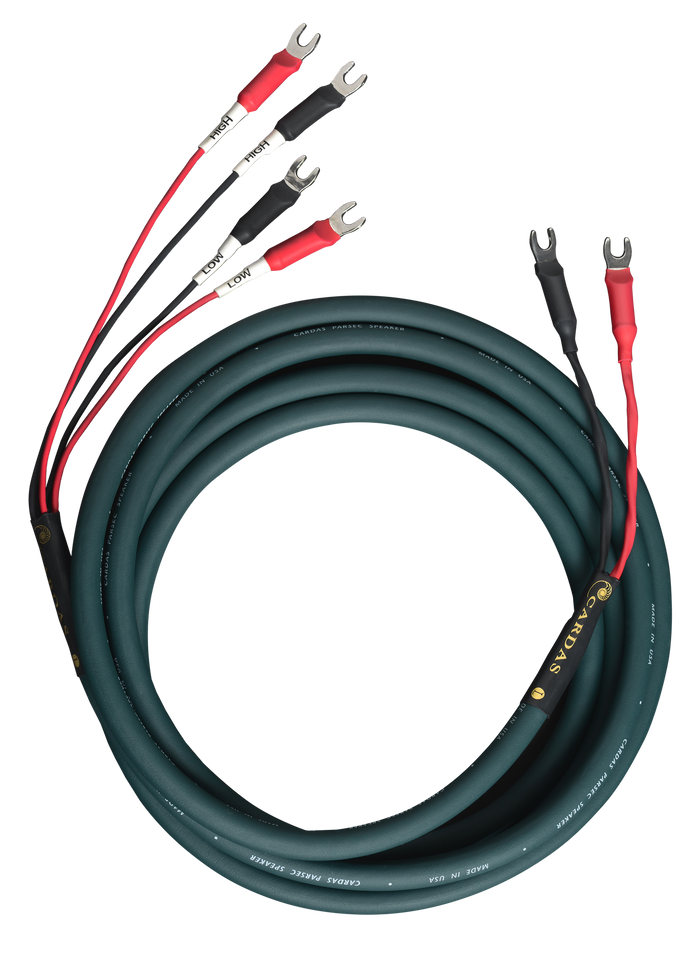
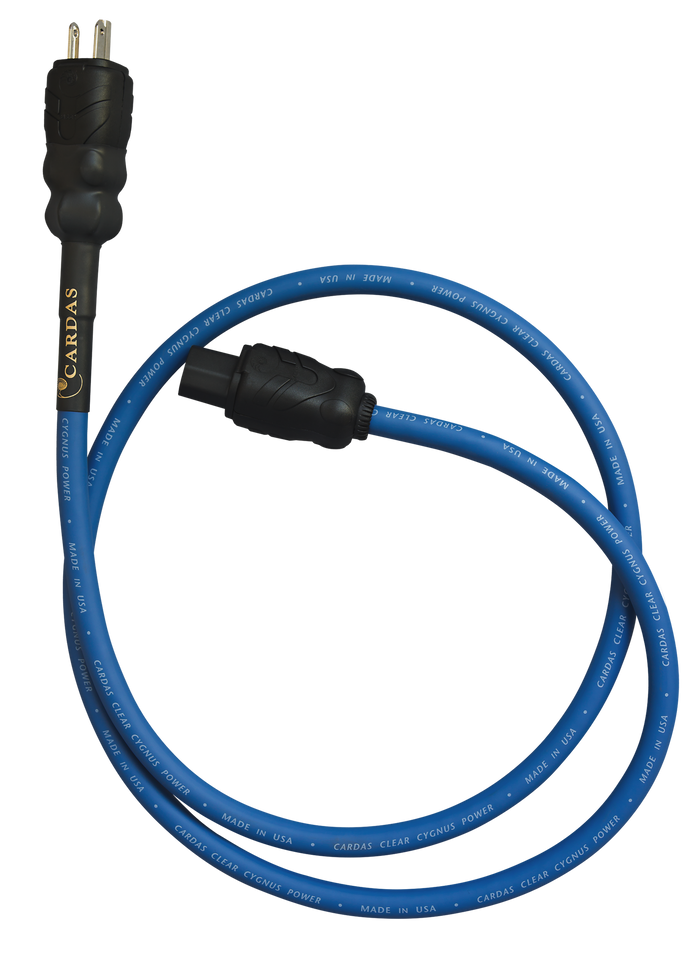
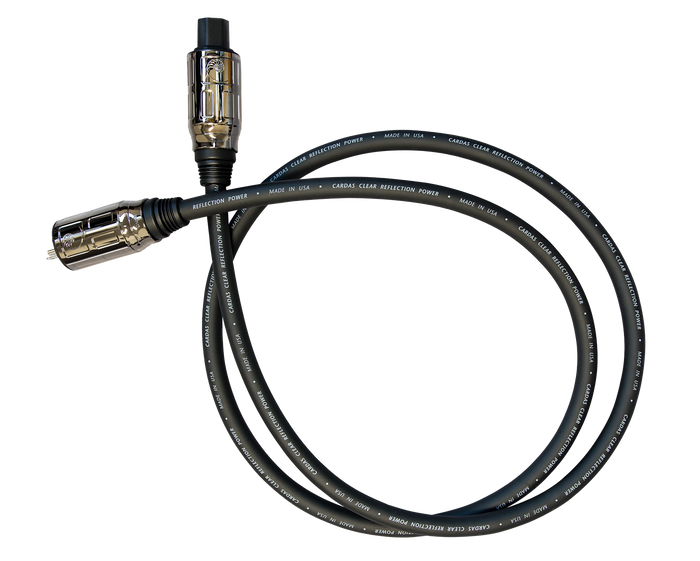
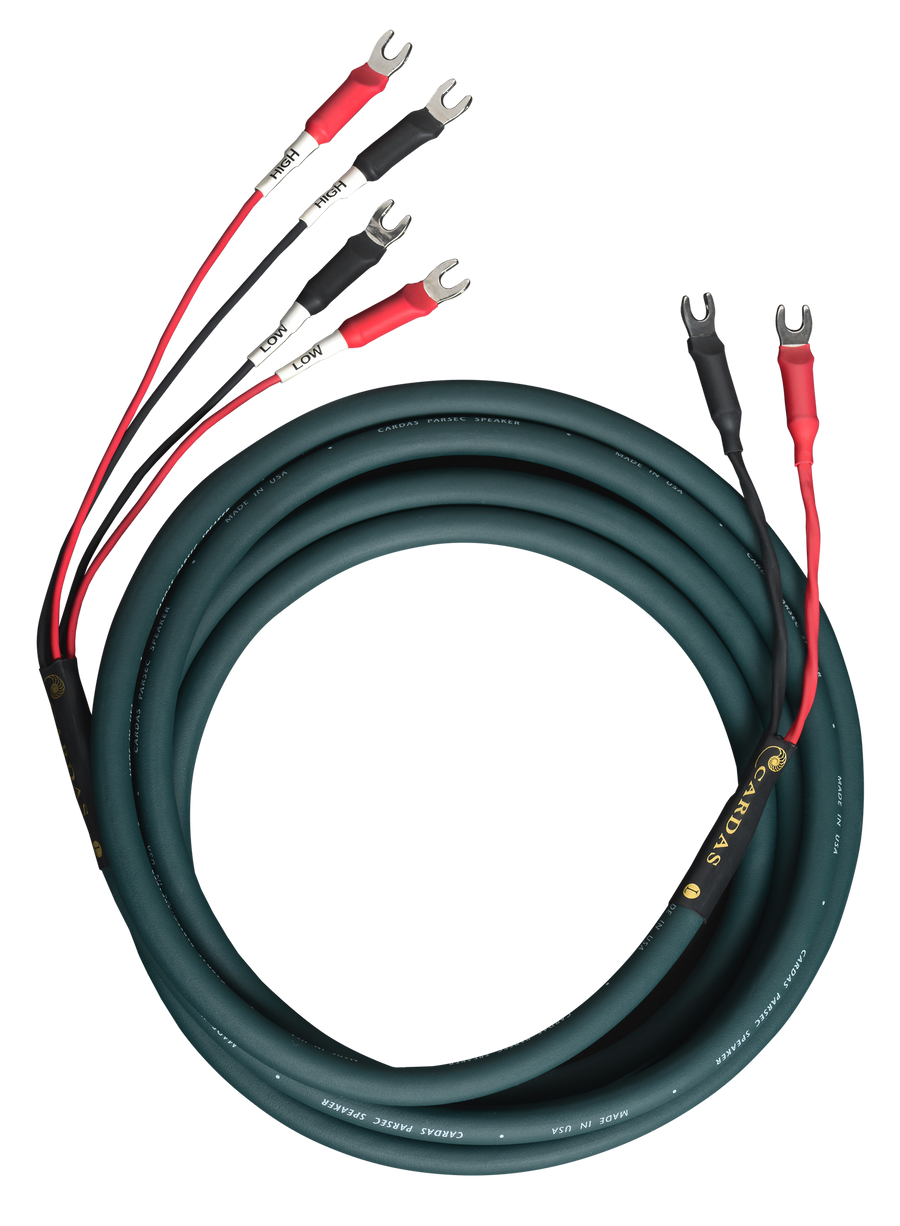
Cardas Clear Beyond Speaker Cable

The Cardas Audio story

Golden Ratio stranding, Matched Propagation copper and hand termination on the Oregon coast since 1992.

Founded 1987 in Ontario, California; in Bandon, on the southern Oregon coast, since 1992 by George Cardas · cardas.com

The history and technologies of Cardas Audio of Bandon, Oregon, and what Pearl Audio keeps on the floor.

George Cardas was a line engineer for the telephone company, engineering transmission lines, and a semi-professional racing driver before he was a cable maker. With the machinist Mike Colver he applied Golden Ratio proportions to engine and exhaust designs that were sometimes banned in their racing league for being too advantageous, and Bob Graham, who would later draw the Cardas Nautilus logo, designed a logo for Cardas Racing Fuel before there was a Cardas Audio. The idea that would define the company came from hearing conductor glare as harmonic resonance: if every strand in a cable is the same size, every strand rings at the same frequency. In 1983 Cardas assembled the first machinery to wind strands in concentric layers stepped in size by 1.618, and on December 30, 1985 he filed for US Patent 4,628,151, a multi-strand conductor cable with its strands sized according to the golden section, granted on December 9, 1986. The Quadlink cables that carried the idea have been in production in one form or another since the mid-1980s.

Cardas Audio was founded in 1987 in Ontario, California, with the family garage as the laboratory. George's friend Kip Dobler made the prototypes and terminated the first cables while George was still at the phone company, and the first dealer was a local stereo shop owner who was initially reluctant. George took early retirement, and within a year or two he had found the last US copper producer able to draw ultra-pure fine wire to his specification, a mill that was close to closing, and promised it a steady stream of orders; a Southern California cable vendor accustomed to military-scale orders was persuaded to build his designs. A second patent, US 4,980,517 of December 1990, covered the arrangement of larger strands outside and smaller strands inside. Between 1990 and 1992 the company also ran Cardas Records, with George producing and engineering audiophile LPs including Ben Harper and Tom Freund's Pleasure and Pain, recorded with Cardas microphones and Hexlink Golden 5c cables. Hexlink and Golden Cross, the early flagships, were designed to tame the edge of early digital recordings, and Golden Cross remained the top of the line for many years.

In 1992, when the lease on the Upland, California facility came up for renewal, George and Darcy Cardas searched the California and Oregon coasts and chose Bandon, a cranberry town of about 3,300 people on the southern Oregon coast, an hour and a half north of the California border. Most of the staff moved with them, including Bob and Linda Graham; Mary, the eldest daughter, who had run the business side in Southern California, stayed there, and Colleen, the middle daughter, became the manager in Bandon. The Golden 6A power strip of the mid-1990s is the ancestor of today's Nautilus. In a 1996 interview George described the recipe that still holds: extremely soft and pure copper, a Teflon and air dielectric, and new connectors of his own because the industry's were not good enough. By 2005 Golden Reference had replaced Golden Cross at the top of the range, with 816 conductors in twelve bundles and rhodium-plated connectors, and SoundStage! called it consummate; a Cardas headphone cable of 2003 is the ancestor of today's Parsec Headphone.

The company's second patented idea arrived with the Clear line. On April 18, 2008 George Cardas filed for US Patent 7,674,973, the Matched Propagation Conductor, which sets the twist of each strand layer around a Kevlar core so that signal speed in the copper matches the dielectric, curing the time smear that telephone engineers had compensated for with loading coils since 1904. Clear launched in 2010 with speaker cables and interconnects; John Marks reviewed the speaker cable in Stereophile that October and called it the best-sounding cables he had heard. At CES in January 2011 Cardas showed a three-tier line of Clear Light, Clear and Clear Beyond, the Clear Beyond speaker cable as thick as a garden hose, and previewed metal earbuds. The EM5813 Ear Speaker followed in 2013 at $425, with Clear Sky as the most affordable Matched Propagation speaker cable the same year, and Angela Cardas Meredith, the youngest daughter, returned around 2014 to manage the company. In 2015 Clear Reflection replaced Golden Cross and Golden Reference, the A8 earspeakers appeared at $299, and Parsec took over from Quadlink.

For the 30th anniversary in 2017 Cardas introduced the Clear Beyond interconnect at $3,750 a meter, the Iridium line in place of Microtwin and Twinlink, Clear Cygnus in place of Clear Light, and an A8 30th Anniversary Edition; hi-fi+ reviewed the Clear Beyond interconnect that July and recommended it very highly. The Clear Beyond XL power cord, with a toroidal ground filter in its termination, followed in 2018, and Robert H. Levi's 2019 reviews in Positive Feedback called the Clear Beyond phono cables the quietest he had ever used and the interconnects the best wire Cardas had produced. When hi-fi+ visited Bandon in 2019 it found about 15 staff and a lifetime warranty on everything but the earbuds. By then The Absolute Sound had reported that OEM wire, strand and connectors for other manufacturers were the company's largest business. In 2022 John Darko filmed American Made in the Bandon building, following a Clear Beyond speaker cable from braiding to forged connector, and Herb Reichert reviewed Clear Beyond in Stereophile, where it has remained a Recommended Component.

Today Angela Cardas Meredith manages Cardas Audio and George Cardas remains head designer, splitting his time between Bandon and Chapala, Mexico; Josh Meredith handles operations and marketing and Brian Von Bork runs sales. About fourteen people braid the Golden Section conductors on machines modified from century-old designs, build the air-tube suspensions, forge the terminations on the upper speaker cables at 10,000 psi, solder the rest with Quad Eutectic, and hand-assemble the Nautilus strip. The copper is still drawn to George's process at a US mill in the Northeast, from rod mined in the Southwest. The range runs from Crosslink and 101 on Grade 2 copper through Iridium, Parsec, Clear Sky, Clear Cygnus, Clear Reflection and Clear to Clear Beyond, every cable with a lifetime warranty and a trade-in path toward the tier above. For Pearl Audio in Portland, Cardas is an Oregon company a few hours down the coast, and its cables are built by people we can call.

Milestones

  1. 1983 Golden Section stranding machinery George Cardas, a telephone-company line engineer and semi-pro racer who had applied the Golden Ratio to engine and exhaust designs, assembles the first machinery to wind cable strands in layers stepped in size by 1:1.618.
  2. 1986 US Patent 4,628,151 Filed December 30, 1985 and granted December 9, 1986: a multi-strand conductor cable with its strands sized according to the golden section, so no two strand sizes share a resonance. Quadlink cables carry the idea from the mid-1980s.
  3. 1987 Cardas Audio founded in Ontario, California The family garage is the lab; Kip Dobler makes the prototypes and terminates the first cables while George is still at the phone company. The first dealer is a reluctant local stereo shop owner. Bob Graham, the company's first graphic designer, draws the Nautilus logo.
  4. 1988 The copper mill A year or two after founding, Cardas finds the last US producer able to draw ultra-pure fine copper to his specification, a mill near closing, and keeps it in business with orders. The copper is drawn slowly and hydrogen-annealed to his process, as it still is.
  5. 1990 Second patent, and Cardas Records US Patent 4,980,517 covers larger strands outside and smaller strands inside in a golden-ratio progression. From 1990 to 1992 George Cardas produces and engineers audiophile LPs on Cardas Records, including Ben Harper and Tom Freund's Pleasure and Pain. Hexlink and Golden Cross are the flagships.
  6. 1992 The move to Bandon, Oregon When the Upland lease expires, George and Darcy Cardas search the California and Oregon coasts and choose Bandon, a town of about 3,300 on the south coast. Most of the staff move with them; Colleen Cardas becomes the Bandon manager.
  7. 1996 Soft copper, Teflon and air In a TNT-Audio interview George Cardas describes the recipe: extremely soft and pure copper, a Teflon and air dielectric, connectors of his own design, and the warning that moving cables upsets their static charge. The Golden 6A power strip of the mid-1990s is the ancestor of the Nautilus.Cardas Audio Nautilus Power Strip
  8. 2005 Golden Reference Golden Reference succeeds Golden Cross at the top of the range: 816 conductors in twelve bundles of 68, rhodium-plated connectors. SoundStage! calls it consummate, with real neutrality rather than the thin, washed-out kind.
  9. 2008 The Matched Propagation patent is filed US Patent 7,674,973, filed April 18, 2008: each strand layer's twist is set so that signal speed in the copper matches the surrounding dielectric, curing the time smear that telephone engineers had compensated for with loading coils since 1904.
  10. 2010 Clear The Clear line launches with speaker cables and interconnects built on Matched Propagation conductors and compression die-forged terminations. John Marks, in Stereophile: the best-sounding cables he had heard.Cardas Audio Clear Interconnect
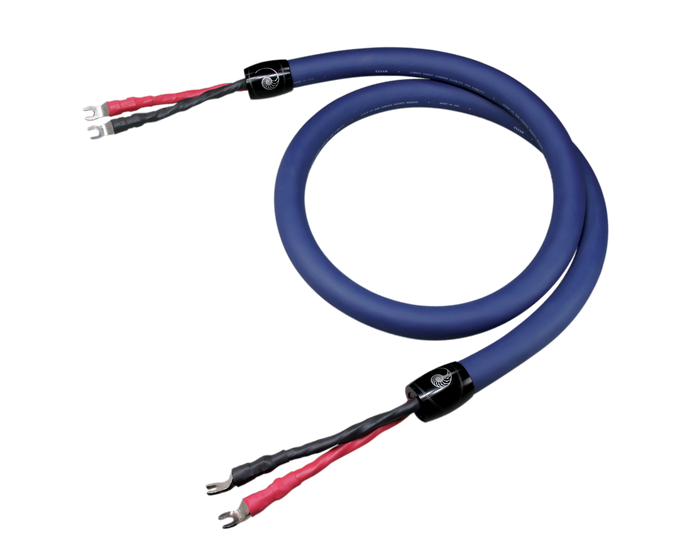
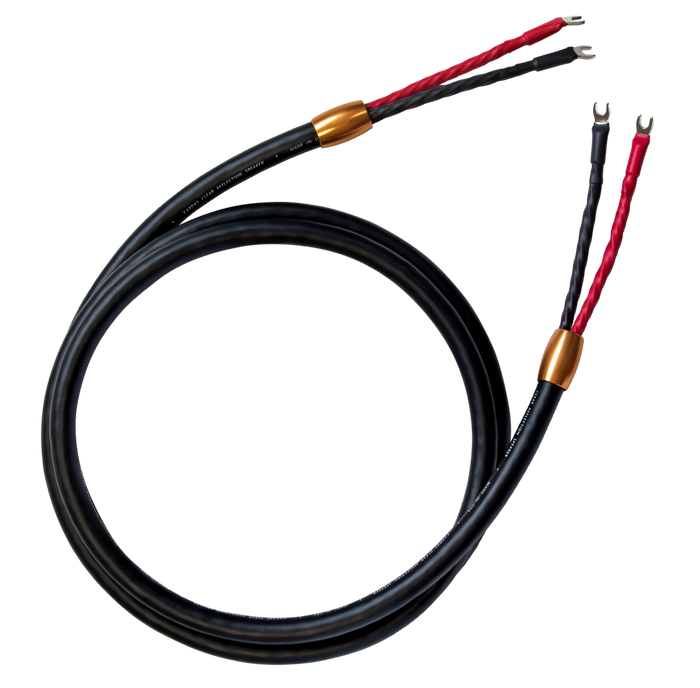
  11. 2011 Clear Light, Clear and Clear Beyond At CES Cardas shows a three-tier Clear line topped by a Clear Beyond speaker cable as thick as a garden hose, with Clear USB and Clear Power on the way, and previews metal earbuds.Cardas Audio Clear Beyond Speaker Cable
  12. 2013 EM5813 Ear Speakers and Clear Sky The EM5813, with a driver housing shaped after the cochlea and eardrum, is released at $425. Clear Sky arrives as the most affordable Matched Propagation speaker cable.Cardas Audio Clear Sky Interconnect
  13. 2015 Clear Reflection, A8 and Parsec Clear Reflection replaces Golden Cross and Golden Reference, borrowing the Golden Reference speaker geometry; hi-fi+ says it brings Golden Reference up to date. The A8 earspeakers appear at $299, and Parsec takes over from Quadlink. Angela Cardas Meredith has returned to manage the company.Cardas Audio Clear Reflection Interconnect
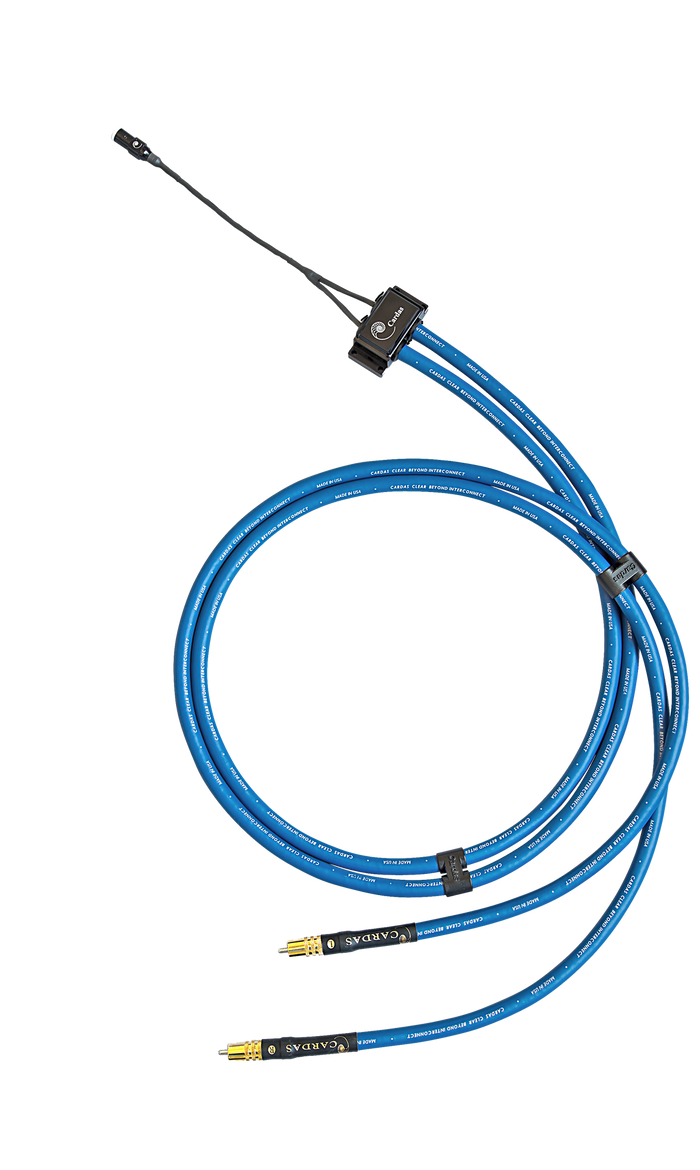
  14. 2017 30th anniversary The Clear Beyond interconnect at $3,750 a meter, Iridium in place of Microtwin and Twinlink, Clear Cygnus in place of Clear Light, and an A8 30th Anniversary Edition. hi-fi+: very highly recommended.Cardas Audio Clear Beyond Interconnect
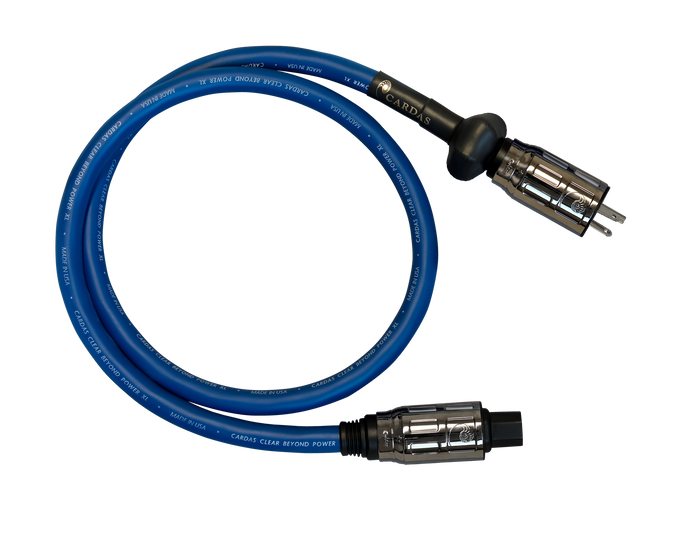
  15. 2018 Clear Beyond XL The flagship power cord adds per-conductor shields and a toroidal ground filter with a ground leg about three times the cable's length. TONE Audio: XL takes its predecessors' prowess to a new level.Cardas Audio Clear Beyond Power XL
  16. 2022 American Made John Darko films a Clear Beyond speaker cable being braided, suspended and forged in Bandon. Herb Reichert reviews Clear Beyond in Stereophile, where it remains a Recommended Component. OEM wire and connectors are the company's largest business; Angela Cardas Meredith manages, George Cardas remains head designer.

Cardas Audio at Pearl Audio

Pearl Audio is an authorized Cardas dealer in Portland, and Cardas is an Oregon company, built in Bandon a few hours down the coast. We carry the full range from Iridium and Parsec through Clear Sky, Clear Cygnus, Clear Reflection and Clear to Clear Beyond, with the phono, digital, power and headphone cables, the Nautilus power strip and the Ground Cable, and we can order any length, termination or internal bi-wire configuration Cardas builds. We help match the tier to the system, so the money goes where it is audible, and we handle Cardas's trade-in program when it is time to move up a tier. Cardas cables are built to order and carry a lifetime warranty, and we can arrange re-termination or repair through Bandon.

All Cardas Audio at Pearl Audio

Signature technologies

The engineering behind Cardas Audio

Cardas Audio gives its technologies names because each one solves a specific problem. Here is what each does, where it came from, why it matters in a system, and what you may hear.

Strands sized at 1:1.618, patented 1986 and 1990Since 1983

Golden Section stranding

Every Cardas conductor is a bundle of individually insulated strands in concentric layers, each layer's strands larger than the layer inside by the Golden Ratio, 1:1.618. Because no two strand sizes share a resonant frequency, the mechanical vibration set up by current cannot build up coherently, and the larger outer strands damp the smaller inner ones. George Cardas built the first machinery for it in 1983 and patented it in 1986 and 1990. Read the deep diveClose

What it does

Alternating current makes the strands of a cable vibrate, and Cardas's own explanation compares each strand to a guitar string with its own resonance. If every strand is the same size, they all resonate at the same frequency and reinforce one another. George Cardas, who had applied Golden Ratio proportions to racing engines and exhausts before he applied them to wire, arranged the strands so that each concentric layer steps up in size by 1.618, the limit of the Fibonacci sequence. No two sizes share a resonance, so the vibration has nowhere to add up, and the heavier outer strands hold the finer inner ones still. The first patent, US 4,628,151 for a multi-strand conductor with strands sized according to the golden section, was filed on December 30, 1985 and granted on December 9, 1986; the second, US 4,980,517 of December 1990, covers the arrangement of larger strands outside and smaller strands inside in an irrational progression. Cardas describes the result as a micro resonance control technique that gives all its cables a constant Q, and it is present in every cable and chassis wire the company makes, from Crosslink and 101 to Clear Beyond, the Ground Cable and the solid-core wiring inside the Nautilus power strip.

Why it matters in a system

A cable cannot add anything useful to a signal; the best it can do is avoid storing energy and releasing it late. Strand resonance is one of the ways a cable stores energy, and it is proportional to current, so it matters most in speaker and power cables. Golden Section stranding is Cardas's mechanical answer, and it is the reason the company's cables have had a recognizably consistent character across four decades of designs.

What you may hear

George Cardas described the problem he set out to solve in 1996 as conductor glare, which he heard as harmonic resonance. Brian Von Bork of Cardas has said a guitar string wound in the Cardas pattern would be completely dead and would not ring; what listeners describe is a lack of brightness or edge without any loss of detail.

Slow-drawn and hydrogen-annealed to George Cardas's process at a US millSince 1988

Cardas copper

Cardas does not smelt or draw its own copper. A year or two after the company was founded, George Cardas found the last US producer able to make ultra-pure fine copper wire to his specification, promised it a steady stream of orders, and had rod drawn slowly through diamond dies and annealed in a hydrogen atmosphere. That Grade 1 copper goes into every Cardas cable from Iridium up. Read the deep diveClose

What it does

In the late 1980s recycling laws and high-speed drawing had filled the market with copper that was fine for house wiring and poor for audio. George Cardas's answer was to control the drawing rather than the mining. Cardas copper is mined in the American Southwest and processed in the Northeast at a mill that was close to closing when Cardas partnered with it; the company has kept it in business with orders ever since, using a method George Cardas developed more than 35 years ago. The rod is drawn slowly through diamond dies and annealed in an oxygen-scavenging hydrogen atmosphere, which avoids both the crystal damage caused by fast drawing and the copper-oxide impurities that come with it. Two non-audio customers, a low-thermal DC measurement cable and detector chips for a cyclotron whose commercial copper lost thermal conductivity near 40 kelvin, showed that noise correlated with drawing damage and oxide, and that slow oxygen-free drawing cured it. Cardas describes the result as smooth from the surface to the core and says it exceeds OFHC and OCC copper in conductivity. Grade 1 copper is used from Iridium to Clear Beyond; a more affordable Grade 2 goes into Crosslink and 101. Cardas also sells its strand by the pound and chassis wire by the foot to other manufacturers.

Why it matters in a system

Every Cardas technology sits on top of the metal. The Golden Section strands, the Litz enamel and the Matched Propagation twist all assume a conductor with a consistent crystal structure and no oxide inclusions, and Cardas has said its goal was the most grain-free copper ever produced for audio. It is also why so much other high-end equipment carries Cardas wire inside: Angela Cardas Meredith has said that even if it does not have the Cardas name on it there is a good chance they made it.

What you may hear

A lack of grain or texture on sustained tones, and the quiet background that reviewers of the Clear series return to. Herb Reichert, writing in Stereophile about Clear Beyond, heard a sublime quiet and a grand spaciousness.

US Patent 7,674,973: the strand twist tuned to the dielectricSince 2010

Matched Propagation conductors

A signal travels faster along a bare conductor than through the insulation around it, and the mismatch stores energy and releases it late, as time smear. Cardas's Matched Propagation Conductor sets the twist pitch, and so the helical length, of each strand layer around a Kevlar core so that signal speed in the copper matches the dielectric. It was filed in 2008 and introduced in the Clear line in 2010. Read the deep diveClose

What it does

Cardas puts the speed of a signal in a typical dielectric at about 78 percent of the speed of light, while in a bare conductor it is faster. Telephone engineers knew the problem a century ago and compensated for it with lumped loading coils, the Pupin coils of 1904. George Cardas's approach, which he says he found largely by ear, cures it continuously along the cable instead: each layer of strands is wound around a central Kevlar element at a twist angle calculated so that the strand's path is long enough for its effective signal speed to match the surrounding dielectric. The patent, US 7,674,973, was filed on April 18, 2008, and by the spring of 2010 George Cardas was describing it as his new patent; its abstract says each strand's length is set from the dielectric's velocity of propagation so that signal speed along the conductor more closely matches speed in the surrounding dielectric. It is a separate idea from Golden Section stranding, which sets strand sizes; Matched Propagation sets strand lengths. It debuted in the Clear cables of 2010 and now runs through Clear Beyond, Clear, Clear Reflection, Clear Cygnus, Clear Sky and Clear SE9 MP, and Cardas lists the Parsec interconnect under it as well.

Why it matters in a system

Time smear is what listeners hear as glare, and it had been compensated for rather than cured in audio cables for as long as there had been audio cables. Matched Propagation was the change that let Cardas move from the slightly warm balance of Golden Cross and Golden Reference, which were designed to tame early digital recordings, to the neutrality of the Clear series. George Cardas warned in 2010 that the Clear conductors have no forgiveness and assume a reference-quality system.

What you may hear

Speed and transparency without edge. John Marks, in Stereophile, called the first Clear speaker cables the best-sounding cables he had heard; Alan Sircom of hi-fi+ found Clear Beyond warm and easy to listen to without being warm-toned, and called that quite the achievement.

Five tiers of Matched Propagation cableSince 2010

The Clear line, from Clear Beyond to Clear Sky

Clear is Cardas's premium range, built around Matched Propagation conductors, Grade 1 copper and air-tube construction. From the top down it runs Clear Beyond, Clear, Clear Reflection, Clear Cygnus and Clear Sky, and each step down uses fewer or lighter conductors, simpler dielectric suspension and, below Clear, less costly connectors. Read the deep diveClose

What it does

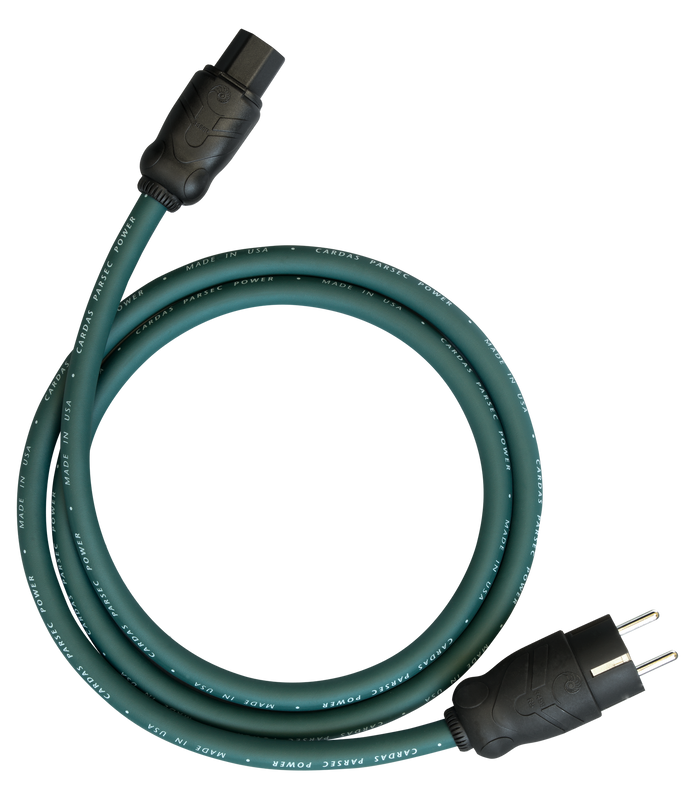
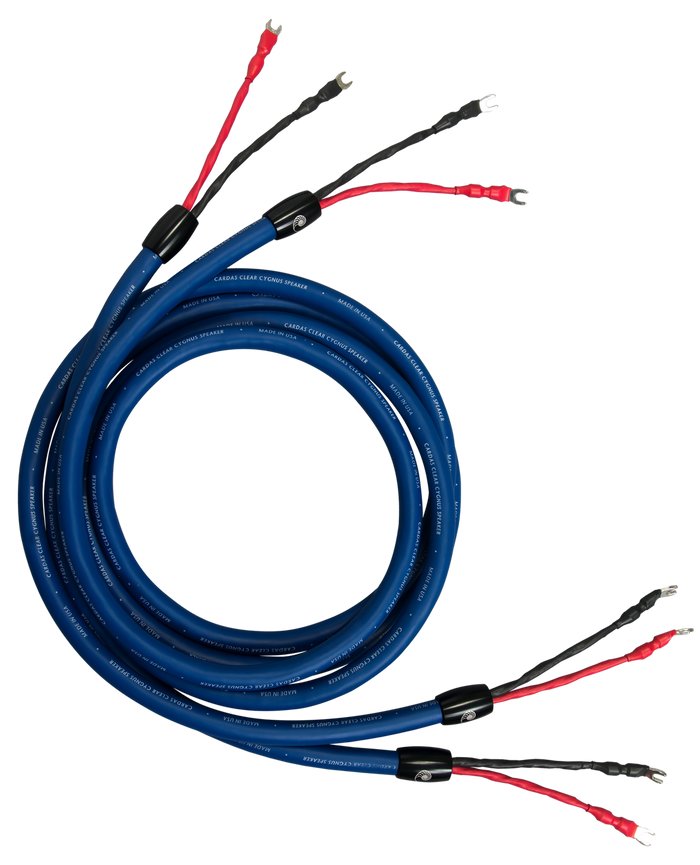
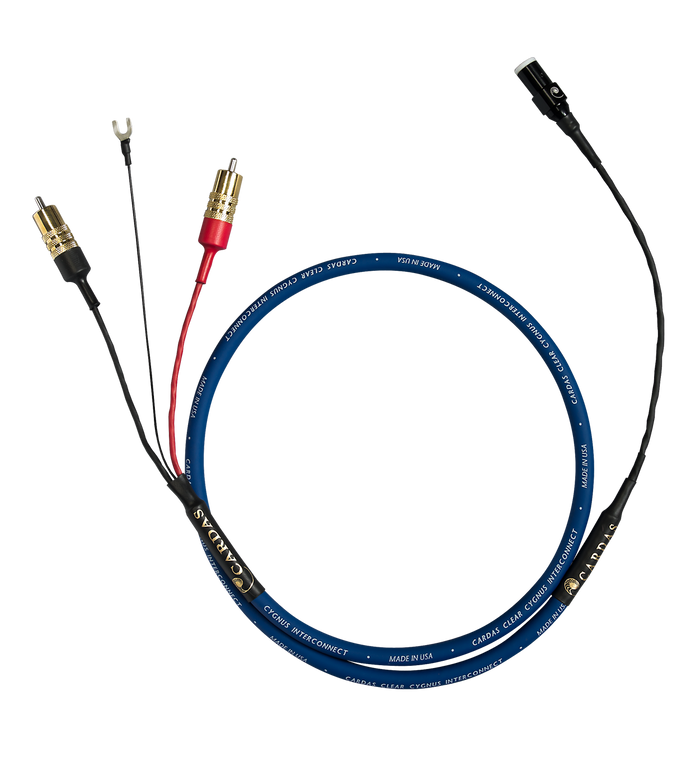
Clear launched in 2010 with the speaker cable and interconnect, and at CES in January 2011 Cardas showed a three-tier line of Clear Light, Clear and Clear Beyond. Today there are five tiers. Clear Beyond is the flagship: the interconnect, introduced for the 30th anniversary in 2017 at $3,750 a meter, is a star quad of four 26.5 AWG conductors with about 25 percent more copper than Clear; the speaker cable carries eight 10.5 AWG conductors, twice as many as Clear, and can be ordered internally bi-wired, which Clear cannot. Clear sits one step down, a triad of three 25.5 AWG conductors in the interconnect, with the same SRCA and CG XLR connectors as Clear Beyond and Clear Jumpers for bi-wiring. Clear Reflection of 2015 replaced Golden Cross and Golden Reference: a two-conductor twisted pair on air tubes sized 1.618 times the core tubes, with the Tri-Quad speaker geometry borrowed from Golden Reference, voiced warmer than Clear, on copper SRCA-CU connectors. Clear Cygnus of 2017 replaced Clear Light with a four-conductor star quad and GRMO connectors, and its speaker cable can be bi-wired. Clear Sky is the least expensive Matched Propagation interconnect, a shielded 23.5 AWG twisted pair. The power cords are shielded twisted triads with air tubes; the Clear Beyond XL of 2018 adds a toroidal ground filter.

Why it matters in a system

The tiers share the same copper and the same patented conductor, so moving up the line changes the amount of copper, the complexity of the air-tube suspension and the connectors rather than the character. That makes it practical to put Clear Beyond where it matters most and Clear Cygnus or Clear Sky elsewhere, and Cardas's trade-in program lets Parsec, Clear Sky X4, Cygnus, Reflection and Clear cables be traded toward the tier above through a dealer.

What you may hear

Herb Reichert of Stereophile heard from Clear Beyond a sublime quiet, a grand spaciousness and seemingly infinite detail, and the apparent volume of the recording venue expanded dramatically. Alan Sircom of hi-fi+ called Clear Cygnus arguably Cardas's most affordable do-no-harm loudspeaker cable.

The same copper and stranding, below ClearSince 2017

Parsec, Iridium and the entry lines

Below the Clear range Cardas builds Parsec, Iridium, Crosslink and 101. Parsec descends from the Quadlink star quad of the mid-1980s and uses Grade 1 copper with a Kevlar core; Iridium, introduced for the 30th anniversary in 2017, replaced Microtwin and Twinlink with simpler, more flexible Grade 1 cables; Crosslink and 101 use Grade 2 copper. Read the deep diveClose

What it does

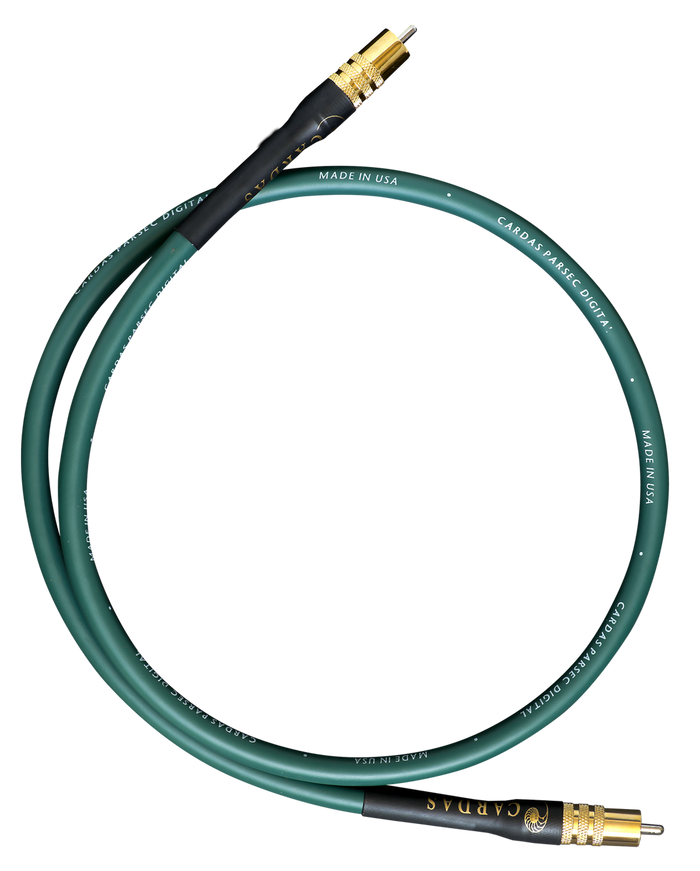
Parsec is the successor to Quadlink, which had been in production since the mid-1980s and was discontinued when Parsec was released. The Parsec speaker cable is a star quad of four 15.5 AWG conductors around a braided Kevlar core, on PTFE air tubes with FEP tape, terminated with Cardas CGMS spades or CABE bananas; the interconnect is a shielded 23.5 AWG twisted pair on poly-e air tubes, which Cardas lists among its Matched Propagation designs. Parsec Power borrows its 14 AWG conductors from Clear Cygnus, Parsec Digital is a 20.5 AWG 75-ohm coax, and the Parsec Headphone cable is a shielded star quad similar to a Cardas headphone cable from 2003. Iridium arrived in 2017 at $250 a meter for the interconnect and $320 for 1.5 meters of speaker cable, replacing Microtwin and Twinlink: a 24.5 AWG star-quad interconnect, an 11.5 AWG twisted-pair speaker cable with cotton filler that is not bi-wirable, a power cord with a toroidal filter and 3455R plugs, and a phono cable hand-soldered in Bandon. Brian Von Bork of Cardas said far better flexibility was the key to the new line. Below Iridium, Crosslink and 101 use Cardas's Grade 2 copper with the same Golden Section stranding; they are the only current Cardas cables not made from Grade 1 copper.

Why it matters in a system

A system does not need its least important run of cable to be its most expensive. Parsec and Iridium give a Cardas system the same copper, stranding and connectors as the Clear range in a form that costs a fraction as much, and Cardas's trade-in program accepts Parsec toward Clear Sky X4, Cygnus, Reflection, Clear and Clear Beyond when the time comes to move up.

What you may hear

Cardas's own description of the Parsec speaker cable is a superb balance of characteristics, and of Iridium speaker cable that it performs like a product costing much more. The family sound is the same lack of edge, with less of the Clear range's resolution and air.

How a Cardas cable is put togetherSince 1996

Air tubes, Litz enamel and Crossfield layers

Each Cardas strand carries its own poly-nylon enamel so strands never touch; each layer is wound in the opposite direction to the one beneath it, with the twist calculated so every strand is the same length; and the finished conductors ride on hollow PTFE or polyethylene air tubes that hold the shield and jacket away from the signal, because air is the best dielectric there is. Read the deep diveClose

What it does

A Cardas conductor is a Litz construction: every strand is coated with a single poly-nylon enamel, which prevents oxidation and stops current hopping between strands, so there is no crosstalk inside the bundle and skin effect cannot shift the signal from strand to strand. The layers are counter-wound, which Cardas calls Crossfield, and the turns per inch of each layer are calculated so that every strand ends up the same length. Around the conductors Cardas builds what it calls air-tube dielectric suspension: hollow tubes of PTFE, LDPE or polyethylene carry the conductors and keep the shield and jacket at a distance, and on Clear Reflection and Clear Cygnus the outer PTFE tubes are sized 1.618 times the core tubes. Clear Beyond's interconnect sits its star quad on LDPE air tubes wrapped in carbon-impregnated PTFE tape, which dissipates static, inside outer PTFE tubes that hold the shield away from the signal; Cardas calls the result a virtual air-suspension environment. The power cords use the same idea with PVC or polyethylene tubes inside a twisted triad. George Cardas was already describing a Teflon and air dielectric around extremely soft and pure copper in 1996, and the braiding and air-tube assembly are done in Bandon. The solid-core Nautilus wiring and the Clear Network cable are the exceptions to the Litz rule.

Why it matters in a system

The dielectric around a conductor stores charge and gives it back late, and the closer and denser the insulation, the more it does so. Suspending the conductors in air, and keeping the shield away from them, lowers that stored energy without the losses of a heavier insulation, and the Litz enamel keeps each strand doing its own job. It is also why Cardas cables are stiff for their size and why the company advises against moving them once they have settled.

What you may hear

Upscale Audio described the layered air tubes that float the conductors as hard to manufacture. What they buy is the quiet background and the lack of glare that the Clear range is known for; Gregory Petan of Positive Feedback heard in Clear Beyond not a hint of tubiness, bloat or low-end overhang.

Billet copper, silver, a flash of rhodium, and no solder on the big cablesSince 1996

Cardas connectors, die-forging and plating

Cardas makes its own connectors because, in the company's early days, George Cardas found none good enough for his cables. They are machined from copper or brass, heavily silver-plated and flashed with rhodium so the silver cannot tarnish. On the four upper speaker cables the conductor and the billet-copper spade or banana are fused in a die at 10,000 psi with no solder at all; everywhere else Cardas uses its own Quad Eutectic solder. Read the deep diveClose

What it does

Cardas rejects the nickel-under-gold plating most connectors use, because the nickel layer makes the connector inferior, and bare copper, which oxidizes quickly. Its own method is heavy silver over machined copper or brass with a rhodium flash on top, a plating sequence it calls tried and true. The families cover the whole system: GRMO and GRCM RCAs, the SRCA used on Clear and Clear Beyond and the all-copper SRCA-CU on Clear Reflection, CG and CE XLRs, CGMS and GRS spades, CABE and CABD bananas, S-DIN and R-DIN phono plugs, the E-5 and 3455R power plugs with solid-copper contacts, and the 4181US outlets in the Nautilus strip. Some are machined at a Bandon machine shop. For the Clear Cygnus, Clear Reflection, Clear and Clear Beyond speaker cables, Cardas uses compression die forging, introduced with Clear in 2010: the copper of the conductor and the billet-copper spade or banana are pressed together at 10,000 psi until they fuse as one, with no solder joint between them. Where solder is used, it is Quad Eutectic, a proprietary blend of silver, copper, tin and lead developed when Cardas found silver solders were not up to terminating its cables, applied with Cardas rosin flux by staff in Bandon. Jeff Rowland's components carry Cardas chassis-mount XLRs.

Why it matters in a system

A cable has at least two joints, and a joint that oxidizes, loosens or adds a dissimilar metal adds resistance and noise that no conductor can remove. Forging takes the solder out of the current path on the speaker cables that carry the most current, and silver under rhodium keeps a contact the same for decades, which is part of why Cardas can put a lifetime warranty on its cables.

What you may hear

Alan Sircom of hi-fi+ described the Clear Reflection terminations as cold-welded and pressure-crimped. Robert H. Levi of Positive Feedback found the Clear Beyond copper connectors snap on and off easily, though he noted the XLRs have no locking mechanism.

Braided, suspended, forged and terminated on the Oregon coastSince 1992

The Bandon factory

Cardas has been built in Bandon, Oregon since 1992, when George and Darcy Cardas moved the company and most of its staff from Southern California to a town of about 3,300 on the south coast. About 14 or 15 people braid the conductors, assemble the air tubes, forge and solder the terminations and hand-assemble the Nautilus strip there, and every cable carries a lifetime warranty. Read the deep diveClose

What it does

When the lease on the Upland, California facility came up in 1992, George and Darcy Cardas chose Bandon, in Coos County, about an hour and a half north of the California border; most of the staff moved with them, and Colleen Cardas, the middle daughter, became the Bandon manager. The Golden Section conductors are braided on machines Cardas modified from designs more than a hundred years old; the air-tube suspensions are built up around them; the upper speaker cables are compression-forged and everything else is terminated by hand with Quad Eutectic solder; wire guides and joiners are 3D-printed and some connectors machined locally; and the Nautilus power strip is hand-assembled with its kilogram copper earth plate. The copper itself is not drawn in Bandon but at a US mill in the Northeast to Cardas's process. hi-fi+ counted about 15 staff on a visit in 2019; Angela Cardas Meredith, who returned around 2014 and manages the company, puts the usual number at about 14. The Absolute Sound reported in 2015 that OEM wire, strand and connectors for other manufacturers had become the company's largest business; EAT, YG Acoustics, Joseph Audio, Avalon and Jeff Rowland are among the published names. John Darko's 2022 film American Made followed a Clear Beyond speaker cable through the building.

Why it matters in a system

A cable made by fourteen people in one building, by a company run by its founder's daughter with the founder as head designer, is built by people who will still be there when it needs re-terminating. Cardas's lifetime warranty on cables, and a trade-in program that credits Parsec through Clear toward the tier above, are consequences of that continuity, and a reason to buy a Cardas cable as a long-term component rather than an accessory.

What you may hear

Pete Collingwood-Trewin of hi-fi+, after visiting Bandon, wrote that he was enamored by the passion in all they do. Angela Cardas Meredith's own summary is that cables are a component too.

Static charge, Golden Cuboid blocks and a test LP from BandonSince 1996

Break-in, Myrtle lifters and the Frequency Sweep record

Cardas's advice on break-in is to plug the cables in, leave them connected and not move them, because a good dielectric holds a static charge that takes time to settle. The company reduces that time with anti-static treatments, lifts cables off the floor on Golden Cuboid blocks of Oregon Myrtle, and produces a Frequency Sweep and Burn-In LP that degausses a system and cleans the stylus. Read the deep diveClose

What it does

George Cardas was explaining in 1996 that moving a cable unbalances its static charge, which is why he said moving cables is a no-no. The company's position has not changed: a good dielectric holds charge, break-in takes at most 200 hours and usually half that, burn-in devices are not considered effective, and the best practice is to keep cables connected and use degaussing sweeps. Cardas shortens the process with anti-static fluid on PFA insulation and anti-static jacket additives. The Golden Cuboid lifters follow the same proportions as the cables: blocks of 1 by 1.618 by 2.618 inches, or 0.618 by 1 by 1.618 for the small size, in Myrtle, a wood that grows only in Coos and Curry counties on the southwestern Oregon coast and is dense enough that unseasoned logs will not float; Douglas Fir blocks with five V-cuts are the cable-lifting version. Cardas says lifting cables off the floor minimizes the dielectric involvement of flooring and carpet. The Frequency Sweep and Burn-In LP, produced by George Cardas and mastered by Stan Ricker on 180-gram vinyl, carries sweeps that ultrasonically clean the stylus and degauss the whole system, polarity checks, locked pink-noise grooves, blank plateaus for setting anti-skate and a strobe label; the Mk II is mastered at 16 2/3 rpm to play at 33 1/3.

Why it matters in a system

Cables and their dielectrics are part of the system's electrical environment, and the floor is part of the cable's. Keeping charge balanced, keeping the cable away from carpet, and periodically degaussing the chain are inexpensive ways to hear what the copper is actually doing, and the sweep record doubles as the tool for setting up a turntable's anti-skate and checking polarity.

What you may hear

Cardas promises nothing dramatic here: a settled cable sounds like itself, and a lifted cable is less affected by the floor beneath it. The sweep record's locked grooves and plateaus are what make a turntable's anti-skate setting audible.

Dual-mono cables since 2003, and an in-ear design shaped like the earSince 2003

Headphone cables and the Ear Mirror earspeakers

Cardas has made headphone cables since at least 2003, and today builds four: Parsec, Clear Reflection SE, Clear and Clear Beyond, the last with a single strand of Grade 1 silver in each conductor group, the company's only use of silver. Its EM5813 and A8 earspeakers put a dynamic driver in a copper-plated brass housing shaped after the cochlea and eardrum. Read the deep diveClose

What it does

The Parsec Headphone cable is a shielded star quad of four 23.5 AWG conductors, similar to a Cardas headphone cable from 2003. Clear Reflection SE is a concentric two-conductor cable of eight 25.5 AWG strands with improved internal damping. Clear Headphone is dual-mono, two isolated cables of eight 26.5 AWG twisted pairs on LDPE air tubes with a 42 AWG composite shield. Clear Beyond Headphone adds what Cardas calls Hybrid Metallurgy: eight 25.5 AWG copper conductors plus four 30 AWG strands of Grade 1 silver per channel, in a Matched Propagation geometry. Cardas is otherwise a copper company; it made one silver speaker cable and did not like how it sounded. George Cardas began experimenting with in-ear loudspeakers around 2009 and released the EM5813 Ear Speaker in 2013 at $425: an 11.45 mm dynamic driver in a copper-plated brass housing on a Golden Spiral curve that Cardas says mirrors the human cochlea and tympanic membrane. EM stands for ear mirror and 5813 is a fragment of the Fibonacci sequence. The A8 of 2015, at $299, uses a 10.85 mm dual-magnet driver whose second magnet reduces eddy currents; the A8 30th Anniversary Edition followed in 2017 at $349. The earspeakers carry a one-year warranty, against the lifetime warranty on cables.

Why it matters in a system

A headphone cable is the one cable most listeners handle every day, and a dual-mono design with isolated channels removes crosstalk at the point where it is most audible. The earspeakers are Cardas's own statement that its ideas about resonance and proportion apply to transducers as well as wire, and they were the company's first products aimed at listeners outside the two-channel system.

What you may hear

Chris Martens of The Absolute Sound called the EM5813 a reference in its price class and beyond. Alan Sircom of hi-fi+ found the A8 30th Anniversary tonally pure, with surprisingly meaty deep bass, a transparent midrange and a treble that soars.

Search