

McIntosh engineering, explained
Solid Cinch™ Speaker Binding Posts
The key to Solid Cinch is its separate, floating clamping barrel. Turn the top of the post, and the barrel presses straight down on the spade lug without rotating against it. The barrel does not roll. This lets you position the speaker cable exactly where you want it, then tighten the connection without dragging the spade around with the turning top. The result is firm clamping pressure that helps keep the cable in place and clear of neighboring terminals. Gold-plated contact surfaces resist corrosion.

How it works
A mechanical detail with an electrical purpose.
A substantial grip
The post clamps the cable termination firmly in place. McIntosh’s custom design uses a floating center barrel, allowing the top to maintain clamping tension when a connected cable or spade moves from side to side.
A durable contact
Gold plating helps the contact surfaces resist corrosion. The connection carries the amplifier’s output to the speaker cable, so secure metal-to-metal contact matters.
A practical connection
Spade lugs are the primary connection: Solid Cinch’s nonrotating barrel presses straight down on the spade, providing firm clamping pressure while keeping the cable aligned. Banana plugs offer an alternative, inserting into the socket at the top of the post.
A closer look at the hardware
Solid Cinch, up close.

Making the connection
Seat it carefully. Secure it once.

To use the Solid Cinch terminal, choose the output terminal that matches your loudspeaker and the amplifier’s operating mode. Check positive and negative connections, keep neighboring spade lugs clear of one another, and support a heavy cable so its weight does not pull on the terminal. Pearl Audio can help select suitable terminations and make the connections during installation.
Open the terminal, seat the spade lug around the center post beneath the clamping barrel, finger tighten, then use the supplied McIntosh wrench for 1/4 turn more.
Our history with McIntosh
The MC275: a story we remember firsthand.
Pearl Audio sold the MC275 Mk IV and Mk V when they were current models. Our long relationship with McIntosh includes the everyday work of choosing speaker cables and fitting them to these amplifiers. The evolution of the MC275’s speaker connections is a part of that history we remember particularly well. That experience also explains why we place so much importance on a connector like Solid Cinch: it accommodates a large spade lug and holds it straight while applying substantial downward clamping force, without twisting the cable out of position as the post is tightened.
Three generations of MC275 speaker connections
Notice the compact terminal layouts of the Mark IV and Mark V, then the more widely spaced Solid Cinch posts on the current Mark VI. Select a photograph to see the full panel and how much more of its width the newer connections occupy.
MC275 Mark IV

MC275 Mark V

MC275 Mark VI · Current model

Factory photographs courtesy of McIntosh. Detail views are scaled for comparison. Select a photograph to open the full-resolution original.
Mk IV: the challenge of the barrier strip
Pearl Audio began selling the MC275 over 20 years ago, offering the Mk IV new from 2005 through 2007. Its screw-terminal barrier strips could make fitting modern speaker cables a challenge. For our MC275 Mk IV customers, we always had to order speaker cables with custom small spades to fit between the barriers and beneath the terminal screws. Even those smaller spades sometimes barely fitted. In some cases, getting a spade into place meant bending it, or even filing or snipping off the sides—an awkward compromise and far from an ideal way to make a connection.
Mk V: better binding posts, still too closely spaced
We also sold the Mk V, introduced in 2007, and were pleased to see it arrive with gold-plated binding posts. The revision was driven primarily by the move to RoHS-compliant manufacturing, including lead-free solder and components. For us, the move from barrier strips to binding posts was a welcome change, even though it did not eliminate the need to order small spades.
The Mk V still used conventional binding posts: the barrel you twisted was also the part that pressed down on the spade lug. As the barrel tightened, friction could turn the spade and its attached speaker cable along with it. That made it a bit of a fiddle to keep the cable positioned exactly where we wanted it while achieving firm, even clamping pressure.
The new posts also remained closely spaced, much like the Mk IV’s compact terminal layout. The terminals were too close together to accommodate large spades, so we still had to order speaker cables with small spades. Even with those smaller terminations, we paid close attention to cable positioning and the clearance between neighboring connections.
Mk VI (2012): a more thorough update
The Mk VI brought a more thorough update, with refinements to the output transformers and circuitry, Power Control connections, and status lighting beneath the small tubes. Its substantial Solid Cinch binding posts brought another practical improvement: more horizontal space between the terminals.
Compare the photographs above and look at how much farther the current MC275’s connections extend across the panel. That extra room makes it much easier for us to fit substantial speaker cables with larger spades, position them neatly, and keep neighboring connections clear of one another. Together with the Solid Cinch clamping design, the wider spacing addresses two of the everyday frustrations we remember from the Mk V.
That experience is part of what we bring to a McIntosh conversation at Pearl Audio. We have sold and worked with successive generations of these amplifiers, and we remember the details that made one generation different from the next, right down to the fit of a speaker-cable spade.
Where Solid Cinch fits into the story
McIntosh amplifiers with multiple impedance output taps need several substantial speaker terminals for each channel. The posts must be large enough to clamp modern spade connectors securely, yet fit alongside one another within the available panel space. That makes precise cable positioning especially valuable. Solid Cinch lets you position the spade and cable at the angle you want, then tighten the terminal as the clamping barrel presses straight down without twisting the connector. This helps keep the cable where you placed it, maintaining clearance from neighboring terminals and a neat path away from the amplifier.
MC275 Mark IV
Screw-terminal barrier strips.
MC275 Mark V
Gold-plated output binding posts replace the strips.
MC275 Mark VI
More widely spaced Solid Cinch binding posts.
In your listening room
Confidence at the connection.
The appeal is easy to appreciate while setting up a system. A substantial cable needs somewhere secure to sit, and a well-made terminal should let you make that connection without wrestling with the cable or wondering whether a spade is properly held. Solid Cinch addresses that practical part of ownership.
Its contribution during playback is a stable electrical connection. It does not increase the amplifier’s rated power or act as a tone control. The gold finish and substantial construction serve the everyday task of keeping the speaker cable securely connected.
A closer look
What was the first Solid Cinch McIntosh amplifier?
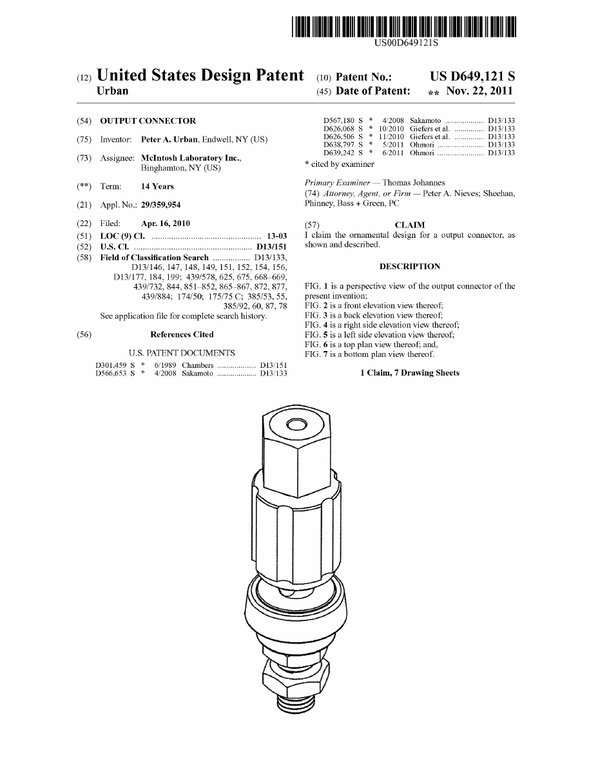
The documented launch of McIntosh’s new custom, patent-pending posts comes with the MC452 and MC302 in 2010. U.S. Design Patent D649,121 S was granted on November 22, 2011.
From the patent record
Read the original patent
U.S. Design Patent D649,121 S, “Output connector,” names Peter A. Urban as the inventor and McIntosh Laboratory Inc. as the assignee. It was filed on April 16, 2010 and issued on November 22, 2011.
The complete eight-page document includes seven drawing sheets showing the connector from different angles. The patent records the connector’s ornamental design.
Open the original patent (PDF, 8 pages)
Source: United States Patent and Trademark Office; original document retrieved from Google Patents.
Which speaker-cable terminations should I use?
At Pearl Audio, we generally prefer spade connections at the amplifier, especially on McIntosh models with Solid Cinch binding posts. A generously sized spade gives the post a broad metal surface to clamp securely. It also allows the cable to leave the amplifier at a natural angle and lie flat as it reaches the carpet.
At the speaker end, we usually choose banana plugs for our in-store systems because they are easy to plug in and disconnect. Well-designed banana plugs, such as Nordost Z-Plugs, use a sprung cylindrical contact that presses outward against the socket, providing a broad area of metal-to-metal contact.
As an audio store, we connect and disconnect loudspeakers several times a day for demonstrations and system comparisons. Banana plugs make those frequent changes quick and straightforward, which is why they are so practical in our listening rooms.
For home use, the choice comes down to preference and how you use your system. If your speakers stay in place and you want the cable to sit closer to the floor, spades are a good choice. If you like to disconnect your cables when cleaning or moving equipment, banana plugs are more convenient. A banana plug may also pull free more readily if someone catches the cable with a foot, potentially reducing the chance of a fall.
When maximum clamping pressure matters most, we prefer spades: tightening the binding post presses the lug firmly against the contact surface.
Do I need to tighten the posts as hard as possible?
No. McIntosh includes a small plastic, non-marring wrench to help tighten the Solid Cinch posts. Finger-tighten the post, then fit the supplied McIntosh wrench over the top and tighten it another ¼ turn. Follow the procedure in your model’s manual. The goal is a firm connection; excessive force can damage a cable termination or terminal.