


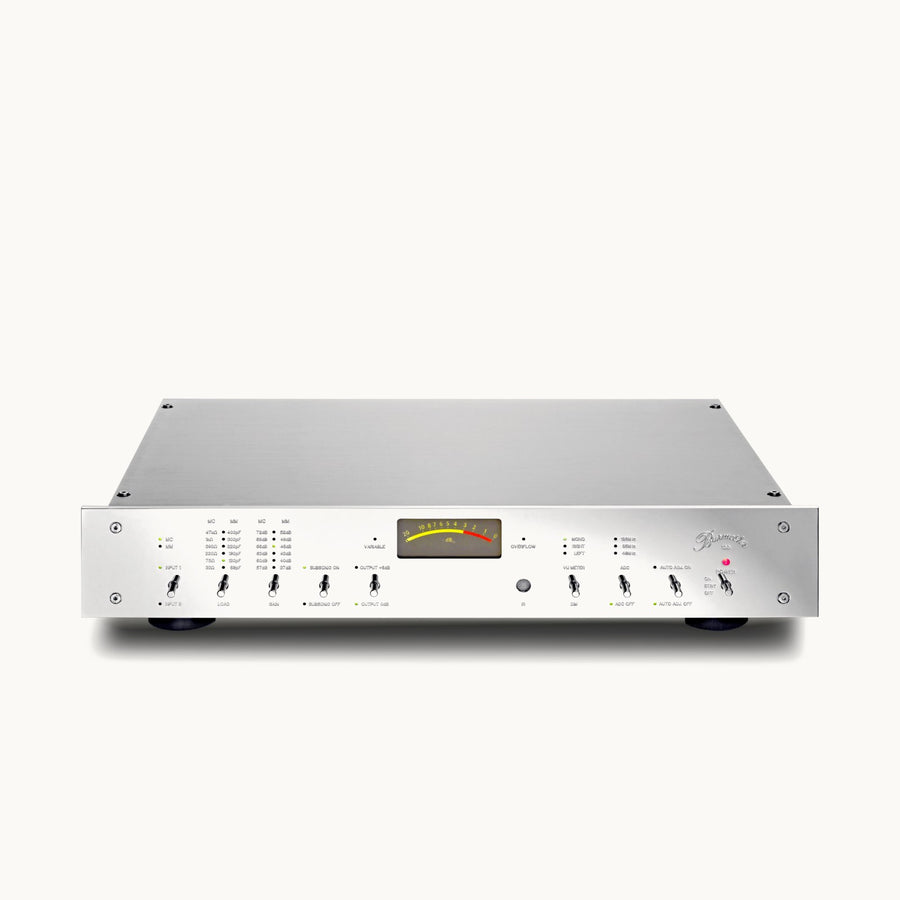
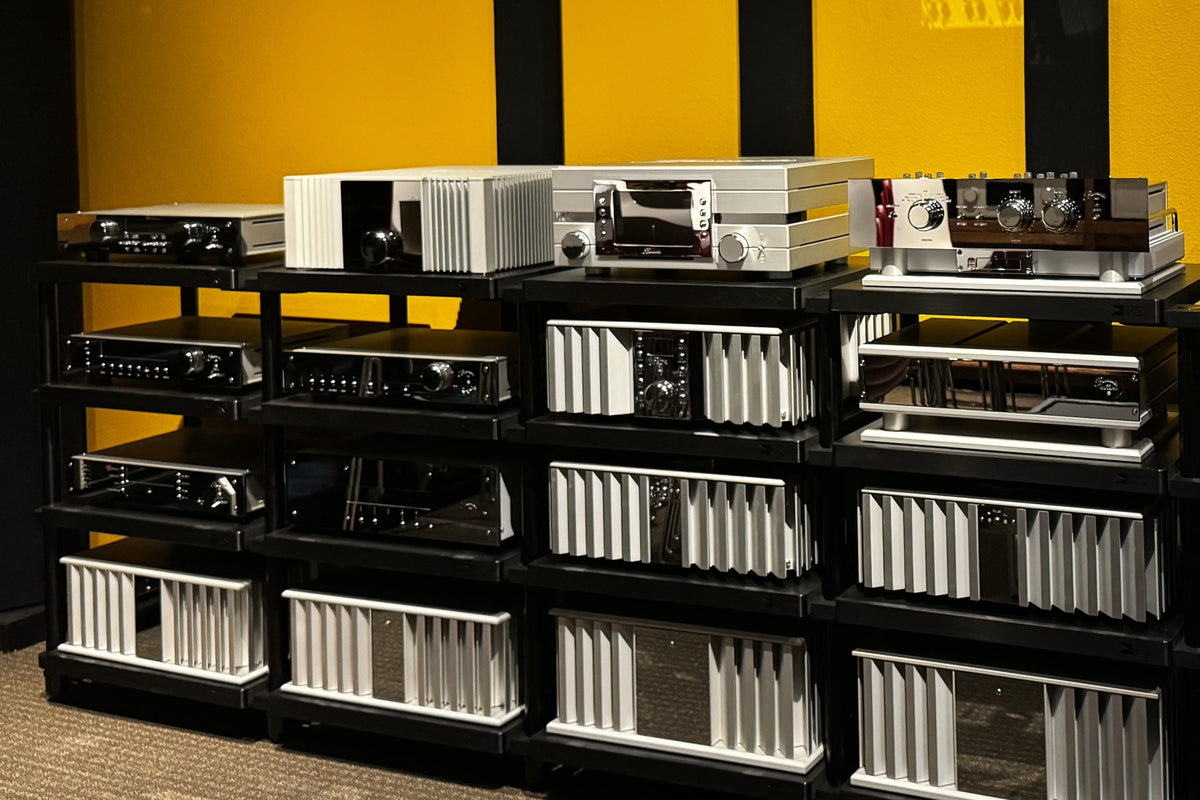
Dieter Burmester never set out to build a hi-fi company. Born in Austria in 1946 and raised in Lüchow in Lower Saxony, he was on stage with rock bands from the age of fifteen, playing bass and guitar every weekend across northern Germany, and he came to Berlin in 1968 to study electrical engineering. By 1977 he was running a small engineering office in Berlin-Schöneberg designing circuitry for medical measuring instruments. What pushed him toward audio was frustration: his Quad tube amplifier kept failing. In July 1977 he applied the precision parts and circuit discipline of his medical work to a solid-state preamplifier and called it the 777, for the month and the year. He built about twenty by hand for friends; a German magazine praised it, dealers called, and when a local bank refused him a loan on the grounds that the business could not work, he found he did not need one.
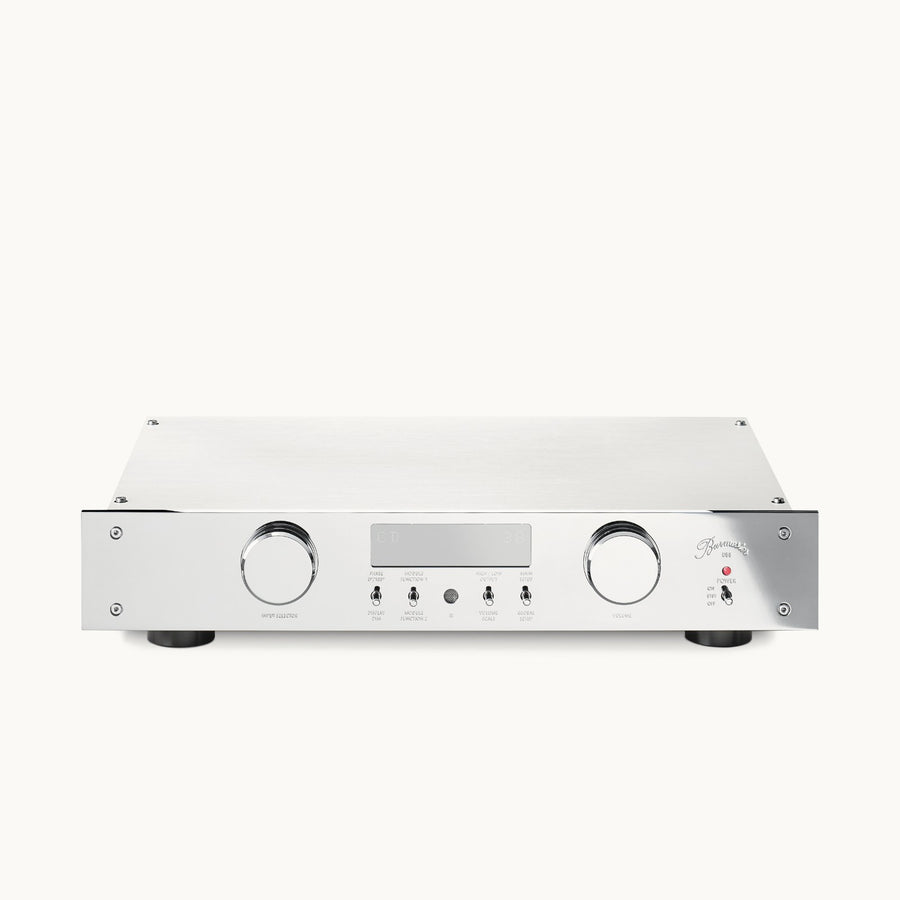
The look arrived almost at once. The 785 preamplifier of May 1978 introduced the mirror-polished chrome front that has identified every Burmester since. The engineering foundations followed in quick succession: in August 1980 the 808, the first modular preamplifier, with plug-in cards that let an owner add phono or balanced inputs years later, a component that has never left production and is sold today as the 808 MK5; in 1983 fully balanced circuitry, brought to home audio for the first time; in 1987 the first amplifier chain that was DC-coupled from the phono stage to the loudspeaker terminals, with no capacitors anywhere in the path. The 909 stereo power amplifier of 1990, stable into one ohm, supervised by a processor and built around an outsized supply, became the template for every Burmester power amplifier since. Dieter Burmester was a founding member of Germany's High End society in 1981, and his description of the enterprise was plain: high-end audio is "a means of transporting musical emotions; nothing more, but also nothing less."
Burmester treated digital as a mechanical and analog problem first. In 1991 the company introduced the first belt-driven CD player, decoupling the disc and laser from the motor as a turntable does, with a bearing it has machined and hand-assembled in Berlin ever since; the 969 and 970, the 069 of 2007 and the 089 of 2010 all descend from it. In 1994 came the 948 power conditioner, a patented circuit that cancels DC on the mains in parallel, with nothing in series with the amplifiers, and still in the catalog. Loudspeakers followed in 1994 and 1995. In the 2000s the X-AMP discrete gain module became the common building block of Burmester's phono stages, preamplifiers, DACs and power amplifiers, and the 111 Musiccenter of 2012, a CD ripper, library, streamer, DAC and balanced preamplifier in one chrome box, put the company a decade ahead of most of high-end audio on computer-based music; the 151 and 151 MK2 brought the platform to the Top Line.
Around 2005 Burmester did something no serious high-end company had done and built a sound system for a car, the Bugatti Veyron. The design was adapted for the Porsche Panamera of 2009, beginning a partnership that now spans the Cayenne, Macan, 911, 718 and Taycan; Mercedes-Benz followed with the 2013 S-Class, the first luxury sedan with 3D surround as standard, then the Maybach, and Ferrari's Purosangue joined in 2022. The automotive work was controversial inside the industry at the time, but it funded the company's growth and fed back into the home products in resonance control and driver design. Through it all Burmester stayed in the same Schöneberg quarter, hand-building every unit, sourcing more than 95 percent of its parts from German suppliers, and putting each finished piece through some three hundred measurements before and after a seven-day burn-in.
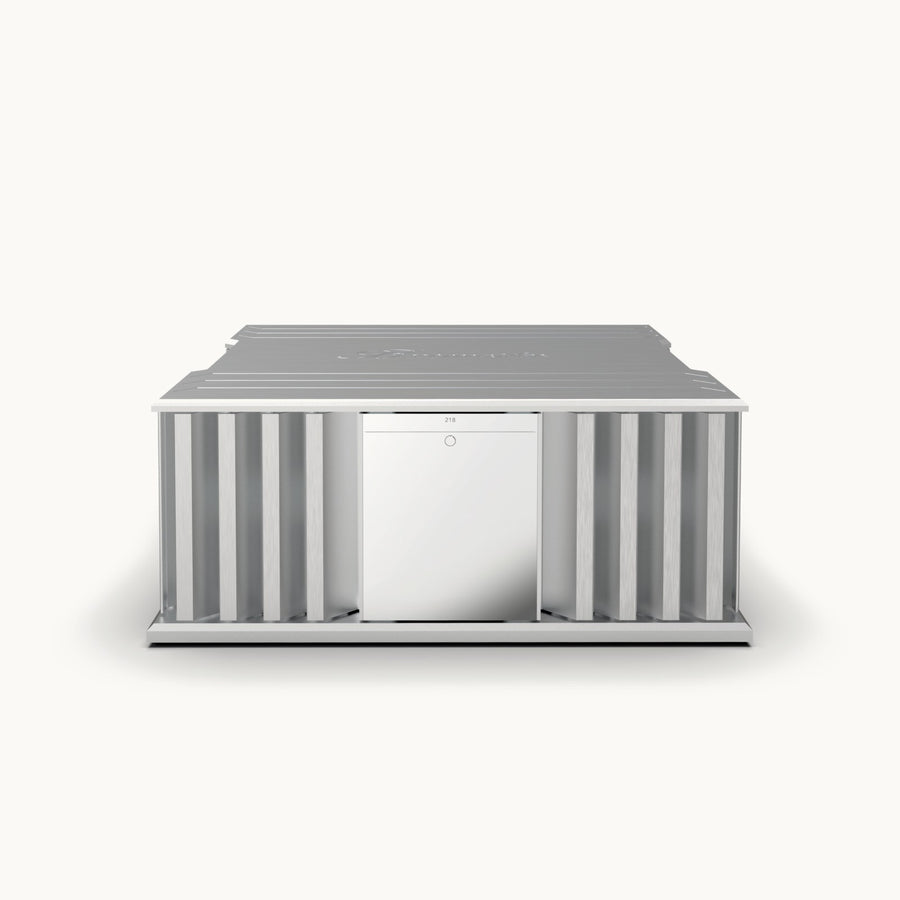
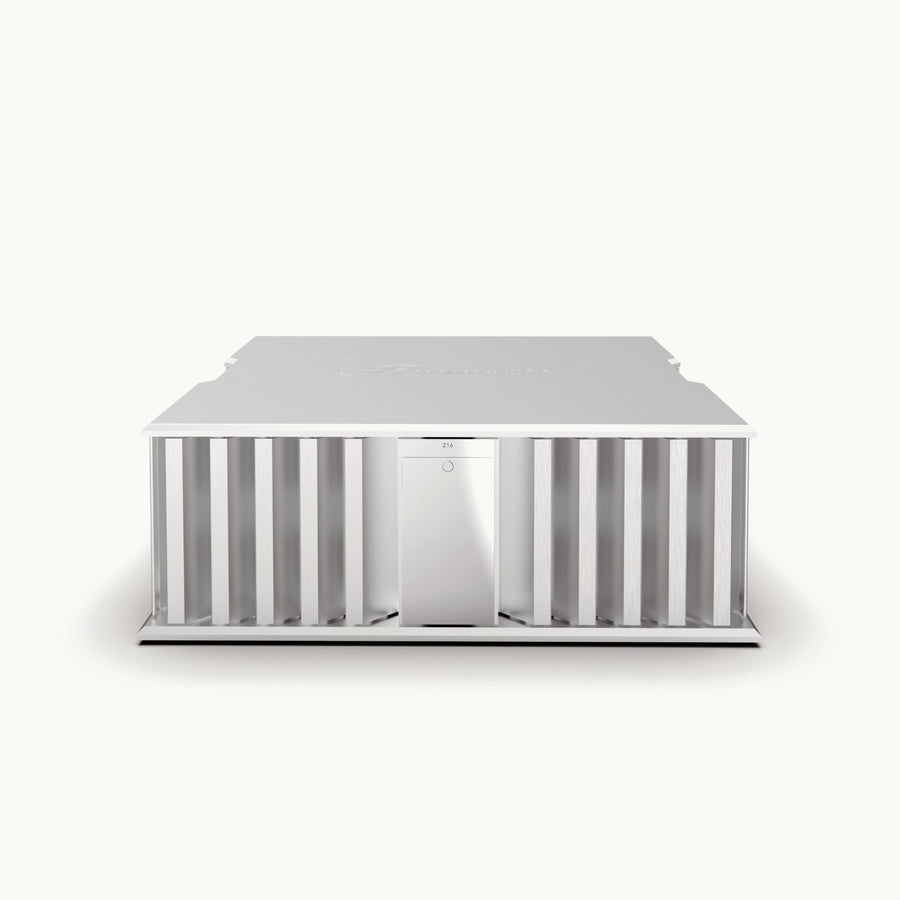
Dieter Burmester died suddenly on August 15, 2015, at 69, still playing guitar in his office and still the public face of the company. His widow Marianne, who had helped build the business, took over as managing partner with long-time development chief Stefan Größler as technical director, and the course was set as evolution rather than revolution. The fortieth anniversary in 2017 brought Burmester's first turntable, the 175; the Signature Line opened in 2018 with the 1,200-watt 159 monoblocks and the BC350 loudspeakers; the BC150, B38, 216 and 218 followed in 2021 and 2022, and the 232 integrated of 2023 introduced a new design language. Since January 2024 the company has been led by co-chief executives Thorsten Poenig and Thomas Schneider, with Ralf Schmidt heading home-audio engineering, and it remains wholly family-owned. In May 2025 Burmester showed an all-new Reference Line, the 249 preamplifier, 257 turntable and 259 power amplifier, built on X-AMP 3 and borrowing, in the company's words, nothing from the previous generation. Nearly fifty years on, every Burmester is still developed and hand-built in Berlin, still wears chrome, and is still measured against the question Dieter asked in 1977: does it carry the music?