
Luxman flagship separates
Luxman C-10X and M-10X
Luxman's flagship control amplifier and the power amplifier it was built to partner. They share a chassis design, a feedback idea and a control link, and together they are the separates version of Luxman's sound: more power, lower noise and room to grow.
C-10X Control Amplifier

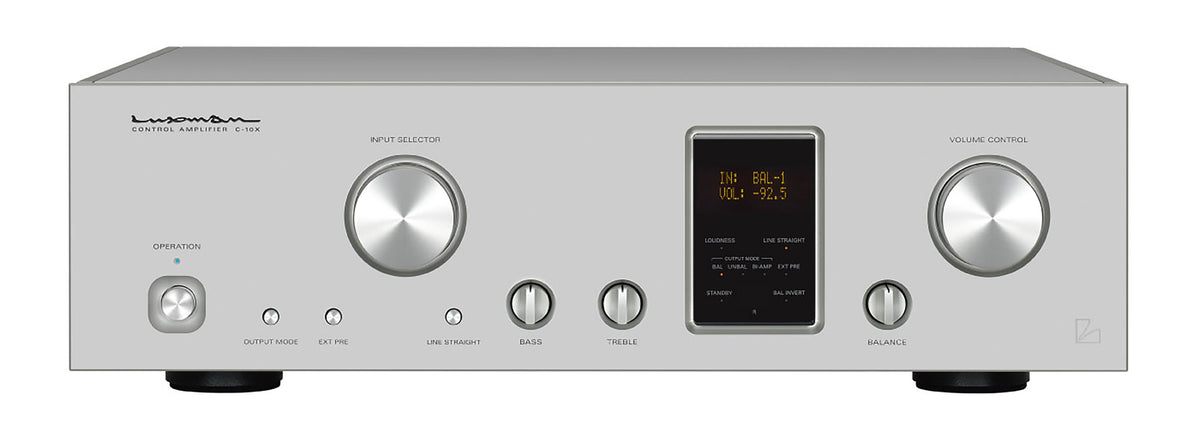
Luxman's flagship control amplifier, introduced in 2023 as the partner for the M-10X. A line stage only, built around four balanced amplifier blocks and the most elaborate version of Luxman's LECUA volume control.
C-10X · LIFES
Feedback that leaves the music alone
Negative feedback lowers distortion, but feeding the whole output back to the input can impose a character of its own. LIFES, the Luxman Integrated Feedback Engine System, feeds back only the distortion component and never the music signal.
In Luxman's description, it measures like a high-feedback design and behaves like a no-feedback one. The C-10X was the first preamplifier to use it.

C-10X · LECUA-EX
Volume without a wiper
The large knob turns an encoder that never touches the audio. The signal passes instead through fixed resistors switched electronically in 192 steps of half a decibel, coupled directly to the amplifier blocks so the four balanced paths stay short and equal.
With no sliding contact there is no channel imbalance at low volume and nothing to wear. The same mechanism handles balance and lets you match the level of each source.
C-10X · Connections
Balanced from input to output
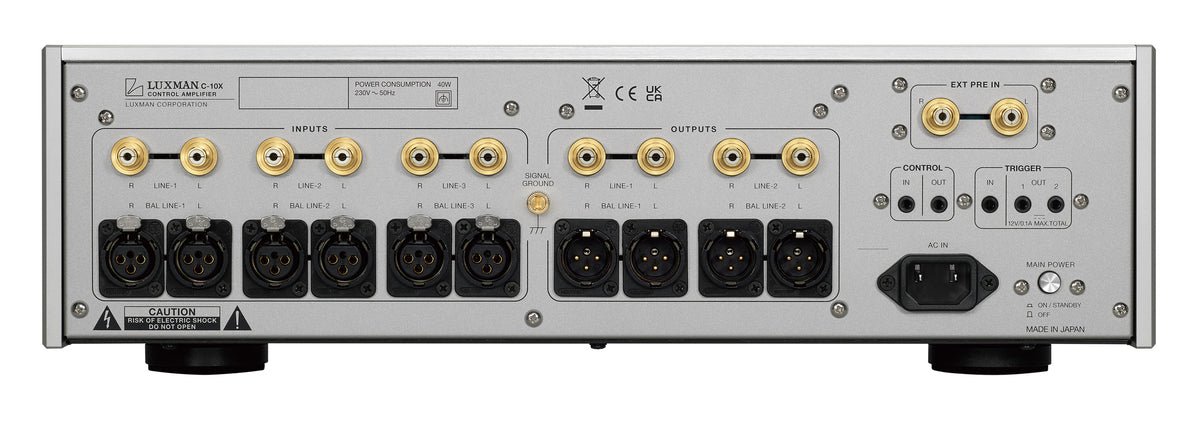
Two balanced amplifier blocks per channel, run under identical conditions, keep the signal symmetrical from the XLR inputs to the XLR outputs. There are three balanced and three unbalanced inputs, and a bypass input for a home theater processor.
Two pairs of outputs can run balanced, unbalanced or bi-amped, with level trim for each.

C-10X · Power supply
A supply built like a power amplifier's
A CI-core transformer feeds seven custom 3,300 µF capacitors for each channel, smoothed separately so one channel's demands never touch the other.
Luxman rates the balanced signal-to-noise ratio at 132 dB, and the balanced output can drive any power amplifier through any sensible length of cable.
M-10X Stereo Amplifier

Luxman's flagship power amplifier and the first product to carry LIFES, launched at the end of 2021 to open the company's centenary. 150 watts a channel, or 600 watts as a bridged monoblock.
M-10X · Output stage
150 watts, with class A at the start
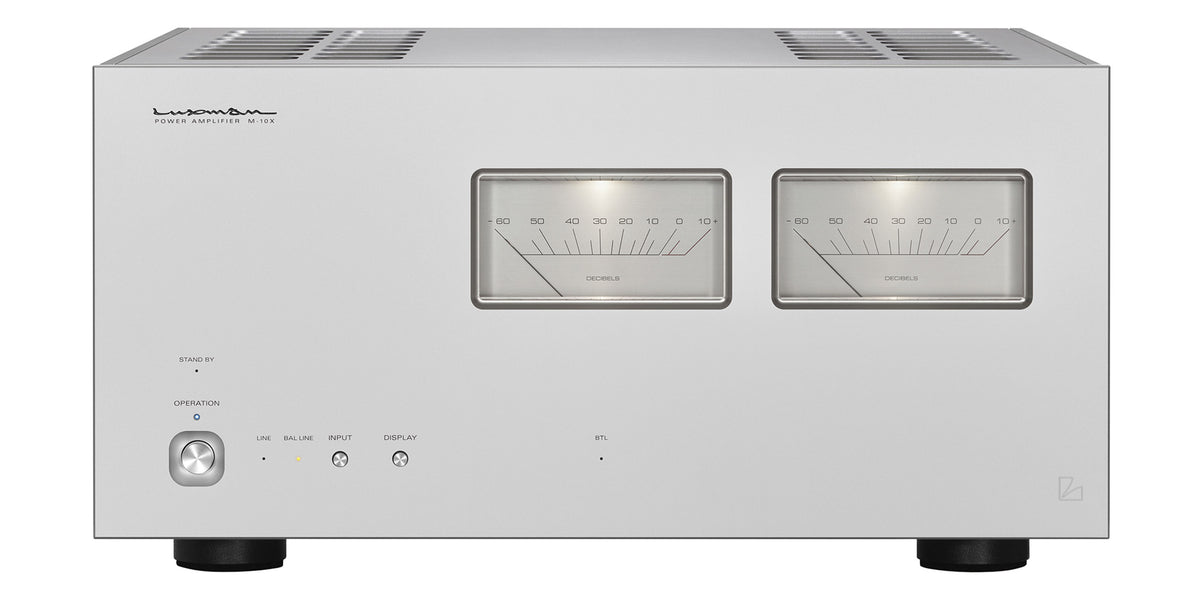
The output stage pairs two three-stage Darlington circuits, each with four push-pull pairs in parallel, a layout Luxman chose to keep its composure into difficult loads. It runs in pure class A up to 12 watts before moving into class AB.
It delivers 150 watts a channel into 8 ohms and 300 into 4, and the illuminated needle meters can be dimmed or switched off.

M-10X · LIFES 1.0
Where LIFES began
The M-10X was the first Luxman to use LIFES, the successor to the ODNF circuit Luxman used since the 1990s. Luxman describes it as simpler than ODNF, with lower distortion and a wider bandwidth.
The result, in Luxman's words, is an amplifier that behaves like a no-feedback design while measuring like a feedback one.
M-10X · Connections
One amplifier now, two later
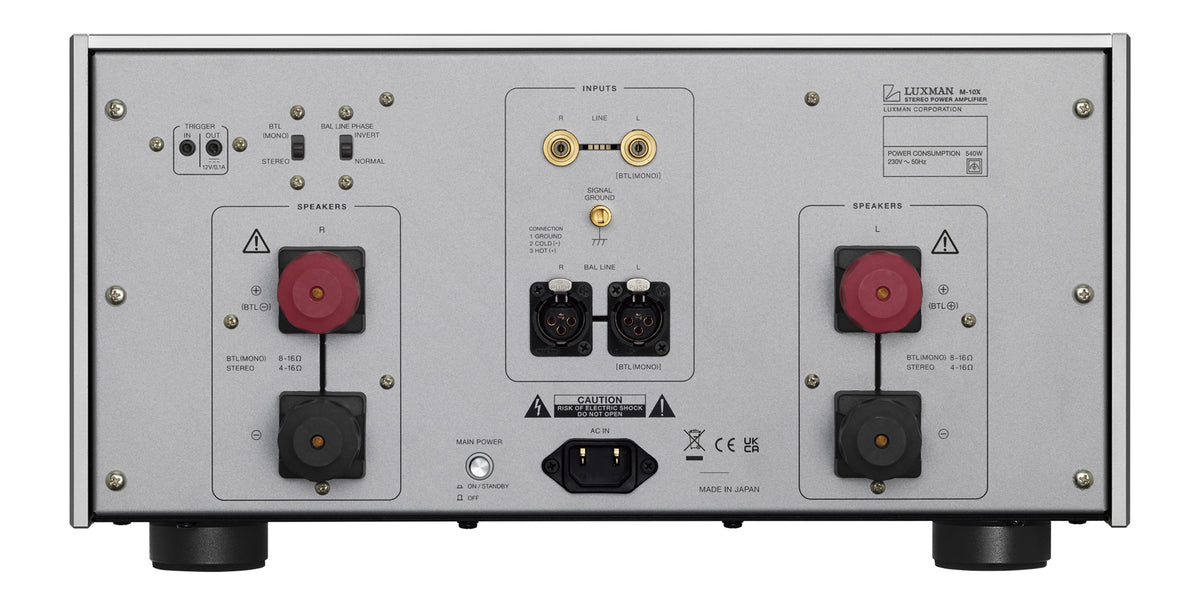
One balanced and one unbalanced input, with a phase switch for sources wired the other way. A switch on the back bridges the two channels into a 600-watt monoblock, so many owners begin with one M-10X and add a second.
A 12-volt trigger and a control link let the C-10X turn it on and off.

M-10X · Power supply
A power supply built for control
A 1,250 VA transformer feeds four 20,000 µF capacitors in separate left and right banks. The damping factor is 600; Stereophile measured an output impedance of 0.06 ohm, the kind of figure that keeps a large woofer under control.
On Stereophile's bench the M-10X reached about 200 watts into 8 ohms and 350 into 4 before clipping, well beyond its rating.
Connecting the pair
How they connect
A pair of balanced cables runs from one of the C-10X's two balanced outputs to the M-10X's balanced inputs, left to left and right to right. In stereo, each loudspeaker connects to its own pair of terminals, red to + and black to −. A control cable between the two lets the C-10X switch the M-10X on and off.
Stereo: 150 watts a channel into 8 ohms, 300 into 4.
Made to work as one
Two boxes that behave like one
The pair share Luxman's full-width chassis and illuminated meters, and a control link turns the M-10X on and off with the C-10X. Connected balanced, they make the separates equivalent of the L-509Z integrated, with more power, lower noise and two chassis.
The C-10X is a line stage only. For records, add Luxman's E-07 phono stage; for discs and streaming, a D-100 or D-07X.


Going further
One C-10X, two M-10X as bridged monoblocks
An M-10X can work as one very powerful single-channel amplifier. Flip the switch on its back panel (Luxman marks it BTL) and its two channels stop playing left and right and instead drive the same loudspeaker together, one pushing while the other pulls. That is called bridging, and it is how one M-10X becomes a monoblock.
With two of them, each loudspeaker gets an amplifier of its own: rated power rises from 150 watts a channel into 8 ohms to 600, and every channel has a whole M-10X behind it, with its own 1,250 VA transformer and all four 20,000 µF capacitors. The result is more headroom on the largest peaks, complete separation between the channels, and the option to place each amplifier close to its loudspeaker on a short speaker cable, while the C-10X's balanced outputs drive the longer interconnects with ease.
Bridged mono: 600 watts into 8 ohms for each loudspeaker, four times the stereo rating, with a whole M-10X and its power supply behind every channel.
How to set each M-10X for mono
- With the amplifier switched off, move the switch marked BTL (MONO) / STEREO up to BTL (MONO).
- Connect a balanced cable from the C-10X to the left balanced input, marked BTL/MONO: the C-10X's left output to one amplifier, its right output to the other.
- Connect the loudspeaker across the two red terminals: + to the left channel's red terminal (marked BTL +), − to the right channel's red terminal (marked BTL −). The black terminals stay empty.
When bridged, each M-10X takes its signal at the left balanced input (marked BTL/MONO), and its left meter shows the channel. Luxman marks the rear panel for loudspeakers of 4 to 16 ohms in stereo and 8 to 16 ohms when bridged, so your loudspeakers decide whether bridging is the right step; we will help you check yours.
With your loudspeakers
Build it with your loudspeakers
Two of the loudspeakers we most often hear with Luxman separates. Choose one to see how we would put the system together.
 Magico S5Sealed three-way with two 10-inch woofers. Rated at 4 ohms and 88 dB.
Our recommendation
C-10X with one M-10X in stereo
The S5 is a 4-ohm loudspeaker, which is where the M-10X in stereo is at its strongest: 300 watts a channel into 4 ohms, and a damping factor of 600 to keep two 10-inch woofers under tight control.
 C-10X Control Preamplifier$19,995
 M-10X Power Amplifier$19,995
 S5From $82,000


300 watts a channel into 4 ohmsFrom $121,990 together
Why not two bridged M-10X?
Luxman marks the M-10X for loudspeakers of 4 to 16 ohms in stereo but 8 to 16 ohms when bridged, and the S5 is rated at 4 ohms. One M-10X in stereo stays inside Luxman's ratings and already gives the S5 more power than most rooms will ask of it.
Luxman America has shown pairs of bridged M-10Xs with Magico loudspeakers at AXPONA. If that is the system you have in mind, we will confirm it with Luxman for your loudspeakers before recommending it.
 Sonus Faber Amati Supreme4.5-way design with separate binding posts for the mid-high and low sections. Rated at 4 ohms and 91 dB.
Our recommendation
C-10X with one M-10X in stereo
At 91 dB the Amati Supreme asks less power than many floorstanders its size, and one M-10X in stereo gives it 300 watts a channel into its 4-ohm rating, with the grip of a damping factor of 600.
- C-10X Control Preamplifier$19,995
- M-10X Power Amplifier$19,995
 Amati Supreme$78,000

300 watts a channel into 4 ohms$117,990 together
Going further: two M-10X, bi-amped
The Amati Supreme has separate terminals for its mid-high and low sections, so two M-10Xs can share the work without bridging. Each amplifier stays in stereo and serves one loudspeaker: one channel drives the mid-high section, the other the woofers. The C-10X has two balanced outputs and a bi-amp mode with level trim for each, so it feeds both amplifiers directly.
Each loudspeaker then has a whole M-10X and its power supply to itself, and the amplifiers stay within Luxman's ratings for a 4-ohm loudspeaker.
- C-10X Control Preamplifier$19,995
- × 22 × M-10X Power Amplifier$19,995 each
- Amati Supreme$78,000
One M-10X per loudspeaker, one channel for each section$137,985 together
Why not two bridged M-10X?
Luxman marks the M-10X for loudspeakers of 4 to 16 ohms in stereo but 8 to 16 ohms when bridged, and the Amati Supreme is rated at 4 ohms. Bi-amping, above, gives each loudspeaker its own M-10X while keeping both amplifiers in stereo, inside Luxman's ratings.
What the reviewers heard
John Jay French reviewed the C-10X with the M-10X for Tracking Angle, in place of the system he had been using, and found the two a natural match. Stereophile reviewed the M-10X on its own in May 2022: John Atkinson found it came very close to the ideal of a straight wire with gain, and his measurements were superb.
Luxman has shown the M-10X as a pair of monoblocks with Magico loudspeakers at AXPONA more than once: driving the Magico M6 with a C-900u preamplifier in 2022, and again in 2024 with the C-10X. We have not found a published review of the M-10X in mono.
“…more importantly it is dead silent.”
“With all types of music, the midrange was clean, uncolored, and detailed.”
“…sounded fabulous driving Magico M6 loudspeakers in a large room.”
- Tracking Angle: Luxman C-10X Control AmplifierJohn Jay French, June 2025; reviewed with the M-10X
- Stereophile: Luxman M-10X power amplifierJohn Atkinson, May 2022
- Stereophile: Luxman M-10X measurementsJohn Atkinson, May 2022
- Hifi Pig: Luxman C-10X PreamplifierLaunch report, December 2023
- Stereophile: More Magico/Luxman (AXPONA 2022)Two M-10X in mono driving Magico M6
- The Absolute Sound: AXPONA 2022, Robert Harley on electronicsA pair of M-10X with Magico M6
- Stereophile: Luxman and Magico (AXPONA 2024)The C-10X with two M-10X in mono
Hear them together
Tell us about your loudspeakers and your room, and we will arrange a session with the C-10X and M-10X in one of our listening rooms.
Arrange an audition or call (503) 222-2599