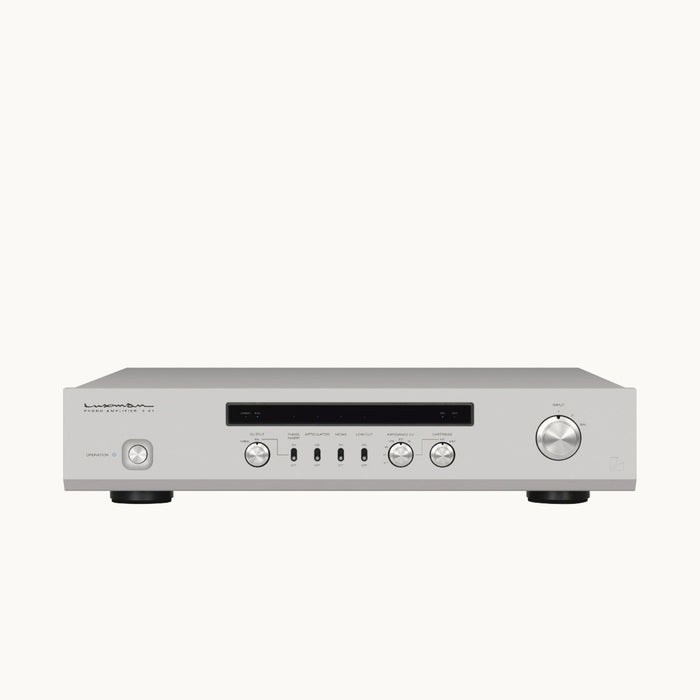
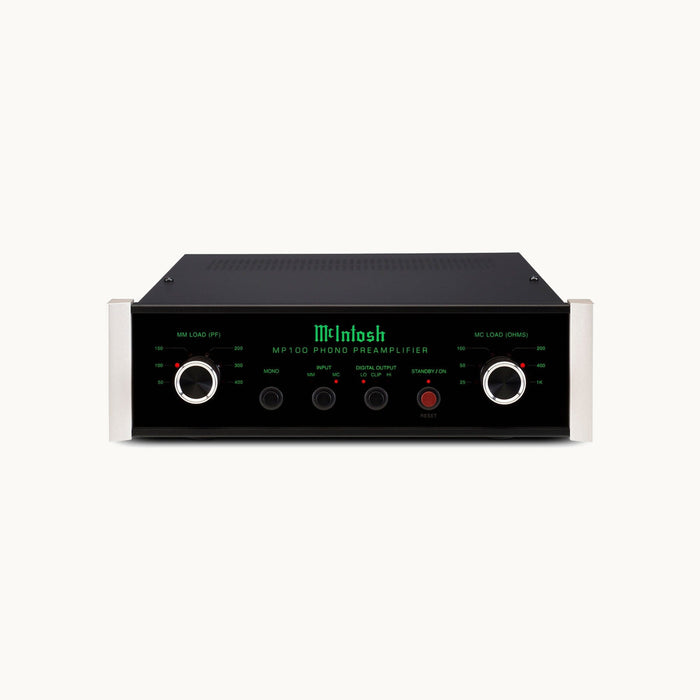
What it does
A phono cartridge produces a signal a thousand times smaller than a CD player or streamer, and records are cut with a deliberate tilt in frequency balance that has to be undone on playback. A phono preamplifier, also called a phono stage, provides the gain and applies that RIAA correction so that the turntable can plug into an ordinary line input. Its quietness, its accuracy and its match to the cartridge set the ceiling on what a turntable can do.
The options
Moving magnet or moving coil
Moving magnet cartridges put out a relatively strong signal and work with nearly any phono stage. Moving coil cartridges, which include most high-end designs, put out a far smaller signal and need either a stage with more gain or a step-up transformer in front of a moving magnet input. Check what your cartridge needs before anything else.
Gain and loading
Gain is how much the stage amplifies; too little and the system sounds thin and noisy, too much and it overloads. Loading is the electrical resistance the cartridge sees, and with moving coil cartridges it affects tonal balance. Better phono stages let you adjust both, by switches or by remote, so that the stage can be tuned to the cartridge rather than the other way around.
Built in or separate
Many integrated amplifiers and preamplifiers include a phono stage, and a good one is enough for many listeners. A separate stage brings its own power supply, more adjustment and the freedom to upgrade the turntable side of the system independently. When records are the main event, we usually recommend a separate.
Tube or solid-state
Tube phono stages such as the Audio Research Reference Phono 3SE bring a sense of ease and dimension to records that many listeners find addictive. Solid-state stages such as the Luxman E-250, the Burmester 100 and the McIntosh MP100 offer lower noise, more gain and less maintenance.
Optical cartridges
DS Audio optical cartridges read the stylus movement with light rather than with magnets and coils. They produce a different kind of signal and need their own equalizer in place of a conventional phono stage; each DS Audio cartridge is sold with a matching equalizer or can be paired with one from their range. A standard phono stage will not work with them.
How we think about it at Pearl
We treat the cartridge, the tonearm and the phono stage as one decision. With the Linn LP12 as our best-selling turntable and two LP12 technicians on staff, we spend a great deal of time on cartridge matching, and we keep a range of stages from Luxman, Burmester, Audio Research, McIntosh, Linn and DS Audio so that we can demonstrate the difference gain and loading make rather than describe it.
Where to start
Tell us your turntable, tonearm and cartridge, and what the phono stage will plug into. If you are buying a new cartridge at the same time, say so; the pairing often changes the answer. Bring a few records you know well.