

McIntosh engineering, explained
McIntosh Blue Watt Meters
The blue glow is unmistakable. The information is useful: these meters show amplifier output power as the music plays. We’ll use the MC462 stereo power amplifier as our example throughout this discussion of McIntosh’s blue meters. Its separate left- and right-channel meters let you see how the demands of a recording change from one moment to the next.

What the needles tell you
A window into the amplifier’s work.
Output, not the volume setting
The volume control sets the listening level, but the recording itself is constantly changing. A soft piano phrase and a forceful chord can produce very different meter readings without your touching the control.
Left and right, separately
The MC462 has a meter for each channel. Instruments and voices occupy different places in a stereo mix, so the needles do not have to move together. That difference can be part of the recording.
Watts and decibels
Watts indicate electrical output power. The accompanying decibel scale expresses the level relative to the amplifier’s rated output. These are two ways to read the same indication.
Hold the peak long enough to see it.
Turn the MC462’s front-panel Meter control to Hold, and each needle retains the highest power peak in a passage, rising again if a stronger peak arrives. If no higher peak follows, the indication gradually falls at approximately 6 dB per minute. This makes a fleeting drum strike or orchestral climax much easier to read: you can glance at the amplifier after the moment has passed and still see an indication of its peak power demand. Hold is particularly useful for understanding how much more power musical peaks require than the quieter passages around them. It changes how the meters display the output; music playback continues normally. See the MC462 owner’s manual, page 13.
Lights off, music on.
For listening without the blue glow, turn the MC462’s front-panel Meter control to Lights Off. The meter illumination switches off while the amplifier continues playing normally. Most McIntosh amplifiers with blue meters offer a way to turn off their illumination, although the controls vary by model.
You can also control the amplifier’s meter lights from a compatible McIntosh preamplifier, such as the C2800. Connect the preamplifier’s Power Control output to the amplifier’s Power Control input with a stereo 3.5 mm Power Control cable, and leave the MC462’s Meter control in Watts or Hold. The preamplifier’s Meter Lights setting can then switch the connected amplifier’s blue illumination on or off, giving you one place to coordinate lighting across compatible components. Selecting Lights Off on the amplifier keeps its meter illumination off locally. See the MC462 owner’s manual and the C2800 owner’s manual.
Reading the scale
A small movement can represent a large power change.
On the MC462, the 0 dB mark corresponds to its 450-watt rated output per channel. Moving 10 dB lower means one-tenth the power: 45 watts at −10 dB, 4.5 watt at −20 dB, and 0.45 watt at −30 dB. The scale lets the meter cover a wide span of output levels.

For example, a rise from 4.5 watt to 45 watts is a tenfold increase in electrical power. It is not ten times the perceived loudness. Nor is the meter’s dB reading a measurement of sound pressure at your chair: speaker sensitivity, listening distance and the room all influence what you hear.
Use the scale on your own amplifier. Other McIntosh models have different power ratings, so the watt value at the same relative dB marking can differ.
In your listening room
Watch a quiet passage become a crescendo.
Imagine listening to a symphony. The strings begin softly, and the needles stay toward the lower part of the scale. Then the brass enters, the timpani strike, and the orchestra grows. With the volume control untouched, the meters rise as the amplifier delivers more power.
That movement gives a visible shape to musical dynamics. A recording with strong contrasts may produce lively swings; a more consistently loud recording may keep the needles in a narrower region. There is no ideal needle position to chase. Set a comfortable listening level and let the recording determine the movement.
The meters help you understand output demand. Power Guard and Sentry Monitor perform the MC462’s separate protection functions; the blue needles are not protection switches.
A McIntosh tradition
From a measuring instrument to a McIntosh signature.
The engineering idea behind McIntosh’s blue meters was to make the amplifier’s changing power output visible to the listener. Music places constantly changing demands on an amplifier, and an ordinary mechanical meter can miss the brief peaks that reveal those demands. McIntosh developed electronic drive circuitry that helped the needle catch a peak and kept the reading visible long enough for the eye to register it. The result brought a useful measuring instrument onto the front of the amplifier. Its illuminated blue face also gave that information a distinctive presentation, one that would become a defining part of McIntosh’s appearance. The original MC2505 manual explains the engineering behind this approach.
The choice of blue has an aviation story behind it. According to published reporting from a 2018 McIntosh factory visit, industrial design consultant Art Burton suggested blue filtering for the illuminated panel, drawing inspiration from blue airfield guidance lights. Burton was a pilot, and the appeal was a light that could be seen clearly without an intrusive glare. That idea helped give McIntosh’s meters their familiar blue glow: a practical display choice that became one of the most recognizable features of the brand.
1967: making the amplifier’s work visible
The MC2505, introduced in 1967, is generally credited as the first McIntosh amplifier to feature the signature blue meters. It marks the beginning of the look we recognize today. The company’s model archive dates both the 50-watt-per-channel MC2505 and the 105-watt-per-channel MC2105 to 1967. Their front-panel meters gave the listener a way to see the changing output of each channel. Today, that familiar pair of needles feels inseparable from the McIntosh experience, but making them useful with music required more than attaching a meter to an amplifier.

A mechanical needle has mass. It cannot accelerate instantly to follow every brief burst of energy in a recording. A drum strike or the attack of a piano note can pass before an ordinary meter reaches the corresponding reading. The challenge was to make a physical pointer convey an event that happened too quickly for the movement—and sometimes the listener’s eye—to follow.
McIntosh’s MC2505 manual explained its solution as dynamic peak locking. One circuit compensated for the inertia of the meter movement, helping the needle respond to short peaks. A second stretched the indication in time, keeping the peak visible briefly enough to be read. The MC2105 manual described the same two-part approach. This was an important distinction: the movement was mechanical, but the circuitry driving it helped make it an informative display of music’s changing demands.
The 1970s: the blue meters become part of the identity
In its own history, McIntosh identifies the 1970s as the period when black glass faceplates and blue amplifier power meters helped establish the brand’s signature appearance. The combination brought together an instrument-panel quality and a recognizable visual warmth. A listener could identify a McIntosh across the room, then look more closely and read what the amplifier was doing.
The meters also appeared far beyond the home listening room. In 1974, the Grateful Dead’s Wall of Sound used 48 McIntosh MC2300 amplifiers. McIntosh’s historical photographs show their paired blue meters among the equipment at soundchecks. That association connects the familiar display with a remarkable chapter in live sound: the same visual language found in a domestic system was present in racks of amplifiers powering a concert.
Jerry Garcia’s “Budman” MC2300
One particularly memorable example is Jerry Garcia’s personal MC2300, nicknamed “Budman” after the sticker on its front panel. Garcia used it to amplify the signal from his Fender Twin, and it became a longstanding part of his stage sound. With its paired meters and unmistakable sticker, this working amplifier connects McIntosh’s history directly to the music it helped create. It sold at Sotheby’s on October 14, 2021, for $378,000. See photographs of Garcia’s amplifier and read McIntosh’s account.
1999: blue meters on an anniversary amplifier
The MC2000 brought the familiar paired blue meters to McIntosh’s 50th-anniversary vacuum-tube amplifier. Its appearance shows how the same recognizable display could carry forward into a very different amplifier design.

2002–2003: the move to LED illumination
The blue glow originally came from incandescent lamps. By 2002, McIntosh was using LEDs with fiber-optic light diffusers in the MC402 stereo amplifier. Its 2002 owner’s manual explicitly describes that combination. The MC501 monoblock followed in 2003, with McIntosh highlighting its cool-running, long-life LED illumination. These models document the transition in the early 2000s; the change rolled through the range as individual products were updated.
For the owner, the benefit is practical: LEDs produce less heat at the illuminated panel and last much longer than conventional bulbs, reducing the need to open an amplifier for lamp replacement. The light diffusers distribute the illumination across the panel. The familiar glow remains, with less maintenance behind it. The needles themselves remain mechanical—the LEDs illuminate the display rather than replacing the moving meter movement.
The MC462 used in our example continues that development with direct LED illumination. The lighting technology has evolved while the purpose of the meters remains the same: making the amplifier’s changing output visible.
2007: a blue meter for the turntable
With the MT10, McIntosh brought its signature blue meter to its first turntable, introduced in 2007. Here the needle has a different job: it indicates the platter’s actual rotational speed, with playback settings for 33⅓, 45 and 78 rpm. Set beneath the glowing green platter, the large central meter gives the turntable an unmistakable McIntosh face. It is a useful reminder to read the scale: this blue meter follows the spinning record, rather than the music’s output level.

The McIntosh clock: watching time pass
The MCLK12 clock gives the blue meters a playful new purpose. The left needle shows the hours and the right shows the minutes; each returns to the beginning when it reaches the end of its scale. Behind the familiar black glass faceplate, a temperature-compensated quartz oscillator keeps time, with battery backup during a power interruption. The LED-lit meters can be switched on or off locally or coordinated with compatible McIntosh components through Power Control. It turns a familiar part of listening into something you can enjoy even when the music is off.
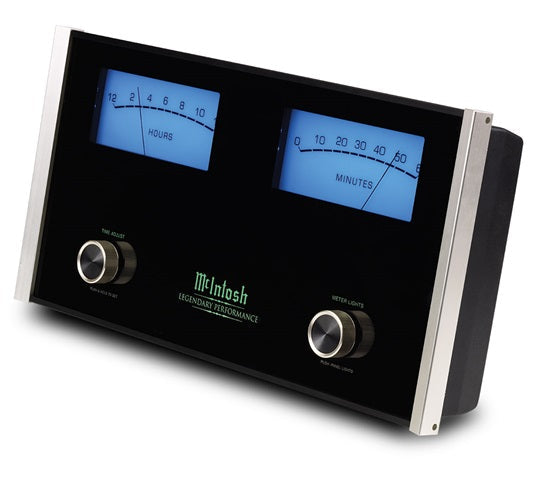
A familiar idea, adapted to new systems
As McIntosh developed different amplifiers, the metering arrangements changed with them. The enduring feature was a readable indication of output, while power scales, response characteristics and controls remained specific to the model. A familiar blue face therefore does not mean that every generation uses identical circuitry or has the same operating features.
A later example is the MC255, announced in 2019. Its TripleView Power Output Meter brought three mechanical pointers into one wide enclosure, displaying the front left, center and right channels independently. The presentation evolved for multichannel listening while retaining the moving needles and illuminated appearance that listeners already associated with McIntosh.
The tradition on the MC462
The MC462 carries that history into a 450-watt-per-channel stereo power amplifier. Its separate left- and right-channel meters display output in watts and decibels, making the changing demands of a stereo recording visible at a glance. The front-panel Meter control includes Watts, Hold and Lights Off positions, so you can choose how to view the output or turn off the blue illumination.
That is the lasting appeal. The meters give the music a visible rhythm, but their purpose remains grounded in measurement. Watch a quiet passage give way to a crescendo and the display connects what you hear with the work the amplifier is doing—a useful idea that has remained part of McIntosh listening for generations.
A closer look
Are these VU meters?
McIntosh identifies the MC462’s displays as power-output meters, marked in watts and decibels. A conventional VU meter uses a different indication standard for audio level. For this amplifier, read the meters as output-power indicators.
Do the meters show how loud the room is?
No. They show the amplifier’s electrical output level. A sound-level meter measures acoustic sound pressure. Different loudspeakers can produce different listening levels from the same amplifier power.
Why don’t the two needles always match?
A stereo recording can contain different levels in its left and right channels. Different needle movement is therefore often expected. A persistent difference across many recordings can also be a reason to check balance and source settings.
Can I turn the meters off?
Yes. On most McIntosh amplifiers with blue meters, you can turn off the blue illumination while continuing to listen normally. On models with a front-panel Meter control, select Lights Off. This switches off the lighting; the meters continue to indicate the amplifier’s output.
A compatible McIntosh preamplifier can also control the meter lights through a Power Control cable. Connect the preamplifier’s Power Control output to the amplifier’s Power Control input, then use the preamplifier’s Meter Lights setting to switch the illumination on or off. On the MC462, leave the Meter control in Watts or Hold to allow this remote control. This lets you coordinate meter lighting across compatible components from the preamp. Available controls vary by model.
Do blue meters mean the same thing on every McIntosh component?
No. The blue glow is a shared McIntosh signature, but the measurement depends on the component. On a power amplifier such as the MC462, the meters indicate the power being delivered to the loudspeakers, with scales in watts and decibels. On the C2800 and C12000 preamplifiers, the two meters show left- and right-channel output signal levels in decibels. They let you follow the changing level of the signal being sent to the power amplifier; they do not measure the amplifier’s speaker-output wattage.
McIntosh has also adapted the familiar meter to other jobs. The MT10 turntable’s meter shows platter speed in revolutions per minute, with markings for 33⅓, 45, and 78 RPM. On the MCLK12 clock, the left meter shows hours and the right shows minutes. The units on the meter face tell you what you are watching: power, signal level, speed, or time.
Models with Blue Watt Meters
- MA12000 Integrated Amplifier
- MA2375 Vacuum Tube Integrated Amplifier
- MA352 Integrated Amplifier
- MA5300 Integrated Amplifier
- MA8950 Integrated Amplifier
- MA9500 Integrated Amplifier
- MC1.25KW Power Amplifier
- MC152 Power Amplifier
- MC2.1KW Power Amplifier
- MC303 Power Amplifier
- MC312 Power Amplifier
- MC462 Power Amplifier
- MC611 Power Amplifier
- MI254 Power Amplifier
- MI502 Power Amplifier
- MSA5500 Streaming Integrated Amplifier
Models with Blue Meters
